Pie chart
Simple share
of total
Stacked 100%
area chart
Only relative
differences matter
Stacked area chart
Relative and absolute
differences matter
Stacked 100%
bar chart
Only relative
differences matter
Stacked
bar chart
Relative and absolute
differences matter
Few periods Many periods
Changing
over time
Static
Variable width
chart
Two variables
per item
Table or tables with
embedded charts
Many
categories
Bar chart horizontal Circular area chart
Cyclical data
Line chart
Many categories
Many periodsFew categories Few periods
Over timeOne variable per item
Among items
Line chart
Non-cyclical data
Source: ©A. Abela, 2010. www.ExtremePresentation.com
Two
variables
Three
variables
Scatter plot
bubble size
Two
variables
Single
variable
Few data
points
Bar histogram
Many data
points
Line histogram
Visualizations
Comparison
Composition
Relationship Distribution
What would you
like to show?
Scatter plot
Scatter plot
Bar chart vertical Bar chart vertical
Single or few categories
Waterfall chart
Accumulation or
subtraction to total
Stacked 100% bar chart
w/subcomponents
Components of
components
Tree map
Accumulation to
total & absolute
difference matters
Comparison Visualizations
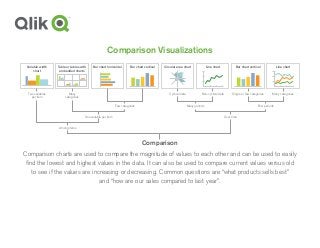
Comparison charts are used to compare the magnitude of values to each other and can be used to easily
find the lowest and highest values in the data. It can also be used to compare current values versus old
to see if the values are increasing or decreasing. Common questions are “what products sells best”
and “how are our sales compared to last year”.
Variable width
chart
Two variables
per item
Table or tables with
embedded charts
Many
categories
Bar chart horizontal Circular area chart
Cyclical data
Line chart
Many categories
Many periodsFew categories Few periods
Over timeOne variable per item
Among items
Line chart
Non-cyclical data
Comparison
Bar chart vertical Bar chart vertical
Single or few categories
Composition Visualizations
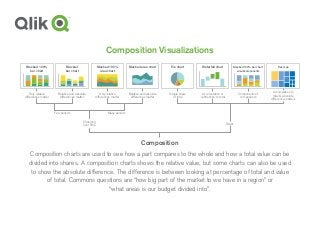
Composition charts are used to see how a part compares to the whole and how a total value can be
divided into shares. A composition charts shows the relative value, but some charts can also be used
to show the absolute difference. The difference is between looking at percentage of total and value
of total. Commons questions are “how big part of the market to we have in a region” or
“what areas is our budget divided into”.
Composition
Pie chart
Simple share
of total
Stacked 100%
area chart
Only relative
differences matter
Stacked area chart
Relative and absolute
differences matter
Stacked 100%
bar chart
Only relative
differences matter
Stacked
bar chart
Relative and absolute
differences matter
Few periods Many periods
Changing
over time
Static
Waterfall chart
Accumulation or
subtraction to total
Stacked 100% bar chart
w/subcomponents
Components of
components
Tree map
Accumulation to
total & absolute
difference matters
Distribution Visualizations
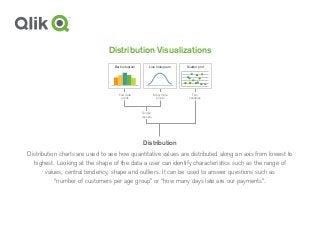
Distribution charts are used to see how quantitative values are distributed along an axis from lowest to
highest. Looking at the shape of the data a user can identify characteristics such as the range of
values, central tendency, shape and outliers. It can be used to answer questions such as
“number of customers per age group” or “how many days late are our payments”.
Distribution
Bar histogram Line histogram Scatter plot
Two
variables
Few data
points
Many data
points
Single
variable
Relationship Visualizations
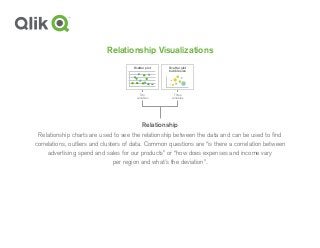
Relationship charts are used to see the relationship between the data and can be used to find
correlations, outliers and clusters of data. Common questions are “is there a correlation between
advertising spend and sales for our products” or “how does expenses and income vary
per region and what’s the deviation”.
Relationship
Two
variables
Three
variables
Scatter plot
bubble size
Scatter plot

Choosing a good chart

  • 1.
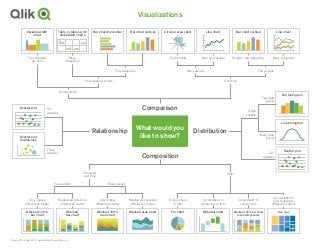
    Pie chart Simple share oftotal Stacked 100% area chart Only relative differences matter Stacked area chart Relative and absolute differences matter Stacked 100% bar chart Only relative differences matter Stacked bar chart Relative and absolute differences matter Few periods Many periods Changing over time Static Variable width chart Two variables per item Table or tables with embedded charts Many categories Bar chart horizontal Circular area chart Cyclical data Line chart Many categories Many periodsFew categories Few periods Over timeOne variable per item Among items Line chart Non-cyclical data Source: ©A. Abela, 2010. www.ExtremePresentation.com Two variables Three variables Scatter plot bubble size Two variables Single variable Few data points Bar histogram Many data points Line histogram Visualizations Comparison Composition Relationship Distribution What would you like to show? Scatter plot Scatter plot Bar chart vertical Bar chart vertical Single or few categories Waterfall chart Accumulation or subtraction to total Stacked 100% bar chart w/subcomponents Components of components Tree map Accumulation to total & absolute difference matters
  • 2.
    Comparison Visualizations Comparison chartsare used to compare the magnitude of values to each other and can be used to easily find the lowest and highest values in the data. It can also be used to compare current values versus old to see if the values are increasing or decreasing. Common questions are “what products sells best” and “how are our sales compared to last year”. Variable width chart Two variables per item Table or tables with embedded charts Many categories Bar chart horizontal Circular area chart Cyclical data Line chart Many categories Many periodsFew categories Few periods Over timeOne variable per item Among items Line chart Non-cyclical data Comparison Bar chart vertical Bar chart vertical Single or few categories
  • 3.
    Composition Visualizations Composition chartsare used to see how a part compares to the whole and how a total value can be divided into shares. A composition charts shows the relative value, but some charts can also be used to show the absolute difference. The difference is between looking at percentage of total and value of total. Commons questions are “how big part of the market to we have in a region” or “what areas is our budget divided into”. Composition Pie chart Simple share of total Stacked 100% area chart Only relative differences matter Stacked area chart Relative and absolute differences matter Stacked 100% bar chart Only relative differences matter Stacked bar chart Relative and absolute differences matter Few periods Many periods Changing over time Static Waterfall chart Accumulation or subtraction to total Stacked 100% bar chart w/subcomponents Components of components Tree map Accumulation to total & absolute difference matters
  • 4.
    Distribution Visualizations Distribution chartsare used to see how quantitative values are distributed along an axis from lowest to highest. Looking at the shape of the data a user can identify characteristics such as the range of values, central tendency, shape and outliers. It can be used to answer questions such as “number of customers per age group” or “how many days late are our payments”. Distribution Bar histogram Line histogram Scatter plot Two variables Few data points Many data points Single variable
  • 5.
    Relationship Visualizations Relationship chartsare used to see the relationship between the data and can be used to find correlations, outliers and clusters of data. Common questions are “is there a correlation between advertising spend and sales for our products” or “how does expenses and income vary per region and what’s the deviation”. Relationship Two variables Three variables Scatter plot bubble size Scatter plot