S o c i a l P e r f o r m a n c e M a n a g e m e n t H U B
How-to guide - Action area 1B.3
Validate and audit data
Validat ing and audit ing dat a
Why is data validation important?
2
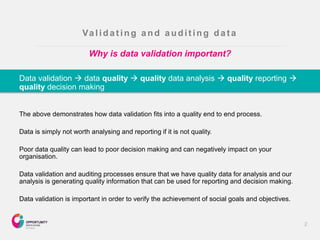
Data validation  data quality  quality data analysis  quality reporting 
quality decision making
The above demonstrates how data validation fits into a quality end to end process.
Data is simply not worth analysing and reporting if it is not quality.
Poor data quality can lead to poor decision making and can negatively impact on your
organisation.
Data validation and auditing processes ensure that we have quality data for analysis and our
analysis is generating quality information that can be used for reporting and decision making.
Data validation is important in order to verify the achievement of social goals and objectives.
Validat ing and audit ing dat a
Data validation
3
Data validation can occur at three points within the end to end process
1. Data collection. Surveys and qualitative interviews should be designed to
have specific quality control requirements such that responses are
consistent, accurate, unbiased. Staff should be sufficiently trained to
conduct interviews that are of a minimum quality standard.
2. At the MIS level. Automated business rules/checks happening with data
inputs. These should ensure data quality, consistency and validity. For
example constraints can be placed on variables such as age (e.g. cannot be
negative or over 150)
3. Manual validation/checking of data through forms by staff members – This
can be an onerous process and take up lots of time and resources.

Training material data validation and internal audit

  • 1.
    S o ci a l P e r f o r m a n c e M a n a g e m e n t H U B How-to guide - Action area 1B.3 Validate and audit data
  • 2.
    Validat ing andaudit ing dat a Why is data validation important? 2 Data validation  data quality  quality data analysis  quality reporting  quality decision making The above demonstrates how data validation fits into a quality end to end process. Data is simply not worth analysing and reporting if it is not quality. Poor data quality can lead to poor decision making and can negatively impact on your organisation. Data validation and auditing processes ensure that we have quality data for analysis and our analysis is generating quality information that can be used for reporting and decision making. Data validation is important in order to verify the achievement of social goals and objectives.
  • 3.
    Validat ing andaudit ing dat a Data validation 3 Data validation can occur at three points within the end to end process 1. Data collection. Surveys and qualitative interviews should be designed to have specific quality control requirements such that responses are consistent, accurate, unbiased. Staff should be sufficiently trained to conduct interviews that are of a minimum quality standard. 2. At the MIS level. Automated business rules/checks happening with data inputs. These should ensure data quality, consistency and validity. For example constraints can be placed on variables such as age (e.g. cannot be negative or over 150) 3. Manual validation/checking of data through forms by staff members – This can be an onerous process and take up lots of time and resources.