Towards Architectural Styles for Android App Software Product Lines
1.
Tobias Dürschmid, MatthiasTrapp, Jürgen Döllner
Hasso Plattner Institute, University of Potsdam
Potsdam, Germany
Towards Architectural Styles for Android
App Software Product Lines
2.
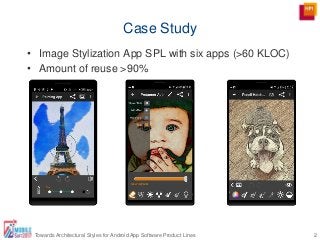
Case Study
• ImageStylization App SPL with six apps (>60 KLOC)
• Amount of reuse >90%
2Towards Architectural Styles for Android App Software Product Lines
3.
Challenges for AndroidApp SPLs
• No general reuse model for features
Fragments have to have a UI
• Inflexibility of feature models
Static preference entries
• Inapplicability of classical SPL techniques
Lack of tool support for AOP in Android
3Towards Architectural Styles for Android App Software Product Lines
4.
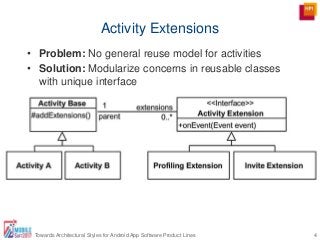
Activity Extensions
• Problem:No general reuse model for activities
• Solution: Modularize concerns in reusable classes
with unique interface
4Towards Architectural Styles for Android App Software Product Lines
5.
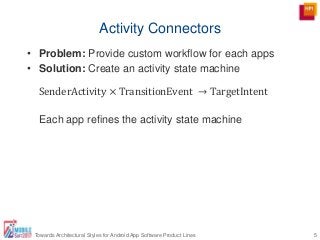
Activity Connectors
5Towards ArchitecturalStyles for Android App Software Product Lines
• Problem: Provide custom workflow for each apps
• Solution: Create an activity state machine
Each app refines the activity state machine
SenderActivity × TransitionEvent → TargetIntent
6.
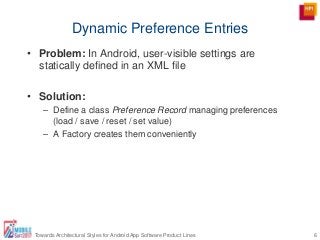
Dynamic Preference Entries
6TowardsArchitectural Styles for Android App Software Product Lines
• Problem: In Android, user-visible settings are
statically defined in an XML file
• Solution:
– Define a class Preference Record managing preferences
(load / save / reset / set value)
– A Factory creates them conveniently
7.
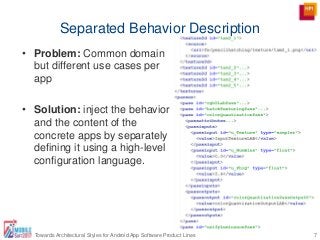
Separated Behavior Description
7TowardsArchitectural Styles for Android App Software Product Lines
• Problem: Common domain
but different use cases per
app
• Solution: inject the behavior
and the content of the
concrete apps by separately
defining it using a high-level
configuration language.
8.
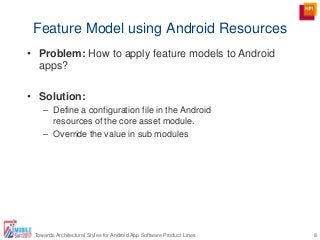
Feature Model usingAndroid Resources
8Towards Architectural Styles for Android App Software Product Lines
• Problem: How to apply feature models to Android
apps?
• Solution:
– Define a configuration file in the Android
resources of the core asset module.
– Override the value in sub modules
9.
Conclusions
9Towards Architectural Stylesfor Android App Software Product Lines
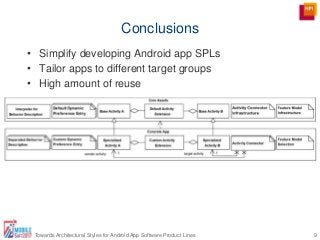
• Simplify developing Android app SPLs
• Tailor apps to different target groups
• High amount of reuse
10.
Contact
10Towards Architectural Stylesfor Android App Software Product Lines
• Tobias Dürschmid
tobias.duerschmid@student.hpi.de
• Matthias Trapp
matthias.trapp@hpi.de
• Jürgen Döllner
juergen.doellner@hpi.de
http://www.4dndvis.de
https://hpi.de/doellner/index.html
https://www.youtube.com/user/HPICGS
This work was funded by the Federal Ministry of
Education and Research (BMBF), Germany within the
InnoProfile Transfer research group "4DnD-Vis".
Editor's Notes
#4 Patterns are reusable not their implementation
Design Pattern können als Workarounds für von der Sprache unbeachtete Modularisierung betrachtet werden.