MINISTRY OF JUSTICE
BRAZILIAN NATIONAL SECRETARIAT OF JUSTICE
DEPARTMENT OF JUSTICE, RATINGS, TITLES AND QUALIFICATION
CONTENT RATINGCONTENT RATINGCONTENT RATINGCONTENT RATING
PRACTICAL GUIDEPRACTICAL GUIDEPRACTICAL GUIDEPRACTICAL GUIDE
Organized byOrganized byOrganized byOrganized by thethethethe
Brazilian National Secretariat of Justice
2nd edition
Brasília
2012
MINISTER OF JUSTICEMINISTER OF JUSTICEMINISTER OF JUSTICEMINISTER OF JUSTICE
José Eduardo Cardozo
EXECUTIVE SECRETARY OF THE MINISTRY OF JUSTICEEXECUTIVE SECRETARY OF THE MINISTRY OF JUSTICEEXECUTIVE SECRETARY OF THE MINISTRY OF JUSTICEEXECUTIVE SECRETARY OF THE MINISTRY OF JUSTICE
Márcia Pelegrini
BRAZILIANBRAZILIANBRAZILIANBRAZILIAN SECRETARY OF JUSTICESECRETARY OF JUSTICESECRETARY OF JUSTICESECRETARY OF JUSTICE
Paulo Abrão Pires Junior
DIRECTOR OF THE DEPARTMENT OF JUSTICE, RATINGS, TITLES AND QUALIFICATIONDIRECTOR OF THE DEPARTMENT OF JUSTICE, RATINGS, TITLES AND QUALIFICATIONDIRECTOR OF THE DEPARTMENT OF JUSTICE, RATINGS, TITLES AND QUALIFICATIONDIRECTOR OF THE DEPARTMENT OF JUSTICE, RATINGS, TITLES AND QUALIFICATION
Fernanda Alves dos Anjos
ASSISTANT DIRECTOR OF THE DEPARTMENT OF JUSTICE, RATINGASSISTANT DIRECTOR OF THE DEPARTMENT OF JUSTICE, RATINGASSISTANT DIRECTOR OF THE DEPARTMENT OF JUSTICE, RATINGASSISTANT DIRECTOR OF THE DEPARTMENT OF JUSTICE, RATINGSSSS, TITLES AND, TITLES AND, TITLES AND, TITLES AND
QUALIFICATIONQUALIFICATIONQUALIFICATIONQUALIFICATION
Davi Ulisses Brasil Simões Pires
CONTENT RATING COORDINATORCONTENT RATING COORDINATORCONTENT RATING COORDINATORCONTENT RATING COORDINATOR
Alessandra Xavier Nunes Macedo
CONTENT PREPARATIONCONTENT PREPARATIONCONTENT PREPARATIONCONTENT PREPARATION
Alessandra X. N. Macedo
Anna Paula U. de A. Branco
Bruna Grazielle M. Silva
Daniel Ramos da Silva
Davi Ulisses B. S. Pires
Gustavo Camilo Baptista
Isabela Maria L. Blumm
Marcela Queiroz Alvim
Marcelo B. Duarte da Costa
Otavio Chamorro Mendoza
Patrícia Almeida Gusmão
Pedro A. Albuquerque
Rafael Figueiredo Vilela
Rafaela Camelo Vieira
Ranna Iara de P. C. Almeida
Tiago Vinícius Vaz
ENGLISH VERSIONENGLISH VERSIONENGLISH VERSIONENGLISH VERSION
TAP Brasil – Associação Brasileira dos Programadores de Televisão por Assinatura
Bitelli Advogados – Marcos Alberto Sant’Anna Bitelli, Ieda Maria Monteiro e Heloisa Ramos
SUPERVISIONSUPERVISIONSUPERVISIONSUPERVISION
Rafael Figueiredo Vilela
ACKNOWLEDGEMENTSACKNOWLEDGEMENTSACKNOWLEDGEMENTSACKNOWLEDGEMENTS
The Brazilian National Secretariat of Justice would like to thank the effort of all the people who are or
were part of the team of collaborators of the Rating System and that, in the course of their work,
tested and improved the contents of this guide.
Free distributionFree distributionFree distributionFree distribution
Total or partial reproduction of thisTotal or partial reproduction of thisTotal or partial reproduction of thisTotal or partial reproduction of this publicationpublicationpublicationpublication by any means is permitted as long as theby any means is permitted as long as theby any means is permitted as long as theby any means is permitted as long as the sourcesourcesourcesource isisisis
credited.credited.credited.credited.
CONTENT RATING: PRACTICAL GUIDE
3
CONTENTSCONTENTSCONTENTSCONTENTS
Introduction…Introduction…Introduction…Introduction…...........................................................................................................................5
Brazilian National Secretariat oBrazilian National Secretariat oBrazilian National Secretariat oBrazilian National Secretariat of Justicef Justicef Justicef Justice...................................................................................6
ObjectiveObjectiveObjectiveObjective..........................................................................................................................................7
Application of theApplication of theApplication of theApplication of the Rating System CriteriaRating System CriteriaRating System CriteriaRating System Criteria...............................................................................8
Content Rating: Analysis Criteria…………..Content Rating: Analysis Criteria…………..Content Rating: Analysis Criteria…………..Content Rating: Analysis Criteria…………............................................................................9
Violence (GA)................................................................................................................9
Violence (PG-10).........................................................................................................10
Violence (PG-12).........................................................................................................11
Violence (PG-14).........................................................................................................13
Violence (PG-16).........................................................................................................14
Violence (PG-18).........................................................................................................15
Sex and Nudity (GA)...................................................................................................16
Sex and Nudity (PG-10)..............................................................................................16
Sex and Nudity (PG-12)..............................................................................................17
Sex and Nudity (PG-14)..............................................................................................18
Sex and Nudity (PG-16)..............................................................................................19
Sex and Nudity (PG-18)..............................................................................................19
Drugs (GA)...................................................................................................................19
Drugs (PG-10)..............................................................................................................20
Drugs (PG-12)..............................................................................................................20
Drugs (PG-14)..............................................................................................................21
Drugs (PG-16)..............................................................................................................21
Drugs (PG-18)..............................................................................................................22
Attenuating Elements...Attenuating Elements...Attenuating Elements...Attenuating Elements.............................................................................................................22
Aggravating ElementsAggravating ElementsAggravating ElementsAggravating Elements.............................................................................................................24
Content Descriptors…………………...Content Descriptors…………………...Content Descriptors…………………...Content Descriptors…………………....................................................................................26
Content Rating: How to Display………….Content Rating: How to Display………….Content Rating: How to Display………….Content Rating: How to Display…………............................................................................27
Symbols and boxes......................................................................................................27
Display on media packaging and RPG book covers..................................................30
Display on banners, posters, billboards, displays and press……..……....................32
Display in catalogs, diaries and programming….......................................................32
Display for digital distribution...................................................................................32
Display for television..................................................................................................34
Display on commercials and previews on electronic media.....................................35
Display on internet websites......................................................................................35
Display on the access to concerts, plays and other entertainment events………...36
FAQFAQFAQFAQ..........................................................................................................................................37
CONTENT RATING: PRACTICAL GUIDE
5
INTRODUCTIONINTRODUCTIONINTRODUCTIONINTRODUCTION
The Brazilian National Secretariat of Justice (SNJ) of the Brazilian Ministry
of Justice has, among its competences, the attribution of rating audiovisual works
(television, market of cinema and video, electronic games and role-playing games – RPG).
This competence derives from the constitutional disposition governed by
the Child and Adolescent Statute and regulated by the Ministry of Justice Ordinances.
The rating system is consolidated as government public policy and its symbols are
recognized by most families who use such symbols to choose which television programs,
films and games their children and adolescents should have access to or not.
With the aim of strengthening the idea of co-responsibility among the
State, family and society (in which communication companies are included), it is vital
that the mechanisms involved in the rating system are known.
The Brazilian National Secretariat of Justice has been endeavoring to unify,
objectify and publicize the criteria and interpretation of the Manual of the New Rating
System (SNJ, 2006). The effort of making the rating system as clear as possible is aligned
with the effective purpose of public policy: provide reliable instruments for families to
choose and to protect children and adolescents against images that might compromise
their upbringing.
This effort is having positive results. By means of workshops on the rating
system conducted in Brasilia and in other towns throughout the country, it was possible
to bring closer the classifications attributed by TV channels to the approvals of the
Ministry of Justice - the current level of correspondence is close to 90%.
This Practical Guide is a democratic instrument whose aim is to provide
transparency and objectiveness to the public policy of the rating system, evincing the
analysis criteria. It may be useful for TV channels, producers and distributors of films and
games, as well as for society overall and families.
CONTENT RATING: PRACTICAL GUIDE
6
BRAZILIAN NATIONAL SECRETARIAT OF JUSTICEBRAZILIAN NATIONAL SECRETARIAT OF JUSTICEBRAZILIAN NATIONAL SECRETARIAT OF JUSTICEBRAZILIAN NATIONAL SECRETARIAT OF JUSTICE
The Brazilian National Secretariat of Justice (SNJ) is one of the seven
secretariats that comprise the Ministry of Justice and has a broad scope of activity. Its
mission is to foster and consolidate justice rights and policies focused on the assurance
and development of Human Rights and Citizenship, by means of joint actions between
the government and society.
The Secretariat's specific objectives are to coordinate the policy of combating
human trafficking; articulate the combat to organized crime, money laundering and
corruption; protect and promote migrants' rights; intensify and improve International
Legal Cooperation; perfect accreditation and supervision mechanisms of Social Entities
qualified as Civil Society Organizations of Public Interest (OSCIP), Federal Public Utility
Institution (UPF) or Foreign Organization (OE).
The SNJ is also in charge of the coordination of rating activities of TV programs
and films, public entertainment, electronic games and role-playing games (RPG), object of
this guide.
CONTENT RATING: PRACTICAL GUIDE
7
OBJOBJOBJOBJECTIVEECTIVEECTIVEECTIVE
The objective of this practical guide is to demonstrate in a clear and simple
way how the Ministry of Justice analyses audiovisual works – television, market of
cinema and video, electronic games and role-playing games (RPG).
The operational and technical definitions of age classification, attenuating
and aggravating elements will be presented below and will show how the Brazilian
National Secretariat of Justice staff issues reports which substantiate the administrative
proceedings of the Content Rating Coordination (COCIND).
The previous manual was issued in 2006. During the time of its utilization
as an instrument which guided all analyses performed by the Brazilian National
Secretariat of Justice on such subject, some sensitive points were identified, and then
adapted, eliminated or included with the objective of serving as grounds for
administrative proceedings, aiming at the protection of children and adolescents against
unsuitable contents, harmless to their healthy physical and psychological development, as
determined in the Child and Adolescent Statute.
This edition, revised and expanded, includes proposals from the Public
Debate via the Internet and from public meetings with experts on the issue of the rights
of children and adolescents.
CONTENT RATING: PRACTICAL GUIDE
8
APPLICATION OF THEAPPLICATION OF THEAPPLICATION OF THEAPPLICATION OF THE
RATING SYSTEM CRITERIARATING SYSTEM CRITERIARATING SYSTEM CRITERIARATING SYSTEM CRITERIA
Overall, as violent situations, drugs related themes and sexual practice and
discourse become more complex, recurrent, intense or impacting (impressive, shocking or
causing major effect), the correspondent rating indicator also becomes more strict and,
therefore, the rating attributed to the work increases. For this reason, when there is one
or more rating indicator, the rating corresponding to the higher age range is attributed to
complete the process.
One must note that since the Manual of New Rating System there have been
special indicators that may attenuate or aggravate the rating categories present in the
audiovisual work, especially the ones that contemplate the relevance of the unsuitable
content for the understanding of the plot, the frequency in which the content is shown
and how the scene was shown (the so-called scene composition, or mise-en-scène, taking
into consideration the framing, editing resources, special effects, sound, characters’
behavior, etc.).
It is important to point out that these indicators are a major progress in the public
policy of the rating system as they work as an instrument of a democratic process, based
on technical factors which, with intense social participation and transparency, resulted on
a tool for the defense of the rights of children and adolescents.
CONTENT RATING: PRACTICAL GUIDE
9
CONTENT RATINGCONTENT RATINGCONTENT RATINGCONTENT RATING
ANALYSIS CRITERIAANALYSIS CRITERIAANALYSIS CRITERIAANALYSIS CRITERIA
Rating indicators and their respective operational descriptions are listed here,
divided by criteria (violence, sex and drugs), attenuating and aggravating elements and
sub-divided by age ranges which they are not recommended to.
A.A.A.A. VIOLVIOLVIOLVIOLENCEENCEENCEENCE
A.1.A.1.A.1.A.1. General AudiencesGeneral AudiencesGeneral AudiencesGeneral Audiences ((((GAGAGAGA))))
This classification applies to works which contain predominantly positive contents
and which do not bring unsuitable elements subject to ratings to ages higher than 10.
Scenes of violence are not always harmful to the psychological development of a child,
such as the ones listed below:
A.1.1.A.1.1.A.1.1.A.1.1. FANTASY VIOLENCEFANTASY VIOLENCEFANTASY VIOLENCEFANTASY VIOLENCE
- Elementary levels of fantasy violence, such as aggressive acts in children cartoons,
which do not correspond to reality in a way such as body injuries;
- Not impacting fights of manicheistic child-youth plots, of the fight between good and
evil, which do not depict suffering, injuries or blood;
- Ludicrous violence inserted in the slapstick comedy genre (food war, blows that do not
cause pain), that is, violence used to promote laughter and not as an act of violence.
EXAMPLE: Cartoon in which the character hits and flattens the other character’s head
with an anvil, then this character returns to his original shape.
A.1.2.A.1.2.A.1.2.A.1.2. DISPLAY OF ARMS WITH NO VIOLENCEDISPLAY OF ARMS WITH NO VIOLENCEDISPLAY OF ARMS WITH NO VIOLENCEDISPLAY OF ARMS WITH NO VIOLENCE
- Display of arms of any nature, without clear motivation of violence.
EXAMPLE: A Samurai grabs his sword from the table and puts in on his back
A.1.3.A.1.3.A.1.3.A.1.3. DEATHS WITH NO VIOLENCEDEATHS WITH NO VIOLENCEDEATHS WITH NO VIOLENCEDEATHS WITH NO VIOLENCE
- Death scenes, whether at the time it happens or showing a dead body, without
involving pain or injuries.
EXAMPLE: An elderly lady dies in her sleep.
CONTENT RATING: PRACTICAL GUIDE
10
A.1.4.A.1.4.A.1.4.A.1.4. BONES AND SKELETONS WITH NO VIOLENCEBONES AND SKELETONS WITH NO VIOLENCEBONES AND SKELETONS WITH NO VIOLENCEBONES AND SKELETONS WITH NO VIOLENCE
- Display of bones and skeletons which do not bear any marks of violence.
EXAMPLE: The discovery of the fossil of a prehistoric man.
A.2.A.2.A.2.A.2. Not recommended for ages underNot recommended for ages underNot recommended for ages underNot recommended for ages under 10 (10 (10 (10 (PG 10PG 10PG 10PG 10))))
The following contents are accepted for this age range:
A.2.1.A.2.1.A.2.1.A.2.1. DISPLAY OF ARMS WITH VIOLENCEDISPLAY OF ARMS WITH VIOLENCEDISPLAY OF ARMS WITH VIOLENCEDISPLAY OF ARMS WITH VIOLENCE
- Use of arms with the intent of committing violent acts, without the consummation of
such acts.
EXAMPLE: Character listens to some noise at home and holds a knife to defend
himself/herself.
A.2.2.A.2.2.A.2.2.A.2.2. FEARFEARFEARFEAR / TEN/ TEN/ TEN/ TENSIONSIONSIONSION
- Framing, camera moves, lighting, art direction, sound, characters’ behavior, editing
resources or any other element of audiovisual language that creates a tense atmosphere
which may cause fear or frighten the viewer.
EXAMPLE: Character hears strange noises in a dark house. Suddenly, a masked person
comes from nowhere, followed by high sound, scaring the viewer.
A.2.3.A.2.3.A.2.3.A.2.3. DISTRESSDISTRESSDISTRESSDISTRESS
- Contents that might cause discomfort in the viewer, such as showing harsh discussions,
depressed or very sad characters, accidents and destructions, death of parents or people or
animals that have a strong bond with the character.
EXAMPLE: Child dies of cancer in hospital in the presence of the crying family.
A.2.4.A.2.4.A.2.4.A.2.4. BONES AND SKELETONS WITH SIGNS OF VIOLENT ACTSBONES AND SKELETONS WITH SIGNS OF VIOLENT ACTSBONES AND SKELETONS WITH SIGNS OF VIOLENT ACTSBONES AND SKELETONS WITH SIGNS OF VIOLENT ACTS
- Bones and skeletons resulting from an act of violence.
EXAMPLE: Police officers find a skull with a bullet hole in it.
A.2.5.A.2.5.A.2.5.A.2.5. CRIMINAL ACTS WITHOUT VIOLENCECRIMINAL ACTS WITHOUT VIOLENCECRIMINAL ACTS WITHOUT VIOLENCECRIMINAL ACTS WITHOUT VIOLENCE
- Any criminal act, offense or violation pursuant Brazilian legislation, which is not linked
to violence per se.
EXAMPLE: Robbery, theft or corruption
A.2.6.A.2.6.A.2.6.A.2.6. DEROGATORY LANGUAGEDEROGATORY LANGUAGEDEROGATORY LANGUAGEDEROGATORY LANGUAGE
- Scenes in which the character makes mean or derogatory comments about someone
who is not present.
CONTENT RATING: PRACTICAL GUIDE
11
EXAMPLE: - Look at that bitch getting close to my boyfriend!
A.3.A.3.A.3.A.3. Not recommended for ages under 12 (PG 12)Not recommended for ages under 12 (PG 12)Not recommended for ages under 12 (PG 12)Not recommended for ages under 12 (PG 12)
The following contents are accepted for this age range:
A.3.1.A.3.1.A.3.1.A.3.1. VIOLEVIOLEVIOLEVIOLENT ACTNT ACTNT ACTNT ACT
- A threat or intentional act of violence against one’s physical integrity, freedom or health
or someone else’s. Cases of human trafficking are included in this category.
EXAMPLE: Characters are involved in a fight with punching and kicking; character
breaks the other character’s nose by throwing a stone; characters puts a tranquilizing pill
in one's tea to make him/her pass out; pepper spraying in a public event; character
threatens to kill one's child; character hurting himself.
A.3.2.A.3.2.A.3.2.A.3.2. BODY INJUBODY INJUBODY INJUBODY INJURYRYRYRY
- Body injuries, fractures, blood and/or internal organs, including images of medical
procedures and accidents.
EXEMPLE: Cardiologist cuts a patient with a scalp. A character with a compound fracture.
A.3.3.A.3.3.A.3.3.A.3.3. DESCRIPTION OF VIOLENCEDESCRIPTION OF VIOLENCEDESCRIPTION OF VIOLENCEDESCRIPTION OF VIOLENCE
- Narrative, graphical chart or dialogs narrating violent acts.
EXAMPLE: Character confesses to murder, revealing that he stabbed someone to death.
A.3.4.A.3.4.A.3.4.A.3.4. PRESENCE OF BLOODPRESENCE OF BLOODPRESENCE OF BLOODPRESENCE OF BLOOD
- Blood from body injury, whether the injury is shown or not: blood originating from
physical assault (such as punching and shots), accidents (such as car crashes or domestic
accidents), medical procedures and internal lesions (such as surgeries, vomiting with
blood) and bloody scenes or objects. Small cuts, hemohephatic testing, menstruation and
nasal bleeding are not considered (except when the framing and scene compositions
emphasize the presence of blood).
EXAMPLE: Bloody walls of the alleged crime scene.
A.3.5.A.3.5.A.3.5.A.3.5. VICTIM’S GRIEFVICTIM’S GRIEFVICTIM’S GRIEFVICTIM’S GRIEF
- Display of one’s grief caused by an act of violence, accident, disease or medical/surgical
procedure.
EXAMPLE: Character crying in severe pain after being involved in a car crash; characters
in a game cry out of pain when they are hit.
CONTENT RATING: PRACTICAL GUIDE
12
A.3.6.A.3.6.A.3.6.A.3.6. NATURAL OR ACCIDENTAL DEATH WITH VIOLENCENATURAL OR ACCIDENTAL DEATH WITH VIOLENCENATURAL OR ACCIDENTAL DEATH WITH VIOLENCENATURAL OR ACCIDENTAL DEATH WITH VIOLENCE
- Natural or accidental death (whether at the time of death or just displaying a dead body)
that involves pain or injuries.
EXAMPLE: Man feels pain as he is having a heart attack and drops dead in the street.
A.3.7.A.3.7.A.3.7.A.3.7. VIOLENT ACT AGAINST ANIMALSVIOLENT ACT AGAINST ANIMALSVIOLENT ACT AGAINST ANIMALSVIOLENT ACT AGAINST ANIMALS
- Display of animal abuse and injuries. The category also applies when the character kills
an animal intentionally, except in the cases of survival or consumption.
EXAMPLE: Annoyed, a man kicks his dog and the animal cries out in pain; boys have fun
kicking cats in the street.
A.3.8.A.3.8.A.3.8.A.3.8. EXPOSUREEXPOSUREEXPOSUREEXPOSURE TO DANGERTO DANGERTO DANGERTO DANGER
- Act or omission that endangers life or health.
EXAMPLE: Setting a house or the woods on fire, exploding a car, having sexual
intercourse without protection knowing that one of the individuals has STD.
A.3.9.A.3.9.A.3.9.A.3.9. SHOWING PEOPLE IN EMBARRASSING ORSHOWING PEOPLE IN EMBARRASSING ORSHOWING PEOPLE IN EMBARRASSING ORSHOWING PEOPLE IN EMBARRASSING OR DEGRADINGDEGRADINGDEGRADINGDEGRADING
SITUATIONSSITUATIONSSITUATIONSSITUATIONS
- Moral harassment, embarrassment, degradation or humiliation which can be expressed
in different ways, whether verbally or through images and contexts. People’s
predisposition to be involved in a situation is not an attenuating element for humiliating
content, especially if people do so innocently or in exchange of something else (money,
for instance).
EXAMPLE: One accepts to wear a donkey hat in exchange of money, one accepts getting
dirty with eggs to be able to participate in a television show; employer offends employee
on air, teacher humiliates student who was late for class.
A.3.10.A.3.10.A.3.10.A.3.10. VERBAL AGGRESSIONVERBAL AGGRESSIONVERBAL AGGRESSIONVERBAL AGGRESSION
- Showing scenes where characters curse one another.
EXAMPLE: Character calls the other a lazy bitch.
A.3.11.A.3.11.A.3.11.A.3.11. OBSCENITYOBSCENITYOBSCENITYOBSCENITY
- Written or gestural act or word, especially obscene ones, with the intent of offending or
embarrassing someone.
EXAMPLE: In the traffic, a man shows his middle finger to another man.
A.3.12.A.3.12.A.3.12.A.3.12. BULLYINGBULLYINGBULLYINGBULLYING
- Bullying is an act of intentional and recurrent psychological violence of an individual
(bully or "tough guy") or group of individuals who intimidate another individual or group
CONTENT RATING: PRACTICAL GUIDE
13
of people incapable of defending themselves, with the intent of isolating such people
socially, by means of acts such as spreading comments, refusing to socialize with the
victim and intimidating other people who wish to socialize with such person.
EXAMPLE: A group of boys who do not allow another boy to play soccer with them and
then command the other kids around not to speak with him.
A.3.13.A.3.13.A.3.13.A.3.13. CORPSESCORPSESCORPSESCORPSES
- Out of context exhibition of dead bodies.
EXAMPLE: Police squad finds a body in the middle of the street; dead bodies in the scene
of an action game.
A.3.14.A.3.14.A.3.14.A.3.14. SEXUAL HARASSMENTSEXUAL HARASSMENTSEXUAL HARASSMENTSEXUAL HARASSMENT
- Character embarrasses someone with the intent of having some advantage or sexual
favor, making use of one’s superior hierarchic status or ascendance inherent to the
exercise of a job, title, position or other form of power.
EXAMPLE: Boss seduces female employee, insinuating they must have sexual intercourse
so that she gets promoted.
A.3.15.A.3.15.A.3.15.A.3.15. OVERVALUATION OF PHYSICAL BEAUTYOVERVALUATION OF PHYSICAL BEAUTYOVERVALUATION OF PHYSICAL BEAUTYOVERVALUATION OF PHYSICAL BEAUTY
- Overvaluation of physical beauty as vital condition for a happier life or social acceptance.
All of that without showing, at the same time, inherent risks of this behavior (such as
anorexia, bulimia, flaws in surgical procedures, among others).
EXAMPLE: Situations in which plastic surgeries or extreme dieting are valued as the sole
or the most important way for a better and happier life. Definition of very restrict beauty
standards and body aesthetics.
A.3.16.A.3.16.A.3.16.A.3.16. OVERVALUATION OF CONSUMPTIONOVERVALUATION OF CONSUMPTIONOVERVALUATION OF CONSUMPTIONOVERVALUATION OF CONSUMPTION
- Scenes and dialogs which show consumption as vital condition for a happier life or
social acceptance.
EXAMPLE: Character humiliates an individual because he/she does not own trendy
sneakers.
A.4.A.4.A.4.A.4. Not recommended for ages under 14 (PG 14)Not recommended for ages under 14 (PG 14)Not recommended for ages under 14 (PG 14)Not recommended for ages under 14 (PG 14)
The following contents are accepted for this age range:
A.4.1.A.4.1.A.4.1.A.4.1. INTENTIONAL DEATHINTENTIONAL DEATHINTENTIONAL DEATHINTENTIONAL DEATH
- Character kills another intentionally.
EXAMPLE: Man shoots another man; vampire kills a werewolf.
CONTENT RATING: PRACTICAL GUIDE
14
A.4.2.A.4.2.A.4.2.A.4.2. STIGMA/PREJSTIGMA/PREJSTIGMA/PREJSTIGMA/PREJUDICEUDICEUDICEUDICE
- Dialogs, images or context that stereotype the so-called minorities or vulnerable groups,
making fun or depreciating an individual or group on account of their particular
characteristics, reaffirming their marginal historical condition, ridiculing personal traits
or beliefs (social identity), focusing on a personal characteristic to belittle the individual
or group, attributing to them a flawed condition.
EXAMPLE: Indian is introduced as a lazy person; homeless person depicted as a criminal;
a child called “gay” because of his/her mannerisms.
A.5.A.5.A.5.A.5. Not recommended for ages under 16 (PG 16)Not recommended for ages under 16 (PG 16)Not recommended for ages under 16 (PG 16)Not recommended for ages under 16 (PG 16)
The following contents are accepted for this age range:
A.5.1.A.5.1.A.5.1.A.5.1. RAPERAPERAPERAPE1
- Contents of non consensual sexual intercourse.
EXAMPLE: Woman is sexually abused.
AAAA.5.2..5.2..5.2..5.2. SEXUAL EXPLOITATIONSEXUAL EXPLOITATIONSEXUAL EXPLOITATIONSEXUAL EXPLOITATION2
- Contents in which the character benefits from another person’s prostitution activities.
EXAMPLE: Character runs a place where there is prostitution; character of a gambler
may perform the role of a ruffian.
A.5.3.A.5.3.A.5.3.A.5.3. SEXUAL COSEXUAL COSEXUAL COSEXUAL COERCIONERCIONERCIONERCION
- Contents in which the character, using his superior hierarchic rank or any other form of
power, convinces someone else to have sexual intercourse.
EXAMPLE: Newbie inmate is forced to have sex with his cell mates; character is forced to
have sex with the boss to keep his/her job; husband forces wife to have sex.
A.5.4.A.5.4.A.5.4.A.5.4. TORTURTORTURTORTURTORTUREEEE
- Presentation of images and sounds in which there is violence with intense and/or
constant physical or psychological suffering of the victim in exchange of something (such
as information), causing death or not.
EXAMPLE: Man beats another man so that he reveals where he is keeping money.
1 Coerce someone, with violence of serious threat, to have sexual intercourse or practice or allow the
practice of libidinous act. (Act 12,015)
2
Induce or lure someone to prostitution or another form of sexual exploitation, facilitating, preventing or
making it difficult for someone to abandon such practice (Act 12,015)
CONTENT RATING: PRACTICAL GUIDE
15
A.5.5.A.5.5.A.5.5.A.5.5. MUTILATIONMUTILATIONMUTILATIONMUTILATION
- Scenes of dismemberment of a character’s body, alive or otherwise, causing pain or not.
Display of dead body parties also included in this category.
EXAMPLE: Man decapitates another man.
A.5.6.A.5.6.A.5.6.A.5.6. SUICIDESUICIDESUICIDESUICIDE
- A character committing suicide. Contexts in which a character considers taking his/her
own life may also be included in this category.
EXAMPLE: Woman jumps from a building; man ingests a large dose of medication with
the intent of taking his own life, etc.
A.5.7.A.5.7.A.5.7.A.5.7. GRATUITOUS VIOLENCE / BANALIZATION OF VIOLENCEGRATUITOUS VIOLENCE / BANALIZATION OF VIOLENCEGRATUITOUS VIOLENCE / BANALIZATION OF VIOLENCEGRATUITOUS VIOLENCE / BANALIZATION OF VIOLENCE
- Violence without a clear reason, for futile reasons or, repeatedly, as a predominant or
single way of solving conflicts.
EXAMPLE: Man meets another man on the street and stabs him on the back, but no cause
or consequence of such act is shown; player may assault pedestrians on the street.
A.5.8.A.5.8.A.5.8.A.5.8. ABORTION, DEATH PENALTY, EUTHANASIAABORTION, DEATH PENALTY, EUTHANASIAABORTION, DEATH PENALTY, EUTHANASIAABORTION, DEATH PENALTY, EUTHANASIA
- Scenes, dialogs and contexts involving variations of these issues.
A.6.A.6.A.6.A.6. Not recommended for ages under 18 (PG 18)Not recommended for ages under 18 (PG 18)Not recommended for ages under 18 (PG 18)Not recommended for ages under 18 (PG 18)
The following contents are accepted for this age range:
A.6.1.A.6.1.A.6.1.A.6.1. VIOLENCE OF HIGH IMPACTVIOLENCE OF HIGH IMPACTVIOLENCE OF HIGH IMPACTVIOLENCE OF HIGH IMPACT
- Scenes of high impact violence images.
EXAMPLE: Person being burned alive.
A.6.2.A.6.2.A.6.2.A.6.2. GLAMORIZATION AND/OU INCITEMENT TO VIOLENCEGLAMORIZATION AND/OU INCITEMENT TO VIOLENCEGLAMORIZATION AND/OU INCITEMENT TO VIOLENCEGLAMORIZATION AND/OU INCITEMENT TO VIOLENCE
- Scenes which, by means of dialogs, images and context, exalt and stimulate violence.
Also when violence is depicted as if it were “beautiful”, “interesting”, “positive”, valuing
the act of violence and/or the attackers.
EXAMPLE: Dialogs with phrases such as “kill someone is the most pleasant feeling a
human being can experience"; games which offer rewards in the form of creative ways of
killing one’s opponent.
A.6.3.A.6.3.A.6.3.A.6.3. CRUELTYCRUELTYCRUELTYCRUELTY
- Realistic scene of violence, in a sadistic way, and which inflicts intense physical pain.
CONTENT RATING: PRACTICAL GUIDE
16
EXAMPLE: Man wants to take revenge and hangs another man on a tree and pulls out his
teeth and fingers before killing him.
A.6.4.A.6.4.A.6.4.A.6.4. HATE CRIMESHATE CRIMESHATE CRIMESHATE CRIMES
- Dialogs, images or contexts showing physical or verbal attacks motivated by
discriminatory hate on account of prejudice based on gender or gender identity, race or
ethnicity, religion or belief, sexual orientation, geographic context, age, physical or social
condition, mannerisms and other situations indicating that individuals belong to a group.
EXAMPLE: Anti-Semitic group meets a Jewish man on the street and attacks him without
any other motivation other than hatred for his culture/race/religion.
A.6.5.A.6.5.A.6.5.A.6.5. PEDOPHILIAPEDOPHILIAPEDOPHILIAPEDOPHILIA
- Sexual violence against vulnerable individuals (children up to 14 years of age)
EXAMPLE: Adult having sex with an eleven-year old child, regardless of his/her consent.
B.B.B.B. SEXSEXSEXSEX ANDANDANDAND NUDNUDNUDNUDITYITYITYITY
B.1.B.1.B.1.B.1. General Audiences (GA)General Audiences (GA)General Audiences (GA)General Audiences (GA)
This classification applies to works which contain predominantly positive contents
and which do not bring unsuitable elements subject to ratings to ages higher than 10.
Scenes suggesting sexual content or nudity are not always harmful to the psychological
development of a child, such as the ones listed below:
B.1.1.B.1.1.B.1.1.B.1.1. NONNONNONNON----EROTIC NUDITYEROTIC NUDITYEROTIC NUDITYEROTIC NUDITY
- Nudity, of any nature, as long as shown without sexual appeal, such as the one in
scientific, artistic or cultural context.
EXAMPLE: Documentary shows the reality of an indigenous tribe where people are
naked.
B.2.B.2.B.2.B.2. Not recommended for ages under 10 (PG 10)Not recommended for ages under 10 (PG 10)Not recommended for ages under 10 (PG 10)Not recommended for ages under 10 (PG 10)
The following contents are accepted for this age range:
B.2.1.B.2.1.B.2.1.B.2.1. EDUCATIONAL CONTENTS ABOUT SEXEDUCATIONAL CONTENTS ABOUT SEXEDUCATIONAL CONTENTS ABOUT SEXEDUCATIONAL CONTENTS ABOUT SEX
- Non-stimulating dialogs and images of sex and which are inserted in educational or
informative context.
EXAMPLE: At school, students learn about the reproductive system.
CONTENT RATING: PRACTICAL GUIDE
17
B.3.B.3.B.3.B.3. Not recommended for ages under 12 (PG 12)Not recommended for ages under 12 (PG 12)Not recommended for ages under 12 (PG 12)Not recommended for ages under 12 (PG 12)
The following contents are accepted for this age range:
B.3.1.B.3.1.B.3.1.B.3.1. VEILED NUDITYVEILED NUDITYVEILED NUDITYVEILED NUDITY
- Nudity without showing frontal views (penis, vagina), breasts and buttocks, that is,
"opaque" or veiled nudity.
EXAMPLE: In a scene with nude images, a stripe or graphic effect is inserted over breasts,
buttocks and genital organs; a character’s breasts are strategically covered with an object
from the scene.
B.3.2.B.3.2.B.3.2.B.3.2. SSSSEXUAL INNUENDOEXUAL INNUENDOEXUAL INNUENDOEXUAL INNUENDO
- The category is applied when it is possible to deduce from dialogs, images and contexts
that the relation happened, will happen or is happening, without, however, being able to
actually see the sexual intercourse.
EXAMPLE: Couple kisses, start to undress and lie in bed; couple kisses all sweaty under
the sheets.
B.3.3.B.3.3.B.3.3.B.3.3. SEXUAL FONDLINGSEXUAL FONDLINGSEXUAL FONDLINGSEXUAL FONDLING
- Sexualization is present in scenes in which the characters caress one another, but the
action does not result in sexual intercourse.
EXAMPLE: At the cinema, boyfriend touches his girlfriend’s breast.
B.3.4.B.3.4.B.3.4.B.3.4. MASTURBATIONMASTURBATIONMASTURBATIONMASTURBATION
- Non-explicit scene of masturbation.
EXAMPLE: Medium plan of a man in the shower is shown, and because of his gestures
(movement of his hand on the pelvic region), it is implied he is masturbating.
B.3.5.B.3.5.B.3.5.B.3.5. FOUL LANGUAGEFOUL LANGUAGEFOUL LANGUAGEFOUL LANGUAGE
- Dialogs, narratives or graphical charts showing foul language or curse words. These are
offensive and vulgar expressions related to sex (including sex organs) and excrements.
EXAMPLE: Sh*t, *ssh*le, p*ssy, f*ck, scr*tum, wh*re, etc.
B.3.6.B.3.6.B.3.6.B.3.6. SEX CONTENT LANGUAGESEX CONTENT LANGUAGESEX CONTENT LANGUAGESEX CONTENT LANGUAGE
- Dialogs, narratives or graphical charts about sex, in any context, without showing
vulgarities, details or whose dialogue is not of erotic or stimulating nature.
EXAMPLE: Characters talk: “Did you really have sex?” When was that?”
CONTENT RATING: PRACTICAL GUIDE
18
B.3.7.B.3.7.B.3.7.B.3.7. SEX SIMULATIONSEX SIMULATIONSEX SIMULATIONSEX SIMULATION
- Images or sounds of a scene which includes false sexual intercourse, without the actual
sex act.
EXAMPLE: Characters pretend to have sex to embarrass a friend.
B.3.8.B.3.8.B.3.8.B.3.8. SEXUAL APPEALSEXUAL APPEALSEXUAL APPEALSEXUAL APPEAL
- Scenes showing stimulating dialogs, desire manifestations or provocations of sexual
nature.
EXAMPLE: Characters look to the buttocks of a woman going past them, showing sexual
interest.
B.4.B.4.B.4.B.4. Not recommended for ages under 14 (PG 14)Not recommended for ages under 14 (PG 14)Not recommended for ages under 14 (PG 14)Not recommended for ages under 14 (PG 14)
The following contents are accepted for this age range:
B.4.1.B.4.1.B.4.1.B.4.1. NUDITYNUDITYNUDITYNUDITY
- Scene in which breasts, buttocks and/or genital organs are shown.
EXAMPLE: A person changing clothes while another person observes.
B.4.2.B.4.2.B.4.2.B.4.2. EROTIZATIONEROTIZATIONEROTIZATIONEROTIZATION
- Images, dialogs and erotic or sexually stimulating contexts such as strip-tease and erotic
dancing.
EXAMPLE: Man strips; woman insinuates herself, wearing only her underwear to seduce
another person.
B.4.3.B.4.3.B.4.3.B.4.3. VULGARITYVULGARITYVULGARITYVULGARITY
- Images, dialogs or context which shows sexuality in a vulgar way.
EXAMPLE: Young man says to a woman standing next to him: “Do your friends know
that you like p*ssy?”
B.4.4.B.4.4.B.4.4.B.4.4. SEXUAL INTERCOURSESEXUAL INTERCOURSESEXUAL INTERCOURSESEXUAL INTERCOURSE
- Scene with any kind of non-explicit sex (vaginal, anal, oral, manual)
EXAMPLE: Couple engages in sexual intercourse, but penetration is not shown.
BBBB.4.5..4.5..4.5..4.5. PROSTITUTIONPROSTITUTIONPROSTITUTIONPROSTITUTION
- Showing any kind of prostitution: seduction/conquest, hiring, sexual practice or
payment.
EXAMPLE: Man stops the car on the street and prostitute approaches, says her price and
gets on the car.
CONTENT RATING: PRACTICAL GUIDE
19
B.5.B.5.B.5.B.5. Not recommended for ages underNot recommended for ages underNot recommended for ages underNot recommended for ages under 16 (PG 16)16 (PG 16)16 (PG 16)16 (PG 16)
The following contents are accepted for this age range:
B.5.1.B.5.1.B.5.1.B.5.1. INTENSE SEXUAL INTERCOURSEINTENSE SEXUAL INTERCOURSEINTENSE SEXUAL INTERCOURSEINTENSE SEXUAL INTERCOURSE
- Hyper-realistic or long scene with any kind of non-explicit sex (vaginal, anal, oral,
manual)
EXAMPLE: Couple engages in long sexual intercourse, where details such as sweat or
orgasms are shown but penetration is not seen.
B.6.B.6.B.6.B.6. Not recommended for ages under 18 (PG 18)Not recommended for ages under 18 (PG 18)Not recommended for ages under 18 (PG 18)Not recommended for ages under 18 (PG 18)
The following contents are accepted for this age range:
B.6.1.B.6.1.B.6.1.B.6.1. EXPLICIT SEXEXPLICIT SEXEXPLICIT SEXEXPLICIT SEX
- Explicit sexual intercourse, of any nature, including masturbation, with realistic
reactions of the characters participating in the sex act, with display of sex organs. Does
not necessarily happen in pornographic works.
EXAMPLE: Woman undoes the man’s pants, caresses his penis and introduces it in her
vagina.
B.6.2.B.6.2.B.6.2.B.6.2. COMPLEX / STRONG IMPACT SEX INTERCOURSESCOMPLEX / STRONG IMPACT SEX INTERCOURSESCOMPLEX / STRONG IMPACT SEX INTERCOURSESCOMPLEX / STRONG IMPACT SEX INTERCOURSES
- Sex with incest (showing sex scenes or erotic-affectionate relations between first degree
relatives, such as father, mother, brother, stepfather, stepson, etc.), group sex, violent
fetish and pornography overall.
EXAMPLE: Couple engaged in sadomasochism.
C.C.C.C. DRDRDRDRUGSUGSUGSUGS
C.1.C.1.C.1.C.1. General Audiences (GA)General Audiences (GA)General Audiences (GA)General Audiences (GA)
This classification applies to works which contain predominantly positive contents
and which do not bring unsuitable elements subject to ratings to ages higher than 10.
Scenes with controlled substances not always harmful to the psychological development
of a child, such as the ones listed below:
C.1.1.C.1.1.C.1.1.C.1.1. MODERATE OR INSINUATED USE OF LEGAL DRUGSMODERATE OR INSINUATED USE OF LEGAL DRUGSMODERATE OR INSINUATED USE OF LEGAL DRUGSMODERATE OR INSINUATED USE OF LEGAL DRUGS
- Scenes which are irrelevant to the plot such as moderate or insinuated use of legal drugs
in social situations, not showing effects related to the use of drugs whose effects are clear,
such as intoxication. The regular use of medication is included in this classification.
CONTENT RATING: PRACTICAL GUIDE
20
EXAMPLE: Sparkling wine in New Year’s eve, wine at dinner, a man takes light
prescription medication to relieve pain; scene composition in bars, glasses and alcoholic
beverages glasses.
C.2.C.2.C.2.C.2. Not recommended for ages under 10 (PG 10)Not recommended for ages under 10 (PG 10)Not recommended for ages under 10 (PG 10)Not recommended for ages under 10 (PG 10)
The following contents are accepted for this age range:
C.2.1.C.2.1.C.2.1.C.2.1. ORAL DESCRIPTION OF THE USE OF LEGAL DRUGSORAL DESCRIPTION OF THE USE OF LEGAL DRUGSORAL DESCRIPTION OF THE USE OF LEGAL DRUGSORAL DESCRIPTION OF THE USE OF LEGAL DRUGS
- Dialogs, narratives or graphic charts with the description of the use of legal drugs.
EXAMPLE: “Yesterday it was hot, I opened a beer and drank it down in a gulp. There is
nothing like having a beer at the beach.”
C.2.2.C.2.2.C.2.2.C.2.2. DISCUSSION ON THE ISSUE “DRUG TRAFFICKING”DISCUSSION ON THE ISSUE “DRUG TRAFFICKING”DISCUSSION ON THE ISSUE “DRUG TRAFFICKING”DISCUSSION ON THE ISSUE “DRUG TRAFFICKING”
- Images, dialogs or contexts showing the issue of “drug trafficking’, addressing the cause,
consequence or pertinent solutions to the case, such as balanced discourse on social issues
involved in the theme.
EXAMPLE: Characters discuss possible penalties for drug dealers.
C.2.3.C.2.3.C.2.3.C.2.3. MEDICINAL USE OF ILLEGAL DRUGSMEDICINAL USE OF ILLEGAL DRUGSMEDICINAL USE OF ILLEGAL DRUGSMEDICINAL USE OF ILLEGAL DRUGS
- The category is applied when there are scenes in which the character uses drugs
considered illegal in Brazil, such as marijuana, for medicinal purposes, when introduced
in the suitable context.
EXAMPLE: Character, living in a country where the use of marijuana for medicinal
purposes is legal, uses the drug to relieve cancer pain.
C.3.C.3.C.3.C.3. Not recommended for ages under 12 (PG 1Not recommended for ages under 12 (PG 1Not recommended for ages under 12 (PG 1Not recommended for ages under 12 (PG 12)2)2)2)
The following contents are accepted for this age range:
C.3.1.C.3.1.C.3.1.C.3.1. USE OF LEGAL DRUGSUSE OF LEGAL DRUGSUSE OF LEGAL DRUGSUSE OF LEGAL DRUGS
- Scenes in which the use of nicotine cigarettes and alcoholic beverages is shown.
EXAMPLE: Character comes home, lights up a cigarette and smokes it sitting in the couch.
C.3.2.C.3.2.C.3.2.C.3.2. INDUCING THE USE OF LEGAL DRUGSINDUCING THE USE OF LEGAL DRUGSINDUCING THE USE OF LEGAL DRUGSINDUCING THE USE OF LEGAL DRUGS
- Scenes in which the character offers a nicotine cigarette or alcoholic beverage or
medication to another person and encourages this person to use that in an irregular way.
EXAMPLE: Man gives a medicine to another person, woman offers a cigarette.
CONTENT RATING: PRACTICAL GUIDE
21
C.3.3.C.3.3.C.3.3.C.3.3. IRREGULAR USE OF MEDICATIONIRREGULAR USE OF MEDICATIONIRREGULAR USE OF MEDICATIONIRREGULAR USE OF MEDICATION
- Scenes in which the use of prescription and non-prescription medication is shown, but
these are consumed irregularly (in high dosage, for instance).
EXAMPLE: Character uses controlled medication without consulting with a physician/
character doubles at his own discretion the tranquilizer prescribed by the doctor.
C.3.4.C.3.4.C.3.4.C.3.4. MENTION TO ILLEGAL DRUGSMENTION TO ILLEGAL DRUGSMENTION TO ILLEGAL DRUGSMENTION TO ILLEGAL DRUGS
- Mention, description or presentation of illegal drugs, without implying drug use of
trafficking.
EXAMPLE: Bag of cocaine and block of marijuana on the table.
C.4.C.4.C.4.C.4. Not recommended for ages under 14 (PG 14)Not recommended for ages under 14 (PG 14)Not recommended for ages under 14 (PG 14)Not recommended for ages under 14 (PG 14)
The following contents are accepted for this age range:
C.4.1.C.4.1.C.4.1.C.4.1. INSINUATION OF THE USE OF ILLEGAL DRUGSINSINUATION OF THE USE OF ILLEGAL DRUGSINSINUATION OF THE USE OF ILLEGAL DRUGSINSINUATION OF THE USE OF ILLEGAL DRUGS
- Scene in which, through images, dialogs or context, one implies there was use of illegal
drugs.
EXAMPLE: Characters shows signs of hallucination.
C.4.2.C.4.2.C.4.2.C.4.2. VERBAL DESCRIPTIONS OF THE USE OF ILLEGAL DRUGSVERBAL DESCRIPTIONS OF THE USE OF ILLEGAL DRUGSVERBAL DESCRIPTIONS OF THE USE OF ILLEGAL DRUGSVERBAL DESCRIPTIONS OF THE USE OF ILLEGAL DRUGS
- Scene in which the character reveals that he used illegal drug.
EXAMPLE: "Yesterday I got home and smoked a joint.”
C.4.3.C.4.3.C.4.3.C.4.3. DISCUSSION ON THE "DECRIMINALIZATION OF ILLEGAL DRUGS”DISCUSSION ON THE "DECRIMINALIZATION OF ILLEGAL DRUGS”DISCUSSION ON THE "DECRIMINALIZATION OF ILLEGAL DRUGS”DISCUSSION ON THE "DECRIMINALIZATION OF ILLEGAL DRUGS”
- Dialogs between characters creating a debate on the liberalization of drugs (from its
production to consumption), clarifying the causes, consequences and solutions pertinent
to the case, with a well balanced discourse on social and health issues that the theme
includes.
EXAMPLE: Debate on television show on the decriminalization of marijuana.
C.5.C.5.C.5.C.5. Not recommended for ages under 16 (PG 16)Not recommended for ages under 16 (PG 16)Not recommended for ages under 16 (PG 16)Not recommended for ages under 16 (PG 16)
The following contents are accepted for this age range:
C.5.1.C.5.1.C.5.1.C.5.1. PRODUCTION OF TRAFFICKING OF ANY ILLEGAL DRUGPRODUCTION OF TRAFFICKING OF ANY ILLEGAL DRUGPRODUCTION OF TRAFFICKING OF ANY ILLEGAL DRUGPRODUCTION OF TRAFFICKING OF ANY ILLEGAL DRUG
- The category is applied when a scene is shown with the production and/or
commercialization of drugs considered illegal in Brazil.
EXAMPLE: Production of cocaine, marijuana crop or purchase of hashish is shown.
CONTENT RATING: PRACTICAL GUIDE
22
C.5.2.C.5.2.C.5.2.C.5.2. USE OF ILLEGAL DRUGSUSE OF ILLEGAL DRUGSUSE OF ILLEGAL DRUGSUSE OF ILLEGAL DRUGS
- Scene of the use of illegal drugs such as cocaine, merla, crack, marijuana and synthetic
drugs.
EXAMPLE: Man inhales cocaine.
C.5.3.C.5.3.C.5.3.C.5.3. INDUCING THE USE OINDUCING THE USE OINDUCING THE USE OINDUCING THE USE OF ILLEGAL DRUGSF ILLEGAL DRUGSF ILLEGAL DRUGSF ILLEGAL DRUGS
- Scene in which the character offers illegal drugs to someone else.
EXAMPLE: Man offers a joint to his buddy and they smoke it together.
C.6.C.6.C.6.C.6. Not recommended for ages under 18 (PG 18)Not recommended for ages under 18 (PG 18)Not recommended for ages under 18 (PG 18)Not recommended for ages under 18 (PG 18)
The following contents are accepted for this age range:
C.6.1.C.6.1.C.6.1.C.6.1. INCITING THE USE OF ILLEGAL DRUGSINCITING THE USE OF ILLEGAL DRUGSINCITING THE USE OF ILLEGAL DRUGSINCITING THE USE OF ILLEGAL DRUGS
- Images, dialogs or contexts in which the use of any illegal drug is encouraged or valued.
EXAMPLE: Man speaks about the benefits of cocaine.
D.D.D.D. ATTENUATING ELEMENTSATTENUATING ELEMENTSATTENUATING ELEMENTSATTENUATING ELEMENTS
Attenuating elements are images or context factors in the work that may reduce
the impact of the indicators.
D.1.D.1.D.1.D.1. SCENE COMPOSITIONSCENE COMPOSITIONSCENE COMPOSITIONSCENE COMPOSITION
- Any element of audiovisual language (direction, screenplay, photography and lighting,
art direction, sound, editing and image quality) which attenuates unsuitable content.
EXAMPLE: A murder is shown in long shot/ a sex scene is shown in a comic way;
characters in a game are shown from the distance, appearing very small and not very
detailed; characters in a game are shown as infantilized animations instead of realistic
reproduction of human beings.
D.2.D.2.D.2.D.2. RELEVANCERELEVANCERELEVANCERELEVANCE
- Unsuitable content is not important or relevant to the work.
EXAMPLE: A scene with sex insinuation not important to the film that is easily ignored
by the viewer.
D.3.D.3.D.3.D.3. FREQUENCYFREQUENCYFREQUENCYFREQUENCY
- Unsuitable content is shown once or a few times in the work.
EXAMPLE: A murder is shown during a long-run soap opera.
CONTENT RATING: PRACTICAL GUIDE
23
D.4.D.4.D.4.D.4. SPORTS, HISTORICAL, ARTISTIC, CULTURAL OR SCIENTIFICSPORTS, HISTORICAL, ARTISTIC, CULTURAL OR SCIENTIFICSPORTS, HISTORICAL, ARTISTIC, CULTURAL OR SCIENTIFICSPORTS, HISTORICAL, ARTISTIC, CULTURAL OR SCIENTIFIC
CONTEXTCONTEXTCONTEXTCONTEXT
- Unsuitable content linked to a sports, historical, artistic, cultural or scientific context.
EXAMPLE: Holocaust horrors, torture during dictatorship times; player’s nose bleeds
after being hit by a ball.
D.5.D.5.D.5.D.5. IRONIC OR COMIC/LUDICROUS CONTEXTIRONIC OR COMIC/LUDICROUS CONTEXTIRONIC OR COMIC/LUDICROUS CONTEXTIRONIC OR COMIC/LUDICROUS CONTEXT
- Unsuitable content shown in a context that disconnects it from reality, through an
ironic or comic/ludicrous aesthetic resource.
EXAMPLE: Comedy program shows unsuccessful sexual intercourse of a couple in a
moment of crisis to make people laugh.
D.6.D.6.D.6.D.6. FANTASY CONTEXTFANTASY CONTEXTFANTASY CONTEXTFANTASY CONTEXT
- The category is applied when the composition of scene of audiovisual work is
imaginative, and its non-correspondence with reality is clear.
- Act of violence is not perpetrated or suffered by a human being or anthropomorphized
being, but by animals, demons, ghosts, E.Ts, etc.
EXAMPLE: Man hits another with a laser sword.
D.7.D.7.D.7.D.7. INSINUATIONS/SIMULATIONS/ATTEMPTSINSINUATIONS/SIMULATIONS/ATTEMPTSINSINUATIONS/SIMULATIONS/ATTEMPTSINSINUATIONS/SIMULATIONS/ATTEMPTS
- Unsuitable content is not really shown, but one implies it happened through images,
dialogs or contexts.
- Unsuitable content that is not consummated.
EXAMPLE: Man touches his nose and suggests that someone else must follow him to use
cocaine.
D.8.D.8.D.8.D.8. MOTIVATIONMOTIVATIONMOTIVATIONMOTIVATION
- It is applied when the character is forced to perform unsuitable content, such as the case
of self defense, perform a legal duty, exclusion of unlawfulness, coercion or sacrifice for
another person.
- Foul language used as interjection or slang, with no direct offense to another character.
EXAMPLE: Person dealing drugs against their will because they are being threatened;
suicide to salve someone else or mankind; woman has an abortion of pregnancy resulting
from rape; “F*ck, I won the bet!”
D.9.D.9.D.9.D.9. COUNTERPOINTCOUNTERPOINTCOUNTERPOINTCOUNTERPOINT
- It is applied when the unsuitable content shown is followed by images, dialogs or
contexts that discourage its practice, such as:
CONTENT RATING: PRACTICAL GUIDE
24
- Negatives consequences to attacker, drug dealer, criminal or to the victims and drug
addicts;
- Condemnation of violence;
- Alternatives ways to solve conflicts.
EXAMPLE: Character gets addicted to some drug and his degradation is shown; character
suffers because she is prostituting herself.
D.10.D.10.D.10.D.10. POSITIVE CONTENTPOSITIVE CONTENTPOSITIVE CONTENTPOSITIVE CONTENTSSSS
- Showing suitable contents for a sound upbringing of children and adolescents.
- Showing references to sex education (STDs included), the use of condoms and
contraceptive methods, aside from intra-family discussions on sex and discussions on
pregnancy in adolescence.
EXAMPLE: Behaviors that denote responsibility, that value honesty, friendship, respect
for others, solidarity, cognitive skills of a child, knowledge, care with the body and the
environment, manual/motor or social/emotional skills, diversity, which promote culture
of peace or refer to human rights in a positive way.
E.E.E.E. AGGRAVATING ELEMENTSAGGRAVATING ELEMENTSAGGRAVATING ELEMENTSAGGRAVATING ELEMENTS
Aggravating elements are context factors in the work that may increase the impact
or aggressive potential of the indicators.
E.1.E.1.E.1.E.1. SCENE COMPOSITIOSCENE COMPOSITIOSCENE COMPOSITIOSCENE COMPOSITIONNNN
- Any element of audiovisual language (direction, screenplay, photography and lighting,
art direction, sound, editing and image quality) which aggravates unsuitable content.
EXAMPLE: A murder is shown in details; sexy music valorizes an erotic scene;
infantilized charts make adult characters look like violent children; high level or graphic
realism of a game makes blood look alive and convincing.
E.2.E.2.E.2.E.2. RELEVANCERELEVANCERELEVANCERELEVANCE
- Unsuitable content is important or relevant to the work.
EXAMPLE: A murder, which is the starting point of a story, is shown and relived during
the entire plot.
E.3.E.3.E.3.E.3. FREQUENCYFREQUENCYFREQUENCYFREQUENCY
- Unsuitable content is shown many times.
EXAMPLE: In a soap opera, recurrent murders are shown and move the plot along.
CONTENT RATING: PRACTICAL GUIDE
25
E.4.E.4.E.4.E.4. INTERACTIONINTERACTIONINTERACTIONINTERACTION
- Technology used enables viewer or player to experience high levels of interaction and
excitement, enhancing one’s immersion in the work.
- Unsuitable contents are performed by the character controlled by the user.
EXAMPLE: Realistic war game, with blood and deaths, in which the player holds the
control as it would hold a real riffle; fight game, with blood and realistic characters that
make the player move intensely while playing, impersonating the moves;
cinematographic apparatus with realist effect, such as three-dimensional image.
E.5.E.5.E.5.E.5. VALORIZATION OF NEGATIVE CONTENTVALORIZATION OF NEGATIVE CONTENTVALORIZATION OF NEGATIVE CONTENTVALORIZATION OF NEGATIVE CONTENT
- It is applied when the negative content shown is followed by images, dialogs or contexts
that value its practice, such as:
- Showing positive consequence for those perpetrating violence in the work;
- Condemnation and complimenting violence in an ambiguous way;
- Showing violence or drug use as the only form or prevailing form to solve conflicts;
- Violent content performed by character with valued image (leading character or person
with a pre-established beauty standard).
EXAMPLE: Robber is not arrested; drug dealer is rewarded; player scores higher for more
violent murder; character says: “You have to kill the murderer”; character is fired and
decides to drink again; good guy, a bar owner, beats up his employees.
E.6.E.6.E.6.E.6. MOTIVATIONMOTIVATIONMOTIVATIONMOTIVATION
- The category is applied when a character performs unsuitable act for a frivolous or futile
reason, such as revolt, revenge or interest.
EXAMPLE: Man kills another instead of reporting him to the police.
E.7.E.7.E.7.E.7. UNSUITABLE CONTENUNSUITABLE CONTENUNSUITABLE CONTENUNSUITABLE CONTENT WITH CHILDREN OR ADOLESCENTST WITH CHILDREN OR ADOLESCENTST WITH CHILDREN OR ADOLESCENTST WITH CHILDREN OR ADOLESCENTS
- It is applied when the one performing or suffering violence is a child or adolescent.
Scenes in which a child or adolescent witnesses an act of violence are included in this
context.
- The aggravating element is applied when the child or adolescent aged 14 witnesses a sex
content situation.
- Child or adolescent uses legal or illegal drug.
EXAMPLE: Adolescent shoots a child; child observes a fight between their parents.
E.8.E.8.E.8.E.8. CONTEXTCONTEXTCONTEXTCONTEXT
---- It is applied when the unsuitable content is inserted in a context that highlights the
impact, feeling or intensity of unsuitability, such as family violence or violence against
people with reduced capacity to react (elderly people, women, handicapped people).
CONTENT RATING: PRACTICAL GUIDE
26
EXAMPLE: Woman is beaten by husband; woman is forced to have sexual intercourse
with her partner.
F.F.F.F. CONTENT DESCRIPTORSCONTENT DESCRIPTORSCONTENT DESCRIPTORSCONTENT DESCRIPTORS
Information on the rating system includes content descriptors which are a
summary of the main rating indicators inserted in the work rated. The list of descriptors
explains the rating system and also informs parents and guardians about the type of
content that the work contains.
For instance, a work rated as “10 years old” and with the descriptor “Violence”
will contain light violent scenes, while a work rated as “16 years old” and the same
descriptor will show stronger violent scenes.
Below is a list of the twelve terms used in the rating system:
F.1 – Violência (Violence);
F.2 – Violência Extrema (Extreme Violence);
F.3 – Conteúdo Sexual (Sexual Content);
F.4 – Nudez (Nudity);
F.5 – Sexo (Sex);
F.6 – Sexo Explícito (Explicit Sex);
F.7 – Drogas (Drogas);
F.8 – Drogas Lícitas (Legal Drugs);
F.9 – Drogas Ilícitas (Illegal Drugs);
F.10 – Linguagem Imprópria (Inappropriate Language);
F.11 – Atos Criminosos (Criminal Acts);
F.12 – Conteúdo Impactante (Impacting Content).
CONTENT RATING: PRACTICAL GUIDE
27
CONTENT RATINGCONTENT RATINGCONTENT RATINGCONTENT RATING
HOW TO DISPLAYHOW TO DISPLAYHOW TO DISPLAYHOW TO DISPLAY
The rating information in of audiovisual works must be displayed in a
standardized way. Standardization is the definition and specification of display size, color,
proportion, positioning, time and duration.
Standardized information of the rating must be visible and clearly transmitted in
any means that contains or advertises the classifiable product, such as:
- cases and packagings of classifiable products;
- cases and packagings of other products with embedded classifiable material;
- banners, posters and advertising displays;
- RPG book covers;
- catalogs, diaries and programming;
- portable devices (mobiles, smartphones, tablets and similar devices);
- places of access to audiovisual works, electronic games, RPG and other entertainment
events;
- products with digital distribution;
- products shown on television and/or cinemas;
- advertising in electronic media (commercials on television, cinema, radio, internet);
- advertising shown outdoors (billboards, boards, etc);
- printed advertisements;
- Brazilian internet websites or those addressed to the Brazilian public;
- movie or game previews.
A.A.A.A. SYMBOLS AND BOXESSYMBOLS AND BOXESSYMBOLS AND BOXESSYMBOLS AND BOXES
All symbols and models dealt with in this section are available for download in the
website of the content rating system, in the portal of the Ministry of Justice.
The information of rating system must be displayed in a summarized or complete
form, according to the type of material and place, as follows:
A.1.A.1.A.1.A.1. Summarized displaySummarized displaySummarized displaySummarized display consists of the presentation of the rating symbolsymbolsymbolsymbol of the
product, as shown in the examples of this item, and cannot be inverted, with mirror-like
effect, showing partial transparency or suffer any angular alteration.
CONTENT RATING: PRACTICAL GUIDE
28
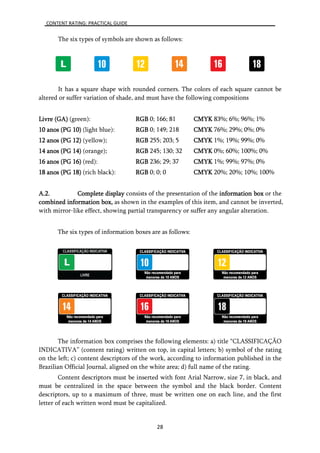
The six types of symbols are shown as follows:
It has a square shape with rounded corners. The colors of each square cannot be
altered or suffer variation of shade, and must have the following compositions
Livre (GA)Livre (GA)Livre (GA)Livre (GA) (green): RGBRGBRGBRGB 0; 166; 81 CMYKCMYKCMYKCMYK 83%; 6%; 96%; 1%
10 anos10 anos10 anos10 anos (PG 10)(PG 10)(PG 10)(PG 10) (light blue): RGBRGBRGBRGB 0; 149; 218 CMYKCMYKCMYKCMYK 76%; 29%; 0%; 0%
12 anos (PG 12)12 anos (PG 12)12 anos (PG 12)12 anos (PG 12) (yellow):::: RGBRGBRGBRGB 255; 203; 5 CMYKCMYKCMYKCMYK 1%; 19%; 99%; 0%
14 anos (PG 14)14 anos (PG 14)14 anos (PG 14)14 anos (PG 14) (orange):::: RGBRGBRGBRGB 245; 130; 32 CMYKCMYKCMYKCMYK 0%; 60%; 100%; 0%
16 anos (PG 116 anos (PG 116 anos (PG 116 anos (PG 16)6)6)6) (red): RGBRGBRGBRGB 236; 29; 37 CMYKCMYKCMYKCMYK 1%; 99%; 97%; 0%
18 anos (PG 18)18 anos (PG 18)18 anos (PG 18)18 anos (PG 18) (rich black): RGBRGBRGBRGB 0; 0; 0 CMYKCMYKCMYKCMYK 20%; 20%; 10%; 100%
A.2.A.2.A.2.A.2. Complete displayComplete displayComplete displayComplete display consists of the presentation of the information boxinformation boxinformation boxinformation box or the
combined information box,combined information box,combined information box,combined information box, as shown in the examples of this item, and cannot be inverted,
with mirror-like effect, showing partial transparency or suffer any angular alteration.
The six types of information boxes are as follows:
The information box comprises the following elements: a) title “CLASSIFICAÇÃO
INDICATIVA” (content rating) written on top, in capital letters; b) symbol of the rating
on the left; c) content descriptors of the work, according to information published in the
Brazilian Official Journal, aligned on the white area; d) full name of the rating.
Content descriptors must be inserted with font Arial Narrow, size 7, in black, and
must be centralized in the space between the symbol and the black border. Content
descriptors, up to a maximum of three, must be written one on each line, and the first
letter of each written word must be capitalized.
CONTENT RATING: PRACTICAL GUIDE
29
At the discretion of the interested party, works rated previously may be submitted
to further analysis by the Brazilian Ministry of Justice to update content descriptors to
current terminology.
Below are three examples with content descriptors chosen randomly:
In the case of a work to which no content descriptor was indicated, the sentence
“Não há inadequações” (No inadequacies) must appear on the inside of the white area.
The sentence must be written with font Arial Narrow, size 7, in black, and must be
centralized in the space between the symbol and the black border. In this exclusive case,
only the first letter of the word “Não” (No) must be capitalized. The model is as follows:
The combined information boxcombined information boxcombined information boxcombined information box comprises the following elements: a) title
“CLASSIFICAÇÃO INDICATIVA” (content rating) written on top, in capital letters; b)
symbols of the lower rating and higher rating contained in the central area to the left; c)
content descriptors of the work aligned on the white area; d) age range variation; e)
website of the content rating system.
Content descriptors must be inserted with font Arial Narrow, size 7, in black, and
must be centralized in the space between the symbol and the black border. Content
descriptors, up to a maximum of three, must be written one on each line, and the first
letter or each written word must be capitalized. The interested party must require that
the Brazilian Ministry of Justice indicates which content descriptors must appear on the
information box.
The information on minimum and maximum age range must be inserted in font
Arial Narrow Bold, size 7, white color, and must be centralized on the black space at the
bottom of the box. The standard phrase must be “Conteúdo varia de X a Y anos” (Content
varies from X to Y years), with no punctuation. Numbers must not be written in full and
the only capital letter must be the first letter of the sentence and the first letter of the
word “Livre” (GA), if it is the case.
CONTENT RATING: PRACTICAL GUIDE
30
Below there are two examples of combined information boxes:
A.3.A.3.A.3.A.3. Symbols and information boxes may be displayed in grayscale when the
material on which they will be printed does not allow use of colors or when the
remaining part of the advertising material or packaging is not printed in colors.
B.B.B.B. DISPLAY ON MEDIA PACKAGINGS AND RPG BOOKDISPLAY ON MEDIA PACKAGINGS AND RPG BOOKDISPLAY ON MEDIA PACKAGINGS AND RPG BOOKDISPLAY ON MEDIA PACKAGINGS AND RPG BOOK
COVERSCOVERSCOVERSCOVERS
The rating must be displayed on two placestwo placestwo placestwo places on the case and packagings of media or
products which contain the classifiable product:
BBBB.1..1..1..1. The summarized display must appear on the left bottom corner or on the
right bottom corner of the front part, according to model shown in item A.1.
For covers or packagings of up to 270cm270cm270cm270cm2222 of front area, the symbol must measure at
least 10mm in heigh10mm in heigh10mm in heigh10mm in height X 10mm in widtht X 10mm in widtht X 10mm in widtht X 10mm in width. The symbol must have a mandatory white color
border around it, with at least 0.25mm in width0.25mm in width0.25mm in width0.25mm in width. Thus, the symbol and its border must
measure, in total, at least 10.5 mm in height x 10.5 mm in width10.5 mm in height x 10.5 mm in width10.5 mm in height x 10.5 mm in width10.5 mm in height x 10.5 mm in width.
For covers or packagings with front area superior to 270cm270cm270cm270cm2222, the symbol and the
border must be adjusted so that they have a total height of at least 10%10%10%10% of the height of
the cover or packaging. The alteration of the symbol’s height implies the proportional
alteration of all its dimensions.
B.B.B.B.2.2.2.2. The complete display must appear on any place of the back part of the
packaging, following the model shown in item A.2.A.2.A.2.A.2.
For covers or packagings of up to 270cm270cm270cm270cm2222
of front area, the box must measure at
least 20mm in height X 35mm in width20mm in height X 35mm in width20mm in height X 35mm in width20mm in height X 35mm in width. The box must have a mandatory white color
border around it, with at least 0.25mm in width0.25mm in width0.25mm in width0.25mm in width. Thus, the box and its border must
measure, in total, at least 20.5mm in height x 35.5mm in width20.5mm in height x 35.5mm in width20.5mm in height x 35.5mm in width20.5mm in height x 35.5mm in width.
For covers or packagings with front area superior to 270cm270cm270cm270cm2222, the box and the
border must be adjusted so that they have a total height of at least 10%10%10%10% of the height of
the cover or packaging. The alteration of the box height implies the proportional
alteration of all its dimensions.
CONTENT RATING: PRACTICAL GUIDE
31
B.3.B.3.B.3.B.3. Packagings with multiple worksPackagings with multiple worksPackagings with multiple worksPackagings with multiple works
In case more than one work is distributed in the same packaging, with distinct
ratings, whether they are in the same media or not, the information on the ratings must
be displayed as follows:
B.3.1.B.3.1.B.3.1.B.3.1. The summarized display, on the front part of the packaging, will consist of
the display of the symbol of the work with the highest rating, following the model shown
in item A.1.A.1.A.1.A.1.
Example 1: The thirteen episodes of the first season of series X will be sold as a
pack. Ten out of the thirteen episodes were rated PG-12, two of them rated PG-14 and
one PG-16. The summarized display (frontal) must be the red square of PG-16.
Example 2: Games X, Y and Z will be released in the same media in a
commemorative edition. Two of them were rated PG-16 and one rated PG-18. The
summarized display (frontal) must be the black square of PG-18.
B.3.2.B.3.2.B.3.2.B.3.2. The complete display on the back of the packaging for multiple works may
be done in three different ways: a) display of the information box corresponding to each
work; b) display of the combined information box; or c) display of information box of the
work with the highest rating.
Option a) Each information box must indicate the work to which it corresponds.
Option b) The combined information box may be displayed in any place in the
back of the packaging, according to model shown in item A.2.A.2.A.2.A.2.
For covers or packagings of up to 270cm270cm270cm270cm2222
of front area, the combined information
box must measure at least 20mm in height X 45mm in width20mm in height X 45mm in width20mm in height X 45mm in width20mm in height X 45mm in width. The box must have a
mandatory white color border around it, with at least 0.25mm in width0.25mm in width0.25mm in width0.25mm in width. Thus, the box
and its border must measure, in total, at least 20.5mm in height x 45.5mm in width20.5mm in height x 45.5mm in width20.5mm in height x 45.5mm in width20.5mm in height x 45.5mm in width. The
rectangular box and the border must have its edges rounded.
For covers or packagings with front area superior to 270cm270cm270cm270cm2222, the box and the
border must be adjusted so that they have a total height of at least 10%10%10%10% of the height of
the cover or packaging. The alteration of the box height implies the proportional
alteration of all its dimensions.
Option c) A regular information box with the age range of the work with the
highest rating is used, but the content descriptors must be combined. The interested party
must request that the Brazilian Ministry of Justice indicate which content descriptors
must appear on the information box.
B.B.B.B.3.3.3.3.3.3.3.3. In case more than one work is distributed in the same packaging, whether
they are in the same media or not, and with the same rating, but with different content
descriptors, there is no need to use the combined information box.
CONTENT RATING: PRACTICAL GUIDE
32
In these circumstances, the regular information box must be used listing in a
combined way all distinct content descriptors up to a maximum of three. The interested
party must request that the Brazilian Ministry of Justice indicate which content
descriptors must appear on the information box.
C.C.C.C. DISPLAY ON BANNERS, POSTERS, BILLBOARDS,DISPLAY ON BANNERS, POSTERS, BILLBOARDS,DISPLAY ON BANNERS, POSTERS, BILLBOARDS,DISPLAY ON BANNERS, POSTERS, BILLBOARDS,
DISPLAYS AND PRESSDISPLAYS AND PRESSDISPLAYS AND PRESSDISPLAYS AND PRESS
The rating must be displayed on posters, flyers, banners, displays (cubes, boxes,
silhouettes, totems, etc.), press (newspapers, magazines, comic books, pamphlets among
others) when advertising classifiable products such as films, electronic games, RPG and
television shows.
C.1.C.1.C.1.C.1. The information will be displayed by means of the rating symbol, with the
mandatory white board, following the model in item A.1.A.1.A.1.A.1., and shown in any visible part
of the object.
The symbol and its border must have a total height of at least 10%10%10%10% of the height of
the advertising material.
In case of advertising a work not yet rated, the information “VERIFIQUE A
CLASSIFICAÇÃO INDICATIVA” (Check the rating) must be displayed, and it should be
written in capital letters and in font Arial Narrow Bold, in such a way that the height of
the letter measures at least 3%3%3%3% of the height of the advertising material.
D.D.D.D. DISPLAY IN CATALOGS, DIARIES ANDDISPLAY IN CATALOGS, DIARIES ANDDISPLAY IN CATALOGS, DIARIES ANDDISPLAY IN CATALOGS, DIARIES AND
PROGRAMMINPROGRAMMINPROGRAMMINPROGRAMMINGGGG
The rating must be shown in products catalogs, diaries and programming.
D.1.D.1.D.1.D.1. Information will be provided in writing, showing only the age range of the
work. If there is no rating, the expression “verifique a classificação indicativa” (Check the
rating) must be used.
The display of rating symbols of the work is optional, in its summarized or
complete form, close to the said product, following the models in items A.1A.1A.1A.1 and A.2.A.2.A.2.A.2.
E.E.E.E. DISPLAY FOR DIGITAL DISTRIBUTIONDISPLAY FOR DIGITAL DISTRIBUTIONDISPLAY FOR DIGITAL DISTRIBUTIONDISPLAY FOR DIGITAL DISTRIBUTION
E.1E.1E.1E.1 The rating must be displayed in digital distribution websites of audiovisual
products such as films, electronic games and television shows. Products for digital
CONTENT RATING: PRACTICAL GUIDE
33
distribution are those whose display or performance does not happen only online, on the
browser, requiring that the consumer stores or installs the product on its equipment. The
information on the rating must be shown together with the information on the product,
before and after its acquisition.
The following modes are included in this category, although the list of inclusions
is not limited to these modes: download services of games, applications and audiovisual
works for mobiles (also smartphones and feature phones); download services of games,
applications and audiovisual works for portable or desk devices; purchase or renting
services of films through downloading; download services of games or films for computers.
E.2.E.2.E.2.E.2. The transmission of the rating will happen with the rating symbol of the
work, with a mandatory white border, as per the model contained in item A.1.A.1.A.1.A.1. Content
descriptors of the work must be listed in full, and close to the square symbol as follows:
Apresenta: XXX, XXX e XXXApresenta: XXX, XXX e XXXApresenta: XXX, XXX e XXXApresenta: XXX, XXX e XXX.
(It contains: XXX, XXX and XXXIt contains: XXX, XXX and XXXIt contains: XXX, XXX and XXXIt contains: XXX, XXX and XXX.)
The XXX characters of the model are to be replaced by the content descriptors
informed by the Ministry. There is no determination of shape or size of font used to write
the phrase; it must only be perfectly legible. In case of work to which no content
descriptor was attributed, no information besides the square symbol is required.
The use of the information box according to the model shown in item A.2A.2A.2A.2 instead
of showing the symbols and descriptors in full is optional.
E.3.E.3.E.3.E.3. When technological limitations of the device do not allow the display of
images, then, instead of the symbol there must be information written in full in any of
the following forms, according to the rating of the work:
““““Não recomendado para menores de XX anosNão recomendado para menores de XX anosNão recomendado para menores de XX anosNão recomendado para menores de XX anos”””” ou ““““LivreLivreLivreLivre””””
(“Not recommended for ages under XX”“Not recommended for ages under XX”“Not recommended for ages under XX”“Not recommended for ages under XX” or “GA”“GA”“GA”“GA”)
The XX marking of the model is replaced by the age attributed by the Ministry.
There is no determination of shape or size of font used to write the phrase; it must only
be perfectly legible.
Technological limitation is the impossibility of the mobile device to show images
and colors, also affecting the game or audiovisual work itself. Whenever the device is
capable of reproducing images, the producer is responsible for adjusting the layout of the
information screen on the work, shown before and after the acquisition, to display the
symbol or information box with the rating.
CONTENT RATING: PRACTICAL GUIDE
34
F.F.F.F. DISPLAY FOR TELEVISIONDISPLAY FOR TELEVISIONDISPLAY FOR TELEVISIONDISPLAY FOR TELEVISION
The rating must be displayed in two momentstwo momentstwo momentstwo moments during the performance of
television shows:
- Complete display, at the beginning of the show.
- Summarized display whenever returning from breaks.
F.1.F.1.F.1.F.1. The complete display at the beginning of the show involves the
presentation of the information barinformation barinformation barinformation bar of content rating at the footer of the projection area
or full screen before the beginning of the show.
F.1.1.F.1.1.F.1.1.F.1.1. The information bar comprises four specific fields: 1111stststst (left corner) – square
symbol of the age range, respecting the color and shape specified in field A.1.A.1.A.1.A.1.; 2222ndndndnd
(top
central part) – age range written in full in the format ““Não recomendado para menores
de XX anos” or “Livre”, capitalized, font Arial Narrow Bold and in legible size; 3333rdrdrdrd
(bottom central part) – content descriptors, if it there are any, in the format “It contains:
XXX, XXX and XXX.”, in font Arial Narrow Bold and legible size; 4444thththth
(right corner) –
information on Brazilian Sign Language (LIBRAS).
Items 2222 and 3333 must be displayed in the same box, with minimum width of ½ of the
screen. In item 2222 the XX marking of the model is replaced by the age expressed in
numerals. In item 3333 the XXX markings of the model are replaced by the content
descriptors informed by the Ministry of Justice. Item 3333 is optional for shows with rating
equal or lower than PG-14.
The information in Brazilian sign language, item 4444, must be displayed pursuant
ABNT norms (NBR 15290) and is optional for shows with rating equal or inferior to PG-
10.
The use of complete initial information through a mode other than the standard
mentioned above is optional for TV channels, so long as it contains all information
required for that age range. For such, the television channel must submit the model
previously for the approval of the Brazilian Ministry of Justice.
F.2.F.2.F.2.F.2. The summarized display consists of the presentation of the rating symbol,
for at least five consecutive seconds, in the first thirty seconds after the break, if there is
one. The symbol must follow the model shown in item A.1.A.1.A.1.A.1.
F.3.F.3.F.3.F.3. Considering that on paid TV the information on ratings must be available
at all times, the summarized display after the break is optional.
CONTENT RATING: PRACTICAL GUIDE
35
G.G.G.G. DISPLAY ON COMMERCIALS AND PREVIEWS ONDISPLAY ON COMMERCIALS AND PREVIEWS ONDISPLAY ON COMMERCIALS AND PREVIEWS ONDISPLAY ON COMMERCIALS AND PREVIEWS ON
ELECTRONIC MEDIAELECTRONIC MEDIAELECTRONIC MEDIAELECTRONIC MEDIA
The rating system must be informed in commercials on electronic media
(television, cinema, radio and internet). That includes the following advertising forms,
although it is not limited to them: previews of television programs, previews of films
shown on television or the cinema, commercial advertising electronic games and products
of the video market, electronic banners on internet websites and radio commercials of
classifiable products.
G.1.G.1.G.1.G.1. On the radio, the age range of the programs, shows and public
entertainment must be informed. While no rating is attributed to it, the expression
“verifique a classificação indicative” (Check the rating) must be stated.
G.2.G.2.G.2.G.2. On television, cinema and market of games and domestic video, advertising
of programs, entertainment and shows must contain the ratings symbols:
a) centralized on the screen, in large size, over black background. The display
must last at least three consecutive seconds and must be inserted at the beginning or end
of advertisement. While no rating is attributed to it, the expression “verifique a
classificação indicativa” (Check the rating)“ must be stated; or
b) on the left bottom corner of the screen, under the terms of item F.2.F.2.F.2.F.2., during the
screening of the advertisement. The exhibition of the symbol must last at least three
consecutive seconds in the first ten seconds of the advertisement. While no rating is
attributed to it, the expression “verifique a classificação indicativa” (Check the rating)
must be stated.
G.3.G.3.G.3.G.3. For graphical advertisements of classifiable work (such as banners) on the
internet, the display of the rating will be happen through the symbol displayed on the
bottom left or right corner, with a minimum height of 10%10%10%10% of the larger side of the
advertisement. While no rating is attributed to it, the expression “verifique a classificação
indicativa” (Check the rating) must be stated.
In all cases where the symbol is used, it must follow the model shown in item A.1.A.1.A.1.A.1.
H.H.H.H. DISPLAY ON INTERNET WEBSITESDISPLAY ON INTERNET WEBSITESDISPLAY ON INTERNET WEBSITESDISPLAY ON INTERNET WEBSITES
The rating must be informed on Brazilian internet websites or those addressed to
the Brazilian public, and which publish any classifiable product, such as websites
advertising products, entertainment and shows; game websites, television shows and films.
CONTENT RATING: PRACTICAL GUIDE
36
H.1.H.1.H.1.H.1. The summarized display must be shown in any location of the main page
(in case of specific site of the product, show or entertainment), or together with the
product in case of websites with ample publicizing.
The symbol must follow the models shown in A.1.A.1.A.1.A.1. with 70 pixels in height70 pixels in height70 pixels in height70 pixels in height, and
the display of the complete exhibition, following the model on item A.2.A.2.A.2.A.2., is optional.
In case of advertising a work not yet rated, the information “verifique a
classificação indicativa” (Check the rating) must be displayed and it should be written in
capital letters in font Arial Narrow Bold, in a clear way with easy visualization.
I.I.I.I. DISPLAY ON THE ACCESS TO CONCERTS, PLAYSDISPLAY ON THE ACCESS TO CONCERTS, PLAYSDISPLAY ON THE ACCESS TO CONCERTS, PLAYSDISPLAY ON THE ACCESS TO CONCERTS, PLAYS
AND OTHER ENTERTAINMENT EVENTSAND OTHER ENTERTAINMENT EVENTSAND OTHER ENTERTAINMENT EVENTSAND OTHER ENTERTAINMENT EVENTS
The rating must be informed in places of direct access to the product,
entertainment or public shows (stores, entry gates) or on ticket booths.
I.1.I.1.I.1.I.1. In cinemas, theaters, circuses, show and performance halls, etc: the
complete rating must be displayed in a location with easy visualization close to the doors,
access gates and ticket booths, according to item A.2.A.2.A.2.A.2.
I.2.I.2.I.2.I.2. In stores, business premises – electronic websites included – for selling and
renting classifiable product: in case it is not possible to inform the complete rating of any
product in a clear way of easy visualization on the packaging or casing, it is the
responsibility of the store or electronic website to provide, according to item A.2.A.2.A.2.A.2., the
complete display of the rating.
CONTENT RATING: PRACTICAL GUIDE
37
FAQ
Overall Considerations
01. What is the Content Rating System?
It is the indication for the family regarding the age range to which
audiovisual works (television, cinema and video market, electronic games and role-
playing games – RPG) are not recommended. It is advisable that parents watch and talk to
their children about the contents and subjects approached.
02. What is the legal basis of the rating system?
The ratings are based on the Brazilian Federal Constitution, on the Child
and Adolescent Statute, Brazilian Ministry of Justice Ordinances no. 1,100/2006,
1,220/2007, 1,642/2012, 1,643/2012 and on the Manual of New Rating System (2006).
Ordinance no. 1,100/2006 of the Brazilian Ministry of Justice regulates the ratings of
public entertainment, especially audiovisual works destined to the cinema and home
video. Ordinances no. 1,220/2007 and 1,642/2012, of the Brazilian Ministry of Justice, and
Ordinance no. 14/2009 of the Brazilian National Secretariat of Justice govern audiovisual
works destined to broadcast on television. Ordinance no. 1,643/2012 of the Brazilian
Ministry of Justice governs electronic games, apps and role-playing games (RPG).
03. Is the rating system the same thing as censorship?
No. Unlike censorship, the rating is a democratic process, shared by the
government, entertainment companies and the society, with the aim of informing
Brazilian families the age range some public entertainment is not recommended to. Thus,
the family has the right of choice guaranteed and children and adolescents have their
psycho-social development preserved.
The Brazilian Ministry of Justice does not prohibit the broadcast and
presentation of shows or the screening of films. The Ministry has the responsibility to
inform the age ranges and time shows are not recommended to. This is what is
established in the Brazilian Federal Constitution, the Child and Adolescent Statute and
Ministry of Justice Ordinances. As one may notice, the rating system is not censorship
and does not replace the family's decision.
04. When did the Rating System Ordinance no. 1,220/2007 of the Brazilian Ministry of
Justice come into force?
The ordinance came into force on July 11, 2007. Since April, 2008, all
municipalities with a time zone different from that of Brasilia had to adopt and respect
the time connection with the age contained in said Ordinance. When Daylight Saving
Time is in force, it must also be respected by television channels.
CONTENT RATING: PRACTICAL GUIDE
38
05. Where do I submit my request for rating or of self-rating?
The owner or legal representative of the audiovisual work must file a rating
or self-rating request sending the document by post, e-mail or personally at the Customer
Service Department of the Brazilian National Secretariat of Justice.
06. How can I know the rating of public entertainment?
The decision on the Ratings is published on the Brazilian Official Journal.
It can also be seen on www.mj.gov.br/classificacao.
Previous analysis and Self-rating
07. What is the difference between self-rating and previous analysis?
Self-rating is adopted by television channels, which submit the process to
the Ministry of Justice without the need to send the audiovisual work. After the show
starts airing, there will be monitoring by the Department of Justice, Ratings, Titles and
Qualification (DEJUS), which will have 60 days to confirm or modify the rating intended
by the television channel.
Previous analysis, however, applies to the market of cinema, home video,
electronic games and RPG. For this service, the applicant must send the work and the
rating intended, with the registration form, to the Coordination of the Rating System
(COCIND) that will analyze and publish the rating attributed to the work in the Brazilian
Official Journal (DOU). Only after such publication is the work ready for
showing/marketing.
08. What kind of work is susceptible to be rated?
The following works require ratings in previous analysis: works for the
cinema, home video, electronic games, apps and RPG. All shows broadcast on television
must request self-rating, except news and sports programs, advertising overall, electoral
programs and works already rated for another media.
The following are exempt of previous analysis: circus shows, theater
presentations, music concerts and other public shows and presentations. These must be
self-rated on the basis of the criteria contained in this Practical Guide, but are exempt
from submitting a request to the Brazilian Ministry of Justice.
09. What happens if the television channel/producer/distributor of works for television
does not perform the self-rating?
If the interested party does not submit a self-rating request of the work
destined to the television market to the Brazilian Ministry of Justice, this Ministry may, at
any time, rate the work. In case abuse is proven, a report is forwarded to the Federal
CONTENT RATING: PRACTICAL GUIDE
39
Prosecution Office, which will determine if there was a violation of article 254 of the
Child and Adolescent Statute (Act 8.069/90).
10. How long does it take to have the response to a request of rating or self-rating?
In the case of television programs, after analyzing the documents, the
decision will be published on the Brazilian Official Journal (DOU) and on the website
www.mj.gov.br/classificacao within 20 working days upon acceptance, authorizing the
television channel to broadcast the program, which will have its self-rating request
authorized or denied within 60 days after the beginning of broadcast.
In the case of the market of cinema, home video, electronic games and RPG,
the Ministry will rate the work through previous analysis within 30 days upon reception.
In case of urgency, the applicant may send an application with arguments justifying the
request to reduce legal term.
11. Can the request for rating or self-rating be denied?
The request will only be rejected (denied) if there is a mistake, lack of
documents, data omitted or inconsistencies in the application.
12. Can the intended rating or self-rating be denied after the analyses of the work?
Yes, in case the intended rating does not correspond to the contents shown
in the work.
13. Is it possible to appeal to the rejection decision?
Yes. The applicant who has his request denied may require the re-
evaluation to the Director of the Department of Justice, Rating, Titles and Qualification.
If the decision of the Director is maintained, the applicant may appeal to the Brazilian
National Secretary of Justice. All decisions are published on the Brazilian Official Journal.
14. In practice, what is the process of rating of audiovisual works like?
The works are analyzed, based on the criteria contained in this Guide, by
professionals of the Coordination of the Rating System, the Department of Justice, Ratings,
Titles and Qualification, of the Brazilian National Secretariat of Justice, of the Ministry of
Justice.
Each work is watched by professionals of different areas of activity. They
discuss the inadequacies, aggravating and attenuating elements found and come to a
conclusion about the rating and content descriptors.
Rating of television programs: television channels or producers send to the
Ministry of Justice a synopsis of the program to be broadcast together with the intended
CONTENT RATING: PRACTICAL GUIDE
40
rating. This is what is called self-rating. After this step, the Ministry of Justice has 60 days
to monitor the work and check if the content broadcast corresponds to the rating
intended by the television channel. In case the content (sex, drugs and violence scenes) is
not in accordance with the self-rating, the program can be re-rated. Television channels
may still request a reconsideration of the rating.
The monitoring work is continuous and based on the criteria of quantity,
relevance, contextualization and intensity of scenes containing sex, violence and drugs.
Audiovisual works (market of cinema and home video): in these cases, the
Ministry of Justice performs a previous analysis to rate them.
Electronic games and role-playing games (RPG): are also analyzed
according to the methodology and criteria contained in this Guide. In the case of RPG,
the analysis is performed upon request by publishing houses or distributors, which must
send a copy of the game book to the Ministry. Producers and distributors of electronic
games send the Ministry of Justice a substantiated request for rating with the game,
synopsis, a copy of the game or a broad demonstrative video of its contents (gameplay).
15. What criteria can be used to substantiate the request of self-rating for television
programs?
The self-classification request must contain the intended rating and be
detailed, including the description of themes, contents and possible inadequacies.
The responsible for the work must note the principles established in article
221st
of the Brazilian Federal Constitution, especially the preference for educational,
artistic, cultural and informative purpose and the respect for ethical and social values of
the person and family.
16. What are the consequences if inadequacies not included in the self-rating request are
found?
The Brazilian Ministry of Justice will monitor the audiovisual work, for
television, for up to 60 days. The monitoring will confirm or change the self-rating
intended by producers and television channels.
Monitoring is continuous. Upon confirmation that the self-rating does not
correspond to the scenes broadcast, the Ministry of Justice may institute administrative
proceedings for re-rating and inform the fact to Federal Prosecution Office and other
government bodies involved for the applicable measures.
CONTENT RATING: PRACTICAL GUIDE
41
Rating Application
17. Does the classification also apply to PPV (Pay Per View), VOD (Video on Demand)
and other distribution channels?
Yes. The system applies to any type of audiovisual work destined to
distribution and broadcast on television or similar media, whatever the final format of
broadcast or distribution.
18. Are the analysis criteria for the market of cinema, home video, electronic games and
role-playing games the same as those for TV?
Yes. The analysis criteria are based on the quantity, relevance,
contextualization and intensity of scenes with sex, drugs and violence content shown.
Before attributing the rating, the analyst evaluates if the work contains aggravating and
attenuating elements. Aggravating elements are, for instance, showing violence and no
punishment for the attacker. Showing cooperative, sympathetic behavior which values
life and human beings can be attenuating elements and help reduce the rating of the
works analyzed.
19. In a television channel for children is it necessary to show the rating “General
Audiences” each time a program is broadcast?
Yes. It is always important to remember that the rating is attributed to
specific audiovisual works and not the entire programming or channel.
20. Should live shows be rated?
Live shows are initially exempt from rating, but they may be rated based on
the monitoring and history, in case of recurrent inadequacies. The applicant must request
self-rating when he is aware that there will be inadequate contents in the show.
21. Should news and sports programs be rated?
No. The Brazilian Ministry of Justice does not rate or monitor news and
sports shows, electoral propaganda and advertising overall, including those related to
programming.
22. Do musical and video shows need to be rated?
Yes. Musical shows and videos must be rated, so long as they are not part of
works not subject to rating, such as news programs. This rule also applies to religious
programs.
CONTENT RATING: PRACTICAL GUIDE
42
23. In the case of television series, how can the self-rating application be done?
The self-rating request may be submitted for the entire series, for each
season or for episode. If there are changes in the theme and/or content in the seasons,
each season must be rated separately. What is important is the clear and objective
information for parents, children and adolescents.
24. Should audiovisual products already rated in another country be also rated in Brazil?
Yes. All audiovisual products to be shown in Brazil must be rated or self-
rated using national standards, except news and sports programs, electoral programs or
propaganda and advertising overall. Live shows can be classified on the basis of the
monitoring activity.
25. Are short films rated?
Yes. Short films are rated just like any other audiovisual work, regardless of
their genre, duration, format of capture, broadcast or distribution.
26. Will the rating of a film shown in the cinema the same when it is shown on TV?
Yes. The matrix system used by the Ministry of Justice attributes the same
rating to the works as long as there is no change in the content rated originally –
elimination or insertion of scenes.
27. Are documentaries subject to rating?
Yes, documentaries must also be rated.
28. Is pay-TV subject to connection between age ranges and screening time?
Pay-TV does not follow the connection between age ranges and screening
time when it offers a blocking device as an effective mean for parents to control programs.
However, the channels must inform the rating attributed to each program.
Responsibilities and Sanctions
29. Who is responsible for informing the rating at the venues of public entertainment?
Producers, distributors, exhibitors or people responsible for public
entertainment have the responsibility to inform, post information in a visible location
and with easy access at the entrance of the venue. The information must highlight the
nature of the entertainment and the age range it is not recommended to, pursuant the
standard defined in the Ordinance 1.100/06 of the Ministry of Justice.
CONTENT RATING: PRACTICAL GUIDE
43
30. Who is responsible for the entire rating process?
The responsibility to respect the rating and publicize the rating symbols is
shared by the producers, television channels or those responsible for the product and the
Brazilian National Secretariat of Justice, of the Ministry of Justice.
31. Can the Ministry of Justice apply sanctions to producers/television channels that
disrespect the rules?
No. The Judiciary Power or Federal Prosecutor Office can define and apply
sanctions. This process is started by the Ministry of Justice when irregularities are
confirmed.
Useful Contacts
Content Rating SystemContent Rating SystemContent Rating SystemContent Rating System
Ministry of Justice
Brazilian National Secretariat of Justice
Department of Justice, Ratings, Titles and Qualification
Content Rating CoordinationContent Rating CoordinationContent Rating CoordinationContent Rating Coordination
Esplanada dos Ministérios, Bloco T,
Ministério da Justiça, Anexo II, Sala 321
CEP 70064-901 – Brasília/DF
Phone: (61) 2025-9061, 2025-9115
www.mj.gov.br/classificacao
email: classificacaoindicativa@mj.gov.br
Practical Guide Content Rating

Practical Guide Content Rating

  • 2.
    MINISTRY OF JUSTICE BRAZILIANNATIONAL SECRETARIAT OF JUSTICE DEPARTMENT OF JUSTICE, RATINGS, TITLES AND QUALIFICATION CONTENT RATINGCONTENT RATINGCONTENT RATINGCONTENT RATING PRACTICAL GUIDEPRACTICAL GUIDEPRACTICAL GUIDEPRACTICAL GUIDE Organized byOrganized byOrganized byOrganized by thethethethe Brazilian National Secretariat of Justice 2nd edition Brasília 2012
  • 3.
    MINISTER OF JUSTICEMINISTEROF JUSTICEMINISTER OF JUSTICEMINISTER OF JUSTICE José Eduardo Cardozo EXECUTIVE SECRETARY OF THE MINISTRY OF JUSTICEEXECUTIVE SECRETARY OF THE MINISTRY OF JUSTICEEXECUTIVE SECRETARY OF THE MINISTRY OF JUSTICEEXECUTIVE SECRETARY OF THE MINISTRY OF JUSTICE Márcia Pelegrini BRAZILIANBRAZILIANBRAZILIANBRAZILIAN SECRETARY OF JUSTICESECRETARY OF JUSTICESECRETARY OF JUSTICESECRETARY OF JUSTICE Paulo Abrão Pires Junior DIRECTOR OF THE DEPARTMENT OF JUSTICE, RATINGS, TITLES AND QUALIFICATIONDIRECTOR OF THE DEPARTMENT OF JUSTICE, RATINGS, TITLES AND QUALIFICATIONDIRECTOR OF THE DEPARTMENT OF JUSTICE, RATINGS, TITLES AND QUALIFICATIONDIRECTOR OF THE DEPARTMENT OF JUSTICE, RATINGS, TITLES AND QUALIFICATION Fernanda Alves dos Anjos ASSISTANT DIRECTOR OF THE DEPARTMENT OF JUSTICE, RATINGASSISTANT DIRECTOR OF THE DEPARTMENT OF JUSTICE, RATINGASSISTANT DIRECTOR OF THE DEPARTMENT OF JUSTICE, RATINGASSISTANT DIRECTOR OF THE DEPARTMENT OF JUSTICE, RATINGSSSS, TITLES AND, TITLES AND, TITLES AND, TITLES AND QUALIFICATIONQUALIFICATIONQUALIFICATIONQUALIFICATION Davi Ulisses Brasil Simões Pires CONTENT RATING COORDINATORCONTENT RATING COORDINATORCONTENT RATING COORDINATORCONTENT RATING COORDINATOR Alessandra Xavier Nunes Macedo CONTENT PREPARATIONCONTENT PREPARATIONCONTENT PREPARATIONCONTENT PREPARATION Alessandra X. N. Macedo Anna Paula U. de A. Branco Bruna Grazielle M. Silva Daniel Ramos da Silva Davi Ulisses B. S. Pires Gustavo Camilo Baptista Isabela Maria L. Blumm Marcela Queiroz Alvim Marcelo B. Duarte da Costa Otavio Chamorro Mendoza Patrícia Almeida Gusmão Pedro A. Albuquerque Rafael Figueiredo Vilela Rafaela Camelo Vieira Ranna Iara de P. C. Almeida Tiago Vinícius Vaz ENGLISH VERSIONENGLISH VERSIONENGLISH VERSIONENGLISH VERSION TAP Brasil – Associação Brasileira dos Programadores de Televisão por Assinatura Bitelli Advogados – Marcos Alberto Sant’Anna Bitelli, Ieda Maria Monteiro e Heloisa Ramos SUPERVISIONSUPERVISIONSUPERVISIONSUPERVISION Rafael Figueiredo Vilela ACKNOWLEDGEMENTSACKNOWLEDGEMENTSACKNOWLEDGEMENTSACKNOWLEDGEMENTS The Brazilian National Secretariat of Justice would like to thank the effort of all the people who are or were part of the team of collaborators of the Rating System and that, in the course of their work, tested and improved the contents of this guide. Free distributionFree distributionFree distributionFree distribution Total or partial reproduction of thisTotal or partial reproduction of thisTotal or partial reproduction of thisTotal or partial reproduction of this publicationpublicationpublicationpublication by any means is permitted as long as theby any means is permitted as long as theby any means is permitted as long as theby any means is permitted as long as the sourcesourcesourcesource isisisis credited.credited.credited.credited.
  • 4.
    CONTENT RATING: PRACTICALGUIDE 3 CONTENTSCONTENTSCONTENTSCONTENTS Introduction…Introduction…Introduction…Introduction…...........................................................................................................................5 Brazilian National Secretariat oBrazilian National Secretariat oBrazilian National Secretariat oBrazilian National Secretariat of Justicef Justicef Justicef Justice...................................................................................6 ObjectiveObjectiveObjectiveObjective..........................................................................................................................................7 Application of theApplication of theApplication of theApplication of the Rating System CriteriaRating System CriteriaRating System CriteriaRating System Criteria...............................................................................8 Content Rating: Analysis Criteria…………..Content Rating: Analysis Criteria…………..Content Rating: Analysis Criteria…………..Content Rating: Analysis Criteria…………............................................................................9 Violence (GA)................................................................................................................9 Violence (PG-10).........................................................................................................10 Violence (PG-12).........................................................................................................11 Violence (PG-14).........................................................................................................13 Violence (PG-16).........................................................................................................14 Violence (PG-18).........................................................................................................15 Sex and Nudity (GA)...................................................................................................16 Sex and Nudity (PG-10)..............................................................................................16 Sex and Nudity (PG-12)..............................................................................................17 Sex and Nudity (PG-14)..............................................................................................18 Sex and Nudity (PG-16)..............................................................................................19 Sex and Nudity (PG-18)..............................................................................................19 Drugs (GA)...................................................................................................................19 Drugs (PG-10)..............................................................................................................20 Drugs (PG-12)..............................................................................................................20 Drugs (PG-14)..............................................................................................................21 Drugs (PG-16)..............................................................................................................21 Drugs (PG-18)..............................................................................................................22 Attenuating Elements...Attenuating Elements...Attenuating Elements...Attenuating Elements.............................................................................................................22 Aggravating ElementsAggravating ElementsAggravating ElementsAggravating Elements.............................................................................................................24 Content Descriptors…………………...Content Descriptors…………………...Content Descriptors…………………...Content Descriptors…………………....................................................................................26 Content Rating: How to Display………….Content Rating: How to Display………….Content Rating: How to Display………….Content Rating: How to Display…………............................................................................27 Symbols and boxes......................................................................................................27 Display on media packaging and RPG book covers..................................................30 Display on banners, posters, billboards, displays and press……..……....................32 Display in catalogs, diaries and programming….......................................................32 Display for digital distribution...................................................................................32 Display for television..................................................................................................34 Display on commercials and previews on electronic media.....................................35 Display on internet websites......................................................................................35 Display on the access to concerts, plays and other entertainment events………...36 FAQFAQFAQFAQ..........................................................................................................................................37
  • 6.
    CONTENT RATING: PRACTICALGUIDE 5 INTRODUCTIONINTRODUCTIONINTRODUCTIONINTRODUCTION The Brazilian National Secretariat of Justice (SNJ) of the Brazilian Ministry of Justice has, among its competences, the attribution of rating audiovisual works (television, market of cinema and video, electronic games and role-playing games – RPG). This competence derives from the constitutional disposition governed by the Child and Adolescent Statute and regulated by the Ministry of Justice Ordinances. The rating system is consolidated as government public policy and its symbols are recognized by most families who use such symbols to choose which television programs, films and games their children and adolescents should have access to or not. With the aim of strengthening the idea of co-responsibility among the State, family and society (in which communication companies are included), it is vital that the mechanisms involved in the rating system are known. The Brazilian National Secretariat of Justice has been endeavoring to unify, objectify and publicize the criteria and interpretation of the Manual of the New Rating System (SNJ, 2006). The effort of making the rating system as clear as possible is aligned with the effective purpose of public policy: provide reliable instruments for families to choose and to protect children and adolescents against images that might compromise their upbringing. This effort is having positive results. By means of workshops on the rating system conducted in Brasilia and in other towns throughout the country, it was possible to bring closer the classifications attributed by TV channels to the approvals of the Ministry of Justice - the current level of correspondence is close to 90%. This Practical Guide is a democratic instrument whose aim is to provide transparency and objectiveness to the public policy of the rating system, evincing the analysis criteria. It may be useful for TV channels, producers and distributors of films and games, as well as for society overall and families.
  • 7.
    CONTENT RATING: PRACTICALGUIDE 6 BRAZILIAN NATIONAL SECRETARIAT OF JUSTICEBRAZILIAN NATIONAL SECRETARIAT OF JUSTICEBRAZILIAN NATIONAL SECRETARIAT OF JUSTICEBRAZILIAN NATIONAL SECRETARIAT OF JUSTICE The Brazilian National Secretariat of Justice (SNJ) is one of the seven secretariats that comprise the Ministry of Justice and has a broad scope of activity. Its mission is to foster and consolidate justice rights and policies focused on the assurance and development of Human Rights and Citizenship, by means of joint actions between the government and society. The Secretariat's specific objectives are to coordinate the policy of combating human trafficking; articulate the combat to organized crime, money laundering and corruption; protect and promote migrants' rights; intensify and improve International Legal Cooperation; perfect accreditation and supervision mechanisms of Social Entities qualified as Civil Society Organizations of Public Interest (OSCIP), Federal Public Utility Institution (UPF) or Foreign Organization (OE). The SNJ is also in charge of the coordination of rating activities of TV programs and films, public entertainment, electronic games and role-playing games (RPG), object of this guide.
  • 8.
    CONTENT RATING: PRACTICALGUIDE 7 OBJOBJOBJOBJECTIVEECTIVEECTIVEECTIVE The objective of this practical guide is to demonstrate in a clear and simple way how the Ministry of Justice analyses audiovisual works – television, market of cinema and video, electronic games and role-playing games (RPG). The operational and technical definitions of age classification, attenuating and aggravating elements will be presented below and will show how the Brazilian National Secretariat of Justice staff issues reports which substantiate the administrative proceedings of the Content Rating Coordination (COCIND). The previous manual was issued in 2006. During the time of its utilization as an instrument which guided all analyses performed by the Brazilian National Secretariat of Justice on such subject, some sensitive points were identified, and then adapted, eliminated or included with the objective of serving as grounds for administrative proceedings, aiming at the protection of children and adolescents against unsuitable contents, harmless to their healthy physical and psychological development, as determined in the Child and Adolescent Statute. This edition, revised and expanded, includes proposals from the Public Debate via the Internet and from public meetings with experts on the issue of the rights of children and adolescents.
  • 9.
    CONTENT RATING: PRACTICALGUIDE 8 APPLICATION OF THEAPPLICATION OF THEAPPLICATION OF THEAPPLICATION OF THE RATING SYSTEM CRITERIARATING SYSTEM CRITERIARATING SYSTEM CRITERIARATING SYSTEM CRITERIA Overall, as violent situations, drugs related themes and sexual practice and discourse become more complex, recurrent, intense or impacting (impressive, shocking or causing major effect), the correspondent rating indicator also becomes more strict and, therefore, the rating attributed to the work increases. For this reason, when there is one or more rating indicator, the rating corresponding to the higher age range is attributed to complete the process. One must note that since the Manual of New Rating System there have been special indicators that may attenuate or aggravate the rating categories present in the audiovisual work, especially the ones that contemplate the relevance of the unsuitable content for the understanding of the plot, the frequency in which the content is shown and how the scene was shown (the so-called scene composition, or mise-en-scène, taking into consideration the framing, editing resources, special effects, sound, characters’ behavior, etc.). It is important to point out that these indicators are a major progress in the public policy of the rating system as they work as an instrument of a democratic process, based on technical factors which, with intense social participation and transparency, resulted on a tool for the defense of the rights of children and adolescents.
  • 10.
    CONTENT RATING: PRACTICALGUIDE 9 CONTENT RATINGCONTENT RATINGCONTENT RATINGCONTENT RATING ANALYSIS CRITERIAANALYSIS CRITERIAANALYSIS CRITERIAANALYSIS CRITERIA Rating indicators and their respective operational descriptions are listed here, divided by criteria (violence, sex and drugs), attenuating and aggravating elements and sub-divided by age ranges which they are not recommended to. A.A.A.A. VIOLVIOLVIOLVIOLENCEENCEENCEENCE A.1.A.1.A.1.A.1. General AudiencesGeneral AudiencesGeneral AudiencesGeneral Audiences ((((GAGAGAGA)))) This classification applies to works which contain predominantly positive contents and which do not bring unsuitable elements subject to ratings to ages higher than 10. Scenes of violence are not always harmful to the psychological development of a child, such as the ones listed below: A.1.1.A.1.1.A.1.1.A.1.1. FANTASY VIOLENCEFANTASY VIOLENCEFANTASY VIOLENCEFANTASY VIOLENCE - Elementary levels of fantasy violence, such as aggressive acts in children cartoons, which do not correspond to reality in a way such as body injuries; - Not impacting fights of manicheistic child-youth plots, of the fight between good and evil, which do not depict suffering, injuries or blood; - Ludicrous violence inserted in the slapstick comedy genre (food war, blows that do not cause pain), that is, violence used to promote laughter and not as an act of violence. EXAMPLE: Cartoon in which the character hits and flattens the other character’s head with an anvil, then this character returns to his original shape. A.1.2.A.1.2.A.1.2.A.1.2. DISPLAY OF ARMS WITH NO VIOLENCEDISPLAY OF ARMS WITH NO VIOLENCEDISPLAY OF ARMS WITH NO VIOLENCEDISPLAY OF ARMS WITH NO VIOLENCE - Display of arms of any nature, without clear motivation of violence. EXAMPLE: A Samurai grabs his sword from the table and puts in on his back A.1.3.A.1.3.A.1.3.A.1.3. DEATHS WITH NO VIOLENCEDEATHS WITH NO VIOLENCEDEATHS WITH NO VIOLENCEDEATHS WITH NO VIOLENCE - Death scenes, whether at the time it happens or showing a dead body, without involving pain or injuries. EXAMPLE: An elderly lady dies in her sleep.
  • 11.
    CONTENT RATING: PRACTICALGUIDE 10 A.1.4.A.1.4.A.1.4.A.1.4. BONES AND SKELETONS WITH NO VIOLENCEBONES AND SKELETONS WITH NO VIOLENCEBONES AND SKELETONS WITH NO VIOLENCEBONES AND SKELETONS WITH NO VIOLENCE - Display of bones and skeletons which do not bear any marks of violence. EXAMPLE: The discovery of the fossil of a prehistoric man. A.2.A.2.A.2.A.2. Not recommended for ages underNot recommended for ages underNot recommended for ages underNot recommended for ages under 10 (10 (10 (10 (PG 10PG 10PG 10PG 10)))) The following contents are accepted for this age range: A.2.1.A.2.1.A.2.1.A.2.1. DISPLAY OF ARMS WITH VIOLENCEDISPLAY OF ARMS WITH VIOLENCEDISPLAY OF ARMS WITH VIOLENCEDISPLAY OF ARMS WITH VIOLENCE - Use of arms with the intent of committing violent acts, without the consummation of such acts. EXAMPLE: Character listens to some noise at home and holds a knife to defend himself/herself. A.2.2.A.2.2.A.2.2.A.2.2. FEARFEARFEARFEAR / TEN/ TEN/ TEN/ TENSIONSIONSIONSION - Framing, camera moves, lighting, art direction, sound, characters’ behavior, editing resources or any other element of audiovisual language that creates a tense atmosphere which may cause fear or frighten the viewer. EXAMPLE: Character hears strange noises in a dark house. Suddenly, a masked person comes from nowhere, followed by high sound, scaring the viewer. A.2.3.A.2.3.A.2.3.A.2.3. DISTRESSDISTRESSDISTRESSDISTRESS - Contents that might cause discomfort in the viewer, such as showing harsh discussions, depressed or very sad characters, accidents and destructions, death of parents or people or animals that have a strong bond with the character. EXAMPLE: Child dies of cancer in hospital in the presence of the crying family. A.2.4.A.2.4.A.2.4.A.2.4. BONES AND SKELETONS WITH SIGNS OF VIOLENT ACTSBONES AND SKELETONS WITH SIGNS OF VIOLENT ACTSBONES AND SKELETONS WITH SIGNS OF VIOLENT ACTSBONES AND SKELETONS WITH SIGNS OF VIOLENT ACTS - Bones and skeletons resulting from an act of violence. EXAMPLE: Police officers find a skull with a bullet hole in it. A.2.5.A.2.5.A.2.5.A.2.5. CRIMINAL ACTS WITHOUT VIOLENCECRIMINAL ACTS WITHOUT VIOLENCECRIMINAL ACTS WITHOUT VIOLENCECRIMINAL ACTS WITHOUT VIOLENCE - Any criminal act, offense or violation pursuant Brazilian legislation, which is not linked to violence per se. EXAMPLE: Robbery, theft or corruption A.2.6.A.2.6.A.2.6.A.2.6. DEROGATORY LANGUAGEDEROGATORY LANGUAGEDEROGATORY LANGUAGEDEROGATORY LANGUAGE - Scenes in which the character makes mean or derogatory comments about someone who is not present.
  • 12.
    CONTENT RATING: PRACTICALGUIDE 11 EXAMPLE: - Look at that bitch getting close to my boyfriend! A.3.A.3.A.3.A.3. Not recommended for ages under 12 (PG 12)Not recommended for ages under 12 (PG 12)Not recommended for ages under 12 (PG 12)Not recommended for ages under 12 (PG 12) The following contents are accepted for this age range: A.3.1.A.3.1.A.3.1.A.3.1. VIOLEVIOLEVIOLEVIOLENT ACTNT ACTNT ACTNT ACT - A threat or intentional act of violence against one’s physical integrity, freedom or health or someone else’s. Cases of human trafficking are included in this category. EXAMPLE: Characters are involved in a fight with punching and kicking; character breaks the other character’s nose by throwing a stone; characters puts a tranquilizing pill in one's tea to make him/her pass out; pepper spraying in a public event; character threatens to kill one's child; character hurting himself. A.3.2.A.3.2.A.3.2.A.3.2. BODY INJUBODY INJUBODY INJUBODY INJURYRYRYRY - Body injuries, fractures, blood and/or internal organs, including images of medical procedures and accidents. EXEMPLE: Cardiologist cuts a patient with a scalp. A character with a compound fracture. A.3.3.A.3.3.A.3.3.A.3.3. DESCRIPTION OF VIOLENCEDESCRIPTION OF VIOLENCEDESCRIPTION OF VIOLENCEDESCRIPTION OF VIOLENCE - Narrative, graphical chart or dialogs narrating violent acts. EXAMPLE: Character confesses to murder, revealing that he stabbed someone to death. A.3.4.A.3.4.A.3.4.A.3.4. PRESENCE OF BLOODPRESENCE OF BLOODPRESENCE OF BLOODPRESENCE OF BLOOD - Blood from body injury, whether the injury is shown or not: blood originating from physical assault (such as punching and shots), accidents (such as car crashes or domestic accidents), medical procedures and internal lesions (such as surgeries, vomiting with blood) and bloody scenes or objects. Small cuts, hemohephatic testing, menstruation and nasal bleeding are not considered (except when the framing and scene compositions emphasize the presence of blood). EXAMPLE: Bloody walls of the alleged crime scene. A.3.5.A.3.5.A.3.5.A.3.5. VICTIM’S GRIEFVICTIM’S GRIEFVICTIM’S GRIEFVICTIM’S GRIEF - Display of one’s grief caused by an act of violence, accident, disease or medical/surgical procedure. EXAMPLE: Character crying in severe pain after being involved in a car crash; characters in a game cry out of pain when they are hit.
  • 13.
    CONTENT RATING: PRACTICALGUIDE 12 A.3.6.A.3.6.A.3.6.A.3.6. NATURAL OR ACCIDENTAL DEATH WITH VIOLENCENATURAL OR ACCIDENTAL DEATH WITH VIOLENCENATURAL OR ACCIDENTAL DEATH WITH VIOLENCENATURAL OR ACCIDENTAL DEATH WITH VIOLENCE - Natural or accidental death (whether at the time of death or just displaying a dead body) that involves pain or injuries. EXAMPLE: Man feels pain as he is having a heart attack and drops dead in the street. A.3.7.A.3.7.A.3.7.A.3.7. VIOLENT ACT AGAINST ANIMALSVIOLENT ACT AGAINST ANIMALSVIOLENT ACT AGAINST ANIMALSVIOLENT ACT AGAINST ANIMALS - Display of animal abuse and injuries. The category also applies when the character kills an animal intentionally, except in the cases of survival or consumption. EXAMPLE: Annoyed, a man kicks his dog and the animal cries out in pain; boys have fun kicking cats in the street. A.3.8.A.3.8.A.3.8.A.3.8. EXPOSUREEXPOSUREEXPOSUREEXPOSURE TO DANGERTO DANGERTO DANGERTO DANGER - Act or omission that endangers life or health. EXAMPLE: Setting a house or the woods on fire, exploding a car, having sexual intercourse without protection knowing that one of the individuals has STD. A.3.9.A.3.9.A.3.9.A.3.9. SHOWING PEOPLE IN EMBARRASSING ORSHOWING PEOPLE IN EMBARRASSING ORSHOWING PEOPLE IN EMBARRASSING ORSHOWING PEOPLE IN EMBARRASSING OR DEGRADINGDEGRADINGDEGRADINGDEGRADING SITUATIONSSITUATIONSSITUATIONSSITUATIONS - Moral harassment, embarrassment, degradation or humiliation which can be expressed in different ways, whether verbally or through images and contexts. People’s predisposition to be involved in a situation is not an attenuating element for humiliating content, especially if people do so innocently or in exchange of something else (money, for instance). EXAMPLE: One accepts to wear a donkey hat in exchange of money, one accepts getting dirty with eggs to be able to participate in a television show; employer offends employee on air, teacher humiliates student who was late for class. A.3.10.A.3.10.A.3.10.A.3.10. VERBAL AGGRESSIONVERBAL AGGRESSIONVERBAL AGGRESSIONVERBAL AGGRESSION - Showing scenes where characters curse one another. EXAMPLE: Character calls the other a lazy bitch. A.3.11.A.3.11.A.3.11.A.3.11. OBSCENITYOBSCENITYOBSCENITYOBSCENITY - Written or gestural act or word, especially obscene ones, with the intent of offending or embarrassing someone. EXAMPLE: In the traffic, a man shows his middle finger to another man. A.3.12.A.3.12.A.3.12.A.3.12. BULLYINGBULLYINGBULLYINGBULLYING - Bullying is an act of intentional and recurrent psychological violence of an individual (bully or "tough guy") or group of individuals who intimidate another individual or group
  • 14.
    CONTENT RATING: PRACTICALGUIDE 13 of people incapable of defending themselves, with the intent of isolating such people socially, by means of acts such as spreading comments, refusing to socialize with the victim and intimidating other people who wish to socialize with such person. EXAMPLE: A group of boys who do not allow another boy to play soccer with them and then command the other kids around not to speak with him. A.3.13.A.3.13.A.3.13.A.3.13. CORPSESCORPSESCORPSESCORPSES - Out of context exhibition of dead bodies. EXAMPLE: Police squad finds a body in the middle of the street; dead bodies in the scene of an action game. A.3.14.A.3.14.A.3.14.A.3.14. SEXUAL HARASSMENTSEXUAL HARASSMENTSEXUAL HARASSMENTSEXUAL HARASSMENT - Character embarrasses someone with the intent of having some advantage or sexual favor, making use of one’s superior hierarchic status or ascendance inherent to the exercise of a job, title, position or other form of power. EXAMPLE: Boss seduces female employee, insinuating they must have sexual intercourse so that she gets promoted. A.3.15.A.3.15.A.3.15.A.3.15. OVERVALUATION OF PHYSICAL BEAUTYOVERVALUATION OF PHYSICAL BEAUTYOVERVALUATION OF PHYSICAL BEAUTYOVERVALUATION OF PHYSICAL BEAUTY - Overvaluation of physical beauty as vital condition for a happier life or social acceptance. All of that without showing, at the same time, inherent risks of this behavior (such as anorexia, bulimia, flaws in surgical procedures, among others). EXAMPLE: Situations in which plastic surgeries or extreme dieting are valued as the sole or the most important way for a better and happier life. Definition of very restrict beauty standards and body aesthetics. A.3.16.A.3.16.A.3.16.A.3.16. OVERVALUATION OF CONSUMPTIONOVERVALUATION OF CONSUMPTIONOVERVALUATION OF CONSUMPTIONOVERVALUATION OF CONSUMPTION - Scenes and dialogs which show consumption as vital condition for a happier life or social acceptance. EXAMPLE: Character humiliates an individual because he/she does not own trendy sneakers. A.4.A.4.A.4.A.4. Not recommended for ages under 14 (PG 14)Not recommended for ages under 14 (PG 14)Not recommended for ages under 14 (PG 14)Not recommended for ages under 14 (PG 14) The following contents are accepted for this age range: A.4.1.A.4.1.A.4.1.A.4.1. INTENTIONAL DEATHINTENTIONAL DEATHINTENTIONAL DEATHINTENTIONAL DEATH - Character kills another intentionally. EXAMPLE: Man shoots another man; vampire kills a werewolf.
  • 15.
    CONTENT RATING: PRACTICALGUIDE 14 A.4.2.A.4.2.A.4.2.A.4.2. STIGMA/PREJSTIGMA/PREJSTIGMA/PREJSTIGMA/PREJUDICEUDICEUDICEUDICE - Dialogs, images or context that stereotype the so-called minorities or vulnerable groups, making fun or depreciating an individual or group on account of their particular characteristics, reaffirming their marginal historical condition, ridiculing personal traits or beliefs (social identity), focusing on a personal characteristic to belittle the individual or group, attributing to them a flawed condition. EXAMPLE: Indian is introduced as a lazy person; homeless person depicted as a criminal; a child called “gay” because of his/her mannerisms. A.5.A.5.A.5.A.5. Not recommended for ages under 16 (PG 16)Not recommended for ages under 16 (PG 16)Not recommended for ages under 16 (PG 16)Not recommended for ages under 16 (PG 16) The following contents are accepted for this age range: A.5.1.A.5.1.A.5.1.A.5.1. RAPERAPERAPERAPE1 - Contents of non consensual sexual intercourse. EXAMPLE: Woman is sexually abused. AAAA.5.2..5.2..5.2..5.2. SEXUAL EXPLOITATIONSEXUAL EXPLOITATIONSEXUAL EXPLOITATIONSEXUAL EXPLOITATION2 - Contents in which the character benefits from another person’s prostitution activities. EXAMPLE: Character runs a place where there is prostitution; character of a gambler may perform the role of a ruffian. A.5.3.A.5.3.A.5.3.A.5.3. SEXUAL COSEXUAL COSEXUAL COSEXUAL COERCIONERCIONERCIONERCION - Contents in which the character, using his superior hierarchic rank or any other form of power, convinces someone else to have sexual intercourse. EXAMPLE: Newbie inmate is forced to have sex with his cell mates; character is forced to have sex with the boss to keep his/her job; husband forces wife to have sex. A.5.4.A.5.4.A.5.4.A.5.4. TORTURTORTURTORTURTORTUREEEE - Presentation of images and sounds in which there is violence with intense and/or constant physical or psychological suffering of the victim in exchange of something (such as information), causing death or not. EXAMPLE: Man beats another man so that he reveals where he is keeping money. 1 Coerce someone, with violence of serious threat, to have sexual intercourse or practice or allow the practice of libidinous act. (Act 12,015) 2 Induce or lure someone to prostitution or another form of sexual exploitation, facilitating, preventing or making it difficult for someone to abandon such practice (Act 12,015)
  • 16.
    CONTENT RATING: PRACTICALGUIDE 15 A.5.5.A.5.5.A.5.5.A.5.5. MUTILATIONMUTILATIONMUTILATIONMUTILATION - Scenes of dismemberment of a character’s body, alive or otherwise, causing pain or not. Display of dead body parties also included in this category. EXAMPLE: Man decapitates another man. A.5.6.A.5.6.A.5.6.A.5.6. SUICIDESUICIDESUICIDESUICIDE - A character committing suicide. Contexts in which a character considers taking his/her own life may also be included in this category. EXAMPLE: Woman jumps from a building; man ingests a large dose of medication with the intent of taking his own life, etc. A.5.7.A.5.7.A.5.7.A.5.7. GRATUITOUS VIOLENCE / BANALIZATION OF VIOLENCEGRATUITOUS VIOLENCE / BANALIZATION OF VIOLENCEGRATUITOUS VIOLENCE / BANALIZATION OF VIOLENCEGRATUITOUS VIOLENCE / BANALIZATION OF VIOLENCE - Violence without a clear reason, for futile reasons or, repeatedly, as a predominant or single way of solving conflicts. EXAMPLE: Man meets another man on the street and stabs him on the back, but no cause or consequence of such act is shown; player may assault pedestrians on the street. A.5.8.A.5.8.A.5.8.A.5.8. ABORTION, DEATH PENALTY, EUTHANASIAABORTION, DEATH PENALTY, EUTHANASIAABORTION, DEATH PENALTY, EUTHANASIAABORTION, DEATH PENALTY, EUTHANASIA - Scenes, dialogs and contexts involving variations of these issues. A.6.A.6.A.6.A.6. Not recommended for ages under 18 (PG 18)Not recommended for ages under 18 (PG 18)Not recommended for ages under 18 (PG 18)Not recommended for ages under 18 (PG 18) The following contents are accepted for this age range: A.6.1.A.6.1.A.6.1.A.6.1. VIOLENCE OF HIGH IMPACTVIOLENCE OF HIGH IMPACTVIOLENCE OF HIGH IMPACTVIOLENCE OF HIGH IMPACT - Scenes of high impact violence images. EXAMPLE: Person being burned alive. A.6.2.A.6.2.A.6.2.A.6.2. GLAMORIZATION AND/OU INCITEMENT TO VIOLENCEGLAMORIZATION AND/OU INCITEMENT TO VIOLENCEGLAMORIZATION AND/OU INCITEMENT TO VIOLENCEGLAMORIZATION AND/OU INCITEMENT TO VIOLENCE - Scenes which, by means of dialogs, images and context, exalt and stimulate violence. Also when violence is depicted as if it were “beautiful”, “interesting”, “positive”, valuing the act of violence and/or the attackers. EXAMPLE: Dialogs with phrases such as “kill someone is the most pleasant feeling a human being can experience"; games which offer rewards in the form of creative ways of killing one’s opponent. A.6.3.A.6.3.A.6.3.A.6.3. CRUELTYCRUELTYCRUELTYCRUELTY - Realistic scene of violence, in a sadistic way, and which inflicts intense physical pain.
  • 17.
    CONTENT RATING: PRACTICALGUIDE 16 EXAMPLE: Man wants to take revenge and hangs another man on a tree and pulls out his teeth and fingers before killing him. A.6.4.A.6.4.A.6.4.A.6.4. HATE CRIMESHATE CRIMESHATE CRIMESHATE CRIMES - Dialogs, images or contexts showing physical or verbal attacks motivated by discriminatory hate on account of prejudice based on gender or gender identity, race or ethnicity, religion or belief, sexual orientation, geographic context, age, physical or social condition, mannerisms and other situations indicating that individuals belong to a group. EXAMPLE: Anti-Semitic group meets a Jewish man on the street and attacks him without any other motivation other than hatred for his culture/race/religion. A.6.5.A.6.5.A.6.5.A.6.5. PEDOPHILIAPEDOPHILIAPEDOPHILIAPEDOPHILIA - Sexual violence against vulnerable individuals (children up to 14 years of age) EXAMPLE: Adult having sex with an eleven-year old child, regardless of his/her consent. B.B.B.B. SEXSEXSEXSEX ANDANDANDAND NUDNUDNUDNUDITYITYITYITY B.1.B.1.B.1.B.1. General Audiences (GA)General Audiences (GA)General Audiences (GA)General Audiences (GA) This classification applies to works which contain predominantly positive contents and which do not bring unsuitable elements subject to ratings to ages higher than 10. Scenes suggesting sexual content or nudity are not always harmful to the psychological development of a child, such as the ones listed below: B.1.1.B.1.1.B.1.1.B.1.1. NONNONNONNON----EROTIC NUDITYEROTIC NUDITYEROTIC NUDITYEROTIC NUDITY - Nudity, of any nature, as long as shown without sexual appeal, such as the one in scientific, artistic or cultural context. EXAMPLE: Documentary shows the reality of an indigenous tribe where people are naked. B.2.B.2.B.2.B.2. Not recommended for ages under 10 (PG 10)Not recommended for ages under 10 (PG 10)Not recommended for ages under 10 (PG 10)Not recommended for ages under 10 (PG 10) The following contents are accepted for this age range: B.2.1.B.2.1.B.2.1.B.2.1. EDUCATIONAL CONTENTS ABOUT SEXEDUCATIONAL CONTENTS ABOUT SEXEDUCATIONAL CONTENTS ABOUT SEXEDUCATIONAL CONTENTS ABOUT SEX - Non-stimulating dialogs and images of sex and which are inserted in educational or informative context. EXAMPLE: At school, students learn about the reproductive system.
  • 18.
    CONTENT RATING: PRACTICALGUIDE 17 B.3.B.3.B.3.B.3. Not recommended for ages under 12 (PG 12)Not recommended for ages under 12 (PG 12)Not recommended for ages under 12 (PG 12)Not recommended for ages under 12 (PG 12) The following contents are accepted for this age range: B.3.1.B.3.1.B.3.1.B.3.1. VEILED NUDITYVEILED NUDITYVEILED NUDITYVEILED NUDITY - Nudity without showing frontal views (penis, vagina), breasts and buttocks, that is, "opaque" or veiled nudity. EXAMPLE: In a scene with nude images, a stripe or graphic effect is inserted over breasts, buttocks and genital organs; a character’s breasts are strategically covered with an object from the scene. B.3.2.B.3.2.B.3.2.B.3.2. SSSSEXUAL INNUENDOEXUAL INNUENDOEXUAL INNUENDOEXUAL INNUENDO - The category is applied when it is possible to deduce from dialogs, images and contexts that the relation happened, will happen or is happening, without, however, being able to actually see the sexual intercourse. EXAMPLE: Couple kisses, start to undress and lie in bed; couple kisses all sweaty under the sheets. B.3.3.B.3.3.B.3.3.B.3.3. SEXUAL FONDLINGSEXUAL FONDLINGSEXUAL FONDLINGSEXUAL FONDLING - Sexualization is present in scenes in which the characters caress one another, but the action does not result in sexual intercourse. EXAMPLE: At the cinema, boyfriend touches his girlfriend’s breast. B.3.4.B.3.4.B.3.4.B.3.4. MASTURBATIONMASTURBATIONMASTURBATIONMASTURBATION - Non-explicit scene of masturbation. EXAMPLE: Medium plan of a man in the shower is shown, and because of his gestures (movement of his hand on the pelvic region), it is implied he is masturbating. B.3.5.B.3.5.B.3.5.B.3.5. FOUL LANGUAGEFOUL LANGUAGEFOUL LANGUAGEFOUL LANGUAGE - Dialogs, narratives or graphical charts showing foul language or curse words. These are offensive and vulgar expressions related to sex (including sex organs) and excrements. EXAMPLE: Sh*t, *ssh*le, p*ssy, f*ck, scr*tum, wh*re, etc. B.3.6.B.3.6.B.3.6.B.3.6. SEX CONTENT LANGUAGESEX CONTENT LANGUAGESEX CONTENT LANGUAGESEX CONTENT LANGUAGE - Dialogs, narratives or graphical charts about sex, in any context, without showing vulgarities, details or whose dialogue is not of erotic or stimulating nature. EXAMPLE: Characters talk: “Did you really have sex?” When was that?”
  • 19.
    CONTENT RATING: PRACTICALGUIDE 18 B.3.7.B.3.7.B.3.7.B.3.7. SEX SIMULATIONSEX SIMULATIONSEX SIMULATIONSEX SIMULATION - Images or sounds of a scene which includes false sexual intercourse, without the actual sex act. EXAMPLE: Characters pretend to have sex to embarrass a friend. B.3.8.B.3.8.B.3.8.B.3.8. SEXUAL APPEALSEXUAL APPEALSEXUAL APPEALSEXUAL APPEAL - Scenes showing stimulating dialogs, desire manifestations or provocations of sexual nature. EXAMPLE: Characters look to the buttocks of a woman going past them, showing sexual interest. B.4.B.4.B.4.B.4. Not recommended for ages under 14 (PG 14)Not recommended for ages under 14 (PG 14)Not recommended for ages under 14 (PG 14)Not recommended for ages under 14 (PG 14) The following contents are accepted for this age range: B.4.1.B.4.1.B.4.1.B.4.1. NUDITYNUDITYNUDITYNUDITY - Scene in which breasts, buttocks and/or genital organs are shown. EXAMPLE: A person changing clothes while another person observes. B.4.2.B.4.2.B.4.2.B.4.2. EROTIZATIONEROTIZATIONEROTIZATIONEROTIZATION - Images, dialogs and erotic or sexually stimulating contexts such as strip-tease and erotic dancing. EXAMPLE: Man strips; woman insinuates herself, wearing only her underwear to seduce another person. B.4.3.B.4.3.B.4.3.B.4.3. VULGARITYVULGARITYVULGARITYVULGARITY - Images, dialogs or context which shows sexuality in a vulgar way. EXAMPLE: Young man says to a woman standing next to him: “Do your friends know that you like p*ssy?” B.4.4.B.4.4.B.4.4.B.4.4. SEXUAL INTERCOURSESEXUAL INTERCOURSESEXUAL INTERCOURSESEXUAL INTERCOURSE - Scene with any kind of non-explicit sex (vaginal, anal, oral, manual) EXAMPLE: Couple engages in sexual intercourse, but penetration is not shown. BBBB.4.5..4.5..4.5..4.5. PROSTITUTIONPROSTITUTIONPROSTITUTIONPROSTITUTION - Showing any kind of prostitution: seduction/conquest, hiring, sexual practice or payment. EXAMPLE: Man stops the car on the street and prostitute approaches, says her price and gets on the car.
  • 20.
    CONTENT RATING: PRACTICALGUIDE 19 B.5.B.5.B.5.B.5. Not recommended for ages underNot recommended for ages underNot recommended for ages underNot recommended for ages under 16 (PG 16)16 (PG 16)16 (PG 16)16 (PG 16) The following contents are accepted for this age range: B.5.1.B.5.1.B.5.1.B.5.1. INTENSE SEXUAL INTERCOURSEINTENSE SEXUAL INTERCOURSEINTENSE SEXUAL INTERCOURSEINTENSE SEXUAL INTERCOURSE - Hyper-realistic or long scene with any kind of non-explicit sex (vaginal, anal, oral, manual) EXAMPLE: Couple engages in long sexual intercourse, where details such as sweat or orgasms are shown but penetration is not seen. B.6.B.6.B.6.B.6. Not recommended for ages under 18 (PG 18)Not recommended for ages under 18 (PG 18)Not recommended for ages under 18 (PG 18)Not recommended for ages under 18 (PG 18) The following contents are accepted for this age range: B.6.1.B.6.1.B.6.1.B.6.1. EXPLICIT SEXEXPLICIT SEXEXPLICIT SEXEXPLICIT SEX - Explicit sexual intercourse, of any nature, including masturbation, with realistic reactions of the characters participating in the sex act, with display of sex organs. Does not necessarily happen in pornographic works. EXAMPLE: Woman undoes the man’s pants, caresses his penis and introduces it in her vagina. B.6.2.B.6.2.B.6.2.B.6.2. COMPLEX / STRONG IMPACT SEX INTERCOURSESCOMPLEX / STRONG IMPACT SEX INTERCOURSESCOMPLEX / STRONG IMPACT SEX INTERCOURSESCOMPLEX / STRONG IMPACT SEX INTERCOURSES - Sex with incest (showing sex scenes or erotic-affectionate relations between first degree relatives, such as father, mother, brother, stepfather, stepson, etc.), group sex, violent fetish and pornography overall. EXAMPLE: Couple engaged in sadomasochism. C.C.C.C. DRDRDRDRUGSUGSUGSUGS C.1.C.1.C.1.C.1. General Audiences (GA)General Audiences (GA)General Audiences (GA)General Audiences (GA) This classification applies to works which contain predominantly positive contents and which do not bring unsuitable elements subject to ratings to ages higher than 10. Scenes with controlled substances not always harmful to the psychological development of a child, such as the ones listed below: C.1.1.C.1.1.C.1.1.C.1.1. MODERATE OR INSINUATED USE OF LEGAL DRUGSMODERATE OR INSINUATED USE OF LEGAL DRUGSMODERATE OR INSINUATED USE OF LEGAL DRUGSMODERATE OR INSINUATED USE OF LEGAL DRUGS - Scenes which are irrelevant to the plot such as moderate or insinuated use of legal drugs in social situations, not showing effects related to the use of drugs whose effects are clear, such as intoxication. The regular use of medication is included in this classification.
  • 21.
    CONTENT RATING: PRACTICALGUIDE 20 EXAMPLE: Sparkling wine in New Year’s eve, wine at dinner, a man takes light prescription medication to relieve pain; scene composition in bars, glasses and alcoholic beverages glasses. C.2.C.2.C.2.C.2. Not recommended for ages under 10 (PG 10)Not recommended for ages under 10 (PG 10)Not recommended for ages under 10 (PG 10)Not recommended for ages under 10 (PG 10) The following contents are accepted for this age range: C.2.1.C.2.1.C.2.1.C.2.1. ORAL DESCRIPTION OF THE USE OF LEGAL DRUGSORAL DESCRIPTION OF THE USE OF LEGAL DRUGSORAL DESCRIPTION OF THE USE OF LEGAL DRUGSORAL DESCRIPTION OF THE USE OF LEGAL DRUGS - Dialogs, narratives or graphic charts with the description of the use of legal drugs. EXAMPLE: “Yesterday it was hot, I opened a beer and drank it down in a gulp. There is nothing like having a beer at the beach.” C.2.2.C.2.2.C.2.2.C.2.2. DISCUSSION ON THE ISSUE “DRUG TRAFFICKING”DISCUSSION ON THE ISSUE “DRUG TRAFFICKING”DISCUSSION ON THE ISSUE “DRUG TRAFFICKING”DISCUSSION ON THE ISSUE “DRUG TRAFFICKING” - Images, dialogs or contexts showing the issue of “drug trafficking’, addressing the cause, consequence or pertinent solutions to the case, such as balanced discourse on social issues involved in the theme. EXAMPLE: Characters discuss possible penalties for drug dealers. C.2.3.C.2.3.C.2.3.C.2.3. MEDICINAL USE OF ILLEGAL DRUGSMEDICINAL USE OF ILLEGAL DRUGSMEDICINAL USE OF ILLEGAL DRUGSMEDICINAL USE OF ILLEGAL DRUGS - The category is applied when there are scenes in which the character uses drugs considered illegal in Brazil, such as marijuana, for medicinal purposes, when introduced in the suitable context. EXAMPLE: Character, living in a country where the use of marijuana for medicinal purposes is legal, uses the drug to relieve cancer pain. C.3.C.3.C.3.C.3. Not recommended for ages under 12 (PG 1Not recommended for ages under 12 (PG 1Not recommended for ages under 12 (PG 1Not recommended for ages under 12 (PG 12)2)2)2) The following contents are accepted for this age range: C.3.1.C.3.1.C.3.1.C.3.1. USE OF LEGAL DRUGSUSE OF LEGAL DRUGSUSE OF LEGAL DRUGSUSE OF LEGAL DRUGS - Scenes in which the use of nicotine cigarettes and alcoholic beverages is shown. EXAMPLE: Character comes home, lights up a cigarette and smokes it sitting in the couch. C.3.2.C.3.2.C.3.2.C.3.2. INDUCING THE USE OF LEGAL DRUGSINDUCING THE USE OF LEGAL DRUGSINDUCING THE USE OF LEGAL DRUGSINDUCING THE USE OF LEGAL DRUGS - Scenes in which the character offers a nicotine cigarette or alcoholic beverage or medication to another person and encourages this person to use that in an irregular way. EXAMPLE: Man gives a medicine to another person, woman offers a cigarette.
  • 22.
    CONTENT RATING: PRACTICALGUIDE 21 C.3.3.C.3.3.C.3.3.C.3.3. IRREGULAR USE OF MEDICATIONIRREGULAR USE OF MEDICATIONIRREGULAR USE OF MEDICATIONIRREGULAR USE OF MEDICATION - Scenes in which the use of prescription and non-prescription medication is shown, but these are consumed irregularly (in high dosage, for instance). EXAMPLE: Character uses controlled medication without consulting with a physician/ character doubles at his own discretion the tranquilizer prescribed by the doctor. C.3.4.C.3.4.C.3.4.C.3.4. MENTION TO ILLEGAL DRUGSMENTION TO ILLEGAL DRUGSMENTION TO ILLEGAL DRUGSMENTION TO ILLEGAL DRUGS - Mention, description or presentation of illegal drugs, without implying drug use of trafficking. EXAMPLE: Bag of cocaine and block of marijuana on the table. C.4.C.4.C.4.C.4. Not recommended for ages under 14 (PG 14)Not recommended for ages under 14 (PG 14)Not recommended for ages under 14 (PG 14)Not recommended for ages under 14 (PG 14) The following contents are accepted for this age range: C.4.1.C.4.1.C.4.1.C.4.1. INSINUATION OF THE USE OF ILLEGAL DRUGSINSINUATION OF THE USE OF ILLEGAL DRUGSINSINUATION OF THE USE OF ILLEGAL DRUGSINSINUATION OF THE USE OF ILLEGAL DRUGS - Scene in which, through images, dialogs or context, one implies there was use of illegal drugs. EXAMPLE: Characters shows signs of hallucination. C.4.2.C.4.2.C.4.2.C.4.2. VERBAL DESCRIPTIONS OF THE USE OF ILLEGAL DRUGSVERBAL DESCRIPTIONS OF THE USE OF ILLEGAL DRUGSVERBAL DESCRIPTIONS OF THE USE OF ILLEGAL DRUGSVERBAL DESCRIPTIONS OF THE USE OF ILLEGAL DRUGS - Scene in which the character reveals that he used illegal drug. EXAMPLE: "Yesterday I got home and smoked a joint.” C.4.3.C.4.3.C.4.3.C.4.3. DISCUSSION ON THE "DECRIMINALIZATION OF ILLEGAL DRUGS”DISCUSSION ON THE "DECRIMINALIZATION OF ILLEGAL DRUGS”DISCUSSION ON THE "DECRIMINALIZATION OF ILLEGAL DRUGS”DISCUSSION ON THE "DECRIMINALIZATION OF ILLEGAL DRUGS” - Dialogs between characters creating a debate on the liberalization of drugs (from its production to consumption), clarifying the causes, consequences and solutions pertinent to the case, with a well balanced discourse on social and health issues that the theme includes. EXAMPLE: Debate on television show on the decriminalization of marijuana. C.5.C.5.C.5.C.5. Not recommended for ages under 16 (PG 16)Not recommended for ages under 16 (PG 16)Not recommended for ages under 16 (PG 16)Not recommended for ages under 16 (PG 16) The following contents are accepted for this age range: C.5.1.C.5.1.C.5.1.C.5.1. PRODUCTION OF TRAFFICKING OF ANY ILLEGAL DRUGPRODUCTION OF TRAFFICKING OF ANY ILLEGAL DRUGPRODUCTION OF TRAFFICKING OF ANY ILLEGAL DRUGPRODUCTION OF TRAFFICKING OF ANY ILLEGAL DRUG - The category is applied when a scene is shown with the production and/or commercialization of drugs considered illegal in Brazil. EXAMPLE: Production of cocaine, marijuana crop or purchase of hashish is shown.
  • 23.
    CONTENT RATING: PRACTICALGUIDE 22 C.5.2.C.5.2.C.5.2.C.5.2. USE OF ILLEGAL DRUGSUSE OF ILLEGAL DRUGSUSE OF ILLEGAL DRUGSUSE OF ILLEGAL DRUGS - Scene of the use of illegal drugs such as cocaine, merla, crack, marijuana and synthetic drugs. EXAMPLE: Man inhales cocaine. C.5.3.C.5.3.C.5.3.C.5.3. INDUCING THE USE OINDUCING THE USE OINDUCING THE USE OINDUCING THE USE OF ILLEGAL DRUGSF ILLEGAL DRUGSF ILLEGAL DRUGSF ILLEGAL DRUGS - Scene in which the character offers illegal drugs to someone else. EXAMPLE: Man offers a joint to his buddy and they smoke it together. C.6.C.6.C.6.C.6. Not recommended for ages under 18 (PG 18)Not recommended for ages under 18 (PG 18)Not recommended for ages under 18 (PG 18)Not recommended for ages under 18 (PG 18) The following contents are accepted for this age range: C.6.1.C.6.1.C.6.1.C.6.1. INCITING THE USE OF ILLEGAL DRUGSINCITING THE USE OF ILLEGAL DRUGSINCITING THE USE OF ILLEGAL DRUGSINCITING THE USE OF ILLEGAL DRUGS - Images, dialogs or contexts in which the use of any illegal drug is encouraged or valued. EXAMPLE: Man speaks about the benefits of cocaine. D.D.D.D. ATTENUATING ELEMENTSATTENUATING ELEMENTSATTENUATING ELEMENTSATTENUATING ELEMENTS Attenuating elements are images or context factors in the work that may reduce the impact of the indicators. D.1.D.1.D.1.D.1. SCENE COMPOSITIONSCENE COMPOSITIONSCENE COMPOSITIONSCENE COMPOSITION - Any element of audiovisual language (direction, screenplay, photography and lighting, art direction, sound, editing and image quality) which attenuates unsuitable content. EXAMPLE: A murder is shown in long shot/ a sex scene is shown in a comic way; characters in a game are shown from the distance, appearing very small and not very detailed; characters in a game are shown as infantilized animations instead of realistic reproduction of human beings. D.2.D.2.D.2.D.2. RELEVANCERELEVANCERELEVANCERELEVANCE - Unsuitable content is not important or relevant to the work. EXAMPLE: A scene with sex insinuation not important to the film that is easily ignored by the viewer. D.3.D.3.D.3.D.3. FREQUENCYFREQUENCYFREQUENCYFREQUENCY - Unsuitable content is shown once or a few times in the work. EXAMPLE: A murder is shown during a long-run soap opera.
  • 24.
    CONTENT RATING: PRACTICALGUIDE 23 D.4.D.4.D.4.D.4. SPORTS, HISTORICAL, ARTISTIC, CULTURAL OR SCIENTIFICSPORTS, HISTORICAL, ARTISTIC, CULTURAL OR SCIENTIFICSPORTS, HISTORICAL, ARTISTIC, CULTURAL OR SCIENTIFICSPORTS, HISTORICAL, ARTISTIC, CULTURAL OR SCIENTIFIC CONTEXTCONTEXTCONTEXTCONTEXT - Unsuitable content linked to a sports, historical, artistic, cultural or scientific context. EXAMPLE: Holocaust horrors, torture during dictatorship times; player’s nose bleeds after being hit by a ball. D.5.D.5.D.5.D.5. IRONIC OR COMIC/LUDICROUS CONTEXTIRONIC OR COMIC/LUDICROUS CONTEXTIRONIC OR COMIC/LUDICROUS CONTEXTIRONIC OR COMIC/LUDICROUS CONTEXT - Unsuitable content shown in a context that disconnects it from reality, through an ironic or comic/ludicrous aesthetic resource. EXAMPLE: Comedy program shows unsuccessful sexual intercourse of a couple in a moment of crisis to make people laugh. D.6.D.6.D.6.D.6. FANTASY CONTEXTFANTASY CONTEXTFANTASY CONTEXTFANTASY CONTEXT - The category is applied when the composition of scene of audiovisual work is imaginative, and its non-correspondence with reality is clear. - Act of violence is not perpetrated or suffered by a human being or anthropomorphized being, but by animals, demons, ghosts, E.Ts, etc. EXAMPLE: Man hits another with a laser sword. D.7.D.7.D.7.D.7. INSINUATIONS/SIMULATIONS/ATTEMPTSINSINUATIONS/SIMULATIONS/ATTEMPTSINSINUATIONS/SIMULATIONS/ATTEMPTSINSINUATIONS/SIMULATIONS/ATTEMPTS - Unsuitable content is not really shown, but one implies it happened through images, dialogs or contexts. - Unsuitable content that is not consummated. EXAMPLE: Man touches his nose and suggests that someone else must follow him to use cocaine. D.8.D.8.D.8.D.8. MOTIVATIONMOTIVATIONMOTIVATIONMOTIVATION - It is applied when the character is forced to perform unsuitable content, such as the case of self defense, perform a legal duty, exclusion of unlawfulness, coercion or sacrifice for another person. - Foul language used as interjection or slang, with no direct offense to another character. EXAMPLE: Person dealing drugs against their will because they are being threatened; suicide to salve someone else or mankind; woman has an abortion of pregnancy resulting from rape; “F*ck, I won the bet!” D.9.D.9.D.9.D.9. COUNTERPOINTCOUNTERPOINTCOUNTERPOINTCOUNTERPOINT - It is applied when the unsuitable content shown is followed by images, dialogs or contexts that discourage its practice, such as:
  • 25.
    CONTENT RATING: PRACTICALGUIDE 24 - Negatives consequences to attacker, drug dealer, criminal or to the victims and drug addicts; - Condemnation of violence; - Alternatives ways to solve conflicts. EXAMPLE: Character gets addicted to some drug and his degradation is shown; character suffers because she is prostituting herself. D.10.D.10.D.10.D.10. POSITIVE CONTENTPOSITIVE CONTENTPOSITIVE CONTENTPOSITIVE CONTENTSSSS - Showing suitable contents for a sound upbringing of children and adolescents. - Showing references to sex education (STDs included), the use of condoms and contraceptive methods, aside from intra-family discussions on sex and discussions on pregnancy in adolescence. EXAMPLE: Behaviors that denote responsibility, that value honesty, friendship, respect for others, solidarity, cognitive skills of a child, knowledge, care with the body and the environment, manual/motor or social/emotional skills, diversity, which promote culture of peace or refer to human rights in a positive way. E.E.E.E. AGGRAVATING ELEMENTSAGGRAVATING ELEMENTSAGGRAVATING ELEMENTSAGGRAVATING ELEMENTS Aggravating elements are context factors in the work that may increase the impact or aggressive potential of the indicators. E.1.E.1.E.1.E.1. SCENE COMPOSITIOSCENE COMPOSITIOSCENE COMPOSITIOSCENE COMPOSITIONNNN - Any element of audiovisual language (direction, screenplay, photography and lighting, art direction, sound, editing and image quality) which aggravates unsuitable content. EXAMPLE: A murder is shown in details; sexy music valorizes an erotic scene; infantilized charts make adult characters look like violent children; high level or graphic realism of a game makes blood look alive and convincing. E.2.E.2.E.2.E.2. RELEVANCERELEVANCERELEVANCERELEVANCE - Unsuitable content is important or relevant to the work. EXAMPLE: A murder, which is the starting point of a story, is shown and relived during the entire plot. E.3.E.3.E.3.E.3. FREQUENCYFREQUENCYFREQUENCYFREQUENCY - Unsuitable content is shown many times. EXAMPLE: In a soap opera, recurrent murders are shown and move the plot along.
  • 26.
    CONTENT RATING: PRACTICALGUIDE 25 E.4.E.4.E.4.E.4. INTERACTIONINTERACTIONINTERACTIONINTERACTION - Technology used enables viewer or player to experience high levels of interaction and excitement, enhancing one’s immersion in the work. - Unsuitable contents are performed by the character controlled by the user. EXAMPLE: Realistic war game, with blood and deaths, in which the player holds the control as it would hold a real riffle; fight game, with blood and realistic characters that make the player move intensely while playing, impersonating the moves; cinematographic apparatus with realist effect, such as three-dimensional image. E.5.E.5.E.5.E.5. VALORIZATION OF NEGATIVE CONTENTVALORIZATION OF NEGATIVE CONTENTVALORIZATION OF NEGATIVE CONTENTVALORIZATION OF NEGATIVE CONTENT - It is applied when the negative content shown is followed by images, dialogs or contexts that value its practice, such as: - Showing positive consequence for those perpetrating violence in the work; - Condemnation and complimenting violence in an ambiguous way; - Showing violence or drug use as the only form or prevailing form to solve conflicts; - Violent content performed by character with valued image (leading character or person with a pre-established beauty standard). EXAMPLE: Robber is not arrested; drug dealer is rewarded; player scores higher for more violent murder; character says: “You have to kill the murderer”; character is fired and decides to drink again; good guy, a bar owner, beats up his employees. E.6.E.6.E.6.E.6. MOTIVATIONMOTIVATIONMOTIVATIONMOTIVATION - The category is applied when a character performs unsuitable act for a frivolous or futile reason, such as revolt, revenge or interest. EXAMPLE: Man kills another instead of reporting him to the police. E.7.E.7.E.7.E.7. UNSUITABLE CONTENUNSUITABLE CONTENUNSUITABLE CONTENUNSUITABLE CONTENT WITH CHILDREN OR ADOLESCENTST WITH CHILDREN OR ADOLESCENTST WITH CHILDREN OR ADOLESCENTST WITH CHILDREN OR ADOLESCENTS - It is applied when the one performing or suffering violence is a child or adolescent. Scenes in which a child or adolescent witnesses an act of violence are included in this context. - The aggravating element is applied when the child or adolescent aged 14 witnesses a sex content situation. - Child or adolescent uses legal or illegal drug. EXAMPLE: Adolescent shoots a child; child observes a fight between their parents. E.8.E.8.E.8.E.8. CONTEXTCONTEXTCONTEXTCONTEXT ---- It is applied when the unsuitable content is inserted in a context that highlights the impact, feeling or intensity of unsuitability, such as family violence or violence against people with reduced capacity to react (elderly people, women, handicapped people).
  • 27.
    CONTENT RATING: PRACTICALGUIDE 26 EXAMPLE: Woman is beaten by husband; woman is forced to have sexual intercourse with her partner. F.F.F.F. CONTENT DESCRIPTORSCONTENT DESCRIPTORSCONTENT DESCRIPTORSCONTENT DESCRIPTORS Information on the rating system includes content descriptors which are a summary of the main rating indicators inserted in the work rated. The list of descriptors explains the rating system and also informs parents and guardians about the type of content that the work contains. For instance, a work rated as “10 years old” and with the descriptor “Violence” will contain light violent scenes, while a work rated as “16 years old” and the same descriptor will show stronger violent scenes. Below is a list of the twelve terms used in the rating system: F.1 – Violência (Violence); F.2 – Violência Extrema (Extreme Violence); F.3 – Conteúdo Sexual (Sexual Content); F.4 – Nudez (Nudity); F.5 – Sexo (Sex); F.6 – Sexo Explícito (Explicit Sex); F.7 – Drogas (Drogas); F.8 – Drogas Lícitas (Legal Drugs); F.9 – Drogas Ilícitas (Illegal Drugs); F.10 – Linguagem Imprópria (Inappropriate Language); F.11 – Atos Criminosos (Criminal Acts); F.12 – Conteúdo Impactante (Impacting Content).
  • 28.
    CONTENT RATING: PRACTICALGUIDE 27 CONTENT RATINGCONTENT RATINGCONTENT RATINGCONTENT RATING HOW TO DISPLAYHOW TO DISPLAYHOW TO DISPLAYHOW TO DISPLAY The rating information in of audiovisual works must be displayed in a standardized way. Standardization is the definition and specification of display size, color, proportion, positioning, time and duration. Standardized information of the rating must be visible and clearly transmitted in any means that contains or advertises the classifiable product, such as: - cases and packagings of classifiable products; - cases and packagings of other products with embedded classifiable material; - banners, posters and advertising displays; - RPG book covers; - catalogs, diaries and programming; - portable devices (mobiles, smartphones, tablets and similar devices); - places of access to audiovisual works, electronic games, RPG and other entertainment events; - products with digital distribution; - products shown on television and/or cinemas; - advertising in electronic media (commercials on television, cinema, radio, internet); - advertising shown outdoors (billboards, boards, etc); - printed advertisements; - Brazilian internet websites or those addressed to the Brazilian public; - movie or game previews. A.A.A.A. SYMBOLS AND BOXESSYMBOLS AND BOXESSYMBOLS AND BOXESSYMBOLS AND BOXES All symbols and models dealt with in this section are available for download in the website of the content rating system, in the portal of the Ministry of Justice. The information of rating system must be displayed in a summarized or complete form, according to the type of material and place, as follows: A.1.A.1.A.1.A.1. Summarized displaySummarized displaySummarized displaySummarized display consists of the presentation of the rating symbolsymbolsymbolsymbol of the product, as shown in the examples of this item, and cannot be inverted, with mirror-like effect, showing partial transparency or suffer any angular alteration.
  • 29.
    CONTENT RATING: PRACTICALGUIDE 28 The six types of symbols are shown as follows: It has a square shape with rounded corners. The colors of each square cannot be altered or suffer variation of shade, and must have the following compositions Livre (GA)Livre (GA)Livre (GA)Livre (GA) (green): RGBRGBRGBRGB 0; 166; 81 CMYKCMYKCMYKCMYK 83%; 6%; 96%; 1% 10 anos10 anos10 anos10 anos (PG 10)(PG 10)(PG 10)(PG 10) (light blue): RGBRGBRGBRGB 0; 149; 218 CMYKCMYKCMYKCMYK 76%; 29%; 0%; 0% 12 anos (PG 12)12 anos (PG 12)12 anos (PG 12)12 anos (PG 12) (yellow):::: RGBRGBRGBRGB 255; 203; 5 CMYKCMYKCMYKCMYK 1%; 19%; 99%; 0% 14 anos (PG 14)14 anos (PG 14)14 anos (PG 14)14 anos (PG 14) (orange):::: RGBRGBRGBRGB 245; 130; 32 CMYKCMYKCMYKCMYK 0%; 60%; 100%; 0% 16 anos (PG 116 anos (PG 116 anos (PG 116 anos (PG 16)6)6)6) (red): RGBRGBRGBRGB 236; 29; 37 CMYKCMYKCMYKCMYK 1%; 99%; 97%; 0% 18 anos (PG 18)18 anos (PG 18)18 anos (PG 18)18 anos (PG 18) (rich black): RGBRGBRGBRGB 0; 0; 0 CMYKCMYKCMYKCMYK 20%; 20%; 10%; 100% A.2.A.2.A.2.A.2. Complete displayComplete displayComplete displayComplete display consists of the presentation of the information boxinformation boxinformation boxinformation box or the combined information box,combined information box,combined information box,combined information box, as shown in the examples of this item, and cannot be inverted, with mirror-like effect, showing partial transparency or suffer any angular alteration. The six types of information boxes are as follows: The information box comprises the following elements: a) title “CLASSIFICAÇÃO INDICATIVA” (content rating) written on top, in capital letters; b) symbol of the rating on the left; c) content descriptors of the work, according to information published in the Brazilian Official Journal, aligned on the white area; d) full name of the rating. Content descriptors must be inserted with font Arial Narrow, size 7, in black, and must be centralized in the space between the symbol and the black border. Content descriptors, up to a maximum of three, must be written one on each line, and the first letter of each written word must be capitalized.
  • 30.
    CONTENT RATING: PRACTICALGUIDE 29 At the discretion of the interested party, works rated previously may be submitted to further analysis by the Brazilian Ministry of Justice to update content descriptors to current terminology. Below are three examples with content descriptors chosen randomly: In the case of a work to which no content descriptor was indicated, the sentence “Não há inadequações” (No inadequacies) must appear on the inside of the white area. The sentence must be written with font Arial Narrow, size 7, in black, and must be centralized in the space between the symbol and the black border. In this exclusive case, only the first letter of the word “Não” (No) must be capitalized. The model is as follows: The combined information boxcombined information boxcombined information boxcombined information box comprises the following elements: a) title “CLASSIFICAÇÃO INDICATIVA” (content rating) written on top, in capital letters; b) symbols of the lower rating and higher rating contained in the central area to the left; c) content descriptors of the work aligned on the white area; d) age range variation; e) website of the content rating system. Content descriptors must be inserted with font Arial Narrow, size 7, in black, and must be centralized in the space between the symbol and the black border. Content descriptors, up to a maximum of three, must be written one on each line, and the first letter or each written word must be capitalized. The interested party must require that the Brazilian Ministry of Justice indicates which content descriptors must appear on the information box. The information on minimum and maximum age range must be inserted in font Arial Narrow Bold, size 7, white color, and must be centralized on the black space at the bottom of the box. The standard phrase must be “Conteúdo varia de X a Y anos” (Content varies from X to Y years), with no punctuation. Numbers must not be written in full and the only capital letter must be the first letter of the sentence and the first letter of the word “Livre” (GA), if it is the case.
  • 31.
    CONTENT RATING: PRACTICALGUIDE 30 Below there are two examples of combined information boxes: A.3.A.3.A.3.A.3. Symbols and information boxes may be displayed in grayscale when the material on which they will be printed does not allow use of colors or when the remaining part of the advertising material or packaging is not printed in colors. B.B.B.B. DISPLAY ON MEDIA PACKAGINGS AND RPG BOOKDISPLAY ON MEDIA PACKAGINGS AND RPG BOOKDISPLAY ON MEDIA PACKAGINGS AND RPG BOOKDISPLAY ON MEDIA PACKAGINGS AND RPG BOOK COVERSCOVERSCOVERSCOVERS The rating must be displayed on two placestwo placestwo placestwo places on the case and packagings of media or products which contain the classifiable product: BBBB.1..1..1..1. The summarized display must appear on the left bottom corner or on the right bottom corner of the front part, according to model shown in item A.1. For covers or packagings of up to 270cm270cm270cm270cm2222 of front area, the symbol must measure at least 10mm in heigh10mm in heigh10mm in heigh10mm in height X 10mm in widtht X 10mm in widtht X 10mm in widtht X 10mm in width. The symbol must have a mandatory white color border around it, with at least 0.25mm in width0.25mm in width0.25mm in width0.25mm in width. Thus, the symbol and its border must measure, in total, at least 10.5 mm in height x 10.5 mm in width10.5 mm in height x 10.5 mm in width10.5 mm in height x 10.5 mm in width10.5 mm in height x 10.5 mm in width. For covers or packagings with front area superior to 270cm270cm270cm270cm2222, the symbol and the border must be adjusted so that they have a total height of at least 10%10%10%10% of the height of the cover or packaging. The alteration of the symbol’s height implies the proportional alteration of all its dimensions. B.B.B.B.2.2.2.2. The complete display must appear on any place of the back part of the packaging, following the model shown in item A.2.A.2.A.2.A.2. For covers or packagings of up to 270cm270cm270cm270cm2222 of front area, the box must measure at least 20mm in height X 35mm in width20mm in height X 35mm in width20mm in height X 35mm in width20mm in height X 35mm in width. The box must have a mandatory white color border around it, with at least 0.25mm in width0.25mm in width0.25mm in width0.25mm in width. Thus, the box and its border must measure, in total, at least 20.5mm in height x 35.5mm in width20.5mm in height x 35.5mm in width20.5mm in height x 35.5mm in width20.5mm in height x 35.5mm in width. For covers or packagings with front area superior to 270cm270cm270cm270cm2222, the box and the border must be adjusted so that they have a total height of at least 10%10%10%10% of the height of the cover or packaging. The alteration of the box height implies the proportional alteration of all its dimensions.
  • 32.
    CONTENT RATING: PRACTICALGUIDE 31 B.3.B.3.B.3.B.3. Packagings with multiple worksPackagings with multiple worksPackagings with multiple worksPackagings with multiple works In case more than one work is distributed in the same packaging, with distinct ratings, whether they are in the same media or not, the information on the ratings must be displayed as follows: B.3.1.B.3.1.B.3.1.B.3.1. The summarized display, on the front part of the packaging, will consist of the display of the symbol of the work with the highest rating, following the model shown in item A.1.A.1.A.1.A.1. Example 1: The thirteen episodes of the first season of series X will be sold as a pack. Ten out of the thirteen episodes were rated PG-12, two of them rated PG-14 and one PG-16. The summarized display (frontal) must be the red square of PG-16. Example 2: Games X, Y and Z will be released in the same media in a commemorative edition. Two of them were rated PG-16 and one rated PG-18. The summarized display (frontal) must be the black square of PG-18. B.3.2.B.3.2.B.3.2.B.3.2. The complete display on the back of the packaging for multiple works may be done in three different ways: a) display of the information box corresponding to each work; b) display of the combined information box; or c) display of information box of the work with the highest rating. Option a) Each information box must indicate the work to which it corresponds. Option b) The combined information box may be displayed in any place in the back of the packaging, according to model shown in item A.2.A.2.A.2.A.2. For covers or packagings of up to 270cm270cm270cm270cm2222 of front area, the combined information box must measure at least 20mm in height X 45mm in width20mm in height X 45mm in width20mm in height X 45mm in width20mm in height X 45mm in width. The box must have a mandatory white color border around it, with at least 0.25mm in width0.25mm in width0.25mm in width0.25mm in width. Thus, the box and its border must measure, in total, at least 20.5mm in height x 45.5mm in width20.5mm in height x 45.5mm in width20.5mm in height x 45.5mm in width20.5mm in height x 45.5mm in width. The rectangular box and the border must have its edges rounded. For covers or packagings with front area superior to 270cm270cm270cm270cm2222, the box and the border must be adjusted so that they have a total height of at least 10%10%10%10% of the height of the cover or packaging. The alteration of the box height implies the proportional alteration of all its dimensions. Option c) A regular information box with the age range of the work with the highest rating is used, but the content descriptors must be combined. The interested party must request that the Brazilian Ministry of Justice indicate which content descriptors must appear on the information box. B.B.B.B.3.3.3.3.3.3.3.3. In case more than one work is distributed in the same packaging, whether they are in the same media or not, and with the same rating, but with different content descriptors, there is no need to use the combined information box.
  • 33.
    CONTENT RATING: PRACTICALGUIDE 32 In these circumstances, the regular information box must be used listing in a combined way all distinct content descriptors up to a maximum of three. The interested party must request that the Brazilian Ministry of Justice indicate which content descriptors must appear on the information box. C.C.C.C. DISPLAY ON BANNERS, POSTERS, BILLBOARDS,DISPLAY ON BANNERS, POSTERS, BILLBOARDS,DISPLAY ON BANNERS, POSTERS, BILLBOARDS,DISPLAY ON BANNERS, POSTERS, BILLBOARDS, DISPLAYS AND PRESSDISPLAYS AND PRESSDISPLAYS AND PRESSDISPLAYS AND PRESS The rating must be displayed on posters, flyers, banners, displays (cubes, boxes, silhouettes, totems, etc.), press (newspapers, magazines, comic books, pamphlets among others) when advertising classifiable products such as films, electronic games, RPG and television shows. C.1.C.1.C.1.C.1. The information will be displayed by means of the rating symbol, with the mandatory white board, following the model in item A.1.A.1.A.1.A.1., and shown in any visible part of the object. The symbol and its border must have a total height of at least 10%10%10%10% of the height of the advertising material. In case of advertising a work not yet rated, the information “VERIFIQUE A CLASSIFICAÇÃO INDICATIVA” (Check the rating) must be displayed, and it should be written in capital letters and in font Arial Narrow Bold, in such a way that the height of the letter measures at least 3%3%3%3% of the height of the advertising material. D.D.D.D. DISPLAY IN CATALOGS, DIARIES ANDDISPLAY IN CATALOGS, DIARIES ANDDISPLAY IN CATALOGS, DIARIES ANDDISPLAY IN CATALOGS, DIARIES AND PROGRAMMINPROGRAMMINPROGRAMMINPROGRAMMINGGGG The rating must be shown in products catalogs, diaries and programming. D.1.D.1.D.1.D.1. Information will be provided in writing, showing only the age range of the work. If there is no rating, the expression “verifique a classificação indicativa” (Check the rating) must be used. The display of rating symbols of the work is optional, in its summarized or complete form, close to the said product, following the models in items A.1A.1A.1A.1 and A.2.A.2.A.2.A.2. E.E.E.E. DISPLAY FOR DIGITAL DISTRIBUTIONDISPLAY FOR DIGITAL DISTRIBUTIONDISPLAY FOR DIGITAL DISTRIBUTIONDISPLAY FOR DIGITAL DISTRIBUTION E.1E.1E.1E.1 The rating must be displayed in digital distribution websites of audiovisual products such as films, electronic games and television shows. Products for digital
  • 34.
    CONTENT RATING: PRACTICALGUIDE 33 distribution are those whose display or performance does not happen only online, on the browser, requiring that the consumer stores or installs the product on its equipment. The information on the rating must be shown together with the information on the product, before and after its acquisition. The following modes are included in this category, although the list of inclusions is not limited to these modes: download services of games, applications and audiovisual works for mobiles (also smartphones and feature phones); download services of games, applications and audiovisual works for portable or desk devices; purchase or renting services of films through downloading; download services of games or films for computers. E.2.E.2.E.2.E.2. The transmission of the rating will happen with the rating symbol of the work, with a mandatory white border, as per the model contained in item A.1.A.1.A.1.A.1. Content descriptors of the work must be listed in full, and close to the square symbol as follows: Apresenta: XXX, XXX e XXXApresenta: XXX, XXX e XXXApresenta: XXX, XXX e XXXApresenta: XXX, XXX e XXX. (It contains: XXX, XXX and XXXIt contains: XXX, XXX and XXXIt contains: XXX, XXX and XXXIt contains: XXX, XXX and XXX.) The XXX characters of the model are to be replaced by the content descriptors informed by the Ministry. There is no determination of shape or size of font used to write the phrase; it must only be perfectly legible. In case of work to which no content descriptor was attributed, no information besides the square symbol is required. The use of the information box according to the model shown in item A.2A.2A.2A.2 instead of showing the symbols and descriptors in full is optional. E.3.E.3.E.3.E.3. When technological limitations of the device do not allow the display of images, then, instead of the symbol there must be information written in full in any of the following forms, according to the rating of the work: ““““Não recomendado para menores de XX anosNão recomendado para menores de XX anosNão recomendado para menores de XX anosNão recomendado para menores de XX anos”””” ou ““““LivreLivreLivreLivre”””” (“Not recommended for ages under XX”“Not recommended for ages under XX”“Not recommended for ages under XX”“Not recommended for ages under XX” or “GA”“GA”“GA”“GA”) The XX marking of the model is replaced by the age attributed by the Ministry. There is no determination of shape or size of font used to write the phrase; it must only be perfectly legible. Technological limitation is the impossibility of the mobile device to show images and colors, also affecting the game or audiovisual work itself. Whenever the device is capable of reproducing images, the producer is responsible for adjusting the layout of the information screen on the work, shown before and after the acquisition, to display the symbol or information box with the rating.
  • 35.
    CONTENT RATING: PRACTICALGUIDE 34 F.F.F.F. DISPLAY FOR TELEVISIONDISPLAY FOR TELEVISIONDISPLAY FOR TELEVISIONDISPLAY FOR TELEVISION The rating must be displayed in two momentstwo momentstwo momentstwo moments during the performance of television shows: - Complete display, at the beginning of the show. - Summarized display whenever returning from breaks. F.1.F.1.F.1.F.1. The complete display at the beginning of the show involves the presentation of the information barinformation barinformation barinformation bar of content rating at the footer of the projection area or full screen before the beginning of the show. F.1.1.F.1.1.F.1.1.F.1.1. The information bar comprises four specific fields: 1111stststst (left corner) – square symbol of the age range, respecting the color and shape specified in field A.1.A.1.A.1.A.1.; 2222ndndndnd (top central part) – age range written in full in the format ““Não recomendado para menores de XX anos” or “Livre”, capitalized, font Arial Narrow Bold and in legible size; 3333rdrdrdrd (bottom central part) – content descriptors, if it there are any, in the format “It contains: XXX, XXX and XXX.”, in font Arial Narrow Bold and legible size; 4444thththth (right corner) – information on Brazilian Sign Language (LIBRAS). Items 2222 and 3333 must be displayed in the same box, with minimum width of ½ of the screen. In item 2222 the XX marking of the model is replaced by the age expressed in numerals. In item 3333 the XXX markings of the model are replaced by the content descriptors informed by the Ministry of Justice. Item 3333 is optional for shows with rating equal or lower than PG-14. The information in Brazilian sign language, item 4444, must be displayed pursuant ABNT norms (NBR 15290) and is optional for shows with rating equal or inferior to PG- 10. The use of complete initial information through a mode other than the standard mentioned above is optional for TV channels, so long as it contains all information required for that age range. For such, the television channel must submit the model previously for the approval of the Brazilian Ministry of Justice. F.2.F.2.F.2.F.2. The summarized display consists of the presentation of the rating symbol, for at least five consecutive seconds, in the first thirty seconds after the break, if there is one. The symbol must follow the model shown in item A.1.A.1.A.1.A.1. F.3.F.3.F.3.F.3. Considering that on paid TV the information on ratings must be available at all times, the summarized display after the break is optional.
  • 36.
    CONTENT RATING: PRACTICALGUIDE 35 G.G.G.G. DISPLAY ON COMMERCIALS AND PREVIEWS ONDISPLAY ON COMMERCIALS AND PREVIEWS ONDISPLAY ON COMMERCIALS AND PREVIEWS ONDISPLAY ON COMMERCIALS AND PREVIEWS ON ELECTRONIC MEDIAELECTRONIC MEDIAELECTRONIC MEDIAELECTRONIC MEDIA The rating system must be informed in commercials on electronic media (television, cinema, radio and internet). That includes the following advertising forms, although it is not limited to them: previews of television programs, previews of films shown on television or the cinema, commercial advertising electronic games and products of the video market, electronic banners on internet websites and radio commercials of classifiable products. G.1.G.1.G.1.G.1. On the radio, the age range of the programs, shows and public entertainment must be informed. While no rating is attributed to it, the expression “verifique a classificação indicative” (Check the rating) must be stated. G.2.G.2.G.2.G.2. On television, cinema and market of games and domestic video, advertising of programs, entertainment and shows must contain the ratings symbols: a) centralized on the screen, in large size, over black background. The display must last at least three consecutive seconds and must be inserted at the beginning or end of advertisement. While no rating is attributed to it, the expression “verifique a classificação indicativa” (Check the rating)“ must be stated; or b) on the left bottom corner of the screen, under the terms of item F.2.F.2.F.2.F.2., during the screening of the advertisement. The exhibition of the symbol must last at least three consecutive seconds in the first ten seconds of the advertisement. While no rating is attributed to it, the expression “verifique a classificação indicativa” (Check the rating) must be stated. G.3.G.3.G.3.G.3. For graphical advertisements of classifiable work (such as banners) on the internet, the display of the rating will be happen through the symbol displayed on the bottom left or right corner, with a minimum height of 10%10%10%10% of the larger side of the advertisement. While no rating is attributed to it, the expression “verifique a classificação indicativa” (Check the rating) must be stated. In all cases where the symbol is used, it must follow the model shown in item A.1.A.1.A.1.A.1. H.H.H.H. DISPLAY ON INTERNET WEBSITESDISPLAY ON INTERNET WEBSITESDISPLAY ON INTERNET WEBSITESDISPLAY ON INTERNET WEBSITES The rating must be informed on Brazilian internet websites or those addressed to the Brazilian public, and which publish any classifiable product, such as websites advertising products, entertainment and shows; game websites, television shows and films.
  • 37.
    CONTENT RATING: PRACTICALGUIDE 36 H.1.H.1.H.1.H.1. The summarized display must be shown in any location of the main page (in case of specific site of the product, show or entertainment), or together with the product in case of websites with ample publicizing. The symbol must follow the models shown in A.1.A.1.A.1.A.1. with 70 pixels in height70 pixels in height70 pixels in height70 pixels in height, and the display of the complete exhibition, following the model on item A.2.A.2.A.2.A.2., is optional. In case of advertising a work not yet rated, the information “verifique a classificação indicativa” (Check the rating) must be displayed and it should be written in capital letters in font Arial Narrow Bold, in a clear way with easy visualization. I.I.I.I. DISPLAY ON THE ACCESS TO CONCERTS, PLAYSDISPLAY ON THE ACCESS TO CONCERTS, PLAYSDISPLAY ON THE ACCESS TO CONCERTS, PLAYSDISPLAY ON THE ACCESS TO CONCERTS, PLAYS AND OTHER ENTERTAINMENT EVENTSAND OTHER ENTERTAINMENT EVENTSAND OTHER ENTERTAINMENT EVENTSAND OTHER ENTERTAINMENT EVENTS The rating must be informed in places of direct access to the product, entertainment or public shows (stores, entry gates) or on ticket booths. I.1.I.1.I.1.I.1. In cinemas, theaters, circuses, show and performance halls, etc: the complete rating must be displayed in a location with easy visualization close to the doors, access gates and ticket booths, according to item A.2.A.2.A.2.A.2. I.2.I.2.I.2.I.2. In stores, business premises – electronic websites included – for selling and renting classifiable product: in case it is not possible to inform the complete rating of any product in a clear way of easy visualization on the packaging or casing, it is the responsibility of the store or electronic website to provide, according to item A.2.A.2.A.2.A.2., the complete display of the rating.
  • 38.
    CONTENT RATING: PRACTICALGUIDE 37 FAQ Overall Considerations 01. What is the Content Rating System? It is the indication for the family regarding the age range to which audiovisual works (television, cinema and video market, electronic games and role- playing games – RPG) are not recommended. It is advisable that parents watch and talk to their children about the contents and subjects approached. 02. What is the legal basis of the rating system? The ratings are based on the Brazilian Federal Constitution, on the Child and Adolescent Statute, Brazilian Ministry of Justice Ordinances no. 1,100/2006, 1,220/2007, 1,642/2012, 1,643/2012 and on the Manual of New Rating System (2006). Ordinance no. 1,100/2006 of the Brazilian Ministry of Justice regulates the ratings of public entertainment, especially audiovisual works destined to the cinema and home video. Ordinances no. 1,220/2007 and 1,642/2012, of the Brazilian Ministry of Justice, and Ordinance no. 14/2009 of the Brazilian National Secretariat of Justice govern audiovisual works destined to broadcast on television. Ordinance no. 1,643/2012 of the Brazilian Ministry of Justice governs electronic games, apps and role-playing games (RPG). 03. Is the rating system the same thing as censorship? No. Unlike censorship, the rating is a democratic process, shared by the government, entertainment companies and the society, with the aim of informing Brazilian families the age range some public entertainment is not recommended to. Thus, the family has the right of choice guaranteed and children and adolescents have their psycho-social development preserved. The Brazilian Ministry of Justice does not prohibit the broadcast and presentation of shows or the screening of films. The Ministry has the responsibility to inform the age ranges and time shows are not recommended to. This is what is established in the Brazilian Federal Constitution, the Child and Adolescent Statute and Ministry of Justice Ordinances. As one may notice, the rating system is not censorship and does not replace the family's decision. 04. When did the Rating System Ordinance no. 1,220/2007 of the Brazilian Ministry of Justice come into force? The ordinance came into force on July 11, 2007. Since April, 2008, all municipalities with a time zone different from that of Brasilia had to adopt and respect the time connection with the age contained in said Ordinance. When Daylight Saving Time is in force, it must also be respected by television channels.
  • 39.
    CONTENT RATING: PRACTICALGUIDE 38 05. Where do I submit my request for rating or of self-rating? The owner or legal representative of the audiovisual work must file a rating or self-rating request sending the document by post, e-mail or personally at the Customer Service Department of the Brazilian National Secretariat of Justice. 06. How can I know the rating of public entertainment? The decision on the Ratings is published on the Brazilian Official Journal. It can also be seen on www.mj.gov.br/classificacao. Previous analysis and Self-rating 07. What is the difference between self-rating and previous analysis? Self-rating is adopted by television channels, which submit the process to the Ministry of Justice without the need to send the audiovisual work. After the show starts airing, there will be monitoring by the Department of Justice, Ratings, Titles and Qualification (DEJUS), which will have 60 days to confirm or modify the rating intended by the television channel. Previous analysis, however, applies to the market of cinema, home video, electronic games and RPG. For this service, the applicant must send the work and the rating intended, with the registration form, to the Coordination of the Rating System (COCIND) that will analyze and publish the rating attributed to the work in the Brazilian Official Journal (DOU). Only after such publication is the work ready for showing/marketing. 08. What kind of work is susceptible to be rated? The following works require ratings in previous analysis: works for the cinema, home video, electronic games, apps and RPG. All shows broadcast on television must request self-rating, except news and sports programs, advertising overall, electoral programs and works already rated for another media. The following are exempt of previous analysis: circus shows, theater presentations, music concerts and other public shows and presentations. These must be self-rated on the basis of the criteria contained in this Practical Guide, but are exempt from submitting a request to the Brazilian Ministry of Justice. 09. What happens if the television channel/producer/distributor of works for television does not perform the self-rating? If the interested party does not submit a self-rating request of the work destined to the television market to the Brazilian Ministry of Justice, this Ministry may, at any time, rate the work. In case abuse is proven, a report is forwarded to the Federal
  • 40.
    CONTENT RATING: PRACTICALGUIDE 39 Prosecution Office, which will determine if there was a violation of article 254 of the Child and Adolescent Statute (Act 8.069/90). 10. How long does it take to have the response to a request of rating or self-rating? In the case of television programs, after analyzing the documents, the decision will be published on the Brazilian Official Journal (DOU) and on the website www.mj.gov.br/classificacao within 20 working days upon acceptance, authorizing the television channel to broadcast the program, which will have its self-rating request authorized or denied within 60 days after the beginning of broadcast. In the case of the market of cinema, home video, electronic games and RPG, the Ministry will rate the work through previous analysis within 30 days upon reception. In case of urgency, the applicant may send an application with arguments justifying the request to reduce legal term. 11. Can the request for rating or self-rating be denied? The request will only be rejected (denied) if there is a mistake, lack of documents, data omitted or inconsistencies in the application. 12. Can the intended rating or self-rating be denied after the analyses of the work? Yes, in case the intended rating does not correspond to the contents shown in the work. 13. Is it possible to appeal to the rejection decision? Yes. The applicant who has his request denied may require the re- evaluation to the Director of the Department of Justice, Rating, Titles and Qualification. If the decision of the Director is maintained, the applicant may appeal to the Brazilian National Secretary of Justice. All decisions are published on the Brazilian Official Journal. 14. In practice, what is the process of rating of audiovisual works like? The works are analyzed, based on the criteria contained in this Guide, by professionals of the Coordination of the Rating System, the Department of Justice, Ratings, Titles and Qualification, of the Brazilian National Secretariat of Justice, of the Ministry of Justice. Each work is watched by professionals of different areas of activity. They discuss the inadequacies, aggravating and attenuating elements found and come to a conclusion about the rating and content descriptors. Rating of television programs: television channels or producers send to the Ministry of Justice a synopsis of the program to be broadcast together with the intended
  • 41.
    CONTENT RATING: PRACTICALGUIDE 40 rating. This is what is called self-rating. After this step, the Ministry of Justice has 60 days to monitor the work and check if the content broadcast corresponds to the rating intended by the television channel. In case the content (sex, drugs and violence scenes) is not in accordance with the self-rating, the program can be re-rated. Television channels may still request a reconsideration of the rating. The monitoring work is continuous and based on the criteria of quantity, relevance, contextualization and intensity of scenes containing sex, violence and drugs. Audiovisual works (market of cinema and home video): in these cases, the Ministry of Justice performs a previous analysis to rate them. Electronic games and role-playing games (RPG): are also analyzed according to the methodology and criteria contained in this Guide. In the case of RPG, the analysis is performed upon request by publishing houses or distributors, which must send a copy of the game book to the Ministry. Producers and distributors of electronic games send the Ministry of Justice a substantiated request for rating with the game, synopsis, a copy of the game or a broad demonstrative video of its contents (gameplay). 15. What criteria can be used to substantiate the request of self-rating for television programs? The self-classification request must contain the intended rating and be detailed, including the description of themes, contents and possible inadequacies. The responsible for the work must note the principles established in article 221st of the Brazilian Federal Constitution, especially the preference for educational, artistic, cultural and informative purpose and the respect for ethical and social values of the person and family. 16. What are the consequences if inadequacies not included in the self-rating request are found? The Brazilian Ministry of Justice will monitor the audiovisual work, for television, for up to 60 days. The monitoring will confirm or change the self-rating intended by producers and television channels. Monitoring is continuous. Upon confirmation that the self-rating does not correspond to the scenes broadcast, the Ministry of Justice may institute administrative proceedings for re-rating and inform the fact to Federal Prosecution Office and other government bodies involved for the applicable measures.
  • 42.
    CONTENT RATING: PRACTICALGUIDE 41 Rating Application 17. Does the classification also apply to PPV (Pay Per View), VOD (Video on Demand) and other distribution channels? Yes. The system applies to any type of audiovisual work destined to distribution and broadcast on television or similar media, whatever the final format of broadcast or distribution. 18. Are the analysis criteria for the market of cinema, home video, electronic games and role-playing games the same as those for TV? Yes. The analysis criteria are based on the quantity, relevance, contextualization and intensity of scenes with sex, drugs and violence content shown. Before attributing the rating, the analyst evaluates if the work contains aggravating and attenuating elements. Aggravating elements are, for instance, showing violence and no punishment for the attacker. Showing cooperative, sympathetic behavior which values life and human beings can be attenuating elements and help reduce the rating of the works analyzed. 19. In a television channel for children is it necessary to show the rating “General Audiences” each time a program is broadcast? Yes. It is always important to remember that the rating is attributed to specific audiovisual works and not the entire programming or channel. 20. Should live shows be rated? Live shows are initially exempt from rating, but they may be rated based on the monitoring and history, in case of recurrent inadequacies. The applicant must request self-rating when he is aware that there will be inadequate contents in the show. 21. Should news and sports programs be rated? No. The Brazilian Ministry of Justice does not rate or monitor news and sports shows, electoral propaganda and advertising overall, including those related to programming. 22. Do musical and video shows need to be rated? Yes. Musical shows and videos must be rated, so long as they are not part of works not subject to rating, such as news programs. This rule also applies to religious programs.
  • 43.
    CONTENT RATING: PRACTICALGUIDE 42 23. In the case of television series, how can the self-rating application be done? The self-rating request may be submitted for the entire series, for each season or for episode. If there are changes in the theme and/or content in the seasons, each season must be rated separately. What is important is the clear and objective information for parents, children and adolescents. 24. Should audiovisual products already rated in another country be also rated in Brazil? Yes. All audiovisual products to be shown in Brazil must be rated or self- rated using national standards, except news and sports programs, electoral programs or propaganda and advertising overall. Live shows can be classified on the basis of the monitoring activity. 25. Are short films rated? Yes. Short films are rated just like any other audiovisual work, regardless of their genre, duration, format of capture, broadcast or distribution. 26. Will the rating of a film shown in the cinema the same when it is shown on TV? Yes. The matrix system used by the Ministry of Justice attributes the same rating to the works as long as there is no change in the content rated originally – elimination or insertion of scenes. 27. Are documentaries subject to rating? Yes, documentaries must also be rated. 28. Is pay-TV subject to connection between age ranges and screening time? Pay-TV does not follow the connection between age ranges and screening time when it offers a blocking device as an effective mean for parents to control programs. However, the channels must inform the rating attributed to each program. Responsibilities and Sanctions 29. Who is responsible for informing the rating at the venues of public entertainment? Producers, distributors, exhibitors or people responsible for public entertainment have the responsibility to inform, post information in a visible location and with easy access at the entrance of the venue. The information must highlight the nature of the entertainment and the age range it is not recommended to, pursuant the standard defined in the Ordinance 1.100/06 of the Ministry of Justice.
  • 44.
    CONTENT RATING: PRACTICALGUIDE 43 30. Who is responsible for the entire rating process? The responsibility to respect the rating and publicize the rating symbols is shared by the producers, television channels or those responsible for the product and the Brazilian National Secretariat of Justice, of the Ministry of Justice. 31. Can the Ministry of Justice apply sanctions to producers/television channels that disrespect the rules? No. The Judiciary Power or Federal Prosecutor Office can define and apply sanctions. This process is started by the Ministry of Justice when irregularities are confirmed. Useful Contacts Content Rating SystemContent Rating SystemContent Rating SystemContent Rating System Ministry of Justice Brazilian National Secretariat of Justice Department of Justice, Ratings, Titles and Qualification Content Rating CoordinationContent Rating CoordinationContent Rating CoordinationContent Rating Coordination Esplanada dos Ministérios, Bloco T, Ministério da Justiça, Anexo II, Sala 321 CEP 70064-901 – Brasília/DF Phone: (61) 2025-9061, 2025-9115 www.mj.gov.br/classificacao email: classificacaoindicativa@mj.gov.br