FinTech Belgium: SocietalImpact
Speech by Tine Holvoet, FinTech Belgium Summit, 14 Dec 2017, The Egg Brussels
Just imagine FinTech Futures: not just loading or updating, but upgrading financial
services. Be with me, an update and an upgrade are not the same. They’re not even in
the same league, an upgrade is a whole different ball game. If updating means wearing a
different suit, upgrading equals a mind shift. Upgrading is simply beyond digitised products
and digital services, it is mastering your future perspective and living it: doing it not merely
as a developer or manager, but also as a user, a citizen, as a human being.
Since 2008, the world’s biggest banks have spent more than $300 billion on fines,
subsidising for their abundance of regulatory failings. Moreover, they’ve spent another
$200 billion on consultancy, reinventing the role of the bank. In the meantime, cross-
industrial competitors raised funding to enter financial services – do you remember Ant
Financial’s $4,5 billion round in 2016? Cash was burnt, agendas were set and bitcoins were
bought. And now, people gather in fintech conferences?! Is this really what you need?
Massage your brain. Did you do well? Can you do great? Did you do nothing at all and will
you be the one fired in the next major lay-off? We’ve got some reasons to be suspicious
of the fintech hurray messages.
Do you need more numbers?
Only 12% of 15 year olds are considered financially literate, but nevertheless, we grant
them mobile phone credits, online bank accounts and numerous retail apps. What about
grownups? All studies conclude what everybody already knows: nobody reads the lengthy
terms and conditions to use a free service. Let me share one research project’s outcome,
just to pitch for all studies: 73% of university students agreed on giving up their first born
child, when they agreed to terms and conditions whilst signing up for a free app. If it’s a
free service, you’re the product. Right? Agree. Happy doom.
Now, techies and fintech ninja’s, what can we offer? What else can we do but contributing
to the next innovation sprint or hackathon? Are we vigilant leaders, sharp-eyed? Are we
aware of new technological options and ever-conscious about both their positive as well
as negative effects? We must identify real needs in a real-time world.
2.
Can we becomevoyagers and team up to make the best ideas tangible? Are we willing to
enter the cycle of ‘learn’ and ‘unlearn’? What about 5, 10, 20 years from now?
I invite you to walk with courageous fintech entrepreneurs, tell them how your company
can support them. I received my bonus for 2017; most of you are bankers – did you?
Imagine we can spend it on Koalect or LITA.co for radical inclusive and U-centric fintech
products such as Otly! (free bank for children, run by parents), Friendly Score (credit score
for people with limited credit history – important for inclusion of migrants) or WorldRemit
(fast, cheap, worldwide money transfer). How can we support financial literacy and social
inclusion with everything we have, as a citizen, a user, a developer, a fan of better
products and higher services?
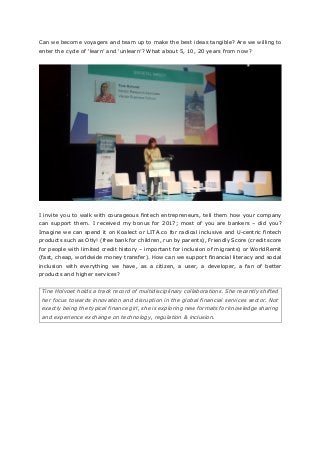
Tine Holvoet holds a track record of multidisciplinary collaborations. She recently shifted
her focus towards innovation and disruption in the global financial services sector. Not
exactly being the typical finance girl, she is exploring new formats for knowledge sharing
and experience exchange on technology, regulation & inclusion.