Fluid Power Symbols
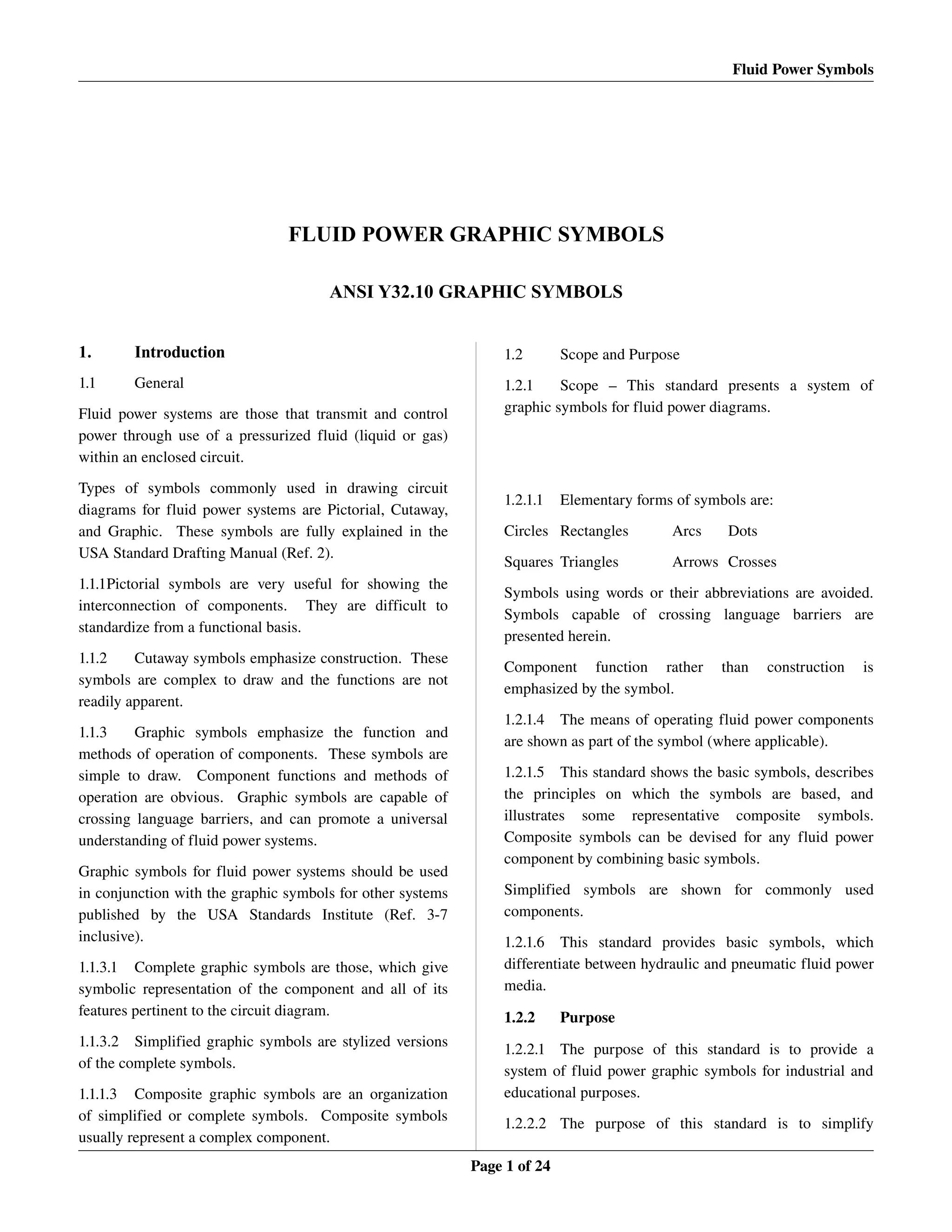
FLUID POWER GRAPHIC SYMBOLS
ANSI Y32.10 GRAPHIC SYMBOLS
1. Introduction
1.1 General
Fluid power systems are those that transmit and control 
power through use of a pressurized fluid (liquid or gas) 
within an enclosed circuit.
Types   of   symbols   commonly   used   in   drawing   circuit 
diagrams for fluid power systems are Pictorial, Cutaway, 
and Graphic.   These symbols are fully explained in the 
USA Standard Drafting Manual (Ref. 2).
1.1.1Pictorial   symbols  are   very   useful  for  showing   the 
interconnection   of   components.     They   are   difficult   to 
standardize from a functional basis.
1.1.2 Cutaway symbols emphasize construction.  These 
symbols are complex to draw and the functions are not 
readily apparent.
1.1.3 Graphic   symbols   emphasize   the   function   and 
methods of operation of components.  These symbols are 
simple to draw.   Component functions and methods of 
operation are obvious.   Graphic symbols are capable of 
crossing language barriers, and can promote a universal 
understanding of fluid power systems.
Graphic symbols for fluid power systems should be used 
in conjunction with the graphic symbols for other systems 
published   by   the   USA   Standards   Institute   (Ref.   3­7 
inclusive).
1.1.3.1 Complete graphic symbols are those, which give 
symbolic representation of the component and all of its 
features pertinent to the circuit diagram.
1.1.3.2 Simplified graphic symbols are stylized versions 
of the complete symbols.
1.1.1.3 Composite graphic symbols are an organization 
of simplified or complete symbols.   Composite symbols 
usually represent a complex component.
1.2 Scope and Purpose
1.2.1 Scope   –   This   standard   presents   a   system   of 
graphic symbols for fluid power diagrams.
1.2.1.1 Elementary forms of symbols are:
Circles Rectangles Arcs Dots
Squares Triangles Arrows Crosses
Symbols using words or their abbreviations are avoided. 
Symbols   capable   of   crossing   language   barriers   are 
presented herein.
Component   function   rather   than   construction   is 
emphasized by the symbol.
1.2.1.4 The means of operating fluid power components 
are shown as part of the symbol (where applicable).
1.2.1.5 This standard shows the basic symbols, describes 
the   principles   on   which   the   symbols   are   based,   and 
illustrates   some   representative   composite   symbols. 
Composite symbols can be devised for any fluid power 
component by combining basic symbols.
Simplified   symbols   are   shown   for   commonly   used 
components.
1.2.1.6 This   standard   provides   basic   symbols,   which 
differentiate between hydraulic and pneumatic fluid power 
media.
1.2.2 Purpose
1.2.2.1 The   purpose   of   this   standard   is   to   provide   a 
system of fluid power graphic symbols for industrial and 
educational purposes.
1.2.2.2 The   purpose   of   this   standard   is   to   simplify 
Page 1 of 24
Fluid Power Symbols
design, fabrication, analysis, and service of fluid power 
circuits.
1.2.2.3 The purpose of this standard is to provide fluid 
power   graphic   symbols,   which   are   internationally 
recognized.
1.2.2.4 The   purpose   of   this   standard   is   to   promote 
universal understanding of fluid power systems.
Page 2 of 24
Fluid Power Symbols
2. Symbol Rules
2.1 Symbols   show   connections,   flow   paths,   and 
functions of components represented.  They can indicate 
conditions occurring during transition from on flow path 
arrangement   to   another.     Symbols   do   not   indicate 
construction, nor do they indicate values, such as pressure, 
flow rate, and other component settings.
2.2 Symbols   do   not   indicate   locations   of   ports, 
direction of shifting spools, or positions of actuators on 
actual components.
2.3 Symbols   may   be   rotated   or   reversed   without 
altering their meaning except in the cases of: a.) Lines to 
Reservoir,   4.1.1;   b.)   Vented   Manifold,   4.1.2.3;   c.) 
Accumulator, 4.2.
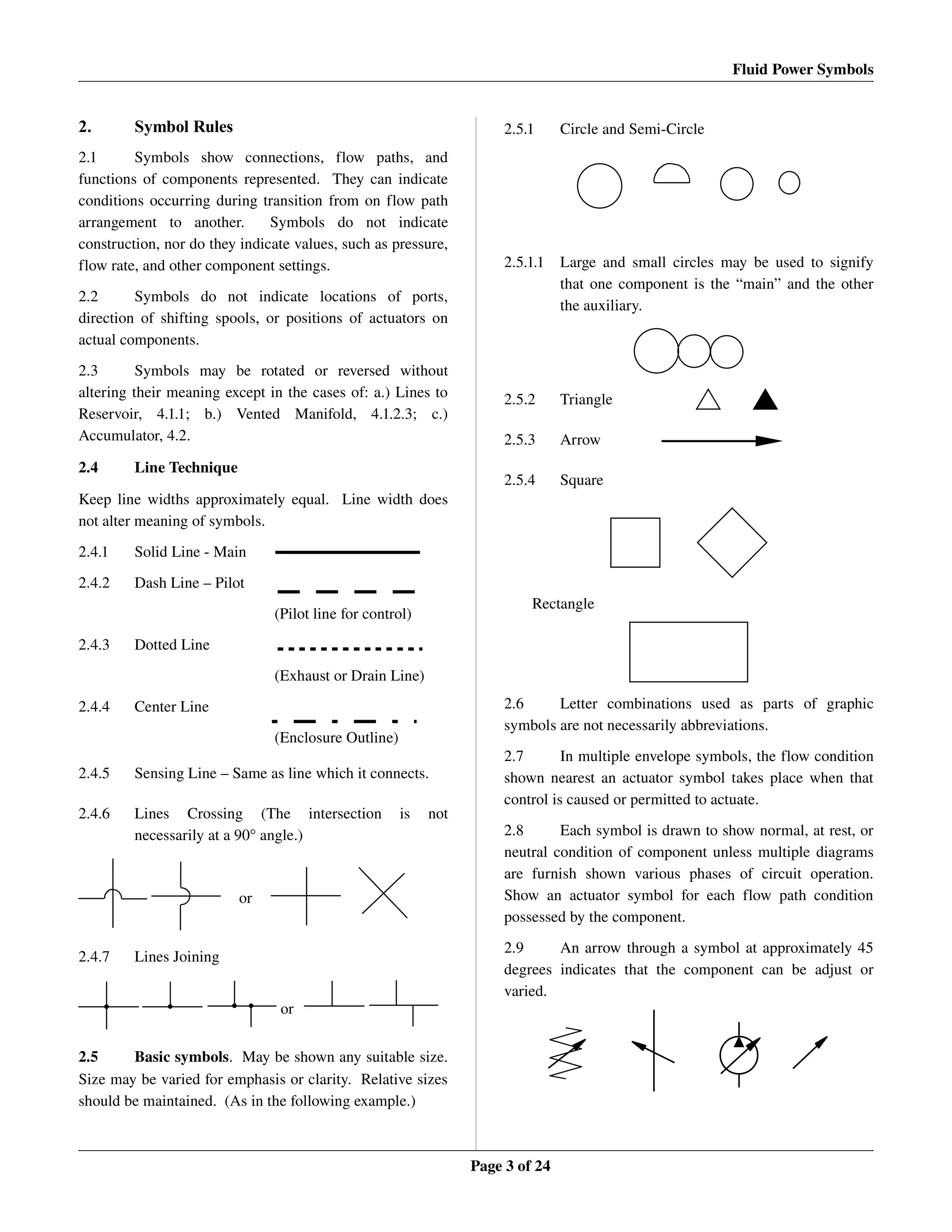
2.4 Line Technique
Keep line widths approximately equal.   Line width does 
not alter meaning of symbols.
2.4.1 Solid Line ­ Main
2.4.2 Dash Line – Pilot
(Pilot line for control)
2.4.3 Dotted Line
(Exhaust or Drain Line)
2.4.4 Center Line
(Enclosure Outline)
2.4.5 Sensing Line – Same as line which it connects.
2.4.6 Lines   Crossing   (The   intersection   is   not 
necessarily at a 90° angle.)
2.4.7 Lines Joining
2.5 Basic symbols.  May be shown any suitable size. 
Size may be varied for emphasis or clarity.  Relative sizes 
should be maintained.  (As in the following example.)
2.5.1 Circle and Semi­Circle
2.5.1.1 Large and small circles may be used to signify 
that one component is the “main” and the other 
the auxiliary.
2.5.2 Triangle
2.5.3 Arrow 
2.5.4 Square
Rectangle
2.6 Letter   combinations   used   as   parts   of   graphic 
symbols are not necessarily abbreviations.
2.7 In multiple envelope symbols, the flow condition 
shown nearest an actuator symbol takes place when that 
control is caused or permitted to actuate.
2.8 Each symbol is drawn to show normal, at rest, or 
neutral condition of component unless multiple diagrams 
are   furnish   shown  various   phases   of   circuit   operation. 
Show an actuator symbol for each flow path condition 
possessed by the component.
2.9 An arrow through a symbol at approximately 45 
degrees indicates that the component can be adjust or 
varied.
Page 3 of 24
or
or
Fluid Power Symbols
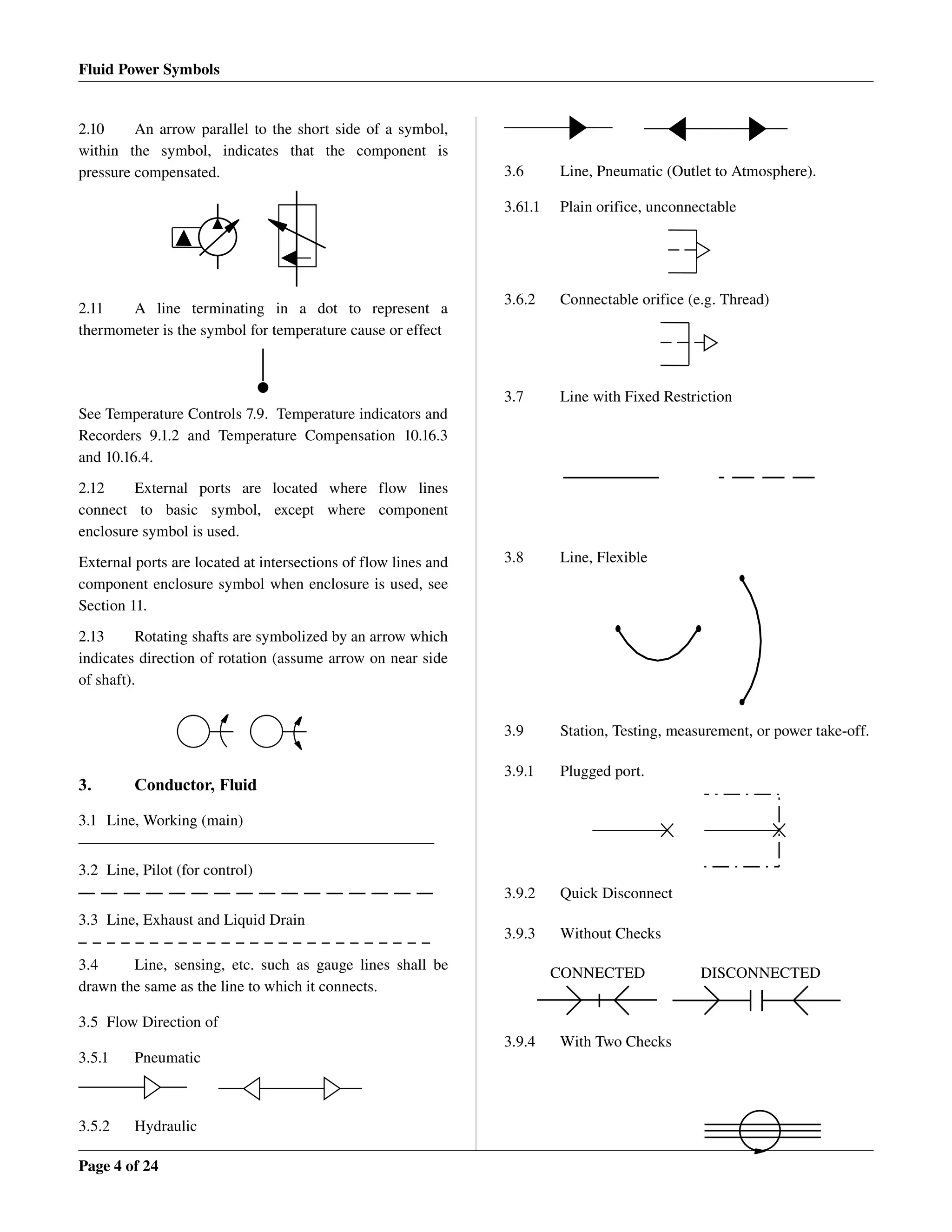
2.10 An arrow parallel to the short side of a symbol, 
within   the   symbol,   indicates   that   the   component   is 
pressure compensated.
2.11 A   line   terminating   in   a   dot   to   represent   a 
thermometer is the symbol for temperature cause or effect
See Temperature Controls 7.9.  Temperature indicators and 
Recorders 9.1.2 and Temperature Compensation 10.16.3 
and 10.16.4.
2.12 External   ports   are   located   where   flow   lines 
connect   to   basic   symbol,   except   where   component 
enclosure symbol is used.
External ports are located at intersections of flow lines and 
component enclosure symbol when enclosure is used, see 
Section 11.
2.13 Rotating shafts are symbolized by an arrow which 
indicates direction of rotation (assume arrow on near side 
of shaft).
3. Conductor, Fluid
3.1 Line, Working (main)
3.2 Line, Pilot (for control)
3.3 Line, Exhaust and Liquid Drain
3.4 Line, sensing, etc. such as gauge lines shall be 
drawn the same as the line to which it connects.
3.5 Flow Direction of
3.5.1 Pneumatic
3.5.2 Hydraulic
3.6 Line, Pneumatic (Outlet to Atmosphere).
3.61.1 Plain orifice, unconnectable
3.6.2 Connectable orifice (e.g. Thread)
3.7 Line with Fixed Restriction
3.8 Line, Flexible
3.9 Station, Testing, measurement, or power take­off.
3.9.1 Plugged port.
3.9.2 Quick Disconnect
3.9.3 Without Checks
3.9.4 With Two Checks
Page 4 of 24
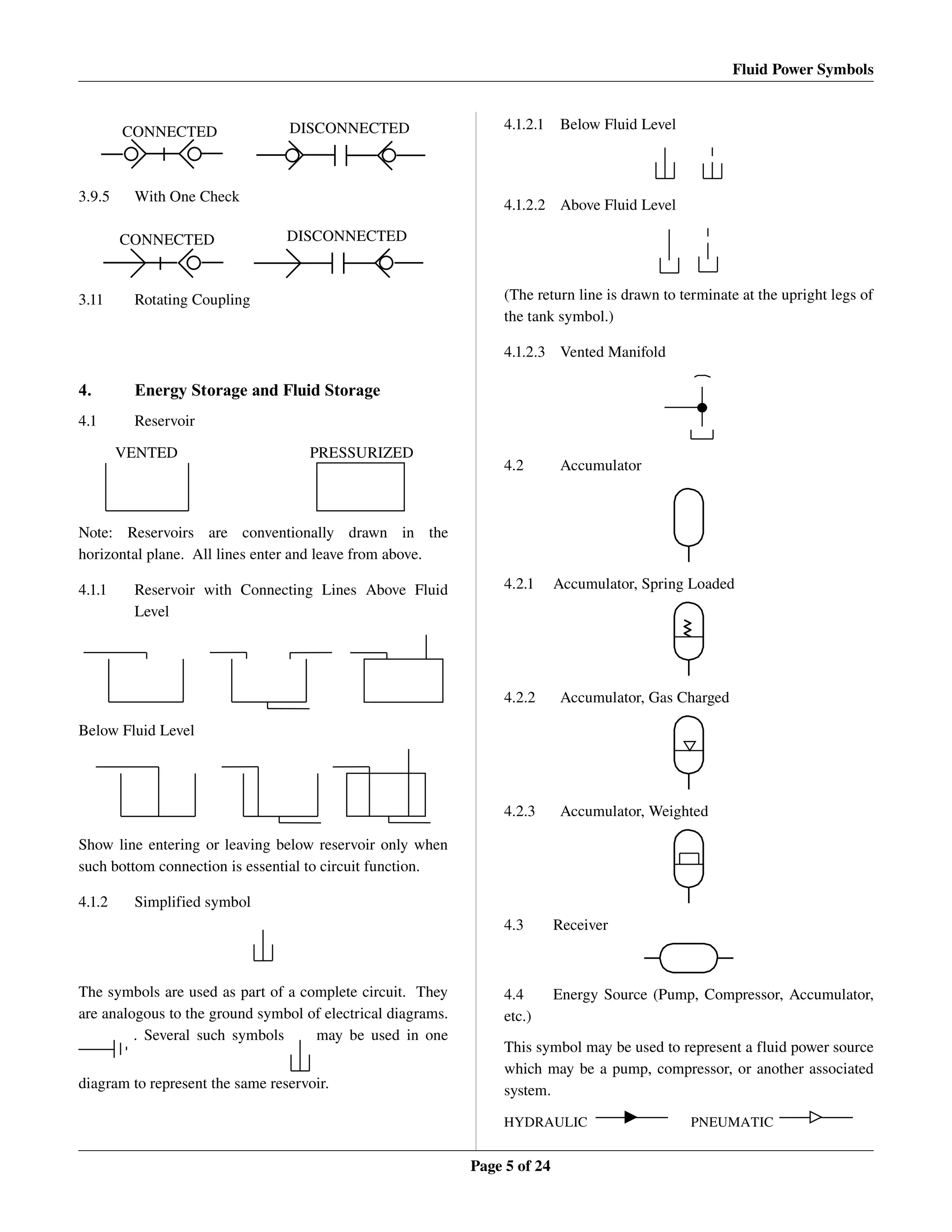
DISCONNECTEDCONNECTED
Fluid Power Symbols
3.9.5 With One Check
3.11 Rotating Coupling
4. Energy Storage and Fluid Storage
4.1 Reservoir
Note:   Reservoirs   are   conventionally   drawn   in   the 
horizontal plane.  All lines enter and leave from above.
4.1.1 Reservoir   with   Connecting   Lines   Above   Fluid 
Level
Below Fluid Level
Show line entering or leaving below reservoir only when 
such bottom connection is essential to circuit function.
4.1.2 Simplified symbol
The symbols are used as part of a complete circuit.  They 
are analogous to the ground symbol of electrical diagrams. 
  . Several such symbols     may be used in one 
diagram to represent the same reservoir.
4.1.2.1 Below Fluid Level
4.1.2.2 Above Fluid Level
(The return line is drawn to terminate at the upright legs of 
the tank symbol.)
4.1.2.3 Vented Manifold
4.2 Accumulator
4.2.1 Accumulator, Spring Loaded
4.2.2 Accumulator, Gas Charged
4.2.3 Accumulator, Weighted
4.3 Receiver
4.4 Energy Source (Pump, Compressor, Accumulator, 
etc.)
This symbol may be used to represent a fluid power source 
which may be a pump, compressor, or another associated 
system.
Page 5 of 24
CONNECTED DISCONNECTED
VENTED PRESSURIZED
PNEUMATICHYDRAULIC
Fluid Power Symbols
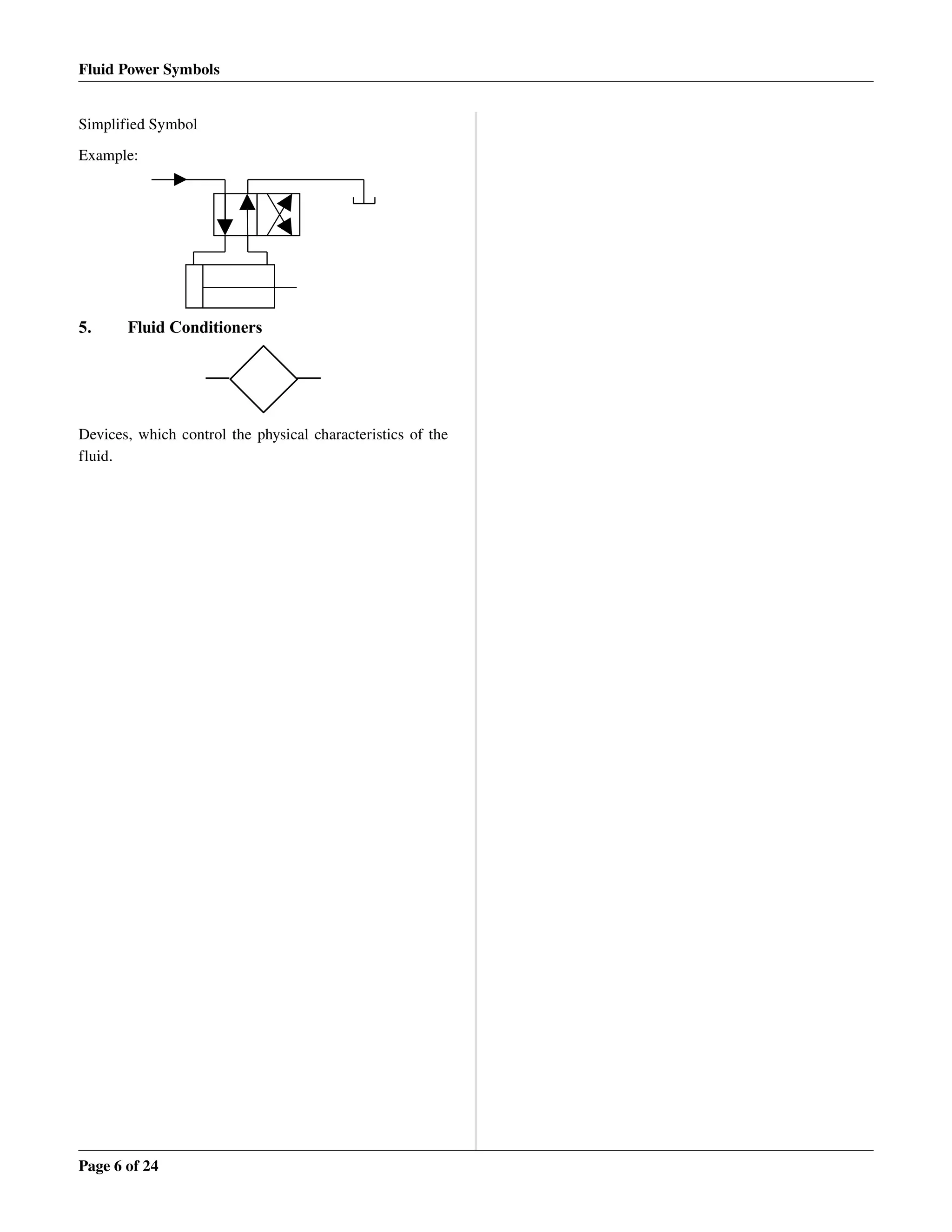
Simplified Symbol
Example:
5. Fluid Conditioners
Devices, which control the physical characteristics of the 
fluid.
Page 6 of 24
Fluid Power Symbols
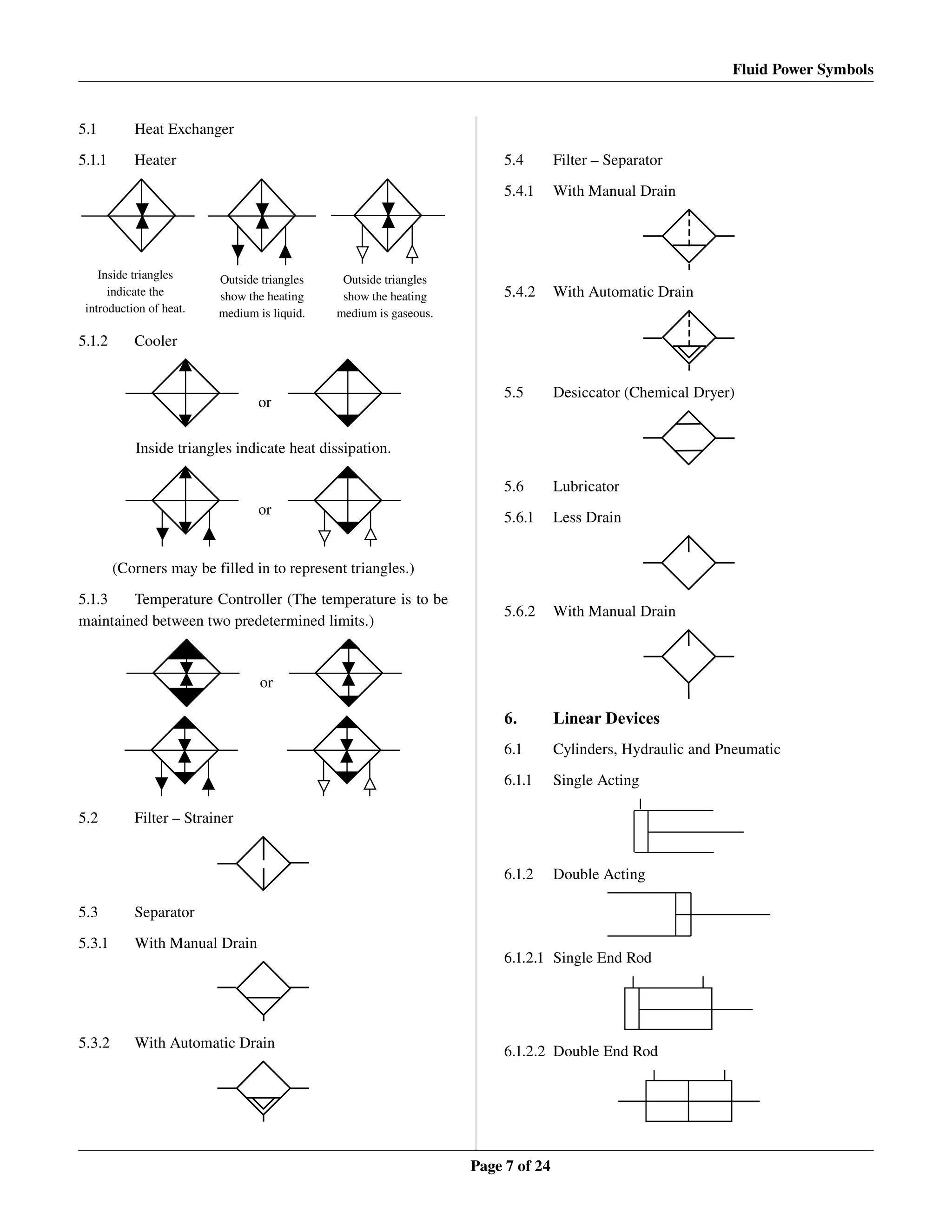
5.1 Heat Exchanger
5.1.1 Heater
5.1.2 Cooler
Inside triangles indicate heat dissipation.
(Corners may be filled in to represent triangles.)
5.1.3 Temperature Controller (The temperature is to be 
maintained between two predetermined limits.)
5.2 Filter – Strainer
5.3 Separator
5.3.1 With Manual Drain
5.3.2 With Automatic Drain
5.4 Filter – Separator
5.4.1 With Manual Drain
5.4.2 With Automatic Drain
5.5 Desiccator (Chemical Dryer)
5.6 Lubricator
5.6.1 Less Drain
5.6.2 With Manual Drain
6. Linear Devices
6.1 Cylinders, Hydraulic and Pneumatic
6.1.1 Single Acting
6.1.2 Double Acting
6.1.2.1 Single End Rod
6.1.2.2 Double End Rod
Page 7 of 24
Inside triangles 
indicate the 
introduction of heat.
Outside triangles 
show the heating 
medium is liquid.
Outside triangles 
show the heating 
medium is gaseous.
or
or
or
Fluid Power Symbols
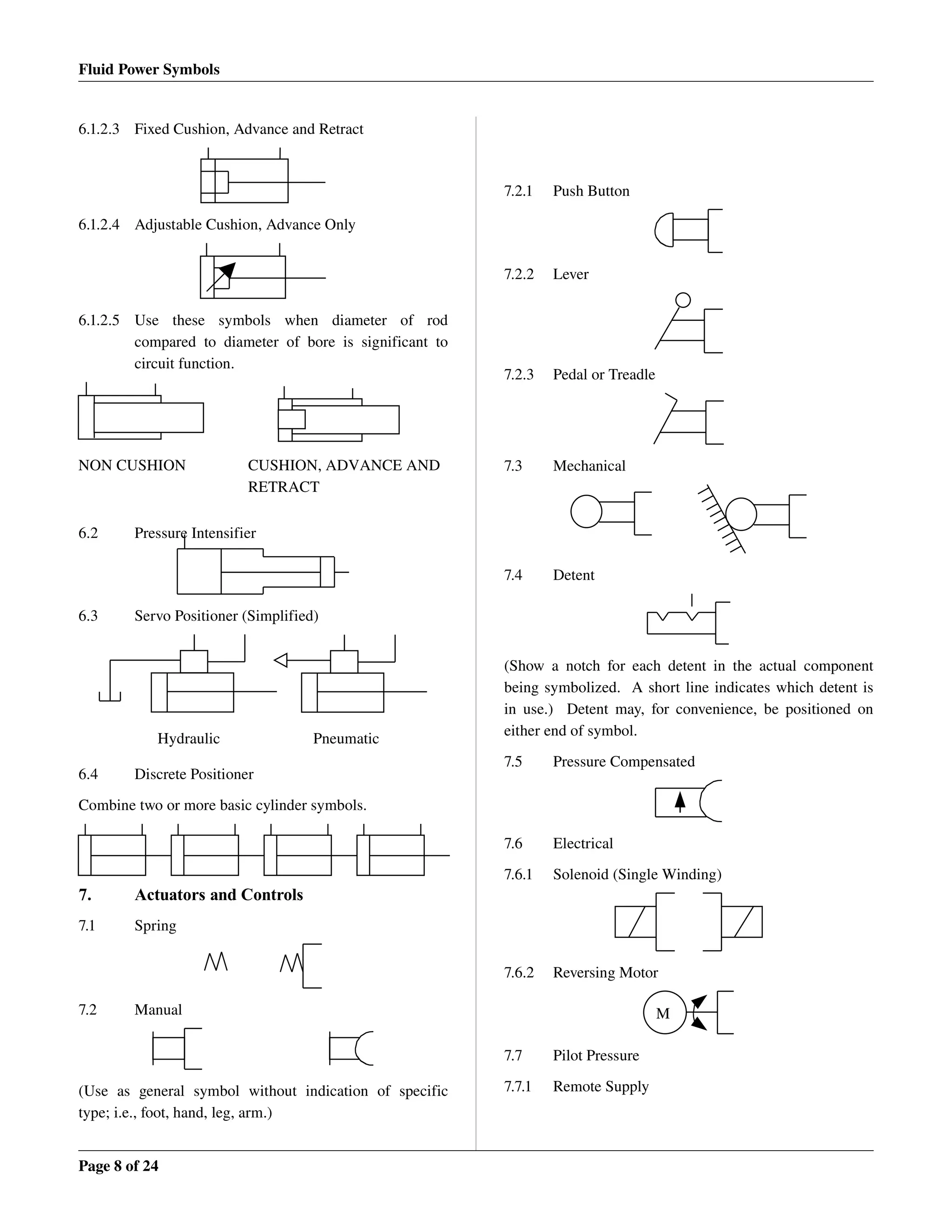
6.1.2.3 Fixed Cushion, Advance and Retract
6.1.2.4 Adjustable Cushion, Advance Only
6.1.2.5 Use   these   symbols   when   diameter   of   rod 
compared to diameter of bore is significant to 
circuit function.
6.2 Pressure Intensifier
6.3 Servo Positioner (Simplified)
6.4 Discrete Positioner
Combine two or more basic cylinder symbols.
7. Actuators and Controls
7.1 Spring
7.2 Manual
(Use   as   general   symbol   without   indication   of   specific 
type; i.e., foot, hand, leg, arm.)
7.2.1 Push Button
7.2.2 Lever
7.2.3 Pedal or Treadle
7.3 Mechanical
7.4 Detent
(Show a notch for each detent in the actual component 
being symbolized.  A short line indicates which detent is 
in use.)   Detent may, for convenience, be positioned on 
either end of symbol.
7.5 Pressure Compensated
7.6 Electrical
7.6.1 Solenoid (Single Winding)
7.6.2 Reversing Motor
7.7 Pilot Pressure
7.7.1 Remote Supply
Page 8 of 24
NON CUSHION CUSHION, ADVANCE AND 
RETRACT
PneumaticHydraulic
M
Fluid Power Symbols
Page 9 of 24
Fluid Power Symbols
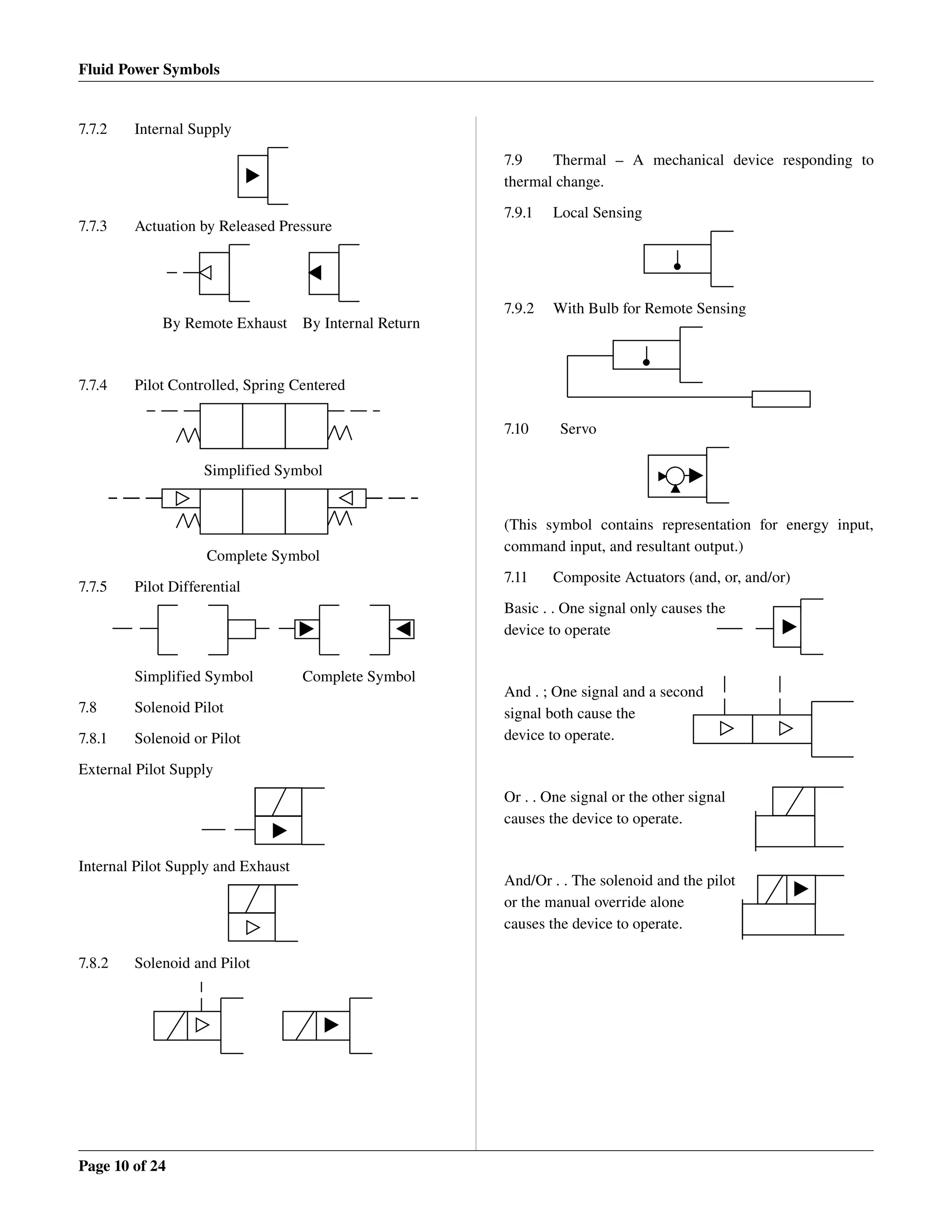
7.7.2 Internal Supply
7.7.3 Actuation by Released Pressure
By Remote Exhaust By Internal Return
7.7.4 Pilot Controlled, Spring Centered
Simplified Symbol
Complete Symbol
7.7.5 Pilot Differential
Simplified Symbol Complete Symbol
7.8 Solenoid Pilot
7.8.1 Solenoid or Pilot
External Pilot Supply
Internal Pilot Supply and Exhaust
7.8.2 Solenoid and Pilot
7.9  Thermal   –   A   mechanical   device   responding   to 
thermal change.
7.9.1 Local Sensing
7.9.2 With Bulb for Remote Sensing
7.10 Servo
(This   symbol   contains   representation   for   energy   input, 
command input, and resultant output.)
7.11 Composite Actuators (and, or, and/or)
Basic . . One signal only causes the 
device to operate
And . ; One signal and a second 
signal both cause the 
device to operate.
Or . . One signal or the other signal 
causes the device to operate.
And/Or . . The solenoid and the pilot 
or the manual override alone 
causes the device to operate.
Page 10 of 24
Fluid Power Symbols
Page 11 of 24
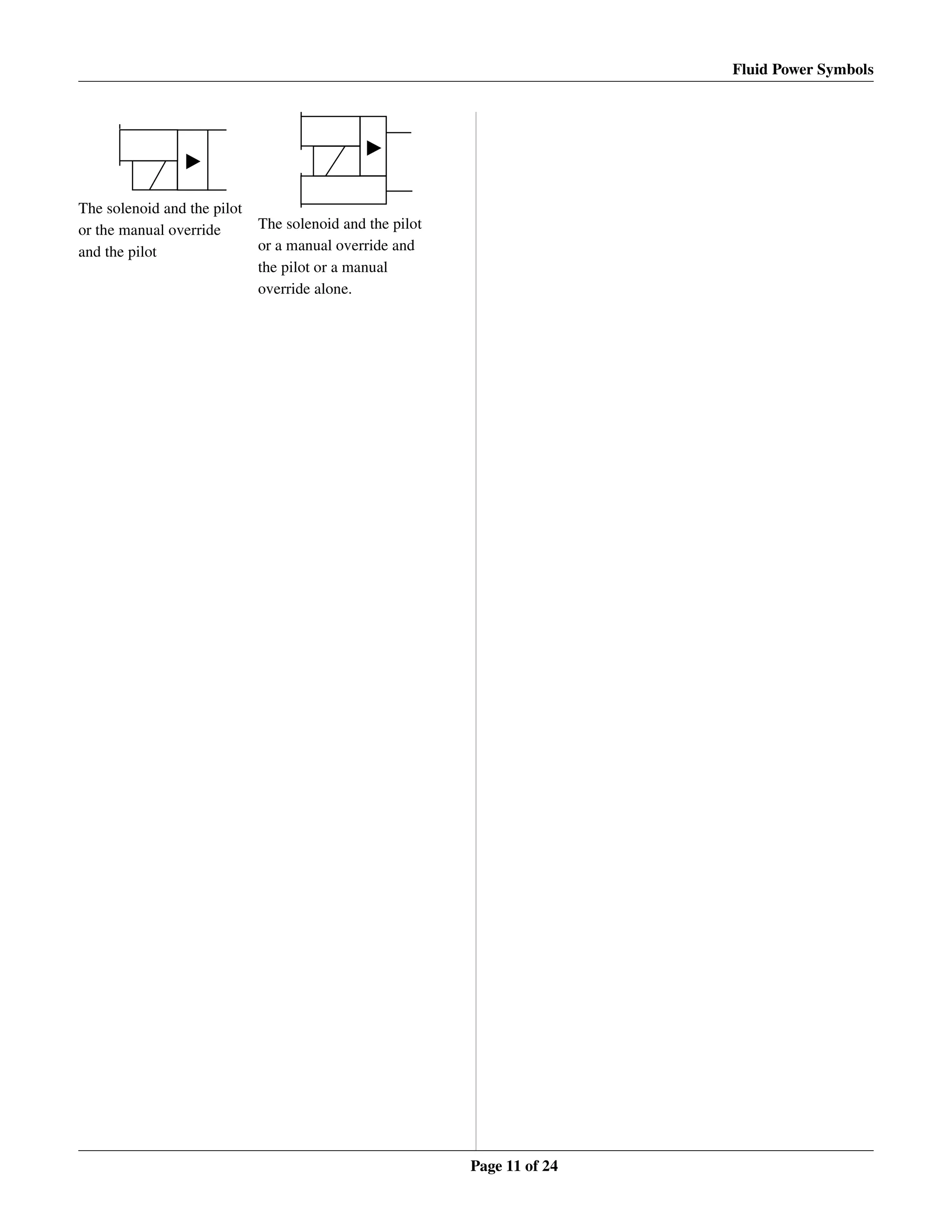
The solenoid and the pilot 
or the manual override 
and the pilot
The solenoid and the pilot 
or a manual override and 
the pilot or a manual 
override alone.
Fluid Power Symbols
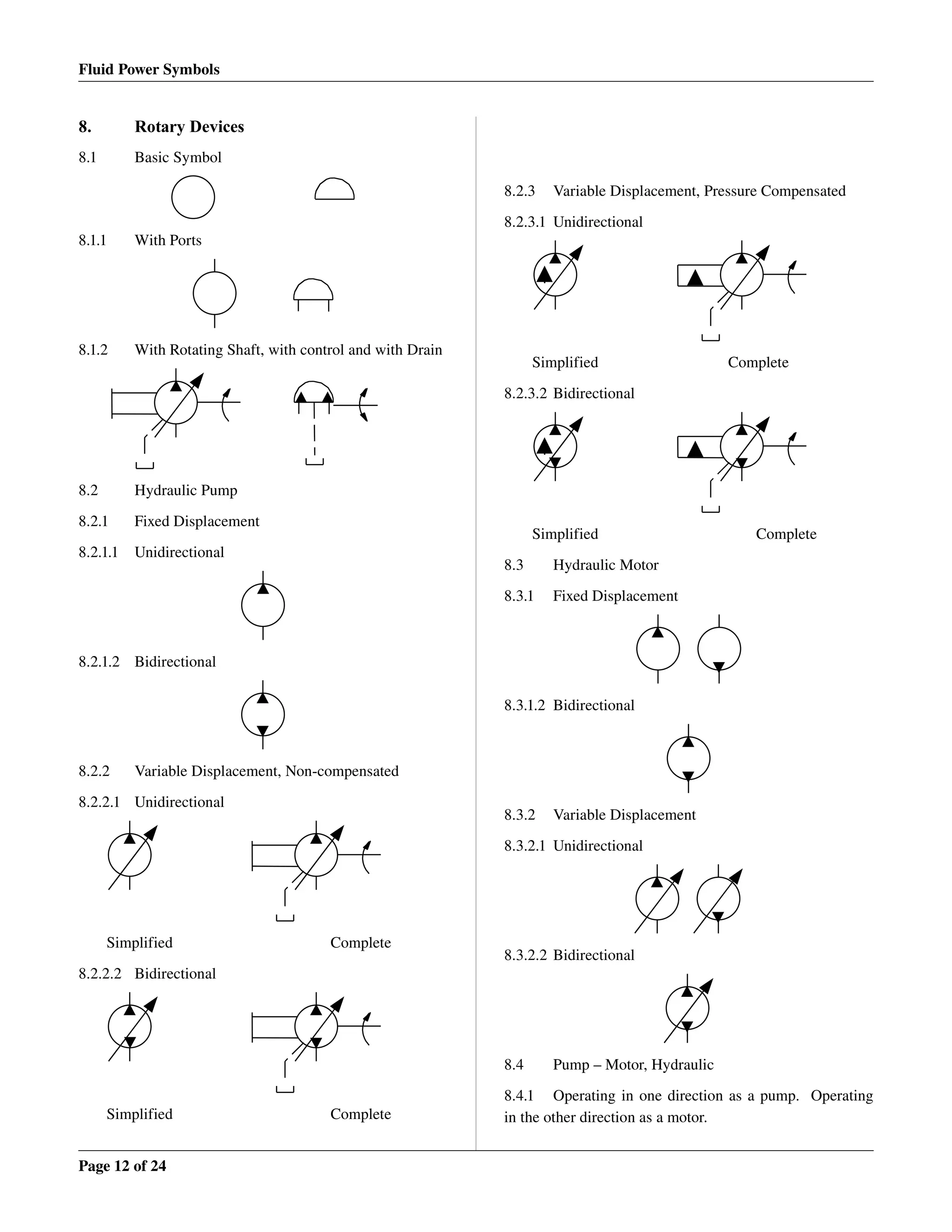
8. Rotary Devices
8.1 Basic Symbol
8.1.1 With Ports
8.1.2 With Rotating Shaft, with control and with Drain
8.2 Hydraulic Pump
8.2.1 Fixed Displacement
8.2.1.1 Unidirectional
8.2.1.2 Bidirectional
8.2.2 Variable Displacement, Non­compensated
8.2.2.1 Unidirectional
Simplified Complete
8.2.2.2 Bidirectional
Simplified Complete
8.2.3 Variable Displacement, Pressure Compensated
8.2.3.1 Unidirectional
Simplified Complete
8.2.3.2 Bidirectional
Simplified Complete
8.3 Hydraulic Motor
8.3.1 Fixed Displacement
8.3.1.2 Bidirectional
8.3.2 Variable Displacement
8.3.2.1 Unidirectional
8.3.2.2 Bidirectional
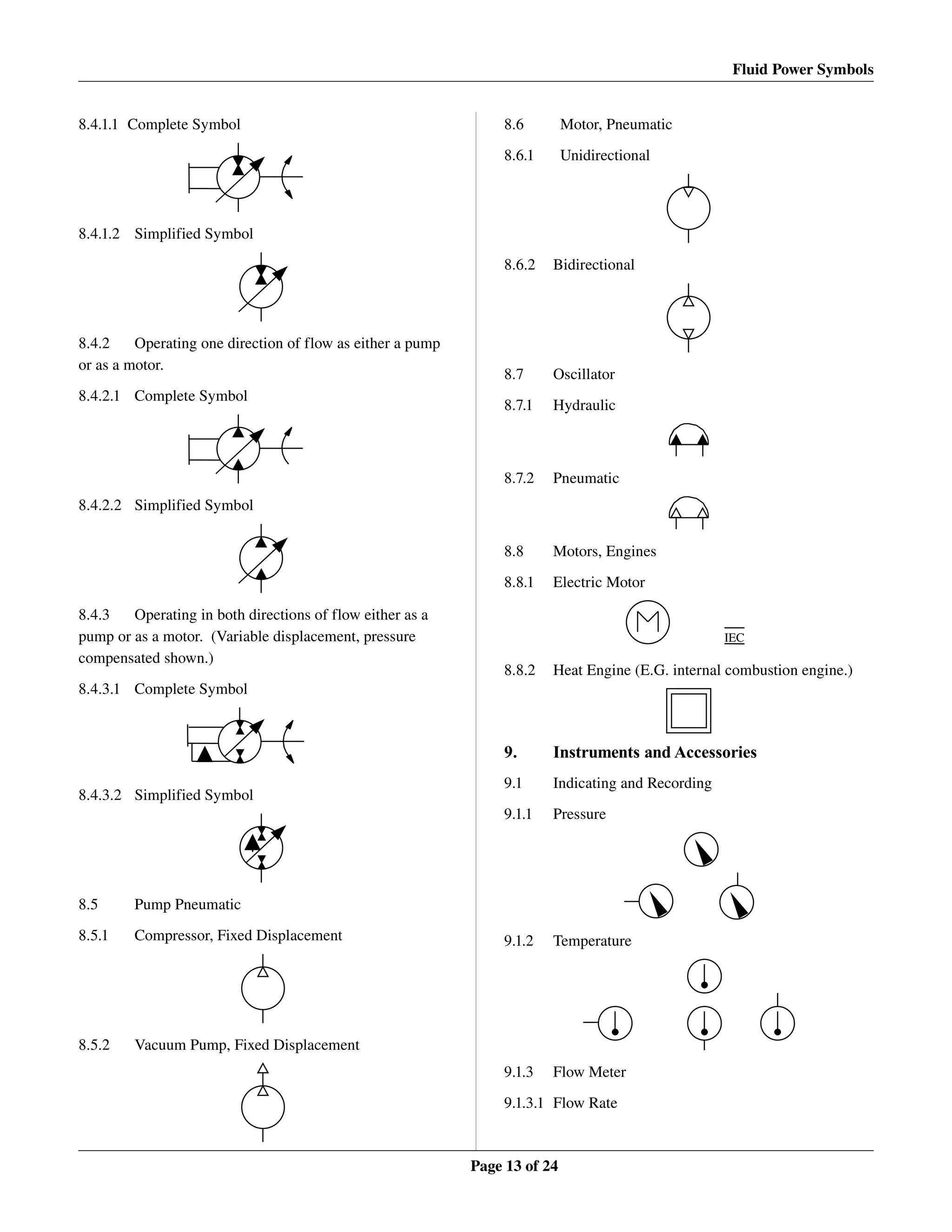
8.4 Pump – Motor, Hydraulic
8.4.1 Operating in one direction as a pump.  Operating 
in the other direction as a motor.
Page 12 of 24
Fluid Power Symbols
8.4.1.1 Complete Symbol
8.4.1.2 Simplified Symbol
8.4.2 Operating one direction of flow as either a pump 
or as a motor.
8.4.2.1 Complete Symbol
8.4.2.2 Simplified Symbol
8.4.3 Operating in both directions of flow either as a 
pump or as a motor.  (Variable displacement, pressure 
compensated shown.)
8.4.3.1 Complete Symbol
8.4.3.2 Simplified Symbol
8.5 Pump Pneumatic
8.5.1 Compressor, Fixed Displacement
8.5.2 Vacuum Pump, Fixed Displacement
8.6 Motor, Pneumatic
8.6.1 Unidirectional
8.6.2 Bidirectional
8.7 Oscillator
8.7.1 Hydraulic
8.7.2 Pneumatic
8.8 Motors, Engines
8.8.1 Electric Motor
8.8.2 Heat Engine (E.G. internal combustion engine.)
9. Instruments and Accessories
9.1 Indicating and Recording
9.1.1 Pressure
9.1.2 Temperature
9.1.3 Flow Meter
9.1.3.1 Flow Rate
Page 13 of 24
IEC
Fluid Power Symbols
9.1.3.2 Totalizing
Page 14 of 24
Fluid Power Symbols
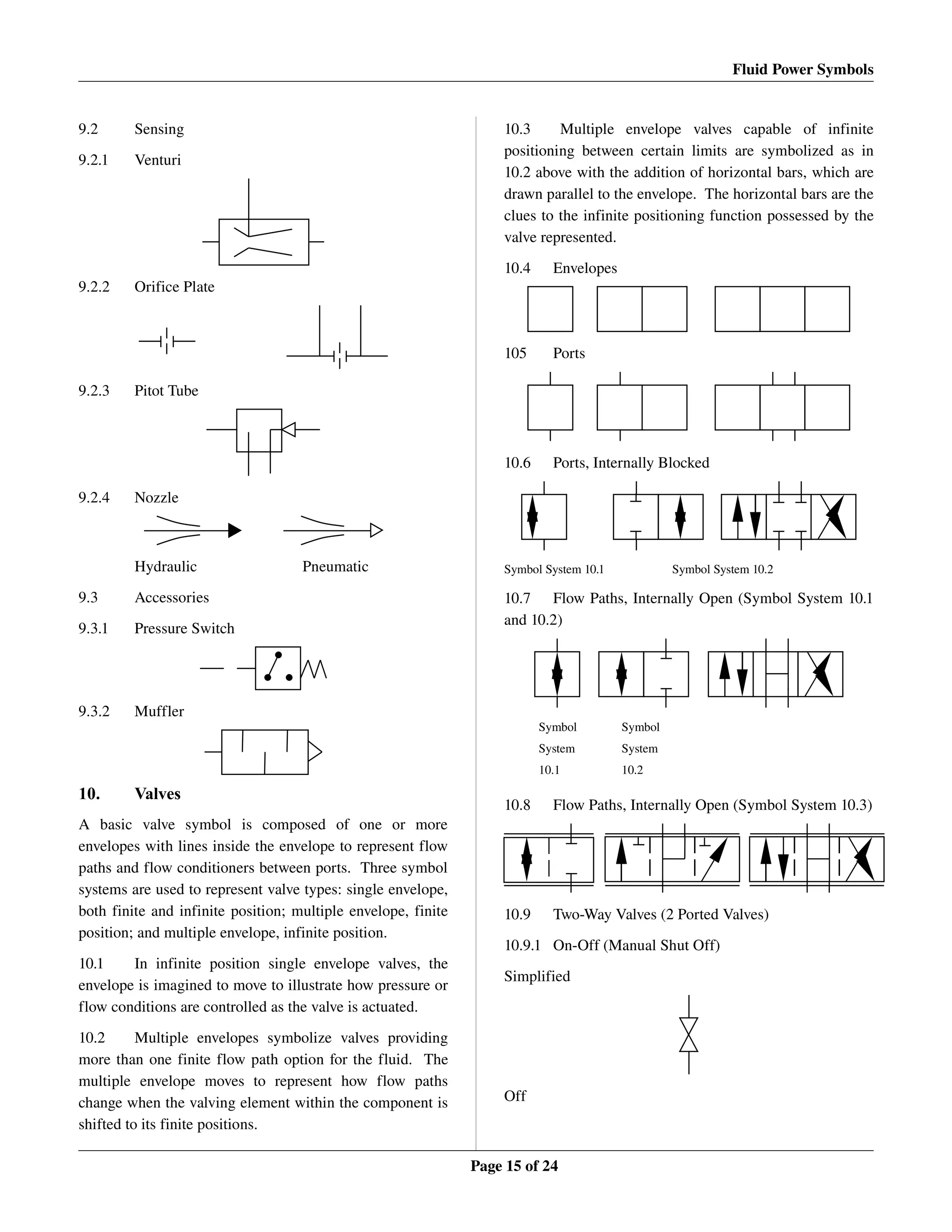
9.2 Sensing
9.2.1 Venturi
9.2.2 Orifice Plate
9.2.3 Pitot Tube
9.2.4 Nozzle
Hydraulic Pneumatic
9.3 Accessories
9.3.1 Pressure Switch
9.3.2 Muffler
10. Valves
A   basic   valve   symbol   is   composed   of   one   or   more 
envelopes with lines inside the envelope to represent flow 
paths and flow conditioners between ports.  Three symbol 
systems are used to represent valve types: single envelope, 
both finite and infinite position; multiple envelope, finite 
position; and multiple envelope, infinite position.
10.1 In infinite position  single envelope valves, the 
envelope is imagined to move to illustrate how pressure or 
flow conditions are controlled as the valve is actuated.
10.2 Multiple envelopes  symbolize   valves  providing 
more than one finite flow path option for the fluid.  The 
multiple   envelope   moves   to   represent   how   flow   paths 
change when the valving element within the component is 
shifted to its finite positions.
10.3 Multiple   envelope   valves   capable   of   infinite 
positioning between certain limits are symbolized as in 
10.2 above with the addition of horizontal bars, which are 
drawn parallel to the envelope.  The horizontal bars are the 
clues to the infinite positioning function possessed by the 
valve represented.
10.4 Envelopes
105 Ports
10.6 Ports, Internally Blocked
Symbol System 10.1 Symbol System 10.2
10.7 Flow Paths, Internally Open (Symbol System 10.1 
and 10.2)
10.8 Flow Paths, Internally Open (Symbol System 10.3)
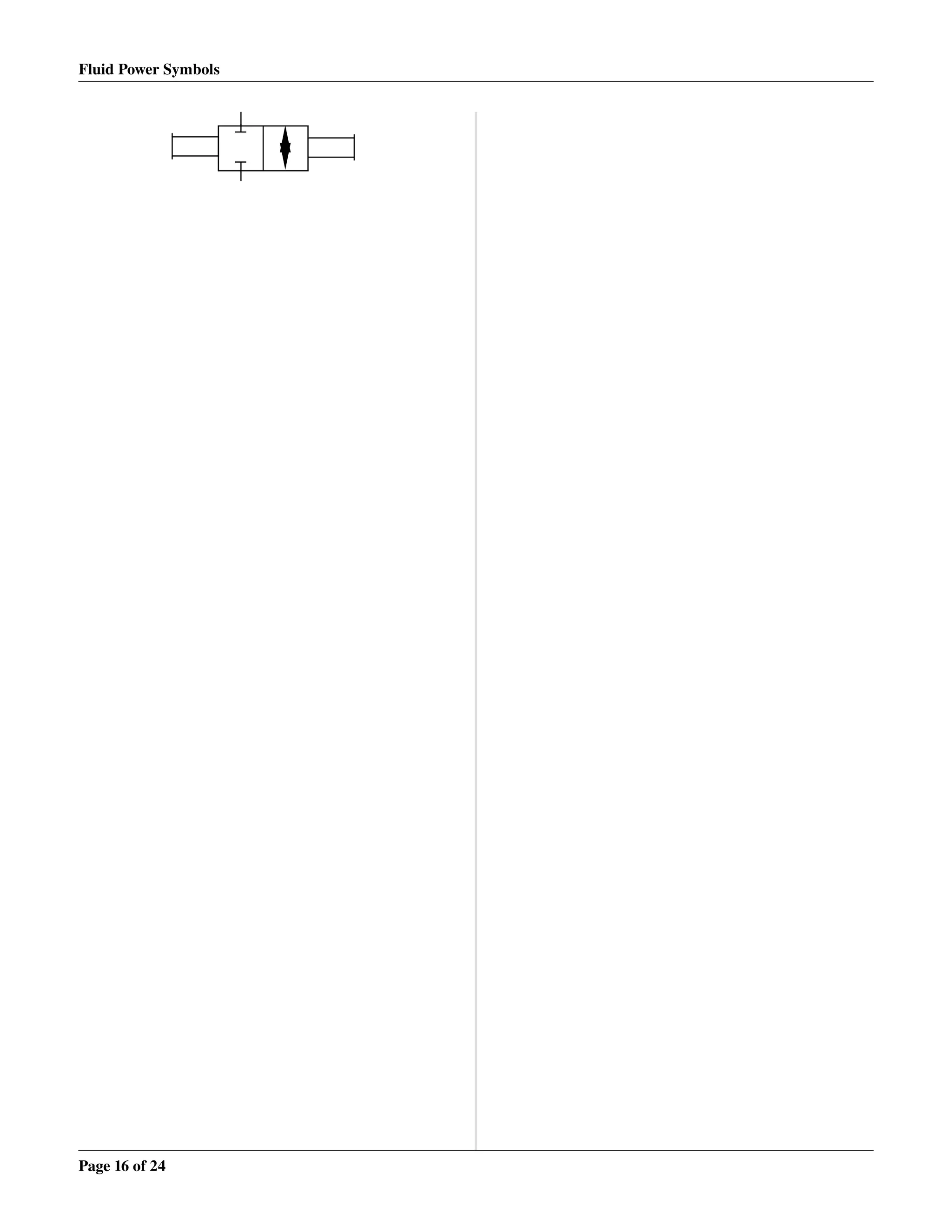
10.9 Two­Way Valves (2 Ported Valves)
10.9.1 On­Off (Manual Shut Off)
Simplified
Off
Page 15 of 24
Symbol
System
10.2
Symbol
System
10.1
Fluid Power Symbols
Page 16 of 24
Fluid Power Symbols
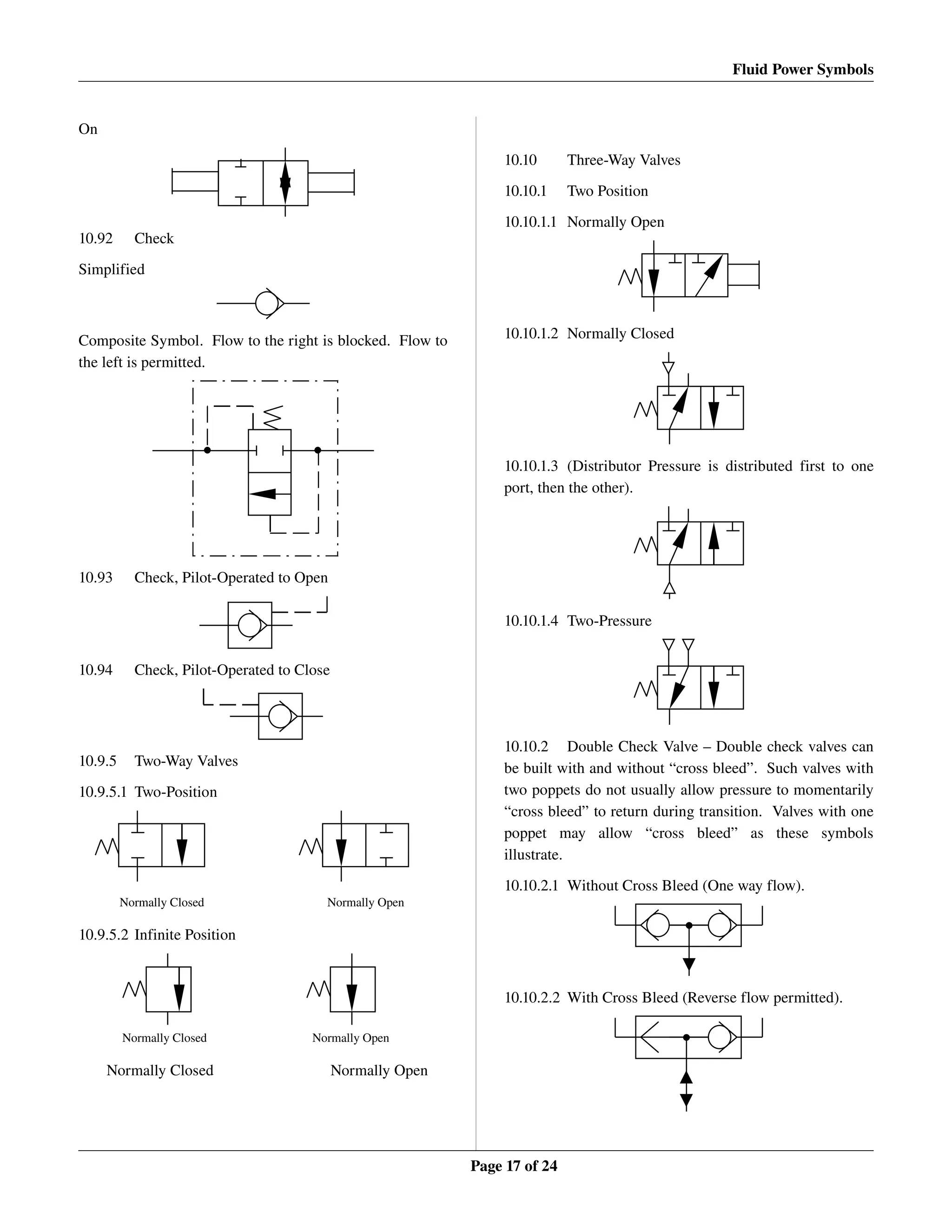
On
10.92 Check
Simplified
Composite Symbol.  Flow to the right is blocked.  Flow to 
the left is permitted. 
10.93 Check, Pilot­Operated to Open
10.94 Check, Pilot­Operated to Close
10.9.5 Two­Way Valves
10.9.5.1 Two­Position
10.9.5.2 Infinite Position
Normally Closed Normally Open
10.10 Three­Way Valves
10.10.1 Two Position
10.10.1.1 Normally Open
10.10.1.2 Normally Closed
10.10.1.3 (Distributor Pressure is distributed first to one 
port, then the other).
10.10.1.4 Two­Pressure
10.10.2 Double Check Valve – Double check valves can 
be built with and without “cross bleed”.  Such valves with 
two poppets do not usually allow pressure to momentarily 
“cross bleed” to return during transition.  Valves with one 
poppet   may   allow   “cross   bleed”   as   these   symbols 
illustrate.
10.10.2.1 Without Cross Bleed (One way flow).
10.10.2.2 With Cross Bleed (Reverse flow permitted).
Page 17 of 24
Normally Closed Normally Open
Fluid Power Symbols
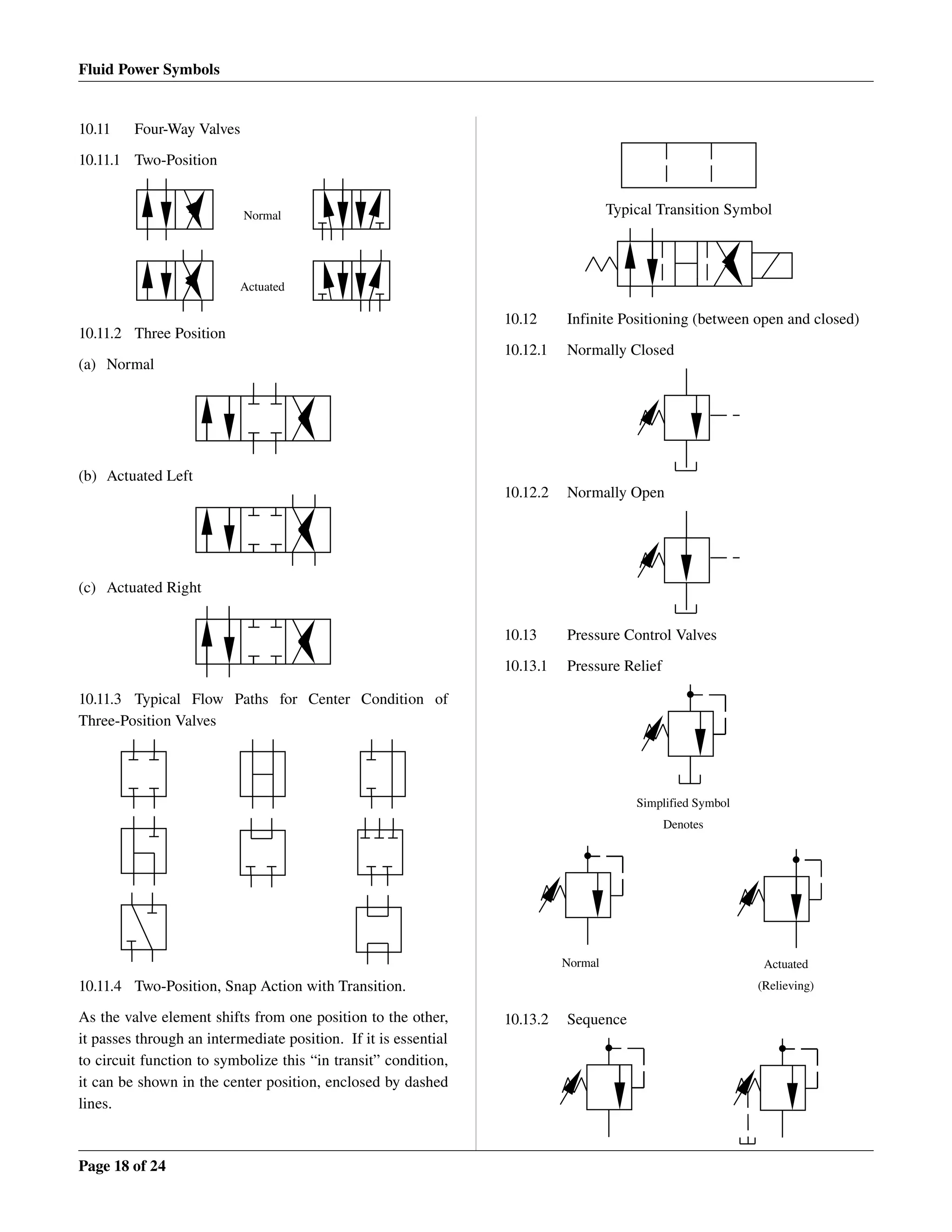
10.11 Four­Way Valves
10.11.1 Two­Position
10.11.2 Three Position
(a) Normal
(b) Actuated Left
(c) Actuated Right
10.11.3 Typical   Flow   Paths   for   Center   Condition   of 
Three­Position Valves
10.11.4 Two­Position, Snap Action with Transition.
As the valve element shifts from one position to the other, 
it passes through an intermediate position.  If it is essential 
to circuit function to symbolize this “in transit” condition, 
it can be shown in the center position, enclosed by dashed 
lines.
Typical Transition Symbol
10.12 Infinite Positioning (between open and closed)
10.12.1 Normally Closed
10.12.2 Normally Open
10.13 Pressure Control Valves
10.13.1 Pressure Relief
10.13.2 Sequence
Page 18 of 24
Normal
Actuated
Simplified Symbol
Denotes
Normal Actuated
(Relieving)
Fluid Power Symbols
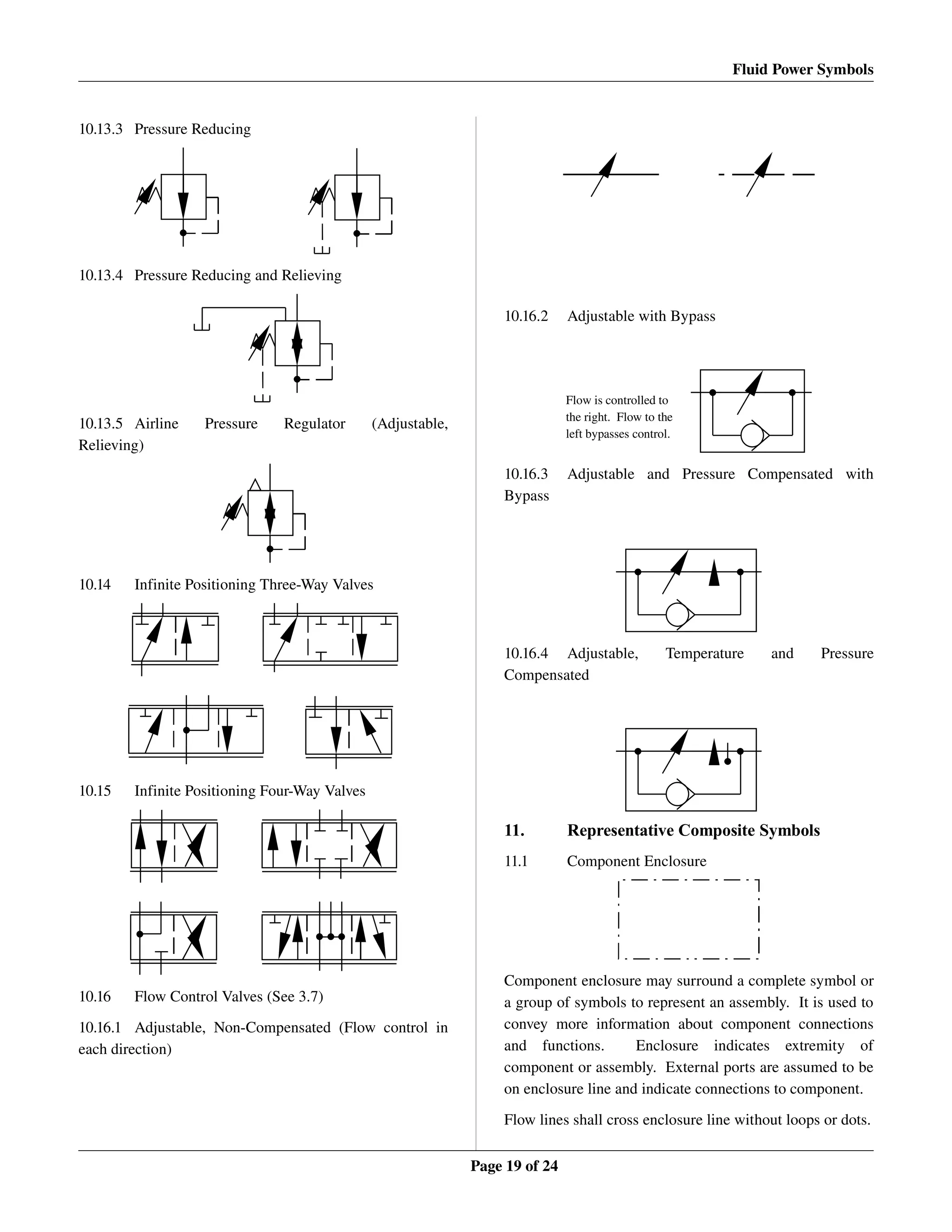
10.13.3 Pressure Reducing
10.13.4 Pressure Reducing and Relieving
10.13.5 Airline   Pressure   Regulator   (Adjustable, 
Relieving)
10.14 Infinite Positioning Three­Way Valves
10.15 Infinite Positioning Four­Way Valves
10.16 Flow Control Valves (See 3.7)
10.16.1 Adjustable, Non­Compensated (Flow control in 
each direction)
10.16.2 Adjustable with Bypass
10.16.3 Adjustable   and   Pressure   Compensated   with 
Bypass
10.16.4 Adjustable,   Temperature   and   Pressure 
Compensated
11. Representative Composite Symbols
11.1 Component Enclosure
Component enclosure may surround a complete symbol or 
a group of symbols to represent an assembly.  It is used to 
convey more information about component connections 
and   functions.     Enclosure   indicates   extremity   of 
component or assembly.  External ports are assumed to be 
on enclosure line and indicate connections to component.
Flow lines shall cross enclosure line without loops or dots.
Page 19 of 24
Flow is controlled to 
the right.  Flow to the 
left bypasses control.
Fluid Power Symbols
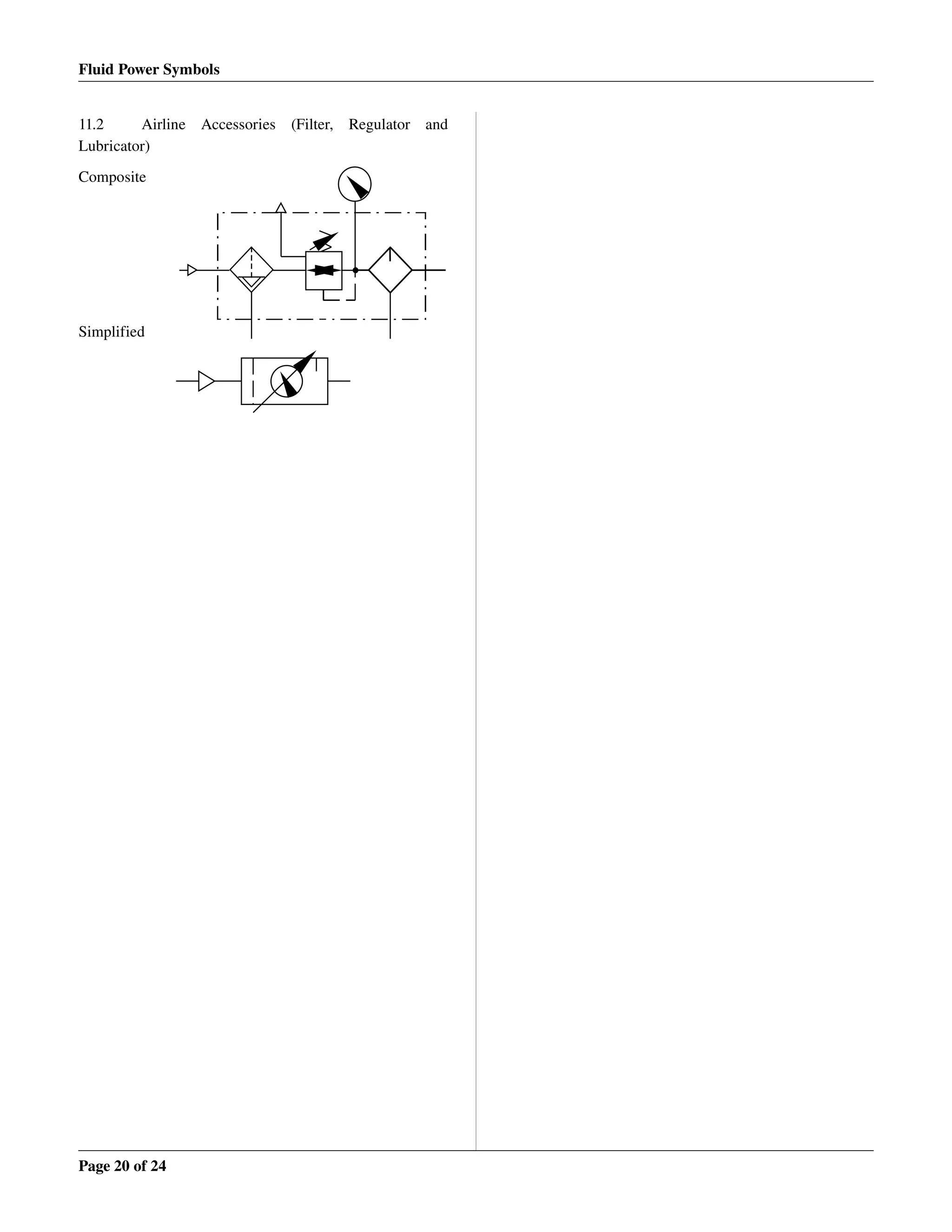
11.2 Airline   Accessories   (Filter,   Regulator   and 
Lubricator)
Composite
Simplified
Page 20 of 24
Fluid Power Symbols
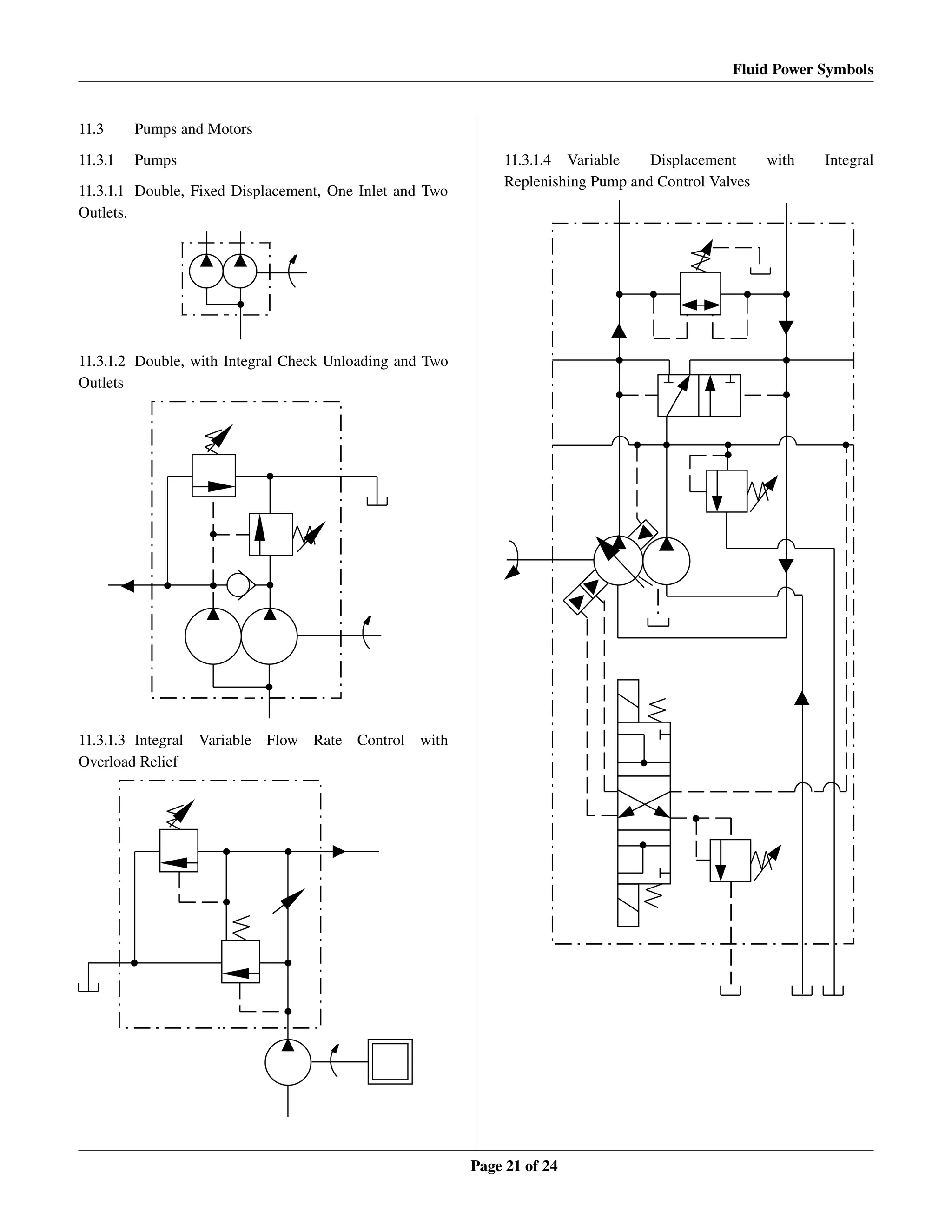
11.3 Pumps and Motors
11.3.1 Pumps
11.3.1.1 Double, Fixed Displacement, One Inlet and Two 
Outlets.
11.3.1.2 Double, with Integral Check Unloading and Two 
Outlets
11.3.1.3 Integral   Variable   Flow   Rate   Control   with 
Overload Relief
11.3.1.4 Variable   Displacement   with   Integral 
Replenishing Pump and Control Valves
Page 21 of 24
Fluid Power Symbols
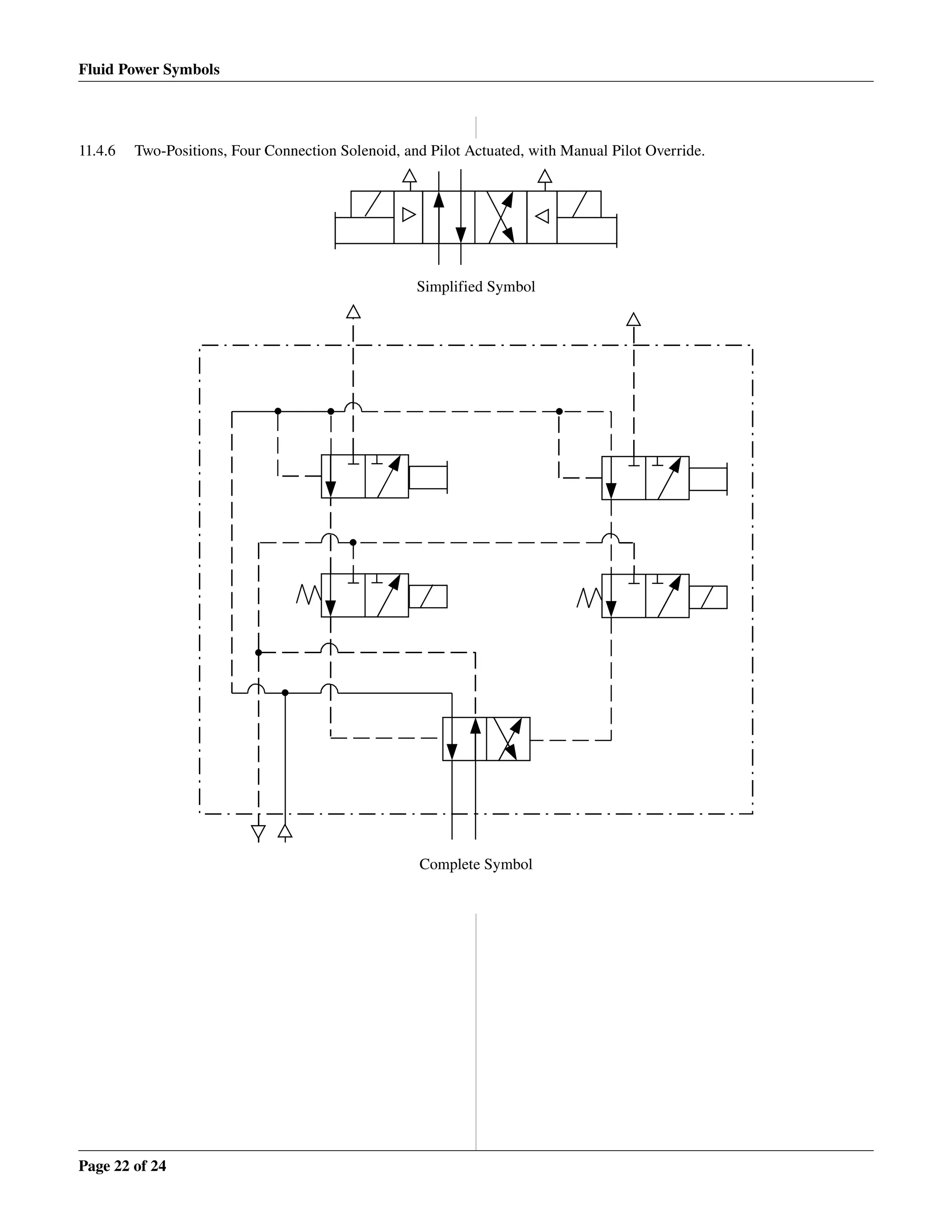
11.4.6 Two­Positions, Four Connection Solenoid, and Pilot Actuated, with Manual Pilot Override.
Simplified Symbol
Complete Symbol
Page 22 of 24
Fluid Power Symbols
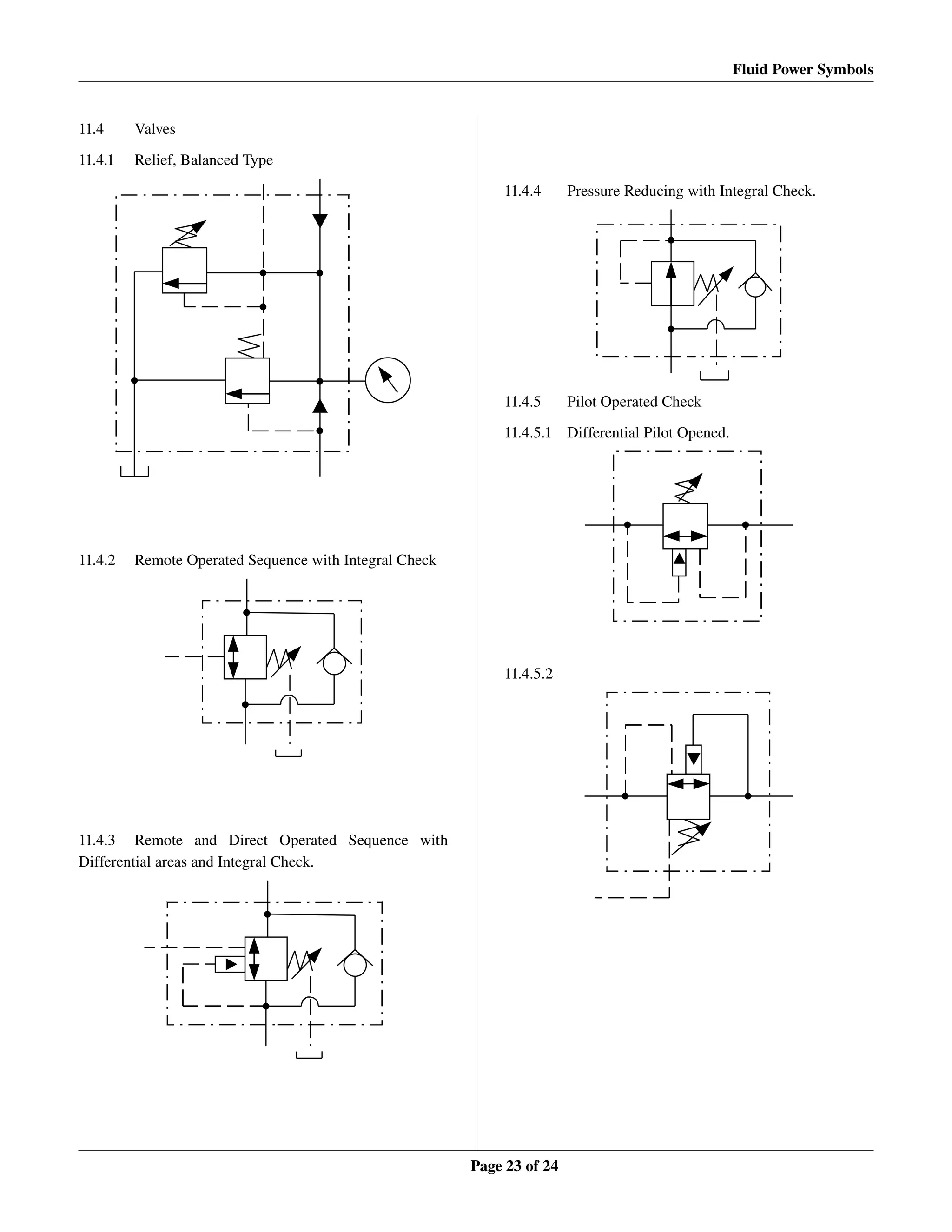
11.4 Valves
11.4.1 Relief, Balanced Type
11.4.2 Remote Operated Sequence with Integral Check
11.4.3 Remote   and   Direct   Operated   Sequence   with 
Differential areas and Integral Check.
11.4.4 Pressure Reducing with Integral Check.
11.4.5 Pilot Operated Check
11.4.5.1 Differential Pilot Opened.
11.4.5.2
Page 23 of 24
Fluid Power Symbols
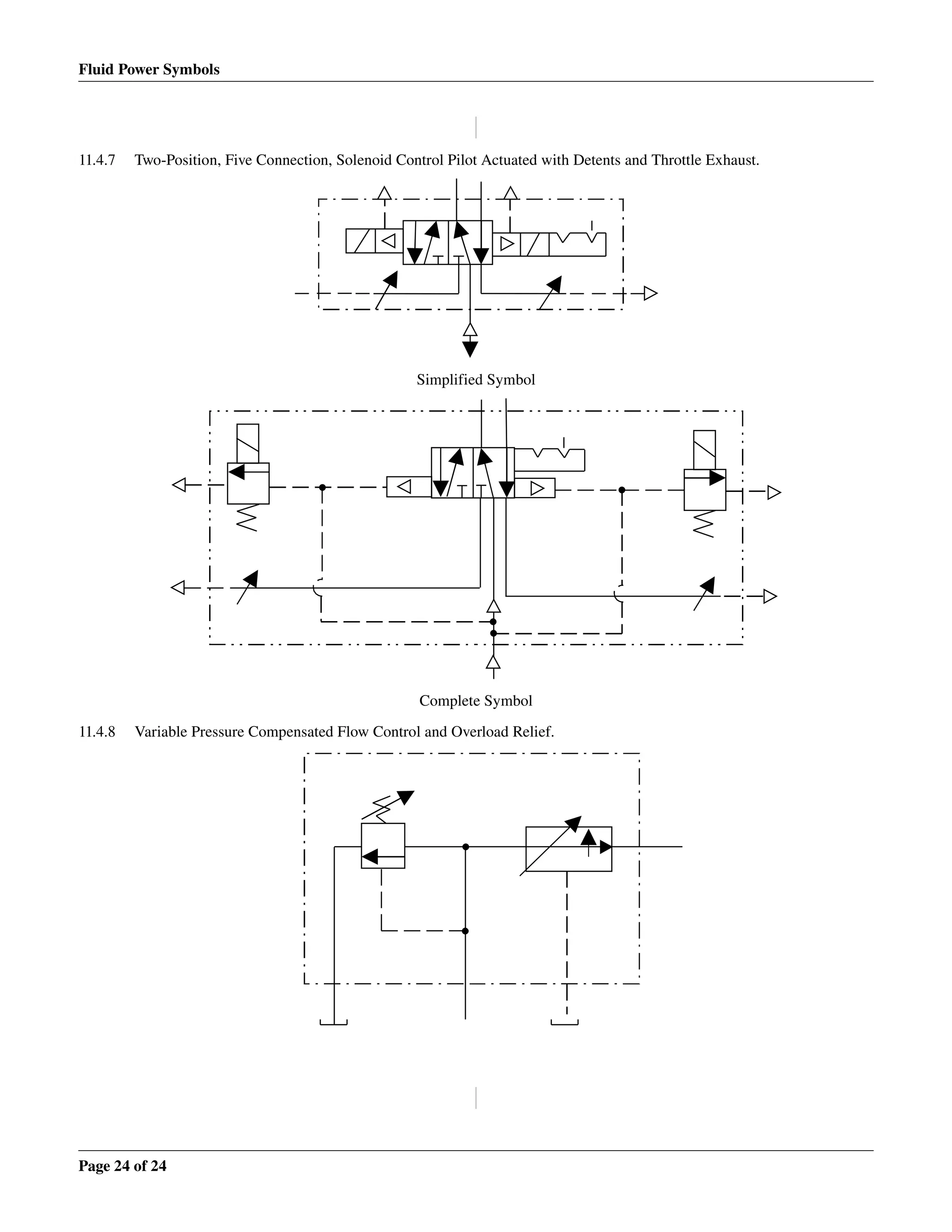
11.4.7 Two­Position, Five Connection, Solenoid Control Pilot Actuated with Detents and Throttle Exhaust.
Simplified Symbol
Complete Symbol
11.4.8 Variable Pressure Compensated Flow Control and Overload Relief.
Page 24 of 24

Fluid power graphic symbols

  • 1.
    Fluid Power Symbols FLUID POWER GRAPHICSYMBOLS ANSI Y32.10 GRAPHIC SYMBOLS 1. Introduction 1.1 General Fluid power systems are those that transmit and control  power through use of a pressurized fluid (liquid or gas)  within an enclosed circuit. Types   of   symbols   commonly   used   in   drawing   circuit  diagrams for fluid power systems are Pictorial, Cutaway,  and Graphic.   These symbols are fully explained in the  USA Standard Drafting Manual (Ref. 2). 1.1.1Pictorial   symbols  are   very   useful  for  showing   the  interconnection   of   components.     They   are   difficult   to  standardize from a functional basis. 1.1.2 Cutaway symbols emphasize construction.  These  symbols are complex to draw and the functions are not  readily apparent. 1.1.3 Graphic   symbols   emphasize   the   function   and  methods of operation of components.  These symbols are  simple to draw.   Component functions and methods of  operation are obvious.   Graphic symbols are capable of  crossing language barriers, and can promote a universal  understanding of fluid power systems. Graphic symbols for fluid power systems should be used  in conjunction with the graphic symbols for other systems  published   by   the   USA   Standards   Institute   (Ref.   3­7  inclusive). 1.1.3.1 Complete graphic symbols are those, which give  symbolic representation of the component and all of its  features pertinent to the circuit diagram. 1.1.3.2 Simplified graphic symbols are stylized versions  of the complete symbols. 1.1.1.3 Composite graphic symbols are an organization  of simplified or complete symbols.   Composite symbols  usually represent a complex component. 1.2 Scope and Purpose 1.2.1 Scope   –   This   standard   presents   a   system   of  graphic symbols for fluid power diagrams. 1.2.1.1 Elementary forms of symbols are: Circles Rectangles Arcs Dots Squares Triangles Arrows Crosses Symbols using words or their abbreviations are avoided.  Symbols   capable   of   crossing   language   barriers   are  presented herein. Component   function   rather   than   construction   is  emphasized by the symbol. 1.2.1.4 The means of operating fluid power components  are shown as part of the symbol (where applicable). 1.2.1.5 This standard shows the basic symbols, describes  the   principles   on   which   the   symbols   are   based,   and  illustrates   some   representative   composite   symbols.  Composite symbols can be devised for any fluid power  component by combining basic symbols. Simplified   symbols   are   shown   for   commonly   used  components. 1.2.1.6 This   standard   provides   basic   symbols,   which  differentiate between hydraulic and pneumatic fluid power  media. 1.2.2 Purpose 1.2.2.1 The   purpose   of   this   standard   is   to   provide   a  system of fluid power graphic symbols for industrial and  educational purposes. 1.2.2.2 The   purpose   of   this   standard   is   to   simplify  Page 1 of 24
  • 2.
    Fluid Power Symbols design, fabrication, analysis, and service of fluid power  circuits. 1.2.2.3 The purpose of this standard is to provide fluid  power  graphic   symbols,   which   are   internationally  recognized. 1.2.2.4 The   purpose   of   this   standard   is   to   promote  universal understanding of fluid power systems. Page 2 of 24
  • 3.
    Fluid Power Symbols 2. Symbol Rules 2.1Symbols   show   connections,   flow   paths,   and  functions of components represented.  They can indicate  conditions occurring during transition from on flow path  arrangement   to   another.     Symbols   do   not   indicate  construction, nor do they indicate values, such as pressure,  flow rate, and other component settings. 2.2 Symbols   do   not   indicate   locations   of   ports,  direction of shifting spools, or positions of actuators on  actual components. 2.3 Symbols   may   be   rotated   or   reversed   without  altering their meaning except in the cases of: a.) Lines to  Reservoir,   4.1.1;   b.)   Vented   Manifold,   4.1.2.3;   c.)  Accumulator, 4.2. 2.4 Line Technique Keep line widths approximately equal.   Line width does  not alter meaning of symbols. 2.4.1 Solid Line ­ Main 2.4.2 Dash Line – Pilot (Pilot line for control) 2.4.3 Dotted Line (Exhaust or Drain Line) 2.4.4 Center Line (Enclosure Outline) 2.4.5 Sensing Line – Same as line which it connects. 2.4.6 Lines   Crossing   (The   intersection   is   not  necessarily at a 90° angle.) 2.4.7 Lines Joining 2.5 Basic symbols.  May be shown any suitable size.  Size may be varied for emphasis or clarity.  Relative sizes  should be maintained.  (As in the following example.) 2.5.1 Circle and Semi­Circle 2.5.1.1 Large and small circles may be used to signify  that one component is the “main” and the other  the auxiliary. 2.5.2 Triangle 2.5.3 Arrow  2.5.4 Square Rectangle 2.6 Letter   combinations   used   as   parts   of   graphic  symbols are not necessarily abbreviations. 2.7 In multiple envelope symbols, the flow condition  shown nearest an actuator symbol takes place when that  control is caused or permitted to actuate. 2.8 Each symbol is drawn to show normal, at rest, or  neutral condition of component unless multiple diagrams  are   furnish   shown  various   phases   of   circuit   operation.  Show an actuator symbol for each flow path condition  possessed by the component. 2.9 An arrow through a symbol at approximately 45  degrees indicates that the component can be adjust or  varied. Page 3 of 24 or or
  • 4.
    Fluid Power Symbols 2.10 An arrow parallel to the short side of a symbol,  within  the   symbol,   indicates   that   the   component   is  pressure compensated. 2.11 A   line   terminating   in   a   dot   to   represent   a  thermometer is the symbol for temperature cause or effect See Temperature Controls 7.9.  Temperature indicators and  Recorders 9.1.2 and Temperature Compensation 10.16.3  and 10.16.4. 2.12 External   ports   are   located   where   flow   lines  connect   to   basic   symbol,   except   where   component  enclosure symbol is used. External ports are located at intersections of flow lines and  component enclosure symbol when enclosure is used, see  Section 11. 2.13 Rotating shafts are symbolized by an arrow which  indicates direction of rotation (assume arrow on near side  of shaft). 3. Conductor, Fluid 3.1 Line, Working (main) 3.2 Line, Pilot (for control) 3.3 Line, Exhaust and Liquid Drain 3.4 Line, sensing, etc. such as gauge lines shall be  drawn the same as the line to which it connects. 3.5 Flow Direction of 3.5.1 Pneumatic 3.5.2 Hydraulic 3.6 Line, Pneumatic (Outlet to Atmosphere). 3.61.1 Plain orifice, unconnectable 3.6.2 Connectable orifice (e.g. Thread) 3.7 Line with Fixed Restriction 3.8 Line, Flexible 3.9 Station, Testing, measurement, or power take­off. 3.9.1 Plugged port. 3.9.2 Quick Disconnect 3.9.3 Without Checks 3.9.4 With Two Checks Page 4 of 24 DISCONNECTEDCONNECTED
  • 5.
    Fluid Power Symbols 3.9.5 With One Check 3.11 Rotating Coupling 4.Energy Storage and Fluid Storage 4.1 Reservoir Note:   Reservoirs   are   conventionally   drawn   in   the  horizontal plane.  All lines enter and leave from above. 4.1.1 Reservoir   with   Connecting   Lines   Above   Fluid  Level Below Fluid Level Show line entering or leaving below reservoir only when  such bottom connection is essential to circuit function. 4.1.2 Simplified symbol The symbols are used as part of a complete circuit.  They  are analogous to the ground symbol of electrical diagrams.    . Several such symbols     may be used in one  diagram to represent the same reservoir. 4.1.2.1 Below Fluid Level 4.1.2.2 Above Fluid Level (The return line is drawn to terminate at the upright legs of  the tank symbol.) 4.1.2.3 Vented Manifold 4.2 Accumulator 4.2.1 Accumulator, Spring Loaded 4.2.2 Accumulator, Gas Charged 4.2.3 Accumulator, Weighted 4.3 Receiver 4.4 Energy Source (Pump, Compressor, Accumulator,  etc.) This symbol may be used to represent a fluid power source  which may be a pump, compressor, or another associated  system. Page 5 of 24 CONNECTED DISCONNECTED CONNECTED DISCONNECTED VENTED PRESSURIZED PNEUMATICHYDRAULIC
  • 6.
  • 7.
    Fluid Power Symbols 5.1 Heat Exchanger 5.1.1 Heater 5.1.2Cooler Inside triangles indicate heat dissipation. (Corners may be filled in to represent triangles.) 5.1.3 Temperature Controller (The temperature is to be  maintained between two predetermined limits.) 5.2 Filter – Strainer 5.3 Separator 5.3.1 With Manual Drain 5.3.2 With Automatic Drain 5.4 Filter – Separator 5.4.1 With Manual Drain 5.4.2 With Automatic Drain 5.5 Desiccator (Chemical Dryer) 5.6 Lubricator 5.6.1 Less Drain 5.6.2 With Manual Drain 6. Linear Devices 6.1 Cylinders, Hydraulic and Pneumatic 6.1.1 Single Acting 6.1.2 Double Acting 6.1.2.1 Single End Rod 6.1.2.2 Double End Rod Page 7 of 24 Inside triangles  indicate the  introduction of heat. Outside triangles  show the heating  medium is liquid. Outside triangles  show the heating  medium is gaseous. or or or
  • 8.
    Fluid Power Symbols 6.1.2.3 Fixed Cushion, Advance and Retract 6.1.2.4 Adjustable Cushion, Advance Only 6.1.2.5Use   these   symbols   when   diameter   of   rod  compared to diameter of bore is significant to  circuit function. 6.2 Pressure Intensifier 6.3 Servo Positioner (Simplified) 6.4 Discrete Positioner Combine two or more basic cylinder symbols. 7. Actuators and Controls 7.1 Spring 7.2 Manual (Use   as   general   symbol   without   indication   of   specific  type; i.e., foot, hand, leg, arm.) 7.2.1 Push Button 7.2.2 Lever 7.2.3 Pedal or Treadle 7.3 Mechanical 7.4 Detent (Show a notch for each detent in the actual component  being symbolized.  A short line indicates which detent is  in use.)   Detent may, for convenience, be positioned on  either end of symbol. 7.5 Pressure Compensated 7.6 Electrical 7.6.1 Solenoid (Single Winding) 7.6.2 Reversing Motor 7.7 Pilot Pressure 7.7.1 Remote Supply Page 8 of 24 NON CUSHION CUSHION, ADVANCE AND  RETRACT PneumaticHydraulic M
  • 9.
  • 10.
    Fluid Power Symbols 7.7.2 Internal Supply 7.7.3 Actuation by Released Pressure By Remote ExhaustBy Internal Return 7.7.4 Pilot Controlled, Spring Centered Simplified Symbol Complete Symbol 7.7.5 Pilot Differential Simplified Symbol Complete Symbol 7.8 Solenoid Pilot 7.8.1 Solenoid or Pilot External Pilot Supply Internal Pilot Supply and Exhaust 7.8.2 Solenoid and Pilot 7.9  Thermal   –   A   mechanical   device   responding   to  thermal change. 7.9.1 Local Sensing 7.9.2 With Bulb for Remote Sensing 7.10 Servo (This   symbol   contains   representation   for   energy   input,  command input, and resultant output.) 7.11 Composite Actuators (and, or, and/or) Basic . . One signal only causes the  device to operate And . ; One signal and a second  signal both cause the  device to operate. Or . . One signal or the other signal  causes the device to operate. And/Or . . The solenoid and the pilot  or the manual override alone  causes the device to operate. Page 10 of 24
  • 11.
  • 12.
    Fluid Power Symbols 8. Rotary Devices 8.1Basic Symbol 8.1.1 With Ports 8.1.2 With Rotating Shaft, with control and with Drain 8.2 Hydraulic Pump 8.2.1 Fixed Displacement 8.2.1.1 Unidirectional 8.2.1.2 Bidirectional 8.2.2 Variable Displacement, Non­compensated 8.2.2.1 Unidirectional Simplified Complete 8.2.2.2 Bidirectional Simplified Complete 8.2.3 Variable Displacement, Pressure Compensated 8.2.3.1 Unidirectional Simplified Complete 8.2.3.2 Bidirectional Simplified Complete 8.3 Hydraulic Motor 8.3.1 Fixed Displacement 8.3.1.2 Bidirectional 8.3.2 Variable Displacement 8.3.2.1 Unidirectional 8.3.2.2 Bidirectional 8.4 Pump – Motor, Hydraulic 8.4.1 Operating in one direction as a pump.  Operating  in the other direction as a motor. Page 12 of 24
  • 13.
    Fluid Power Symbols 8.4.1.1 Complete Symbol 8.4.1.2 Simplified Symbol 8.4.2Operating one direction of flow as either a pump  or as a motor. 8.4.2.1 Complete Symbol 8.4.2.2 Simplified Symbol 8.4.3 Operating in both directions of flow either as a  pump or as a motor.  (Variable displacement, pressure  compensated shown.) 8.4.3.1 Complete Symbol 8.4.3.2 Simplified Symbol 8.5 Pump Pneumatic 8.5.1 Compressor, Fixed Displacement 8.5.2 Vacuum Pump, Fixed Displacement 8.6 Motor, Pneumatic 8.6.1 Unidirectional 8.6.2 Bidirectional 8.7 Oscillator 8.7.1 Hydraulic 8.7.2 Pneumatic 8.8 Motors, Engines 8.8.1 Electric Motor 8.8.2 Heat Engine (E.G. internal combustion engine.) 9. Instruments and Accessories 9.1 Indicating and Recording 9.1.1 Pressure 9.1.2 Temperature 9.1.3 Flow Meter 9.1.3.1 Flow Rate Page 13 of 24 IEC
  • 14.
  • 15.
    Fluid Power Symbols 9.2 Sensing 9.2.1 Venturi 9.2.2Orifice Plate 9.2.3 Pitot Tube 9.2.4 Nozzle Hydraulic Pneumatic 9.3 Accessories 9.3.1 Pressure Switch 9.3.2 Muffler 10. Valves A   basic   valve   symbol   is   composed   of   one   or   more  envelopes with lines inside the envelope to represent flow  paths and flow conditioners between ports.  Three symbol  systems are used to represent valve types: single envelope,  both finite and infinite position; multiple envelope, finite  position; and multiple envelope, infinite position. 10.1 In infinite position  single envelope valves, the  envelope is imagined to move to illustrate how pressure or  flow conditions are controlled as the valve is actuated. 10.2 Multiple envelopes  symbolize   valves  providing  more than one finite flow path option for the fluid.  The  multiple   envelope   moves   to   represent   how   flow   paths  change when the valving element within the component is  shifted to its finite positions. 10.3 Multiple   envelope   valves   capable   of   infinite  positioning between certain limits are symbolized as in  10.2 above with the addition of horizontal bars, which are  drawn parallel to the envelope.  The horizontal bars are the  clues to the infinite positioning function possessed by the  valve represented. 10.4 Envelopes 105 Ports 10.6 Ports, Internally Blocked Symbol System 10.1 Symbol System 10.2 10.7 Flow Paths, Internally Open (Symbol System 10.1  and 10.2) 10.8 Flow Paths, Internally Open (Symbol System 10.3) 10.9 Two­Way Valves (2 Ported Valves) 10.9.1 On­Off (Manual Shut Off) Simplified Off Page 15 of 24 Symbol System 10.2 Symbol System 10.1
  • 16.
  • 17.
    Fluid Power Symbols On 10.92 Check Simplified Composite Symbol.  Flow to the right is blocked.  Flow to  the left is permitted.  10.93 Check, Pilot­Operated to Open 10.94Check, Pilot­Operated to Close 10.9.5 Two­Way Valves 10.9.5.1 Two­Position 10.9.5.2 Infinite Position Normally Closed Normally Open 10.10 Three­Way Valves 10.10.1 Two Position 10.10.1.1 Normally Open 10.10.1.2 Normally Closed 10.10.1.3 (Distributor Pressure is distributed first to one  port, then the other). 10.10.1.4 Two­Pressure 10.10.2 Double Check Valve – Double check valves can  be built with and without “cross bleed”.  Such valves with  two poppets do not usually allow pressure to momentarily  “cross bleed” to return during transition.  Valves with one  poppet   may   allow   “cross   bleed”   as   these   symbols  illustrate. 10.10.2.1 Without Cross Bleed (One way flow). 10.10.2.2 With Cross Bleed (Reverse flow permitted). Page 17 of 24 Normally Closed Normally Open Normally Closed Normally Open
  • 18.
    Fluid Power Symbols 10.11 Four­Way Valves 10.11.1 Two­Position 10.11.2Three Position (a) Normal (b) Actuated Left (c) Actuated Right 10.11.3 Typical   Flow   Paths   for   Center   Condition   of  Three­Position Valves 10.11.4 Two­Position, Snap Action with Transition. As the valve element shifts from one position to the other,  it passes through an intermediate position.  If it is essential  to circuit function to symbolize this “in transit” condition,  it can be shown in the center position, enclosed by dashed  lines. Typical Transition Symbol 10.12 Infinite Positioning (between open and closed) 10.12.1 Normally Closed 10.12.2 Normally Open 10.13 Pressure Control Valves 10.13.1 Pressure Relief 10.13.2 Sequence Page 18 of 24 Normal Actuated Simplified Symbol Denotes Normal Actuated (Relieving)
  • 19.
    Fluid Power Symbols 10.13.3 Pressure Reducing 10.13.4 Pressure Reducing and Relieving 10.13.5Airline   Pressure   Regulator   (Adjustable,  Relieving) 10.14 Infinite Positioning Three­Way Valves 10.15 Infinite Positioning Four­Way Valves 10.16 Flow Control Valves (See 3.7) 10.16.1 Adjustable, Non­Compensated (Flow control in  each direction) 10.16.2 Adjustable with Bypass 10.16.3 Adjustable   and   Pressure   Compensated   with  Bypass 10.16.4 Adjustable,   Temperature   and   Pressure  Compensated 11. Representative Composite Symbols 11.1 Component Enclosure Component enclosure may surround a complete symbol or  a group of symbols to represent an assembly.  It is used to  convey more information about component connections  and   functions.     Enclosure   indicates   extremity   of  component or assembly.  External ports are assumed to be  on enclosure line and indicate connections to component. Flow lines shall cross enclosure line without loops or dots. Page 19 of 24 Flow is controlled to  the right.  Flow to the  left bypasses control.
  • 20.
    Fluid Power Symbols 11.2 Airline  Accessories   (Filter,   Regulator   and  Lubricator) Composite Simplified Page 20 of 24
  • 21.
    Fluid Power Symbols 11.3 Pumps and Motors 11.3.1 Pumps 11.3.1.1Double, Fixed Displacement, One Inlet and Two  Outlets. 11.3.1.2 Double, with Integral Check Unloading and Two  Outlets 11.3.1.3 Integral   Variable   Flow   Rate   Control   with  Overload Relief 11.3.1.4 Variable   Displacement   with   Integral  Replenishing Pump and Control Valves Page 21 of 24
  • 22.
  • 23.
    Fluid Power Symbols 11.4 Valves 11.4.1 Relief, Balanced Type 11.4.2Remote Operated Sequence with Integral Check 11.4.3 Remote   and   Direct   Operated   Sequence   with  Differential areas and Integral Check. 11.4.4 Pressure Reducing with Integral Check. 11.4.5 Pilot Operated Check 11.4.5.1 Differential Pilot Opened. 11.4.5.2 Page 23 of 24
  • 24.