INTERVIEW
72 Gulf Property
W
ithhelp from a
Qatari partner
and support
from a cash-
strapped gov-
ernment, here’s a Palestinian
property developer who has
endeavoured to build not just
a residential project but an
entire city.
Rawabi is a new commu-
nity for Palestinian families
that will provide opportunities
for affordable home owner-
ship, employment, educa-
tion, leisure and an attractive
environment in which to live,
work and grow. Rawabi, the
first Palestinian planned city,
is a bold initiative in both its
facets: a new population
center for Palestine and a
courageous economic initia-
tive that will contribute to per-
manent new job creation and
sustainable long-term growth
for the Palestinian economy.
The new city, located in the
West Bank and close to Ra-
mallah and Jerusalem, inte-
grates international best
practices for urban master
planning, sustainable envi-
ronmental policy, regionally-
suited architecture and state
of-the-art infrastructure for
residents, enterprises and
visitors.
Rawabi provides more
than 5,000 housing units with
multiple floor plans spread
across 23 neighbourhoods,
intends to eventually house
40,000 people. Through at-
tracting investors and tech-
nology suppliers, Rawabi
plans to generate more than
5,000 permanent jobs, creat-
ing quality of life and making
a long-term, sustainable con-
tribution to national prosper-
ity.
Bayti Real Estate Invest-
ment Company, the devel-
oper of Rawabi, is jointly
owned by Palestinian realtor
Massar International and
Qatari Diar, the development
company owned by the
Qatari government.
The joint-venture company
was established to jump-start
the development of the
Palestinian real estate sector
with a mission to create af-
fordable, accessible, family-
friendly communities and
create several thousand di-
rect and indirect employment
opportunities for Palestini-
ans, providing multi-level
stimulus to the national econ-
omy. In an exclusive inter-
view with Gulf Property,
Bashar Masri, Chief Execu-
AgifttoPalestiniansAgifttoPalestinians
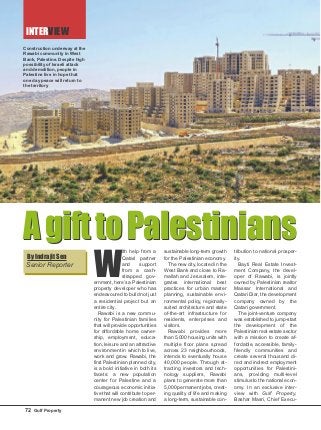
Construction underway at the
Rawabi community in West
Bank, Palestine. Despite high
possibility of Israeli attack
and demolition, people in
Palestine live in hope that
one day peace will return to
the territory
By Indrajit Sen
Senior Reporter
2.
INTERVIEW
Gulf Property 73
tiveOfficer of Massar Inter-
national talks about Rawabi,
the Palestinian Authority’s
role and the Israeli threat
looming over the city.
Gulf Property: How do you
describe your company
and its mission? How big
is the workforce? Do you
operate just from Ramallah
or do you have branches;
if yes where? What are the
services you offer your
clients?
Bashar Masri: The city of
Rawabi is being developed
by Bayti Real Estate Invest-
ment Company is a joint ven-
ture between my
organisation Massar Interna-
tional and Qatari Diar. Mas-
sar International has 25
subsidiaries operating in
Palestine, Egypt, Jordan and
Morocco. Massar and its
subsidiaries employ roughly
1,500 people in the region,
excluding those working at
Rawabi. Rawabi alone em-
ploys about 4,000 Palestini-
ans.
Massar International of-
fers services in the areas of
real estate development, in-
formation and communica-
tions technology and
financial services.
From what it appears,
Rawabi is not just a real
estate project but a
planned city, with special
amenities. Can you elabo-
rate on the salient features
of this project?
Yes. Rawabi, the first Pales-
tinian planned city, is the
largest private sector project
ever carried out in Palestine.
The city integrates interna-
tional planning principles,
sustainable environmental
practices, regionally-suited
architecture, state of-the-art
infrastructure and ease of ac-
cess for both residents and
visitors. Its amenities, which
include a commercial center,
art spaces, educational and
medical facilities, will make it
a destination as well as
home for all Palestinians.
Rawabi will initially be
home to 25,000 residents,
with additional residential
and commercial units slated
for subsequent construction
phases that will ultimately
serve a city with a population
of more than 40,000.
Located 9 kilometre north
of Ramallah and 3.5 kilome-
tre north of Birzeit, Rawabi
lies 25 kilometre to the north
of Jerusalem and 25 kilome-
tre south of Nablus. The view
west from Rawabi’s hilltops
offers a panorama of the
Mediterranean coast.
Rawabi’s municipal bound-
aries will encompass
6,300,000 square metres of
land.
The investment for this
project has been over $1
billion. What has been the
source of finances? Have
you sought bank finance?
Funding for the construction
of the new city has been pro-
vided primarily the two joint
venture shareholders of
Bayti Real Estate Investment
Company: Massar Interna-
tional and Qatari Diar.
A few donors provided
small amounts of targeted
funding early on for feasibility
studies related to the provi-
sion of public services and
for some components of the
city’s public infrastructure, in-
cluding a $5 million grant
from the United States
Agency for International De-
velopment for the initial
phases of construction of the
city’s road network.
Rawabi is, however, a pri-
vate sector undertaking and
virtually all of the capital re-
quired for construction has
come from Bayti.
How many and which cate-
gories of residential units,
namely studio apartments,
1, 2 and 3 bedroom apart-
ments, penthouses or vil-
las, will be there in
Rawabi?
The majority of the 5,000
housing units constructed in
are 2 and 3 bedroom apart-
ments designed for family liv-
ing. Some buildings also
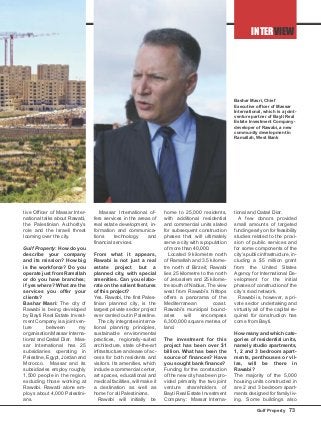
Bashar Masri, Chief
Executive officer of Massar
International, which is a joint-
venture partner of Bayti Real
Estate Investment Company -
developer of Rawabi, a new
community development in
Ramallah, West Bank
3.
INTERVIEW
feature one-bedroom apart-
ments,but in general cultural
preferences and lifestyles in
Palestine create more de-
mand for the 2 and 3 bed-
room models.
A very limited number of
high-rise penthouse apart-
ments are found in the resi-
dential towers located in the
heart of the downtown area,
the City Center. Rawabi at
the moment has no single-
family homes, or villas, under
construction but the master-
plan does include villas in
later construction phases.
When fully built, Rawabi
will offer homes to suit the
taste of families and individ-
uals at all stages of life and
socio-economic strata, but
the focus is to build homes
accessible and attractive to
working Palestinian families
and professionals.
What is the pricing struc-
ture of housing units in
Rawabi? How would you
rate living in Rawabi as: Af-
fordable or expensive?
Ninety percent of apartments
at Rawabi range between 92
square metres to 240 square
metres in size starting at
$60,000 and up to $150,000.
The rest 10 per cent of them
reach up to 340 square
metre and their price differs
according to their location
and features.
With the introduction of
mortgage lending with
favourable terms by Pales-
tine’s major banks, all of
whom are on-site at Rawabi,
the cost of buying a home at
Rawabi is well within the
reach of most working Pales-
tinians.
The pricing structure of
Rawabi homes was a critical
consideration for the project;
obviously, if these homes
were not affordable to our
target market, we couldn’t
sell them.
Will Rawabi house retail
units, cinemas and hotels?
If yes, which brands?
Rawabi’s downtown area,
the City Center, will feature
many exciting retail, enter-
tainment and accommoda-
tion opportunities, including a
pedestrian promenade.
We have a 7-screen 4-D
movie theater under con-
struction (the first in the re-
gion), international retailers,
including clothing stores,
home goods outlets and
restaurants, and a hotel.
Many of our favourite Pales-
tinian stores and cafes will
also be found at Rawabi, and
each neighbourhood will
offer convenience retail as
well.
To top that off, we are
building a 12,000 seat out-
door amphitheater for out-
door concerts, and the city is
full of parks and walking
trails. If you haven’t found
what you’re looking for in
terms of retail, entertainment
and healthful living at
Rawabi, you probably need
to just stroll down the block a
bit further.
What was your strategy re-
garding promoting the
project in Dubai? How was
the response? Are in-
vestors from Dubai and the
GCC pooling money in
Rawabi?
The response was exciting.
Many Palestinians living in
the UAE and in the Gulf had
heard of Rawabi, but didn’t
really quite yet believe it had
become a reality. Our prime
objective was to showcase
the project to them so that
they could purchase a home
back in Palestine.
Undoubtedly, our goal is to
create a modern living envi-
ronment in Palestine that
competes with the comforts
and conveniences found in
regional capital cities.
Rawabi is designed not just
for Palestinians living in
Palestine today, but also to
encourage many of the thou-
sands of Palestinians living
abroad to seriously consider
coming home – to work, to
live and to grow right here in
Palestine. We believe we
made great strides towards
that goal.
Our promotion in Dubai
was intended to also attract
potential investors as well.
We are now focused on at-
tracting companies to base
operations at Rawabi.
Bayti Real Estate Invest-
ment Company is a collab-
oration between Qatari
Diar and Massar Interna-
tional. So can we consider
this joint venture to be a
proof of Qatar’s keen inter-
est in Palestinian affairs
and its commitment to de-
veloping the Palestinian
economy?
Qatar has always been a
strong supporter of economic
development in Palestine,
and their investment in
Rawabi is proof of that.
We are business partners
working through private-sec-
tor development to achieve a
shared goal of long-term
Palestinian prosperity and
quality of life for the Palestin-
ian people.
What is distinct about
Rawabi is that it has its
own municipality. Will
there be more support
from the government in
terms of organising police
stations, hospitals and
other civil services?
74 Gulf Property
4.
Rawabi is fully-incorporated
Palestinianmunicipality,
which means we have estab-
lished strong local gover-
nance structures in
accordance with Palestinian
law, under the oversight of
the Palestinian National Au-
thority, like all other munici-
palities in Palestine.
Mayors and municipal
councils, such as ours at
Rawabi, are responsible for
coordination of the provision
of public services within the
city limits, under the overar-
ching framework of the laws
and requirements of our na-
tional government.
But the Palestinian Author-
ity does not own Rawabi, as
it does not own Nablus, or
Ramallah, or any other mu-
nicipality in Palestine.
Typically, governments do
provide funding for all the
public infrastructure of cities.
However, this is not the case
in Rawabi, due to the special
circumstances of the PA and
its limited budgets. So the
public infrastructure of the
city had to be financed and
built by Bayti, without finan-
cial help from the PA.
It should be made clear,
though, that the PA is very
supportive of Rawabi and
has exerted a great deal of
effort creating an enabling
environment for the project,
even if they could not finance
its public infrastructure.
Is there any threat of Israeli
occupation looming over
Rawabi? Are there any Is-
raeli settlements nearby?
The occupation is of course
a factor that has created nu-
merous obstacles, some of
which are extremely serious
and as yet remain unre-
solved.
To date, the Israeli govern-
ment has withheld approval
for us to widen the main road
that leads to Rawabi. Even
more importantly, we are still
without approval to tap into
the main water supply.
It is impossible to under-
state the severity of those
problems. These issues
have been highlighted re-
peatedly in the international
press. These are not prob-
lems we can solve on our
own – the solution lies in
government action.
We press forward with con-
struction, however, we have
never lost hope that the res-
olution will be achieved in the
future.
Yes, there are several set-
tlements nearby, but they do
not pose significant problems
for us, except in the macro
sense.
At this point, Rawabi is too
big to be threatened by small
groups of troublemakers.
Palestine needs ten more
Rawabis.
Depending on Rawabi’s
success, will Bayti Real
Estate Investment Com-
pany create more such
planned cities in future in
the West Bank and Gaza?
Absolutely. We would love to
replicate this success. As
well, we welcome industry
growth as other Palestinian
real estate developers scale
up and join us – there are a
number of great projects al-
ready underway.
We are a young country
with a huge demand for new
housing, which will only be-
come larger as the popula-
tion grows.
From the real estate indus-
try perspective, the outlook is
very bright. We are all work-
ing towards the same goal –
every job we create, every
home we build for a Palestin-
ian family takes us that much
closer to realising the dream
of a peaceful Palestine. g
‘The occupation [of the
Palestine by Israel] is of
course a factor that has
created numerous
obstacles, some of
which are extremely
serious and as yet
remain unresolved.
To date, the Israeli
government has
withheld approval for
us to widen the main
road that leads to
Rawabi. Even more
importantly, we are still
without approval to tap
into the main water
supply. We press
forward with
construction. However,
we have never lost
hope...’
– Bashar Masri
INTERVIEW
Gulf Property 75
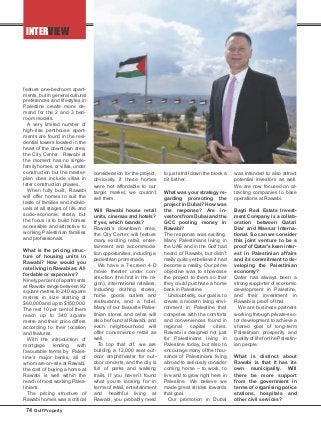
Bashar Masr in action
![Rawabi is fully-incorporated
Palestinian municipality,
which means we have estab-
lished strong local gover-
nance structures in
accordance with Palestinian
law, under the oversight of
the Palestinian National Au-
thority, like all other munici-
palities in Palestine.
Mayors and municipal
councils, such as ours at
Rawabi, are responsible for
coordination of the provision
of public services within the
city limits, under the overar-
ching framework of the laws
and requirements of our na-
tional government.
But the Palestinian Author-
ity does not own Rawabi, as
it does not own Nablus, or
Ramallah, or any other mu-
nicipality in Palestine.
Typically, governments do
provide funding for all the
public infrastructure of cities.
However, this is not the case
in Rawabi, due to the special
circumstances of the PA and
its limited budgets. So the
public infrastructure of the
city had to be financed and
built by Bayti, without finan-
cial help from the PA.
It should be made clear,
though, that the PA is very
supportive of Rawabi and
has exerted a great deal of
effort creating an enabling
environment for the project,
even if they could not finance
its public infrastructure.
Is there any threat of Israeli
occupation looming over
Rawabi? Are there any Is-
raeli settlements nearby?
The occupation is of course
a factor that has created nu-
merous obstacles, some of
which are extremely serious
and as yet remain unre-
solved.
To date, the Israeli govern-
ment has withheld approval
for us to widen the main road
that leads to Rawabi. Even
more importantly, we are still
without approval to tap into
the main water supply.
It is impossible to under-
state the severity of those
problems. These issues
have been highlighted re-
peatedly in the international
press. These are not prob-
lems we can solve on our
own – the solution lies in
government action.
We press forward with con-
struction, however, we have
never lost hope that the res-
olution will be achieved in the
future.
Yes, there are several set-
tlements nearby, but they do
not pose significant problems
for us, except in the macro
sense.
At this point, Rawabi is too
big to be threatened by small
groups of troublemakers.
Palestine needs ten more
Rawabis.
Depending on Rawabi’s
success, will Bayti Real
Estate Investment Com-
pany create more such
planned cities in future in
the West Bank and Gaza?
Absolutely. We would love to
replicate this success. As
well, we welcome industry
growth as other Palestinian
real estate developers scale
up and join us – there are a
number of great projects al-
ready underway.
We are a young country
with a huge demand for new
housing, which will only be-
come larger as the popula-
tion grows.
From the real estate indus-
try perspective, the outlook is
very bright. We are all work-
ing towards the same goal –
every job we create, every
home we build for a Palestin-
ian family takes us that much
closer to realising the dream
of a peaceful Palestine. g
‘The occupation [of the
Palestine by Israel] is of
course a factor that has
created numerous
obstacles, some of
which are extremely
serious and as yet
remain unresolved.
To date, the Israeli
government has
withheld approval for
us to widen the main
road that leads to
Rawabi. Even more
importantly, we are still
without approval to tap
into the main water
supply. We press
forward with
construction. However,
we have never lost
hope...’
– Bashar Masri
INTERVIEW
Gulf Property 75
Bashar Masr in action](https://image.slidesharecdn.com/34075966-0e61-46c4-b494-0fe7f9b7edf6-150325064304-conversion-gate01/85/72-75-low-res-4-320.jpg?cb=1427265936)


