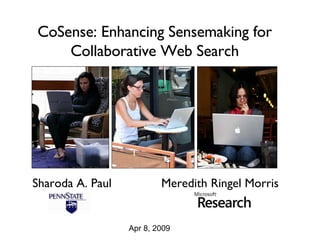
CoSense: Enhancing Sensemaking for Collaborative Web Search

Loading...

Flash Player 9 (or above) is needed to view presentations.
We have detected that you do not have it on your computer. To install it, go here.

0 comments

Post a comment

    Post a comment
    Embed Video
    Edit your comment Cancel

    Notes on slide 1

    Good afternoon ladies and gentleman, thank you for attending this talk. I am Sharoda Paul from Penn State University and I’m going to present our paper ‘Cosense: Enhancing Sensemaking in Collaborative Web Search, written with my co-author Meredith Morris of Microsoft Research. The study I am presenting explored how people make sense of information found during collaborative Web search tasks. For instance, if a group of friends are planning to go on a vacation, they might each go online and search the Web for fun activities to add to their vacation itinerary. The question we explored in our study is ‘how do people make sense of the information generated during such a collaborative Web search task.

    3 Favorites

    CoSense: Enhancing Sensemaking for Collaborative Web Search - Presentation Transcript

    1. CoSense: Enhancing Sensemaking for Collaborative Web Search Sharoda A. Paul Meredith Ringel Morris Apr 8, 2009
    2. Getting information off the Internet is like taking a drink from a fire hydrant - Mitchell Kapor
    3. Making sense of information found during a Web search task can be daunting
    4. During collaborative Web search tasks, making sense of information can be even more complex and challenging “ How does sensemaking occur during collaborative Web search task?”
    5. Goals
      • Understand how sensemaking occurs during collaborative Web search
      • Develop a tool to help enhance users’ sensemaking during collaborative Web search tasks
    6. Background: Sensemaking
      • Sensemaking has been studied in a variety of fields (Weick, 1995; Dervin 2003; Russell, 1993)
      • Challenging problem in HCI
      Sensemaking is finding meaning or understanding of information
      • Important part of information seeking activities
    7. Background: Collaborative Sensemaking
      • Most sensemaking research has been at the individual level
      • Sensemaking is important in collaborative information seeking activities
      • (Hansen & Jarvelin, 2005; Hertzum, 2008)
      • Little understanding of how sensemaking occurs at the group level
    8. Background: Collaborative Web search
      • People collaborate during Web search (Morris, 2008)
      • Tools have been developed to support collaborative Web search (Morris, 2007; Pickens et al., 2008)
      • Lack of understanding of users’ behavior during collaborative Web search, specifically sensemaking behavior
    9. What we did
      • Formative study
        • Identified sensemaking challenges in using a collaborative Web search tool, SearchTogether
      • Design
        • new tool CoSense to help users overcome sensemaking challenges
      • Evaluation
        • of CoSense to examine
          • how sensemaking takes place during collaborative Web search
          • how tools can be designed to support sensemaking
    10. SearchTogether (UIST, 2007) Query history Search session Add comments and ratings to Web pages Chat with collaborators
    11. SearchTogether: Features
      • Session summary
      • Group query history
      • Integrated chat
      • Ratings and comments
      • Peek-and-follow browsing
      • Standard, split, and multi-engine search
    12. Formative study: Design
      • Goal: Understand how SearchTogether supports sensemaking
      Phase 1 Phase 2 Group ST ST ST
      • Interviews
      • Observations
      • Audio and video recording
      Data collection SearchTogether Tools used 6 groups (3 in each group) Participants Vacation planning 2-phase design Task
    13. Formative study: Findings
      • Sensemaking challenges
        • Awareness
          • Context and action awareness
        • Sensemaking trajectories
          • Steps in the sensemaking process
        • Sensemaking handoffs
          • Understanding information found asynchronously
    14. CoSense
      • Integrated with SearchTogether
      • Four views of information
        • Search strategies view
        • Timeline view
        • Workspace view
        • Chat-centric view
      Database SearchTogether CoSense
    15. Search strategies view (1)
    16. Search strategies view (2)
    17. Timeline view
    18. Workspace view
    19. Chat-centric view
    20. Evaluation of CoSense
      • Goal:
        • Examine if CoSense improved sensemaking challenges faced in formative study
      • Interviews
      • Observations
      • Online questionnaire
      Data collection SearchTogether and CoSense Tools used 18 participants (4 in each group) Participants Vacation planning 2-phase design Task
    21. Evaluation of CoSense: Data collection
      • Questionnaire tested participants’ understanding of
          • Task-related information
          • Others’ task performance
          • Others’ skills and contributions
          • Task state and progress on goals
      “ Which group member do you think contributed most to the task and why?” “ Which websites generated a lot of discussion?”
    22. Evaluation of CoSense: Findings
      • CoSense views supported sensemaking during
        • Synchronous and asynchronous search
        • Initial vs. handoff stages of search
      • Also supported different styles of sensemaking
    23. CoSense view usage: During task (1)
      • During synchronous search
        • Most used views: search strategies and chat-centric
        • Popular features
          • Viewing tag clouds
          • Clicking on chat messages to see associated Web pages.
    24. CoSense view usage: During task (2)
      • During asynchronous search
        • Most used were timeline and workspace views
        • Popular features
          • Opening Web pages from the timeline
          • Editing ‘scratchpad’ and opening links from summary
    25. CoSense view usage: During questionnaire
      • Search strategies view
        • Skills and strategies of group members
      • Timeline view
        • Connections between different content
      • Workspace view
        • Group members’ contributions and roles
      • Chat-centric view
        • Group members’ contributions and decisions reached
    26. CoSense usage during handoff “ The tag clouds and statistics on how many queries had been done, what were the group’s sites, and what is their popularity, helped me immensely …I was able to plan [the search] better using the websites and keywords ” “ The flow of the search was hard to tell [by looking at SearchTogether]. The timeline in CoSense helped because of the information about order of queries. I identified what had already been done ”
    27. Discussion
      • Synchronous search
        • Focus on ‘ how’ is information being found
      • Asynchronous search
        • Focus on ‘ what’ information was found
    28. Conclusion
      • CoSense addressed challenges found in the formative study
        • Awareness
        • Temporality and trajectories
        • Handoffs
      • Contributions
        • Gained an understanding of sensemaking in groups
        • Designed features to support sensemaking in collaborative Web search
    29. Future work
      • Explore further sensemaking styles during synchronous and asynchronous search and handoff
      • Examine how the products of sensemaking are passed on across time and group members
      • Move towards models of collaborative information seeking
    30. Thank you!
      • [email_address]
      • http://www.personal.psu.edu/sap246
      • Information Processing & Management
      • Special Issue on Collaborative Information Seeking
      • Papers Due: May 8 th
      • http://research.microsoft.com/~merrie for the CFP
    31. References
      • Photos courtesy of Flickr users sean dreilinger, Ed Yourdon, quinn.anya, Joseph Robertson, Feuillu, sonson, iamhenry, SonnyandSandy
      • User sketches inspired by www.xkcd.com
      • Weick, K.E.. (1995). Sensemaking in Organizations . Foundations for Organizational Science. Thousand Oaks, CA: Sage Publications, Inc.
      • Russell, D.M., et al. (1993). The cost structure of sensemaking . in Proceedings of CHI ‘93 . Amsterdam, The Netherlands. ACM Press.
      • Dervin, B., L. Foreman-Wernet, and E. Lauterbach, eds. (2003). Sense-Making METHODOLOGY Reader: Selected Writings of Brenda Derwin . Hampton Press, Inc., Cresskill, NJ.
      • Hansen, P. and Jarvelin, K. (2005). Collaborative information retrieval in an information-intensive domain. Information Processing and Management . 41, 1101-1119.
      • Hertzum, M. (2008). Collaborative information seeking: The combined activity of information seeking and collaborative grounding. Information Processing and Management . 44, 957-962.
      • Morris, M. R. and Horvitz, E. (2007). SearchTogether: An interface for collaborative Web search. Proceedings of UIST ‘07 , Newport, RI, USA. ACM Press.
      • Pickens, J., Golovchinsky, G., Shah, C., Qvarfordt, P., and Back, M. (2008). Algorithmic mediation for collaborative exploratory search. In Proc. of SIGIR ’08, Singapore. ACM Press.

    + Sharoda PaulSharoda Paul, 6 months ago

    custom

    453 views, 3 favs, 0 embeds more stats

    My presentation on CoSense, a tool to enhance sense more

    More info about this document

    © All Rights Reserved

    Go to text version

    • Total Views 453
      • 453 on SlideShare
      • 0 from embeds
    • Comments 0
    • Favorites 3
    • Downloads 0
    Most viewed embeds

    more

    All embeds

    less

    Flagged as inappropriate Flag as inappropriate
    Flag as inappropriate

    Select your reason for flagging this presentation as inappropriate. If needed, use the feedback form to let us know more details.

    Cancel
    File a copyright complaint
    Having problems? Go to our helpdesk?

    Categories