
International Development Summer Institute 2013 i…

Course 1: Communication Technology for Disaster Preparedness and Response Strategies Course 2: New Approaches to Monitoring and Evaluation in Health and Development Learn more at: http://www.payson.tulane.edu/content/summer-institute Course 1 Description: The Southeast Asian coastline is vulnerable to many natural disasters including the impact of tropical storms, typhoons, tsunamis, and flooding. During the most recent floods, 65 out of Thailand's 77 provinces were declared flood disaster zones. The Bangkok metropolitan area has experienced major flooding in 2010, 2011 and 2012 that inundated large parts of the city and surrounding territories. The purpose of this course is to provide students with an introduction to the use of information and modern communication technology for disaster mitigation including disaster preparedness education as well as technology applications during and after disasters. As part of the course, students will study successful (and unsuccessful) applications of technology in disaster settings using examples from the local context. They will be trained to quickly choose the best technology solution under acute circumstances. Participants in the program will learn through lectures, case studies, field trips and guest speakers, including visits to local and international NGOs working on technology and disaster mitigation in Thailand. Course 2 Description: hailand has seen major improvements in all sectors of health and development in the last few decades. Life expectancy increased to approximately 70 years at birth, the vast majority of the population now has access to safe drinking water and sanitation, and a system providing universal health care for Thai nationals was introduced in 2002. Yet, serious challenges remain, including the management of HIV/AIDS, tuberculosis, malaria and other infectious diseases. The purpose of this course is to provide students with knowledge and skills in the basic concepts, principles and methodologies of monitoring and evaluating health and development interventions. As part of the coursework, we will study established and new approaches to M&E at the case of the comprehensive and successful HIV/AIDS response in Thailand as well as other examples from the local context. At the end of the course, you will be able to assess the ability of a specific evaluation method or combination of methods to measure both the process and impact of an intervention and to design and execute an evaluation project with assistance. Participants in the program will complete practical data collection exercises and learn through field visits, guest speakers and involvement with local public health personnel and Thai government officials. This will include visits to international organizations and local and international NGOs working on health and development in Thailand.

Recommended
More Related Content
More from Tulane University Law School Payson Center for International Development
More from Tulane University Law School Payson Center for International Development (20)
Recently uploaded
Recently uploaded (20)
International Development Summer Institute 2013 i…
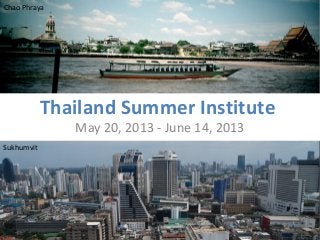
- 1. Chao Phraya Thailand Summer Institute May 20, 2013 - June 14, 2013 Sukhumvit
- 2. Thailand Summer Institute 2013 • "Communication Technology for Disaster Preparedness and Response Strategies” – Location: Bangkok, Thailand – Dates: May 20-31, 2013 • "New Approaches to Monitoring and Evaluation in Health and Development” – Location: Bangkok, Thailand – Dates: June 3-14, 2013
- 3. Instructors • Dr. William Bertrand • Dr. Elke de Buhr • Dr. Julie Hernandez
- 4. An Introduction to Bangkok, Thailand
- 5. Course #1: Communication Technology for Disaster Preparedness and Response Strategies • The Southeast Asian coastline is vulnerable to many natural disasters including the impact of tropical storms, typhoons, tsunamis, and flooding • During the most recent floods, 65 out of Thailand's 77 provinces were declared flood disaster zones • The Bangkok metropolitan area has experienced major flooding in 2010, 2011 and 2012 that inundated large parts of the city and surrounding territories
- 6. Course #1: Communication Technology for Disaster Preparedness and Response Strategies (cont.) • Introduction to the use of ICT for disaster mitigation including disaster preparedness education as well as technology applications during and after disasters (immediate response and relief, and long term recovery) • Case Studies of successful (and unsuccessful) applications of technology in disaster settings • Integrated approach to larger disaster issues: Complex emergencies, epidemic outbreak EWI and monitoring, emergency information systems • Field visits: Local and international NGOs, site visits
- 7. Course #2: "New Approaches to Monitoring and Evaluation in Health and Development” • Thailand has seen major improvements in all sectors of health and development • Life expectancy increased to approximately 70 years at birth, the vast majority of the population now has access to safe drinking water and sanitation, and a system providing universal health care for Thai nationals was introduced in 2002 • Yet, serious challenges remain, which include the management of HIV/AIDS, tuberculosis, malaria and other infectious diseases
- 8. Course #2: "New Approaches to Monitoring and Evaluation in Health and Development” (cont.) • Introduction to M&E of health and development interventions: – Study established and new approaches to M&E at the case of the HIV/AIDS response in Thailand and other examples from the local context – Assess the ability of a specific evaluation method or combination of methods to measure both the process and impact of an intervention – Learn how to design and execute an evaluation project with assistance • Field visits: International organizations and local and international NGOs working on health and development in Thailand
- 9. Field Research • Course #1: Technology for Disaster Preparedness and Response Strategies – Students will compare and evaluate ICT applications that have been tested in the context of South Asian disasters – They will design and implement targeted tools for field testing in Bangkok • Course #2: Monitoring and Evaluation – Students will assess the M&E strategy of a local health or development organization covering process, outcome and impact measures
- 10. Course Logistics • Teaching: – Lectures, including guest speakers (mostly in the mornings) – Site visits/field trips, and group work (mostly afternoons, sometimes all day) • Housing and Meals: – Single or shared rooms (max. two students per room) – Included meals: Breakfast, lunch and two coffee breaks Bourbon Street Hotel (Bangkok)
- 11. Ayutthaya Field Trips Grand Palace
- 12. Questions?