Testable JavaScript
Architecting Your Application for
Testability
Mark Ethan Trostler
Google Inc.
twitter: @zzoass
mark@zzo.com
Loose
Coupling
Tight
Focus
No
Surprises
What Is Testability?
Minimal
Tedium
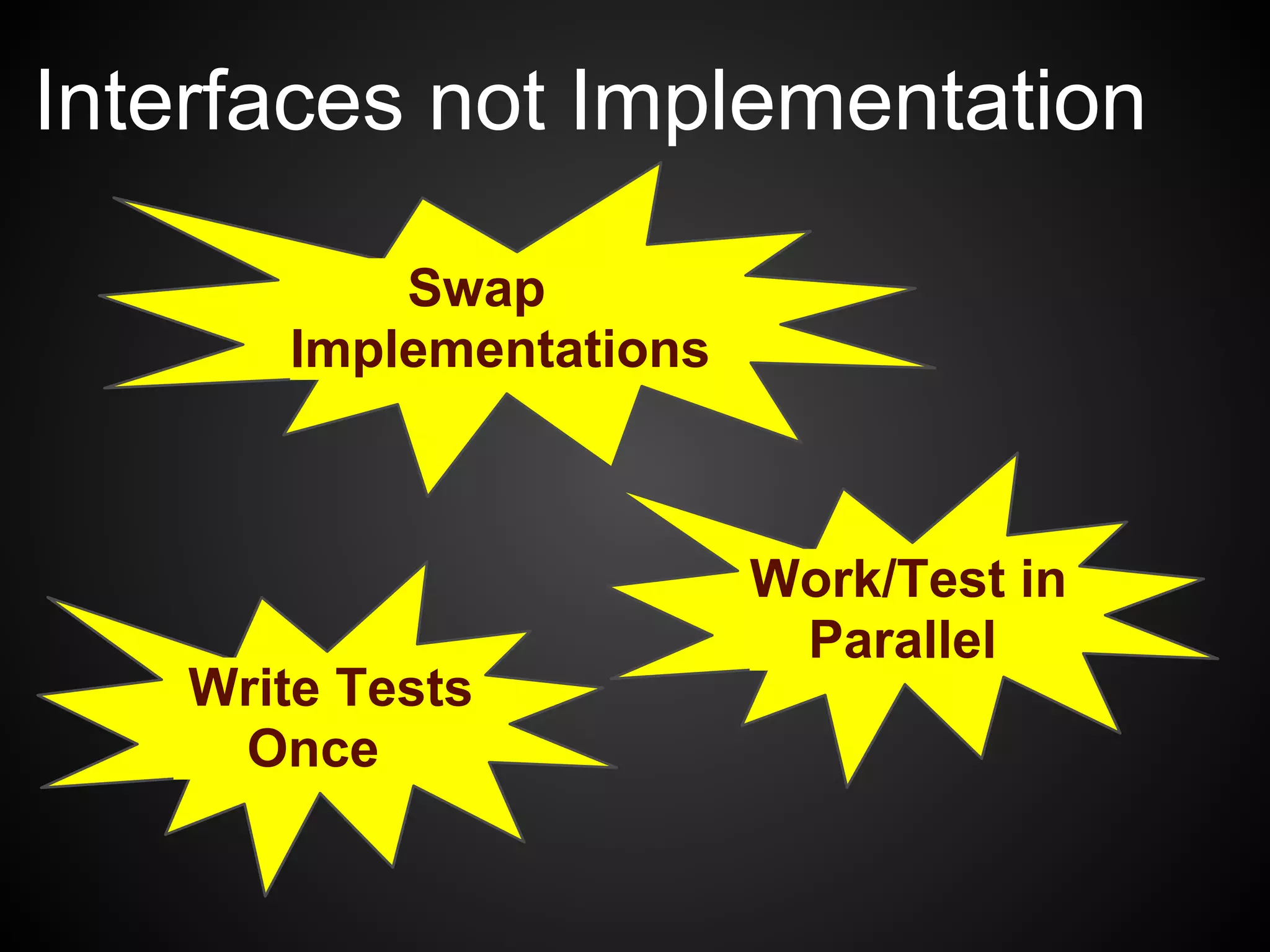
Swap
Implementations
Work/Test in
Parallel
Interfaces not Implementation
Write Tests
Once
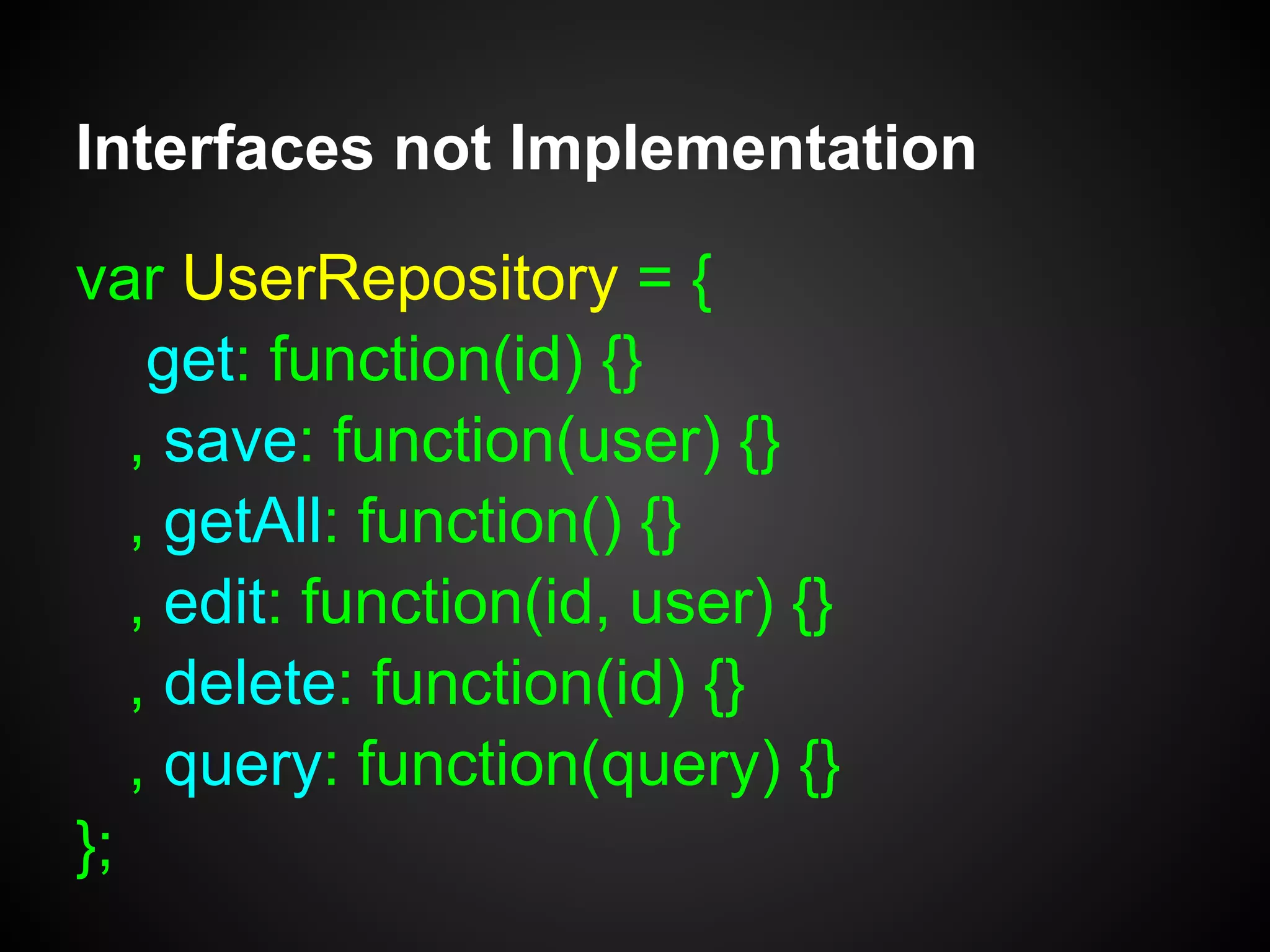
Interfaces not Implementation
var UserRepository = {
get: function(id) {}
, save: function(user) {}
, getAll: function() {}
, edit: function(id, user) {}
, delete: function(id) {}
, query: function(query) {}
};
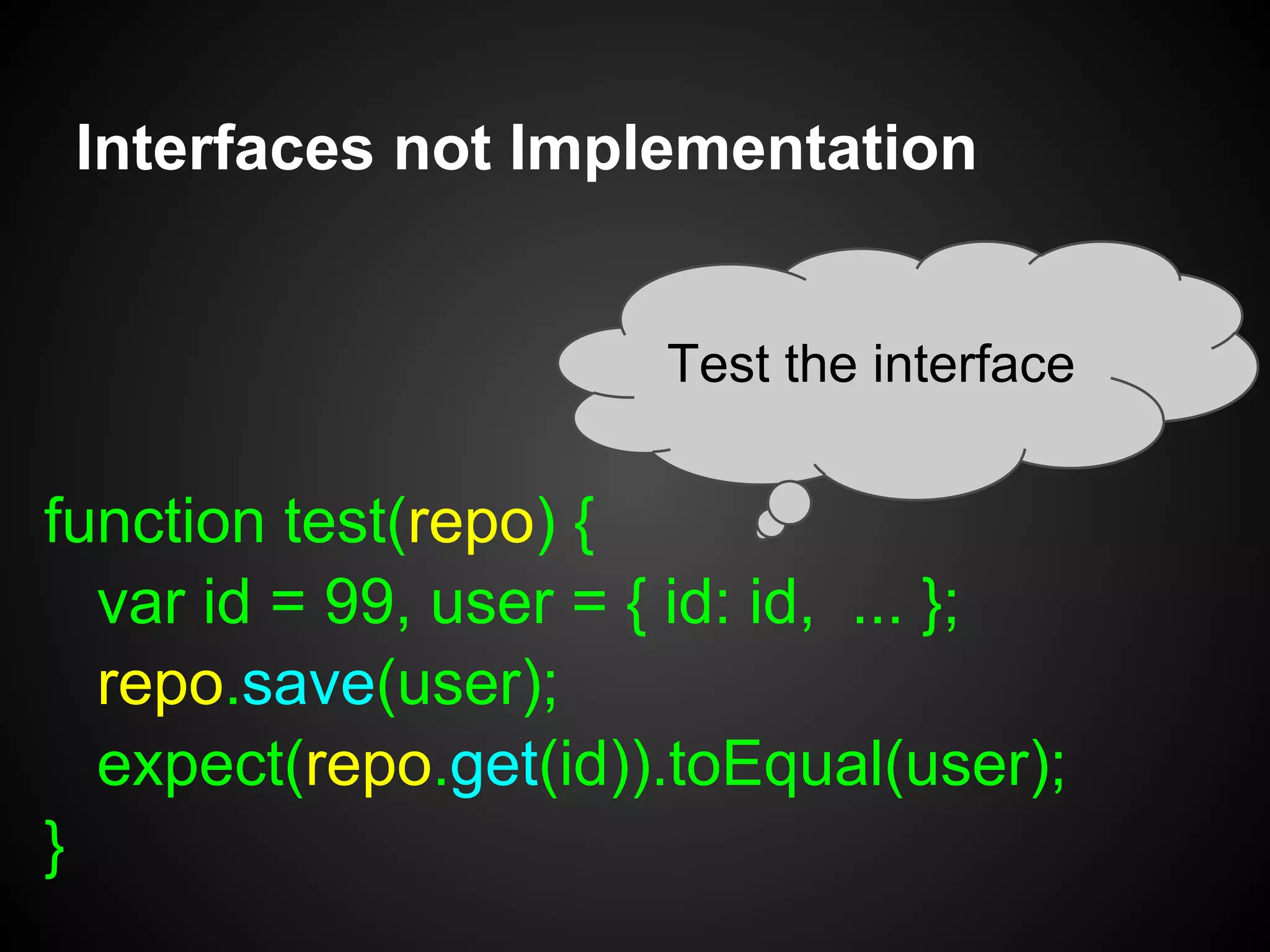
Interfaces not Implementation
function test(repo) {
var id = 99, user = { id: id, ... };
repo.save(user);
expect(repo.get(id)).toEqual(user);
}
Test the interface
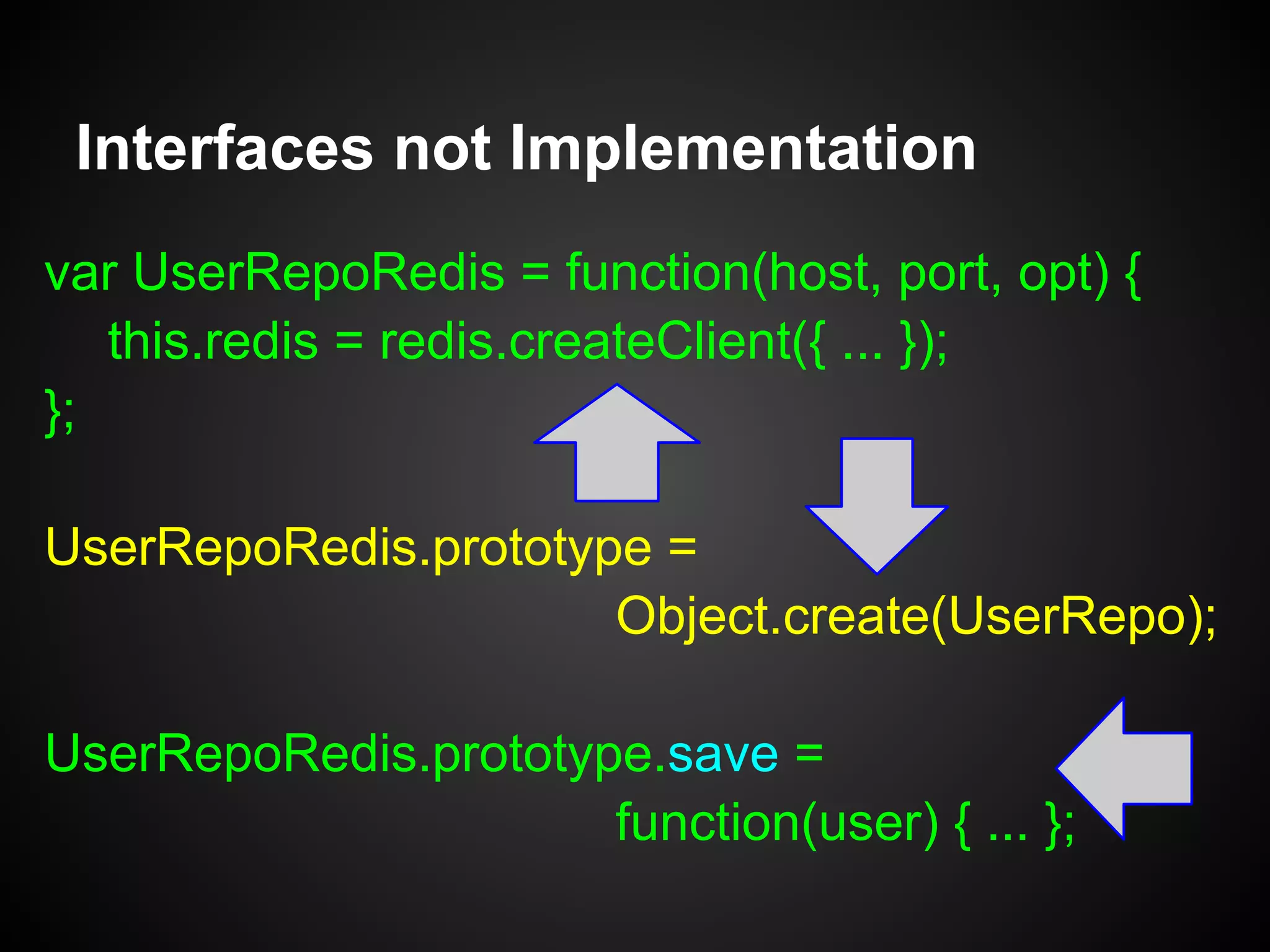
Interfaces not Implementation
var UserRepoRedis = function(host, port, opt) {
this.redis = redis.createClient({ ... });
};
UserRepoRedis.prototype =
Object.create(UserRepo);
UserRepoRedis.prototype.save =
function(user) { ... };
Interfaces not Implementation
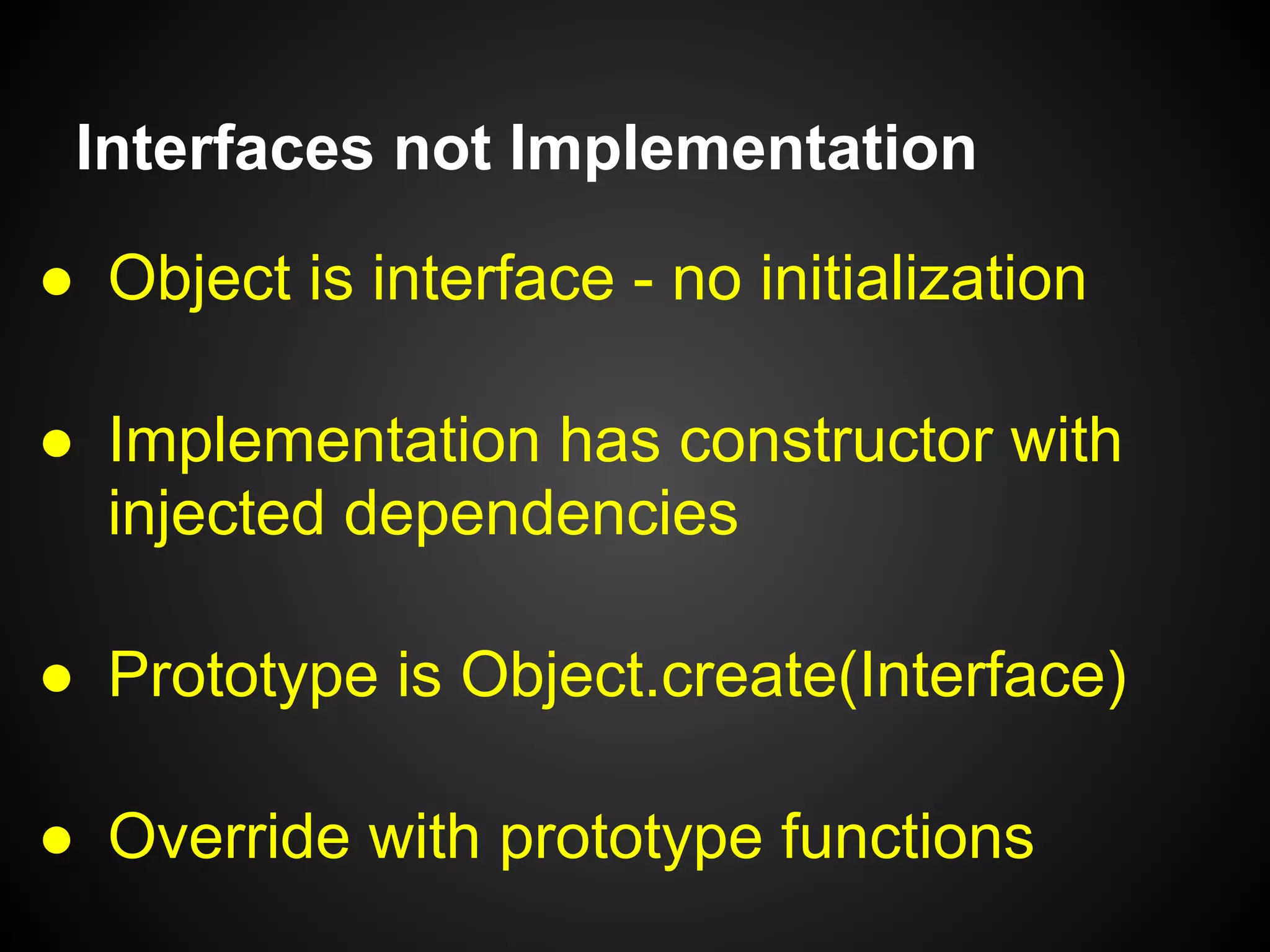
• Object is interface - no initialization
• Implementation has constructor with
injected dependencies
• Prototype is Object.create(Interface)
• Override with prototype functions
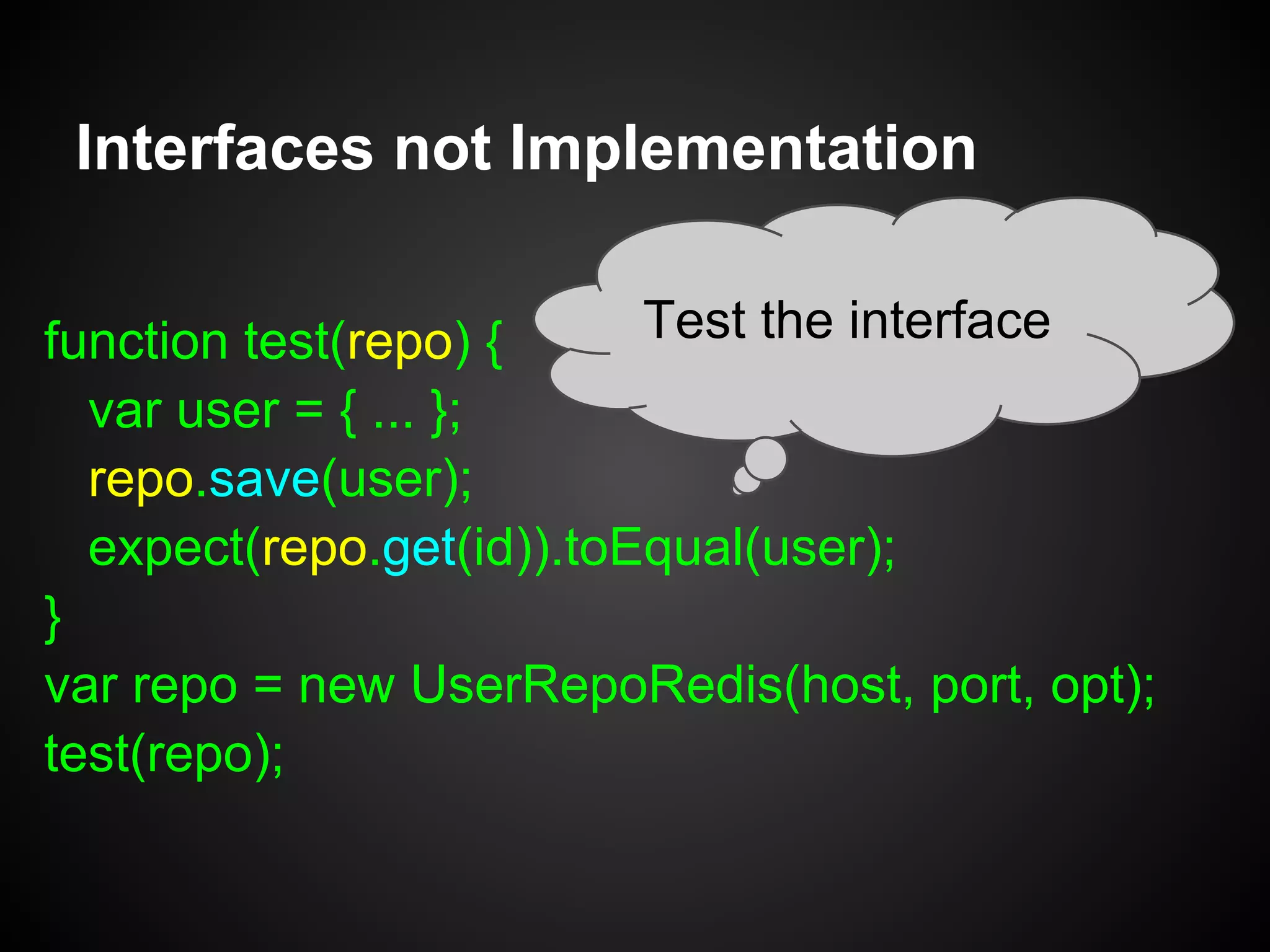
Interfaces not Implementation
function test(repo) {
var user = { ... };
repo.save(user);
expect(repo.get(id)).toEqual(user);
}
var repo = new UserRepoRedis(host, port, opt);
test(repo);
Test the interface
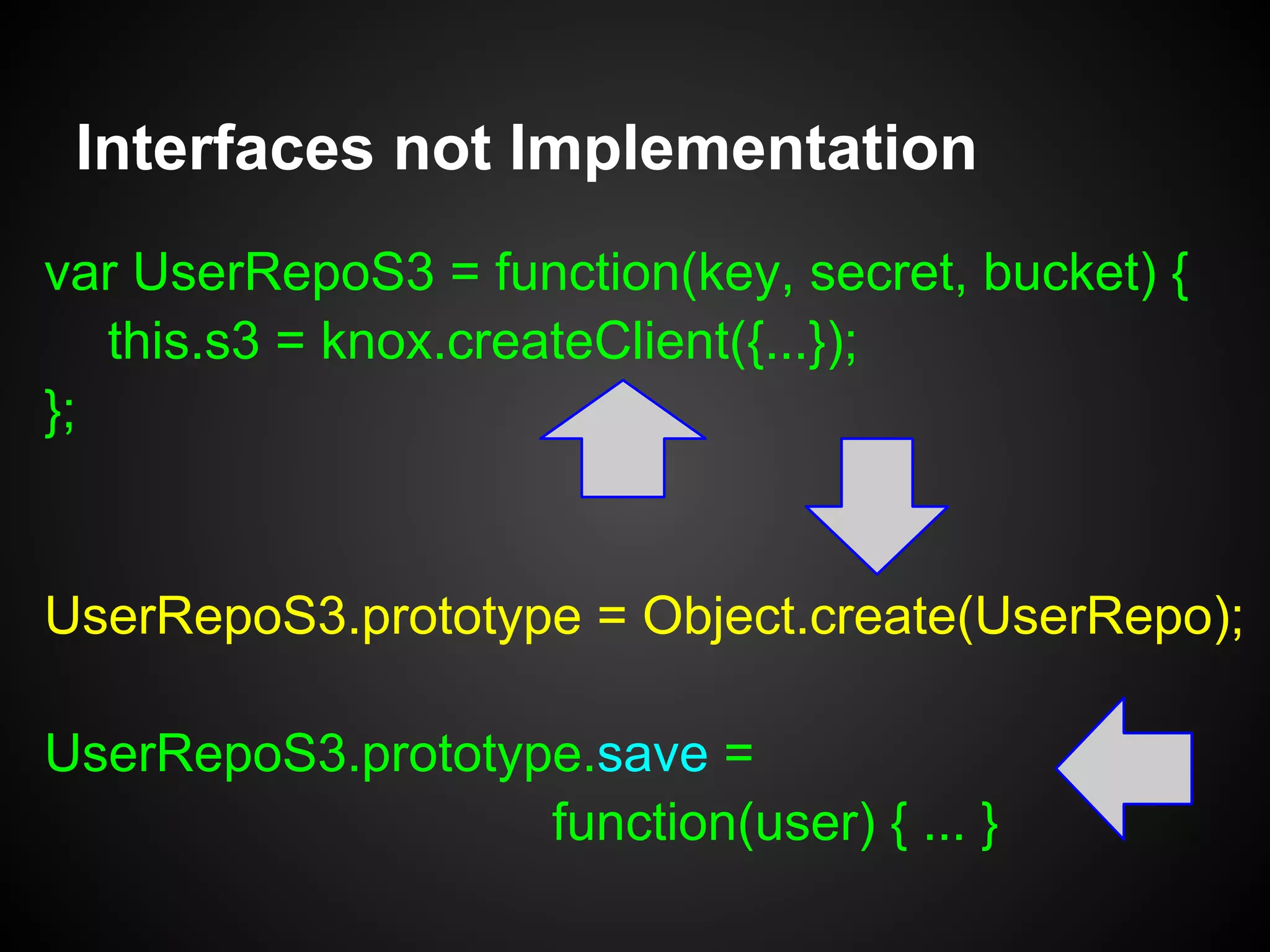
Interfaces not Implementation
var UserRepoS3 = function(key, secret, bucket) {
this.s3 = knox.createClient({...});
};
UserRepoS3.prototype = Object.create(UserRepo);
UserRepoS3.prototype.save =
function(user) { ... }
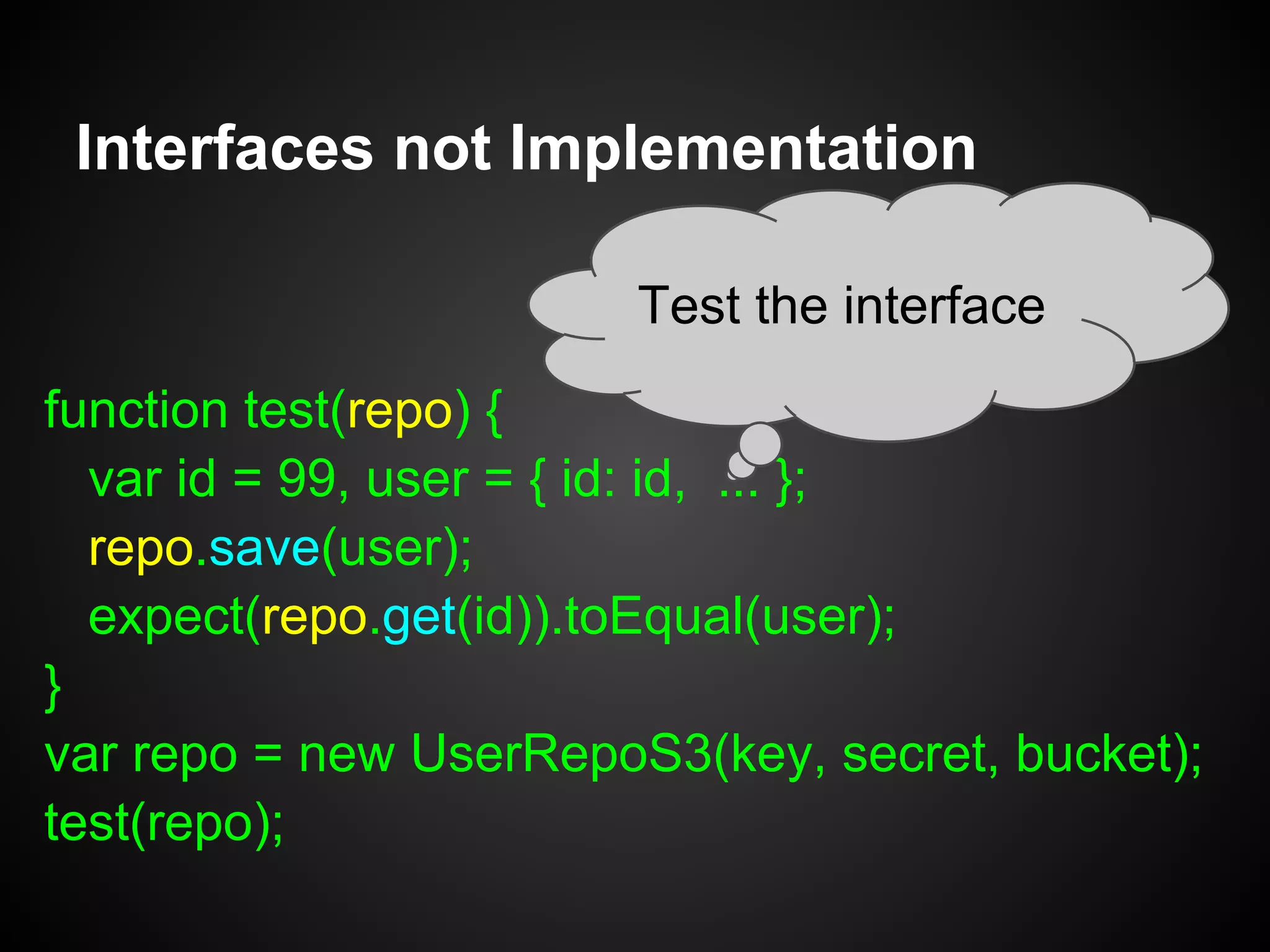
Interfaces not Implementation
function test(repo) {
var id = 99, user = { id: id, ... };
repo.save(user);
expect(repo.get(id)).toEqual(user);
}
var repo = new UserRepoS3(key, secret, bucket);
test(repo);
Test the interface
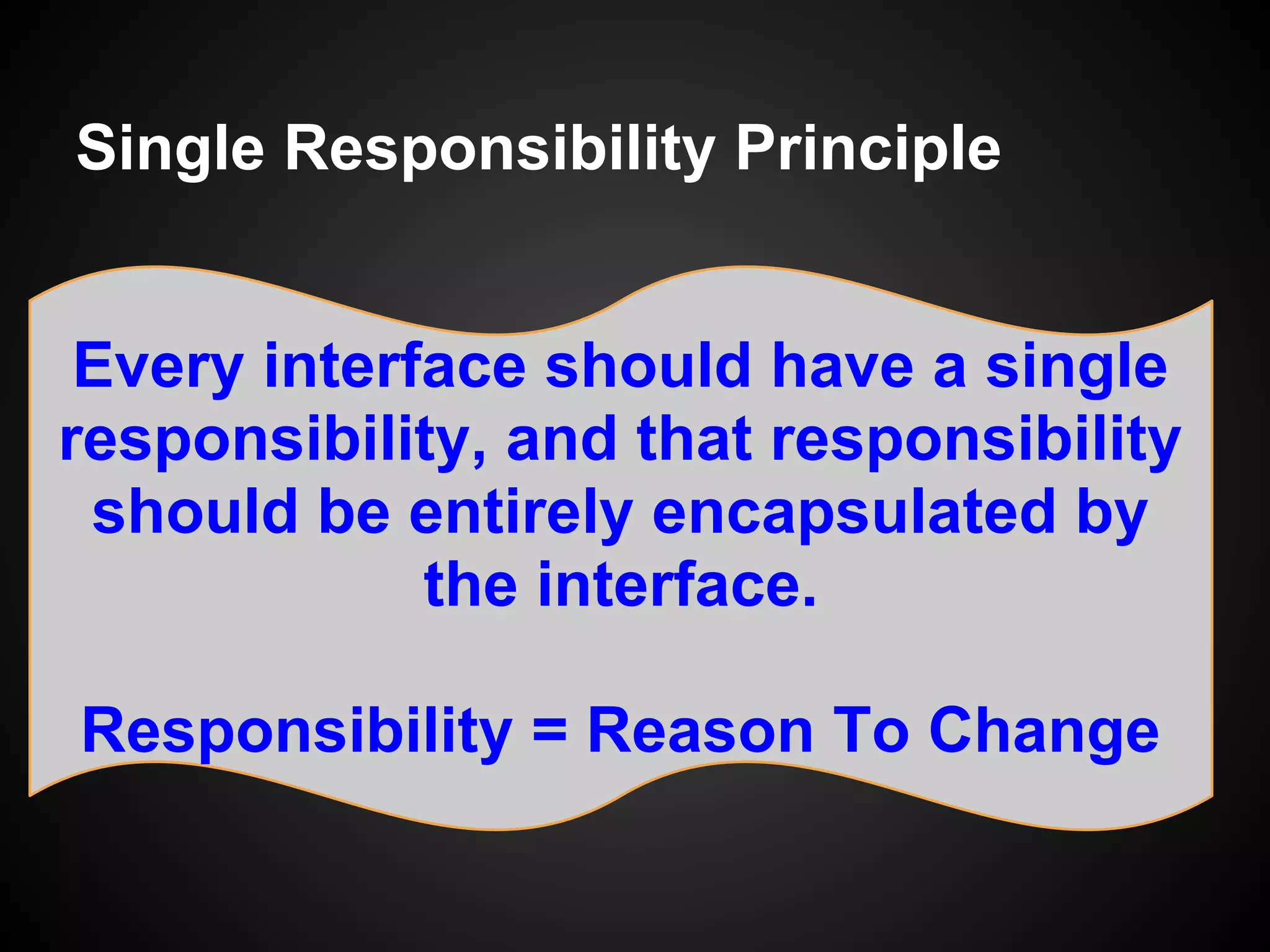
Single Responsibility Principle
Every interface should have a single
responsibility, and that responsibility
should be entirely encapsulated by
the interface.
Responsibility = Reason To Change
Interface Segregation Principle
No object should be forced
to depend on methods it
does not use.
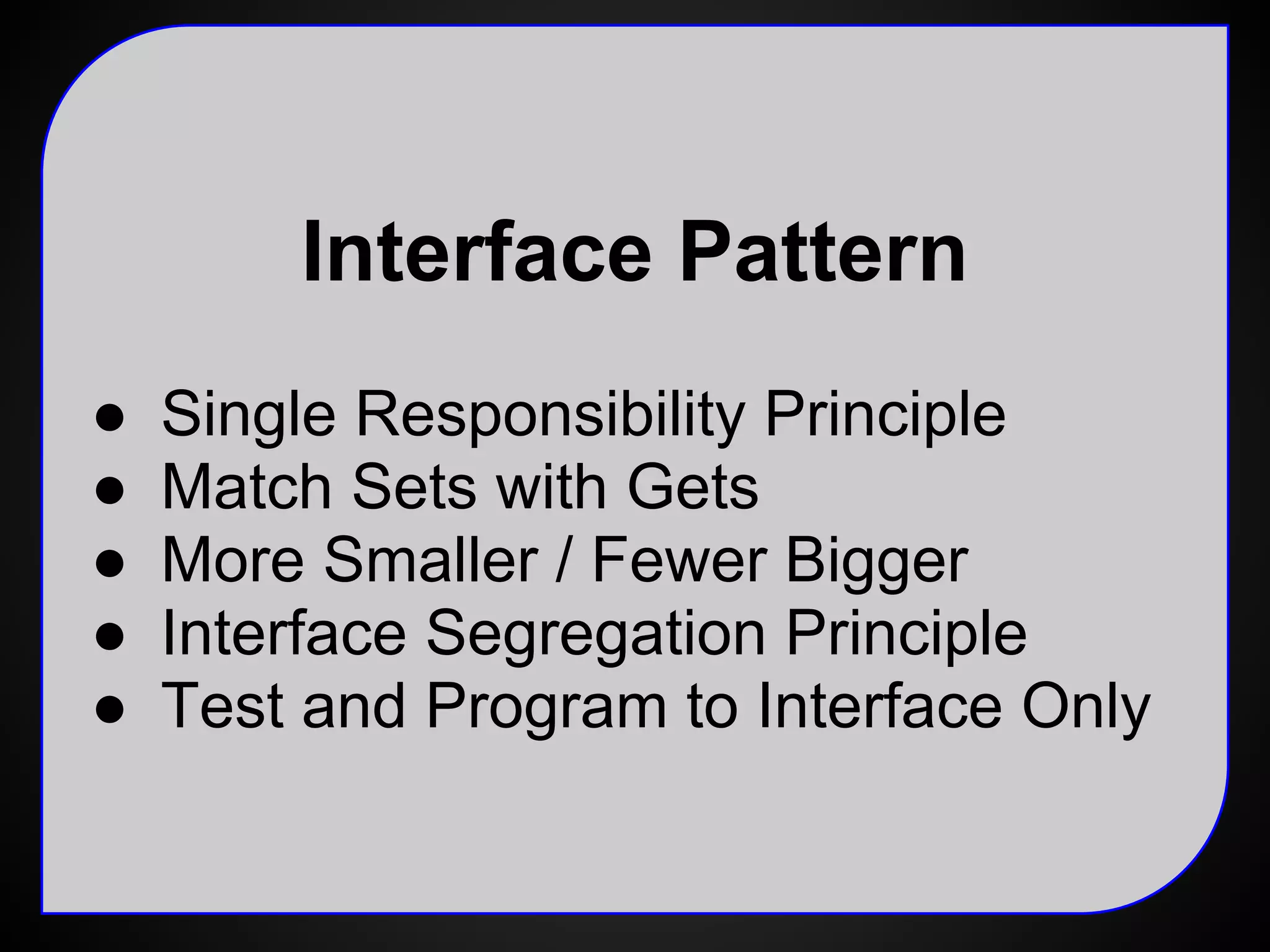
Interface Pattern
• Single Responsibility Principle
• Match Sets with Gets
• More Smaller / Fewer Bigger
• Interface Segregation Principle
• Test and Program to Interface Only
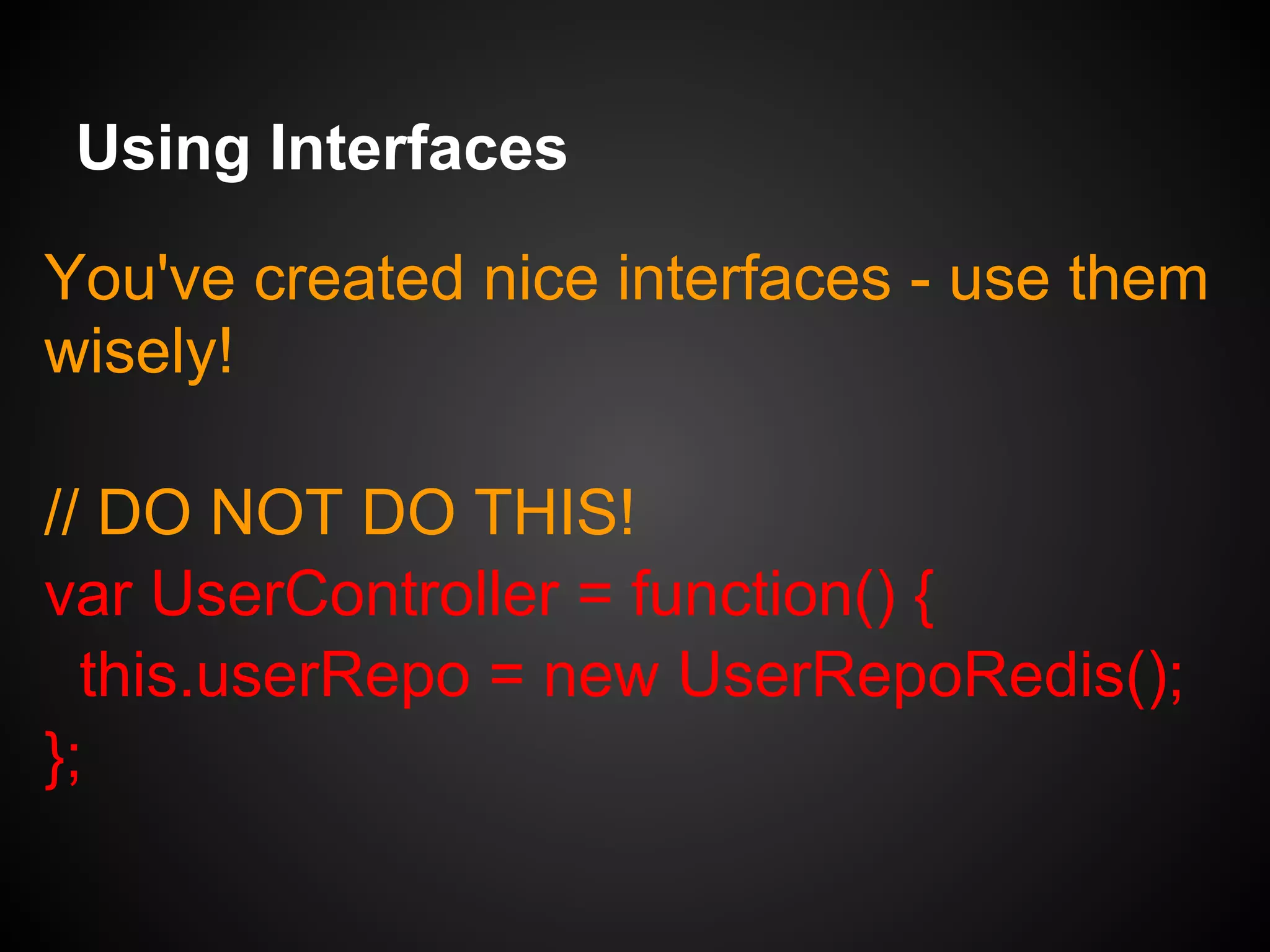
Using Interfaces
You've created nice interfaces - use them
wisely!
// DO NOT DO THIS!
var UserController = function() {
this.userRepo = new UserRepoRedis();
};
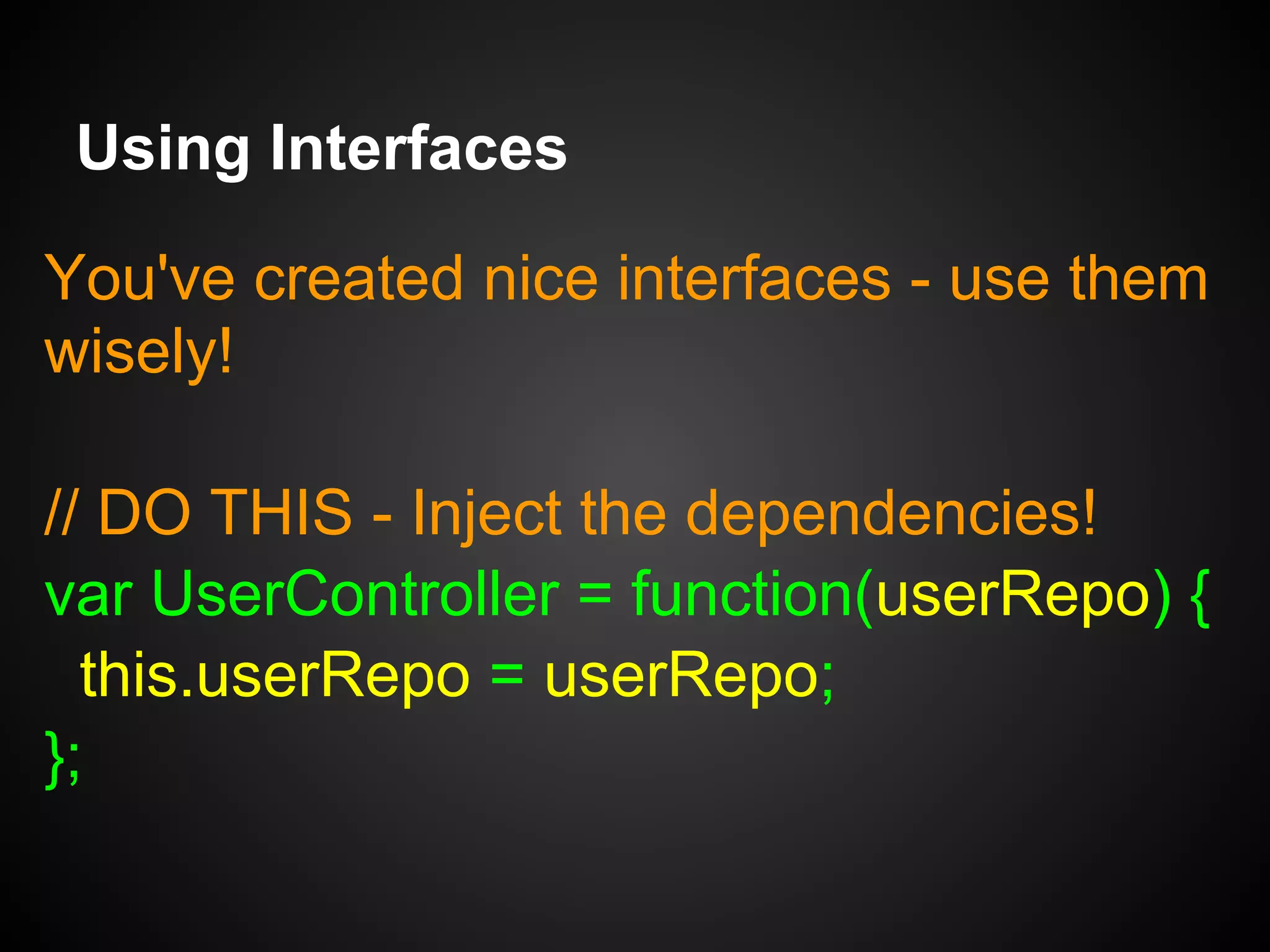
Using Interfaces
You've created nice interfaces - use them
wisely!
// DO THIS - Inject the dependencies!
var UserController = function(userRepo) {
this.userRepo = userRepo;
};
Liskov Substitution Principle
Any objects that implement
an interface can be used
interchangeably
Constructor Injection
All dependencies should be injected into your
object's constructor*.
•  Make dependencies explicit
•  Loose coupling
•  Cannot instantiate a non-usable Object
* Except:
•  runtime dependencies
•  objects with a shorter lifetime
Instantiating Implementations
So do all dependees need to provide fully
initialized objects to their dependents when
instantiating them?
NO - THEY DO NOT INSTANTIATE THEM!
Object Creation vs. Object Use
•  ensures a loosely coupled system
•  ensures testability
Object Creation vs. Object Use
creation
Happens one time at the Composition Root.
All Objects* are created/wired together at
this time
•  startup
•  Request
use
Happens all the time throughout the application
Object Creation
What creates the objects?
Forces specification of dependencies and
their lifespan
•  DIY DI
•  wire.js / cujojs
•  Inverted
•  Intravenous
•  AngularJS
whole lotta others...
Cross-Cutting Concerns
What about the crap I might need?
•  Logging
•  Auditing
•  Profiling
•  Security
•  Caching
•  ....
"Cross-cutting concerns"
Cross-Cutting Concerns
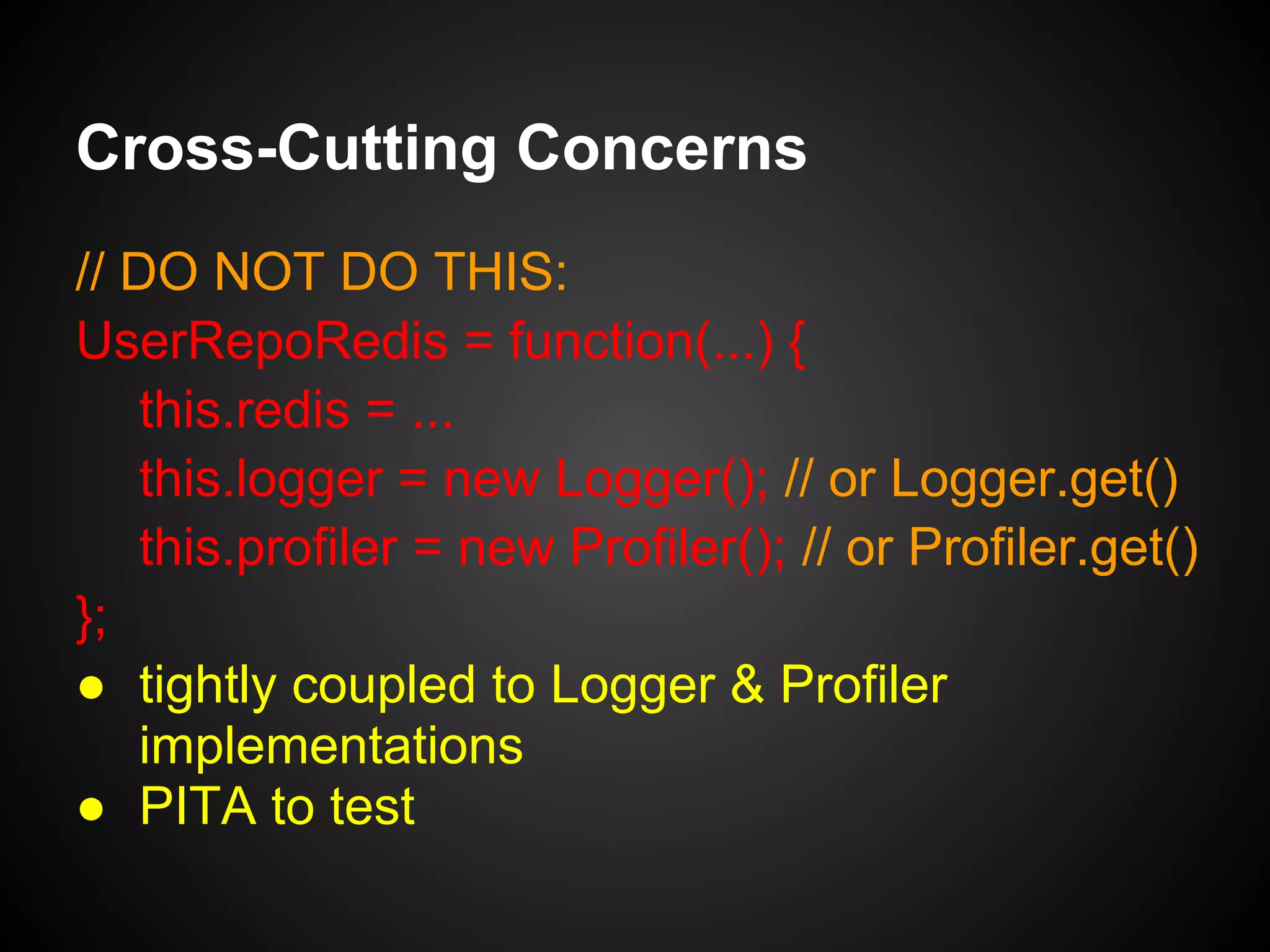
// DO NOT DO THIS:
UserRepoRedis = function(...) {
this.redis = ...
this.logger = new Logger(); // or Logger.get()
this.profiler = new Profiler(); // or Profiler.get()
};
•  tightly coupled to Logger & Profiler
implementations
•  PITA to test
Cross-Cutting Concerns
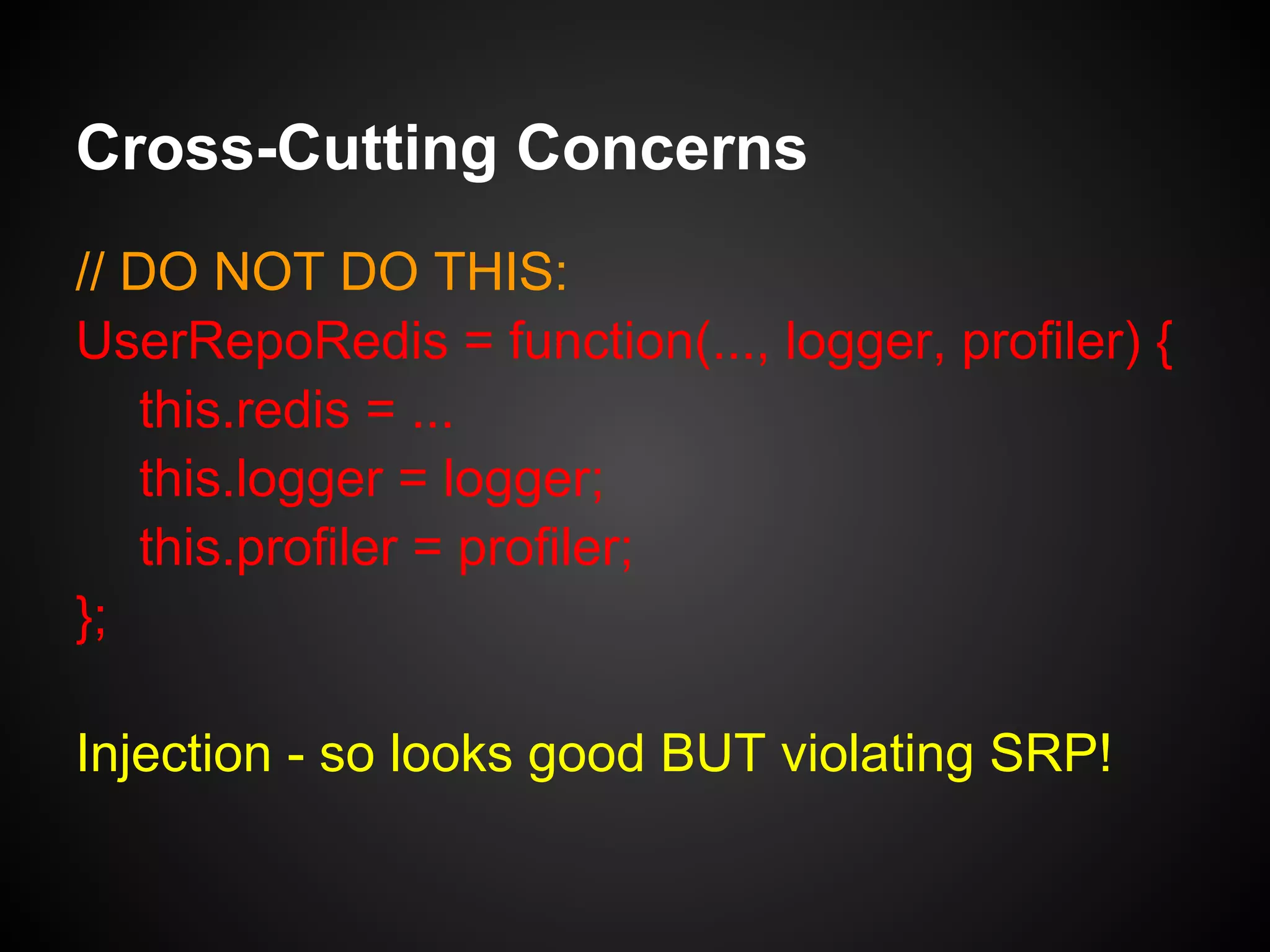
// DO NOT DO THIS:
UserRepoRedis = function(..., logger, profiler) {
this.redis = ...
this.logger = logger;
this.profiler = profiler;
};
Injection - so looks good BUT violating SRP!
Cross-Cutting Concerns
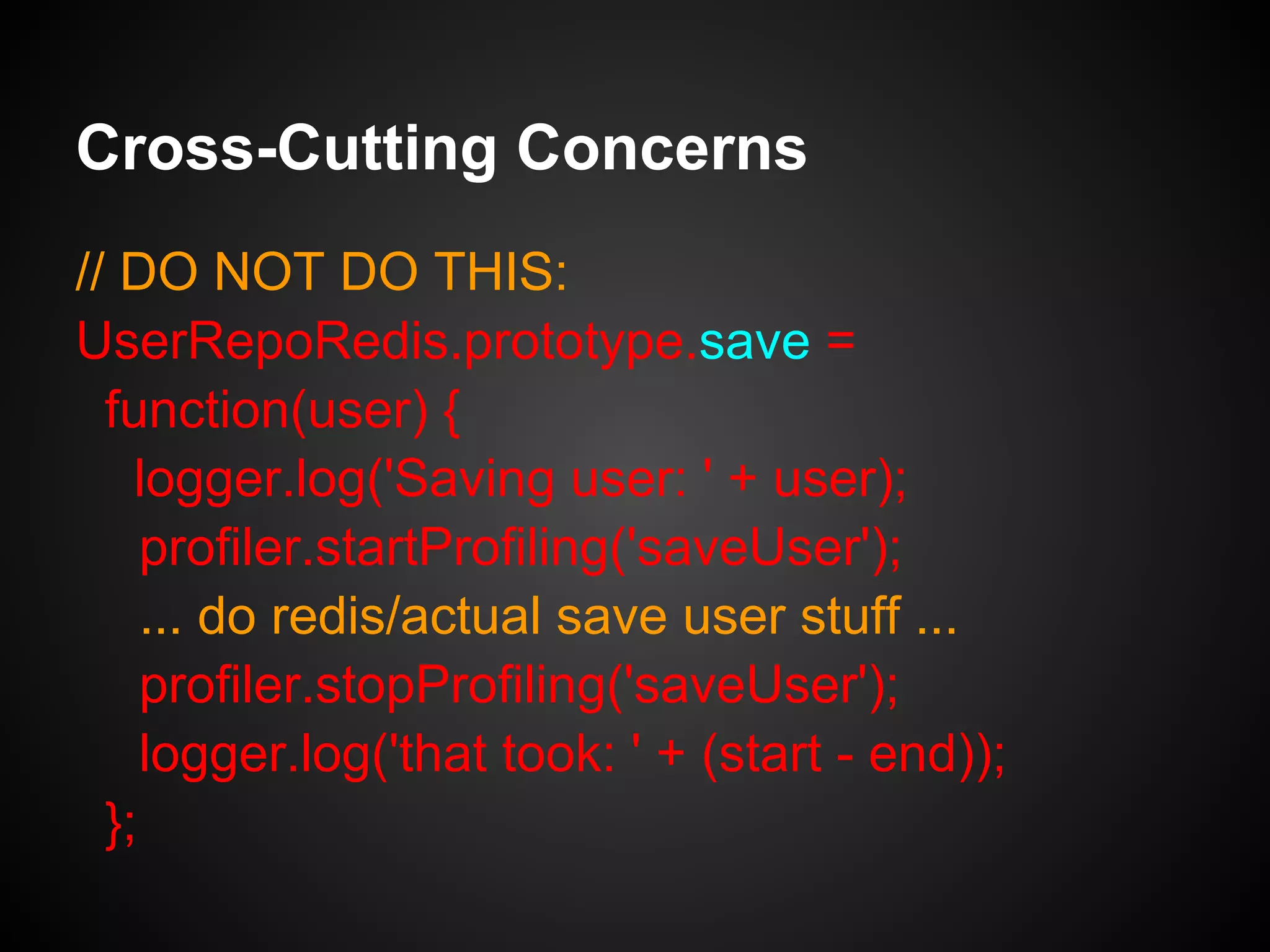
// DO NOT DO THIS:
UserRepoRedis.prototype.save =
function(user) {
logger.log('Saving user: ' + user);
profiler.startProfiling('saveUser');
... do redis/actual save user stuff ...
profiler.stopProfiling('saveUser');
logger.log('that took: ' + (start - end));
};
Cross-Cutting Concerns
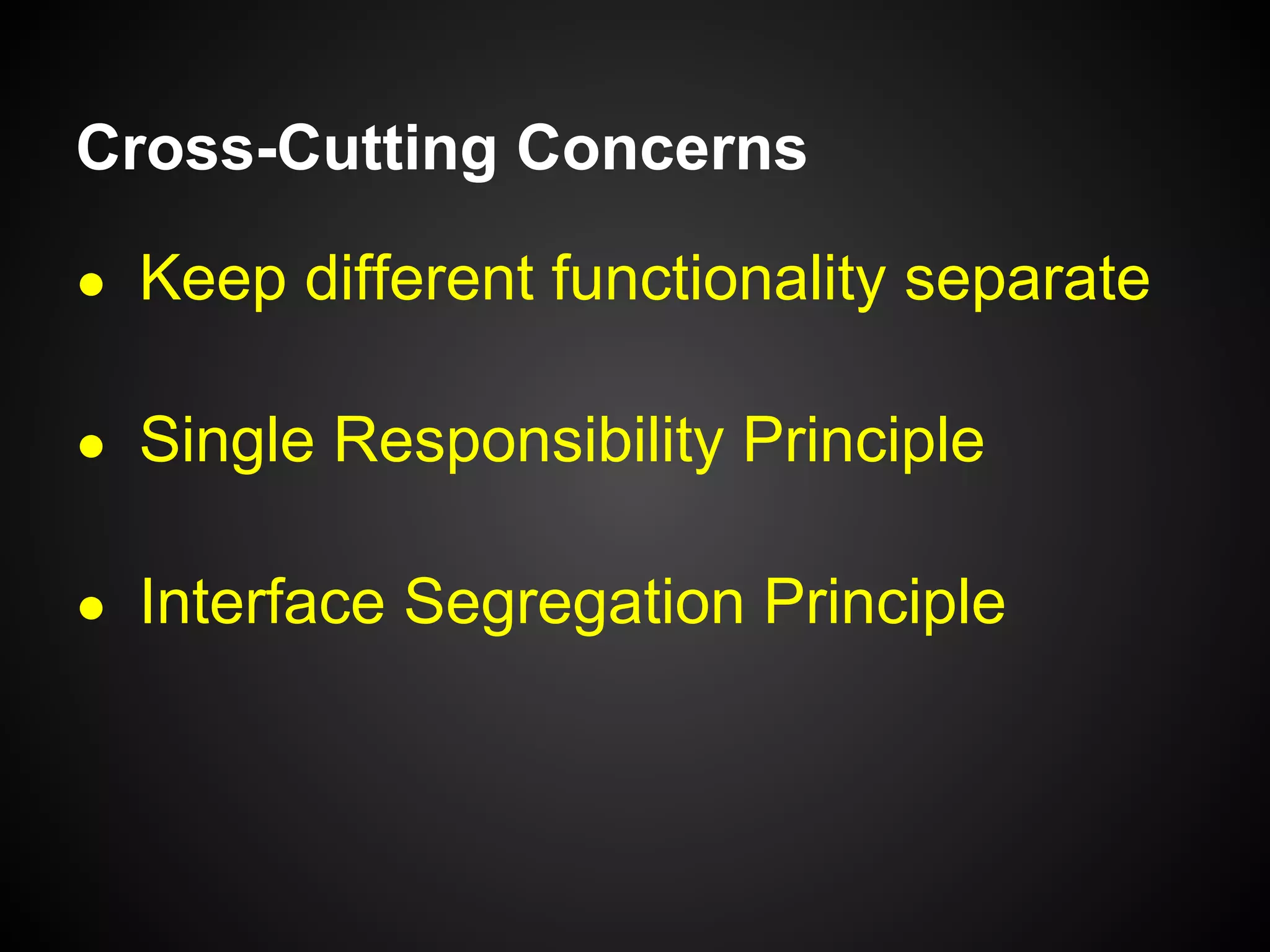
•  Keep different functionality separate
•  Single Responsibility Principle
•  Interface Segregation Principle
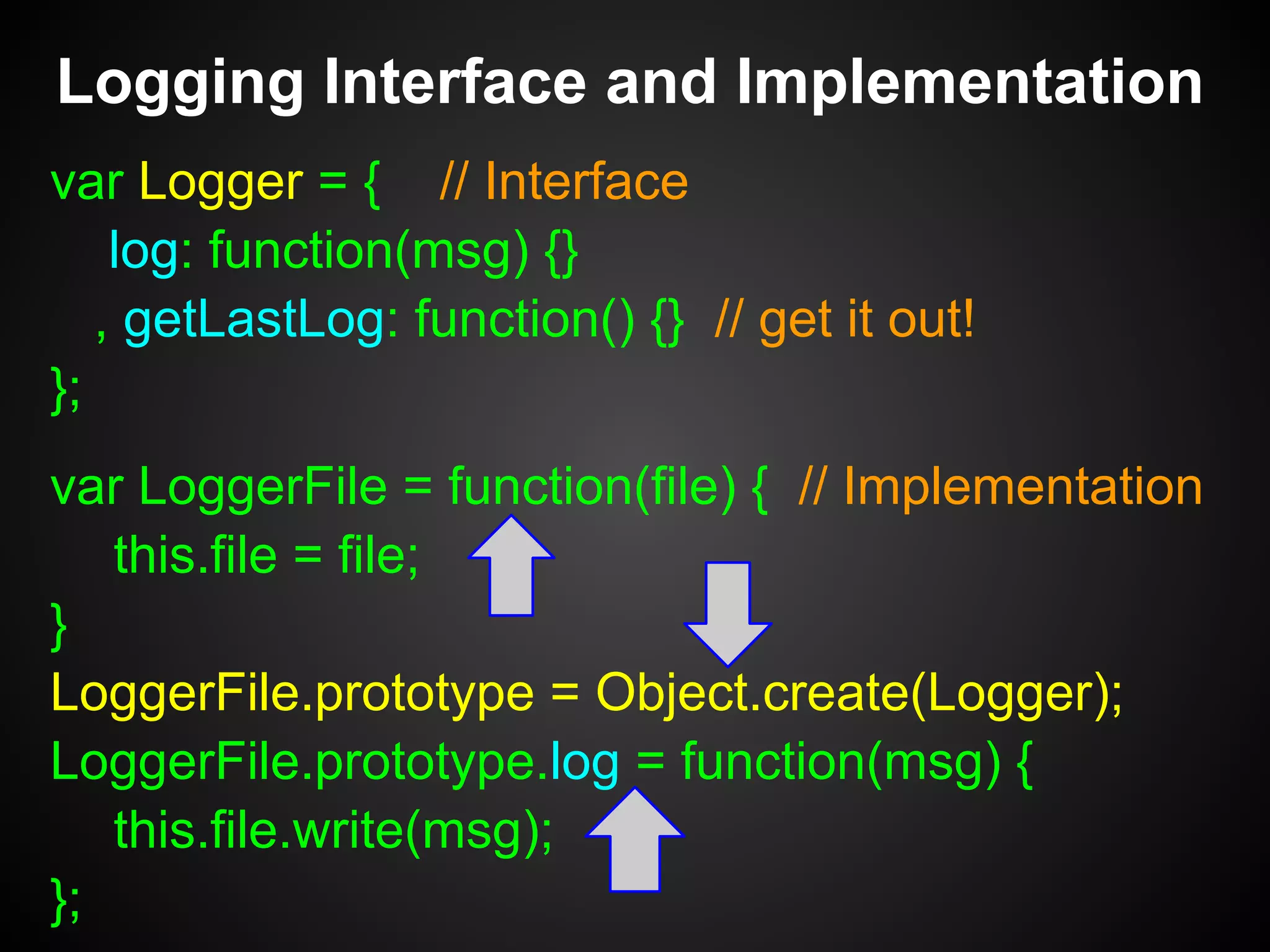
var LoggerFile = function(file) { // Implementation
this.file = file;
}
LoggerFile.prototype = Object.create(Logger);
LoggerFile.prototype.log = function(msg) {
this.file.write(msg);
};
Logging Interface and Implementation
var Logger = { // Interface
log: function(msg) {}
, getLastLog: function() {} // get it out!
};
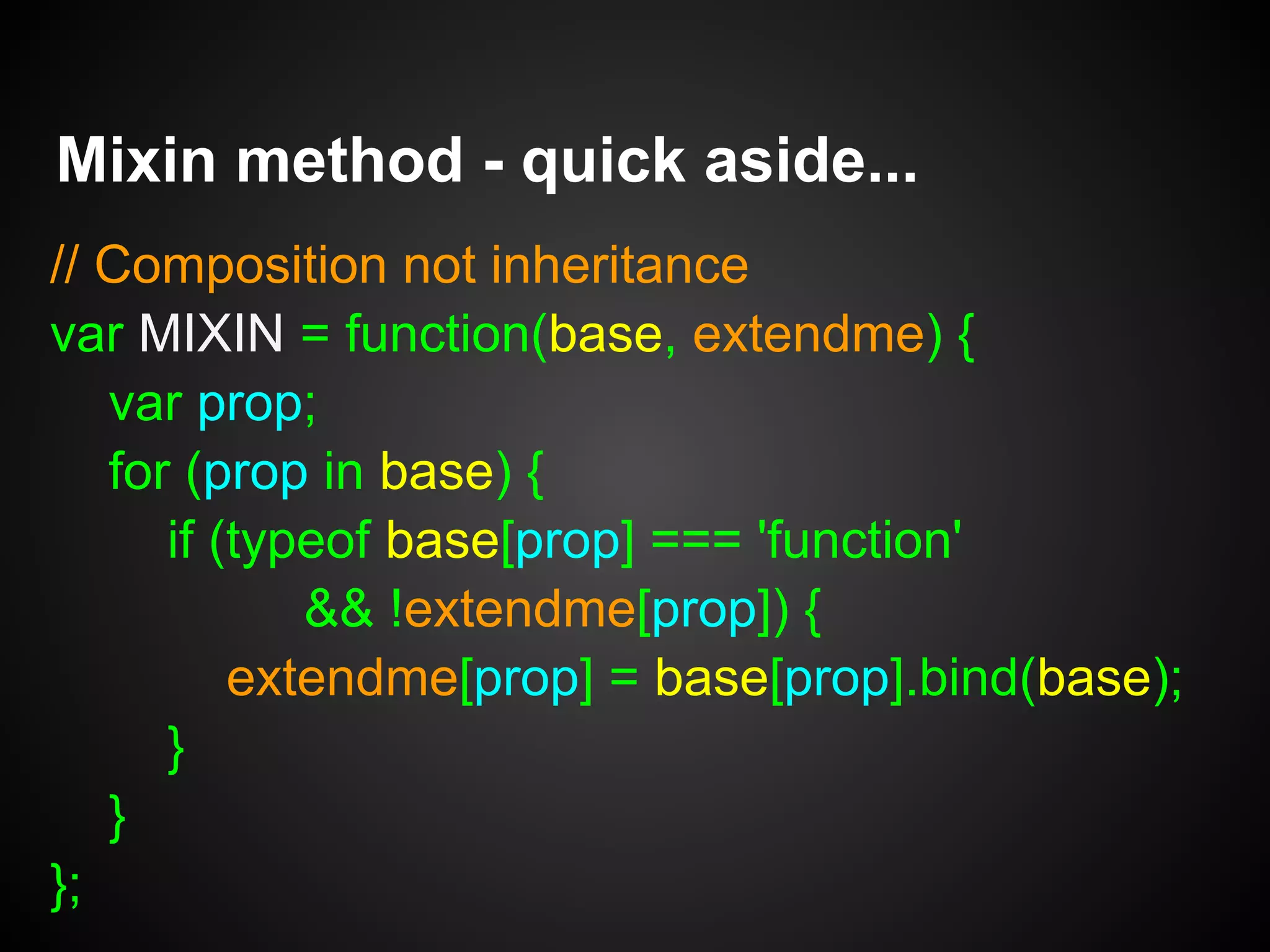
Mixin method - quick aside...
// Composition not inheritance
var MIXIN = function(base, extendme) {
var prop;
for (prop in base) {
if (typeof base[prop] === 'function'
&& !extendme[prop]) {
extendme[prop] = base[prop].bind(base);
}
}
};
Decorator
var UserRepoLogger = function(repo, logger) {
this.innerRepo = repo;
this.logger = logger;
MIXIN(repo, this); // Mixin repo's methods
};
UserRepoLogger.prototype.save =
function(user) {
this.logger.log('Saving user: ' + user);
return this.innerRepo.save(user);
};
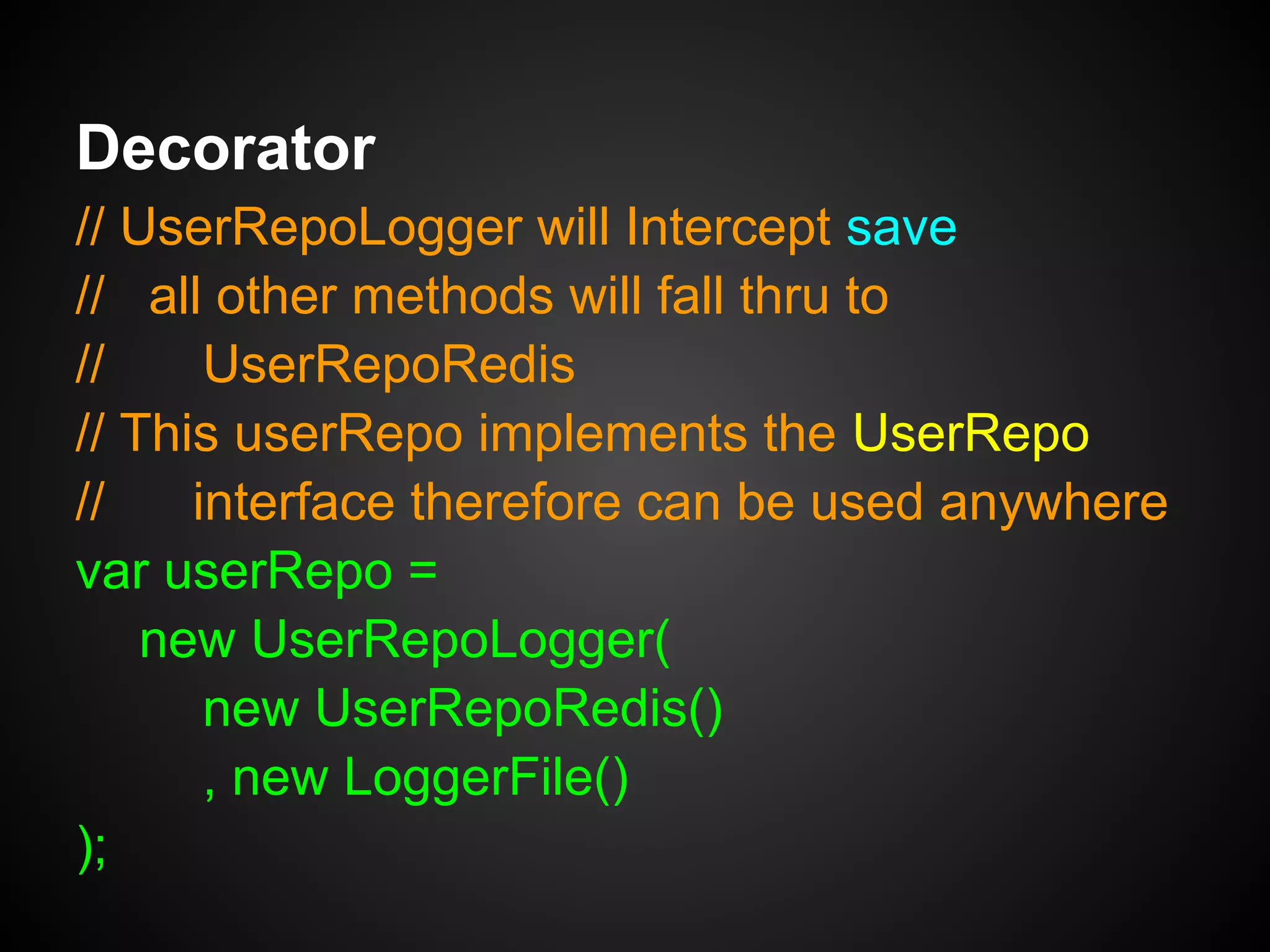
Decorator
// UserRepoLogger will Intercept save
// all other methods will fall thru to
// UserRepoRedis
// This userRepo implements the UserRepo
// interface therefore can be used anywhere
var userRepo =
new UserRepoLogger(
new UserRepoRedis()
, new LoggerFile()
);
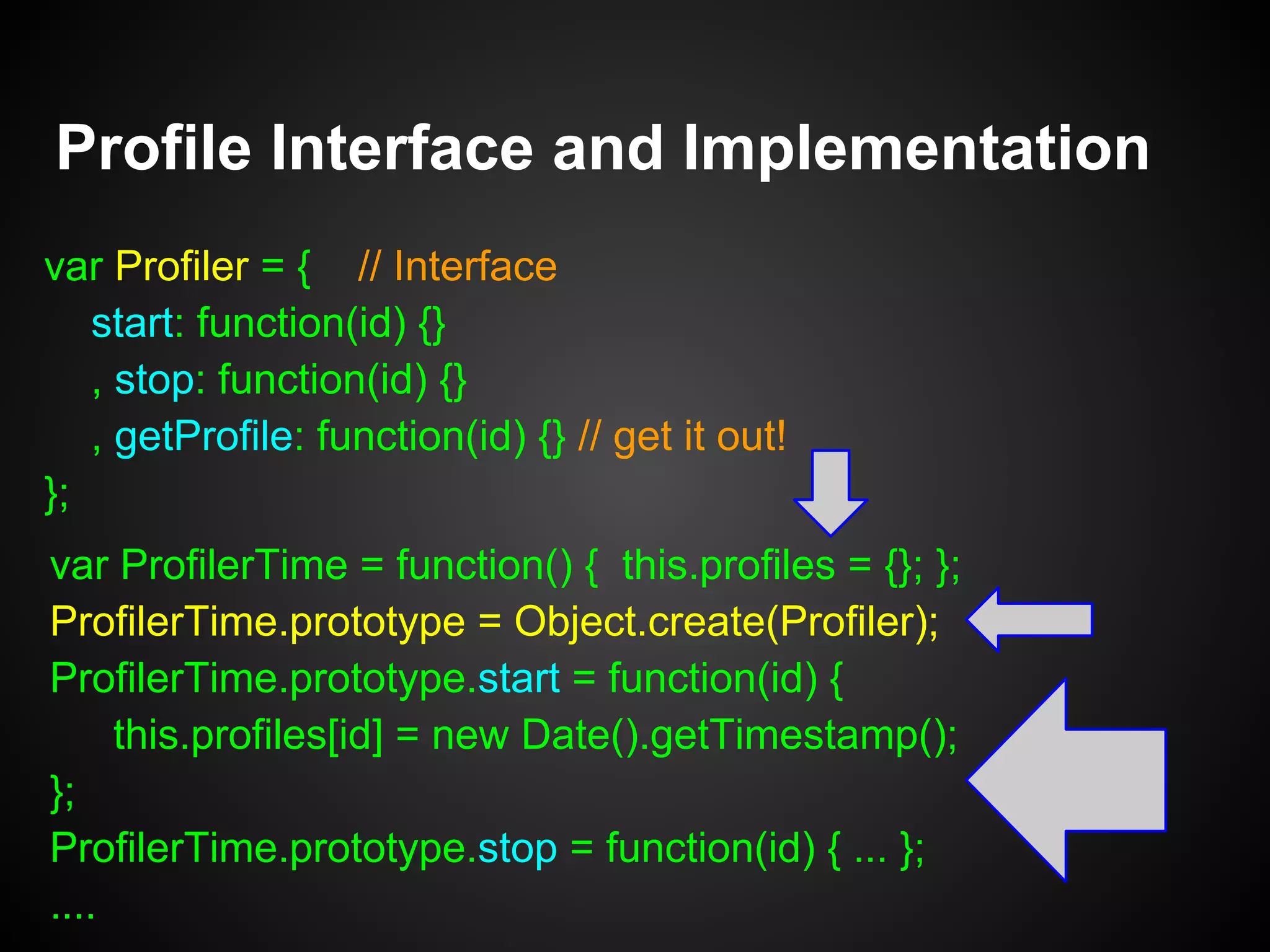
var ProfilerTime = function() { this.profiles = {}; };
ProfilerTime.prototype = Object.create(Profiler);
ProfilerTime.prototype.start = function(id) {
this.profiles[id] = new Date().getTimestamp();
};
ProfilerTime.prototype.stop = function(id) { ... };
....
Profile Interface and Implementation
var Profiler = { // Interface
start: function(id) {}
, stop: function(id) {}
, getProfile: function(id) {} // get it out!
};
Decorator
var UserRepoProfiler = function(repo, profiler) {
this.innerRepo = repo;
this.profiler = profiler;
MIXIN(repo, this); // Mixin repo's methods
};
UserRepoProfiler.prototype.save = f(user) {
this.profiler.start('save user');
this.innerRepo.save(user);
this.profiler.stop('save user');
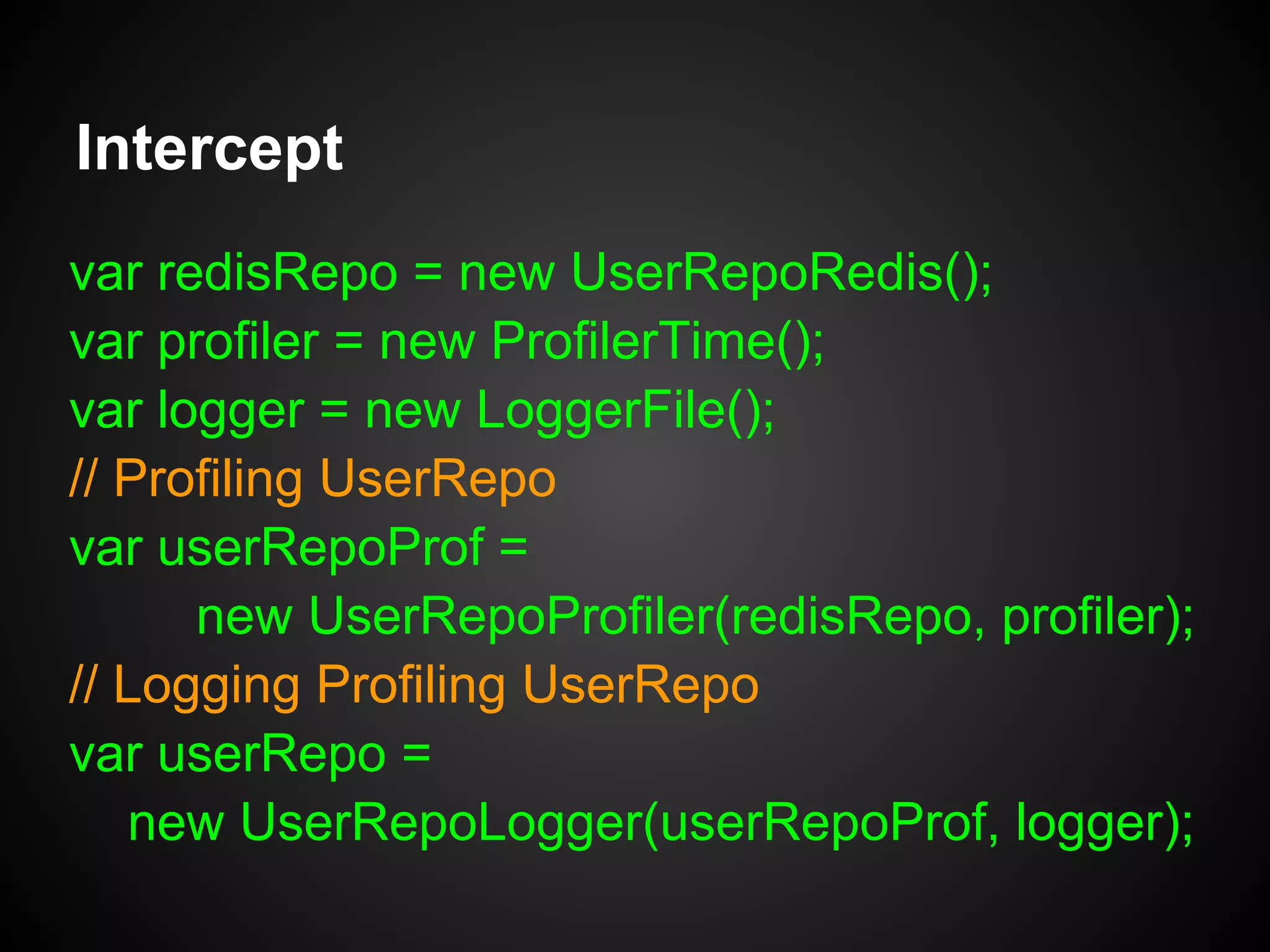
Intercept
var redisRepo = new UserRepoRedis();
var profiler = new ProfilerTime();
var logger = new LoggerFile();
// Profiling UserRepo
var userRepoProf =
new UserRepoProfiler(redisRepo, profiler);
// Logging Profiling UserRepo
var userRepo =
new UserRepoLogger(userRepoProf, logger);
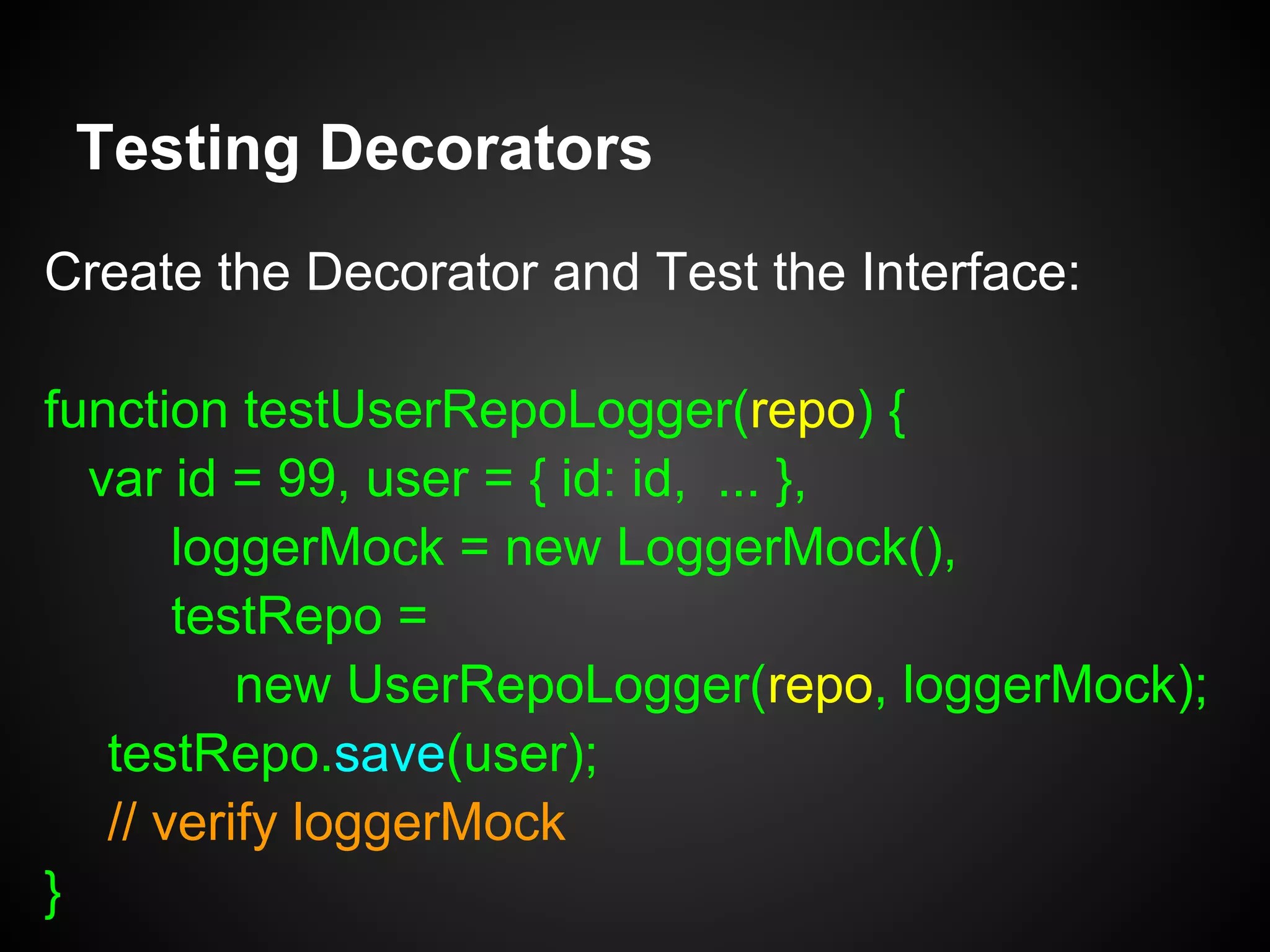
Testing Decorators
Create the Decorator and Test the Interface:
function testUserRepoLogger(repo) {
var id = 99, user = { id: id, ... },
loggerMock = new LoggerMock(),
testRepo =
new UserRepoLogger(repo, loggerMock);
testRepo.save(user);
// verify loggerMock
}
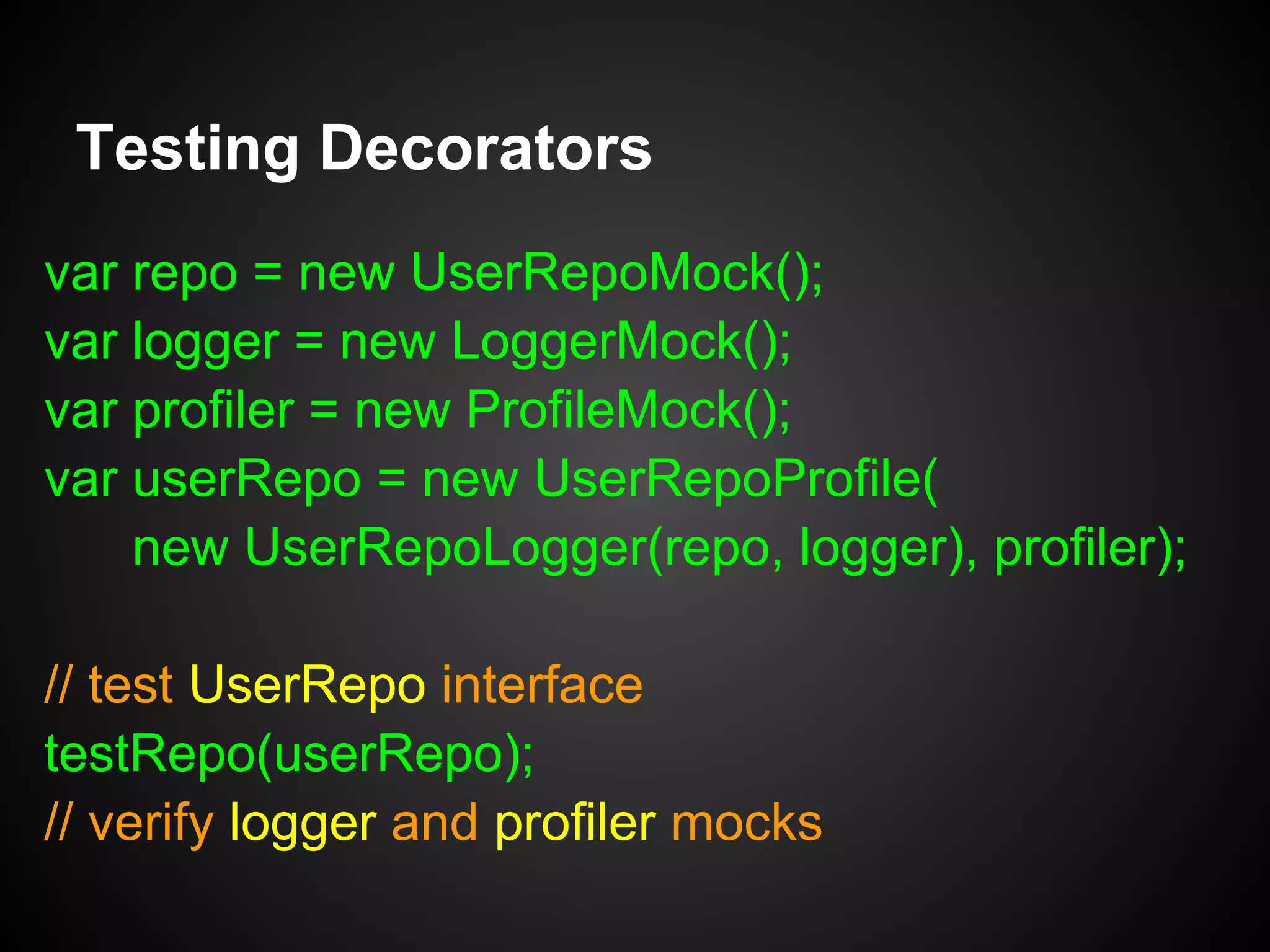
Testing Decorators
var repo = new UserRepoMock();
var logger = new LoggerMock();
var profiler = new ProfileMock();
var userRepo = new UserRepoProfile(
new UserRepoLogger(repo, logger), profiler);
// test UserRepo interface
testRepo(userRepo);
// verify logger and profiler mocks
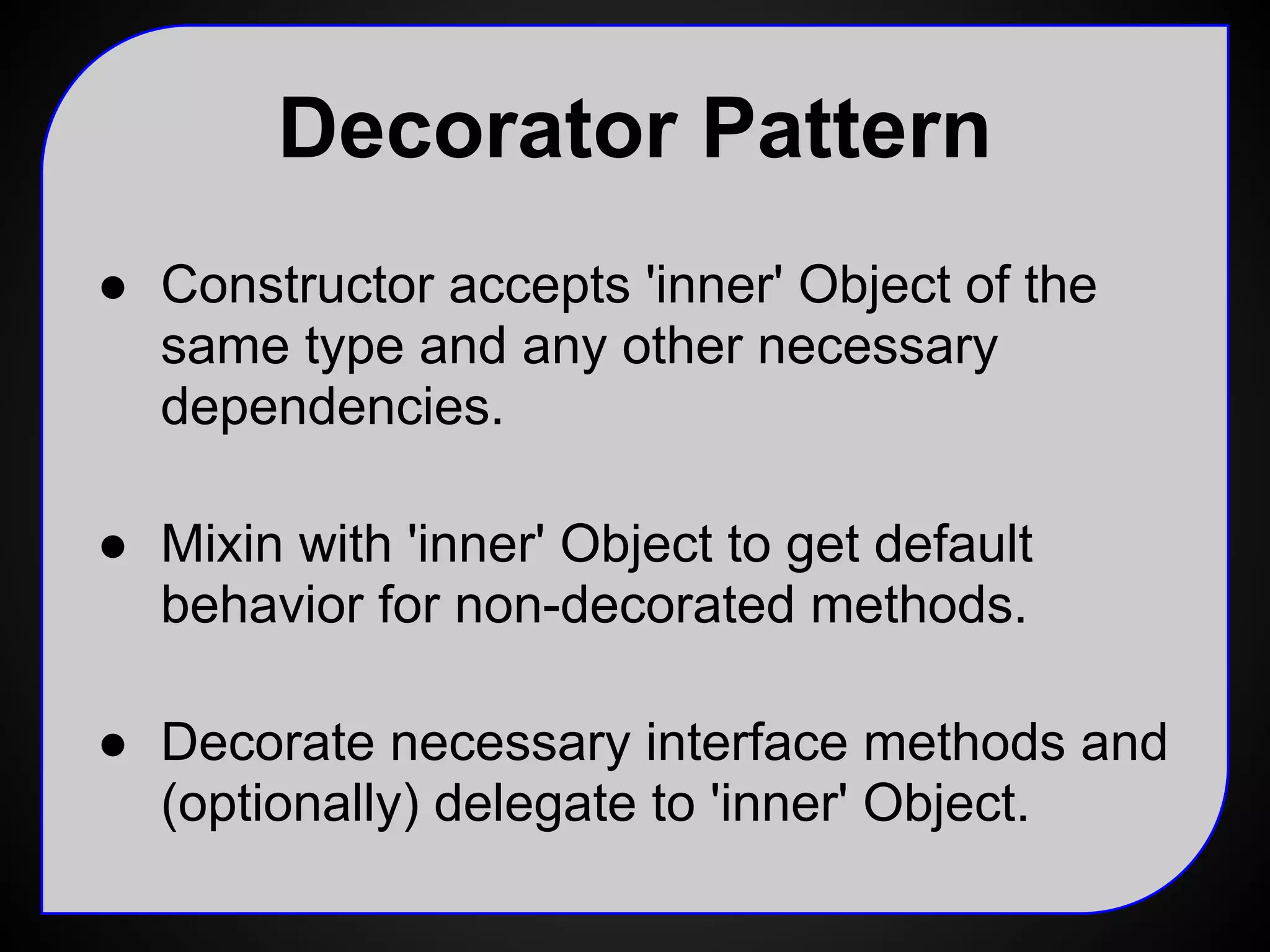
Decorator Pattern
•  Constructor accepts 'inner' Object of the
same type and any other necessary
dependencies.
•  Mixin with 'inner' Object to get default
behavior for non-decorated methods.
•  Decorate necessary interface methods and
(optionally) delegate to 'inner' Object.
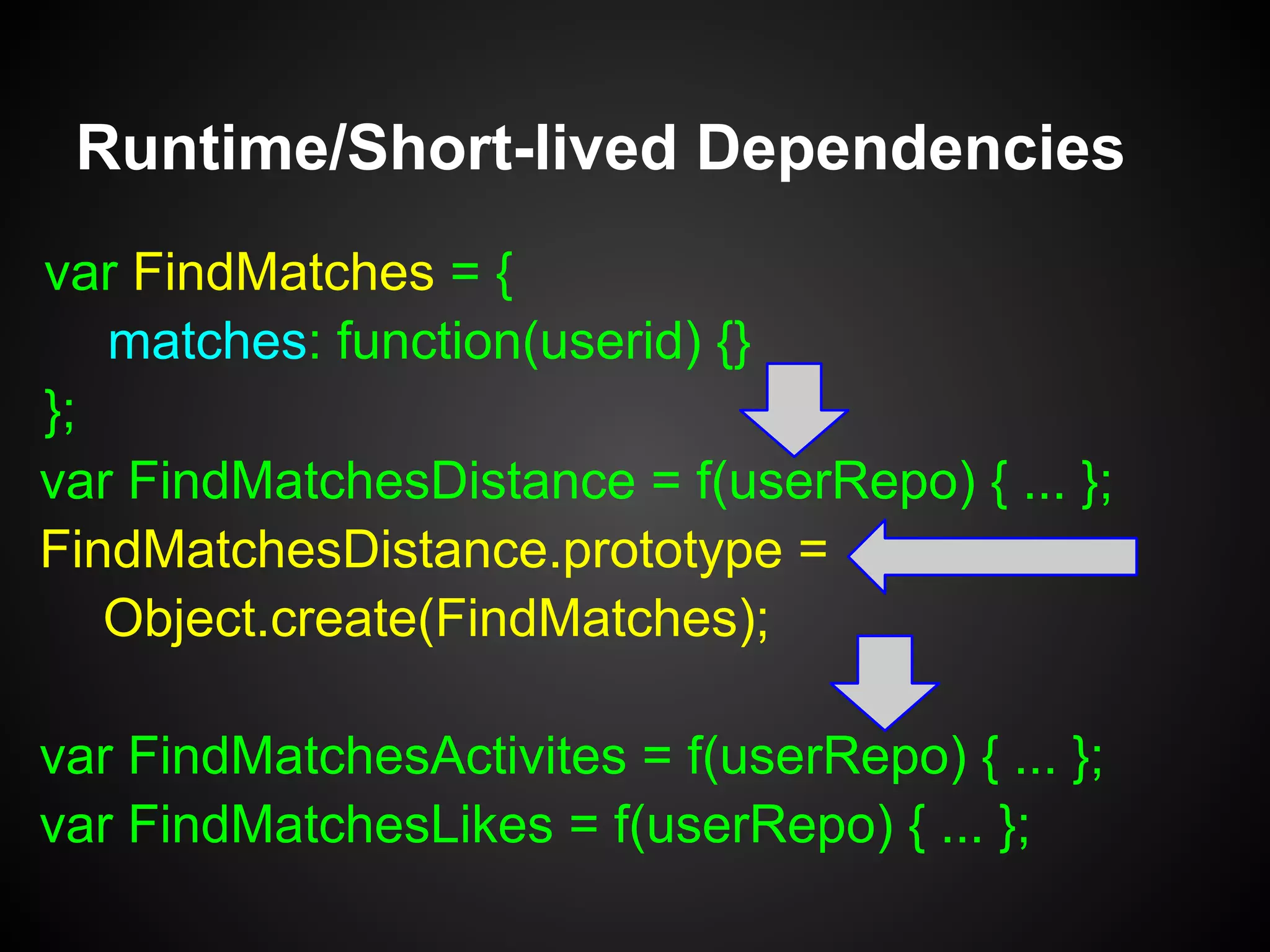
var FindMatchesDistance = f(userRepo) { ... };
FindMatchesDistance.prototype =
Object.create(FindMatches);
var FindMatchesActivites = f(userRepo) { ... };
var FindMatchesLikes = f(userRepo) { ... };
Runtime/Short-lived Dependencies
var FindMatches = {
matches: function(userid) {}
};
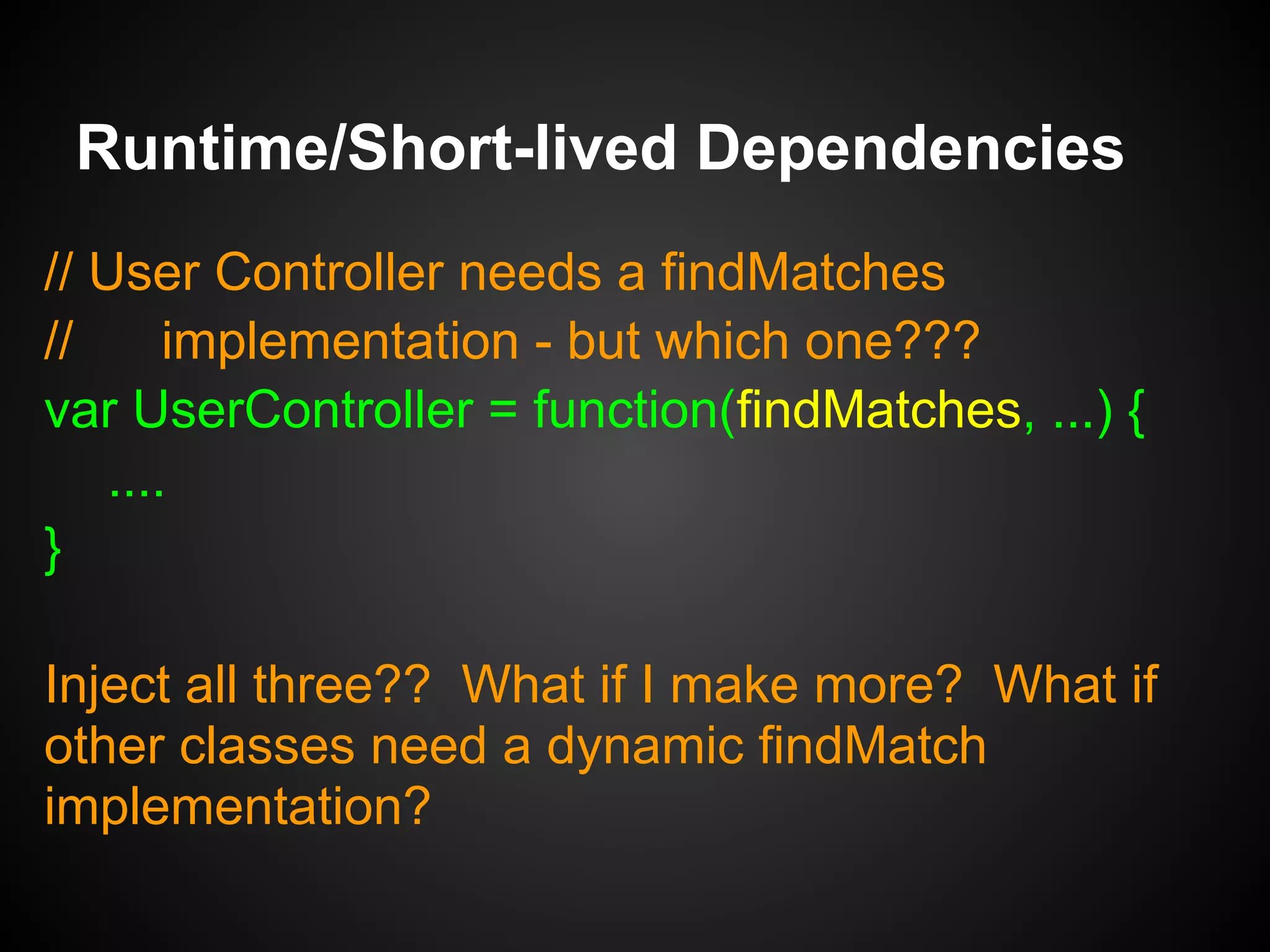
Runtime/Short-lived Dependencies
// User Controller needs a findMatches
// implementation - but which one???
var UserController = function(findMatches, ...) {
....
}
Inject all three?? What if I make more? What if
other classes need a dynamic findMatch
implementation?
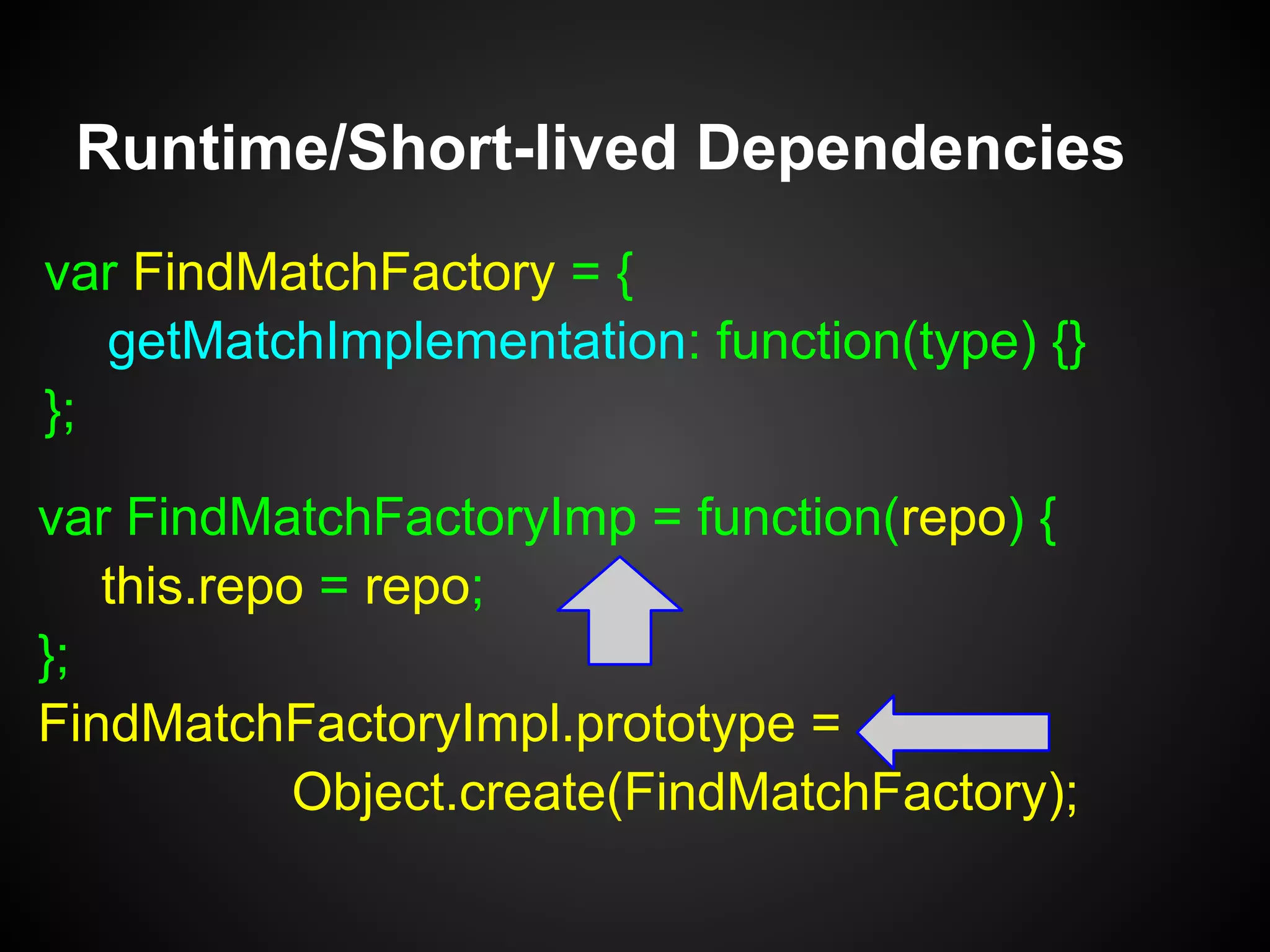
var FindMatchFactoryImp = function(repo) {
this.repo = repo;
};
FindMatchFactoryImpl.prototype =
Object.create(FindMatchFactory);
Runtime/Short-lived Dependencies
var FindMatchFactory = {
getMatchImplementation: function(type) {}
};
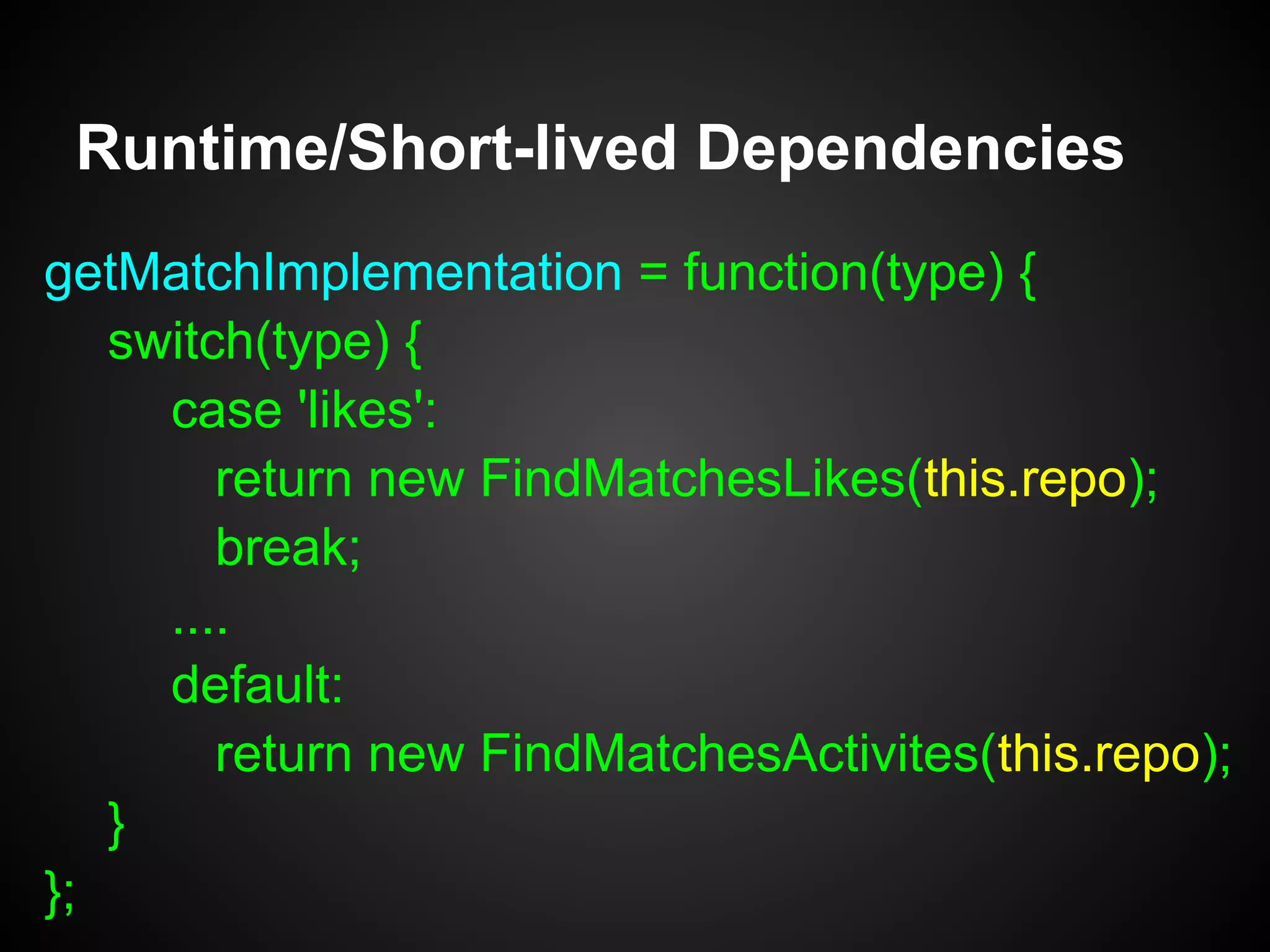
Runtime/Short-lived Dependencies
getMatchImplementation = function(type) {
switch(type) {
case 'likes':
return new FindMatchesLikes(this.repo);
break;
....
default:
return new FindMatchesActivites(this.repo);
}
};
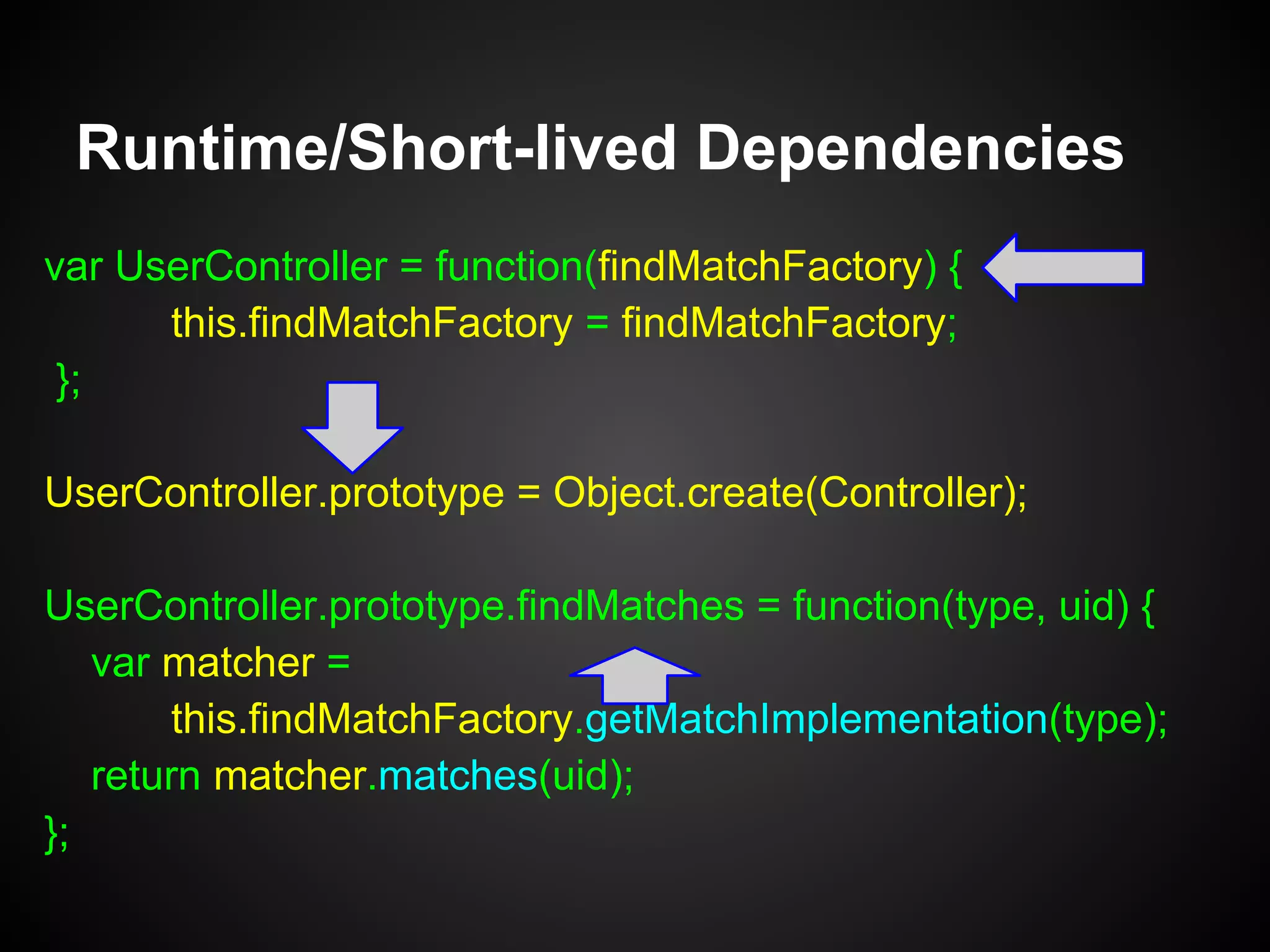
Runtime/Short-lived Dependencies
var UserController = function(findMatchFactory) {
this.findMatchFactory = findMatchFactory;
};
UserController.prototype = Object.create(Controller);
UserController.prototype.findMatches = function(type, uid) {
var matcher =
this.findMatchFactory.getMatchImplementation(type);
return matcher.matches(uid);
};
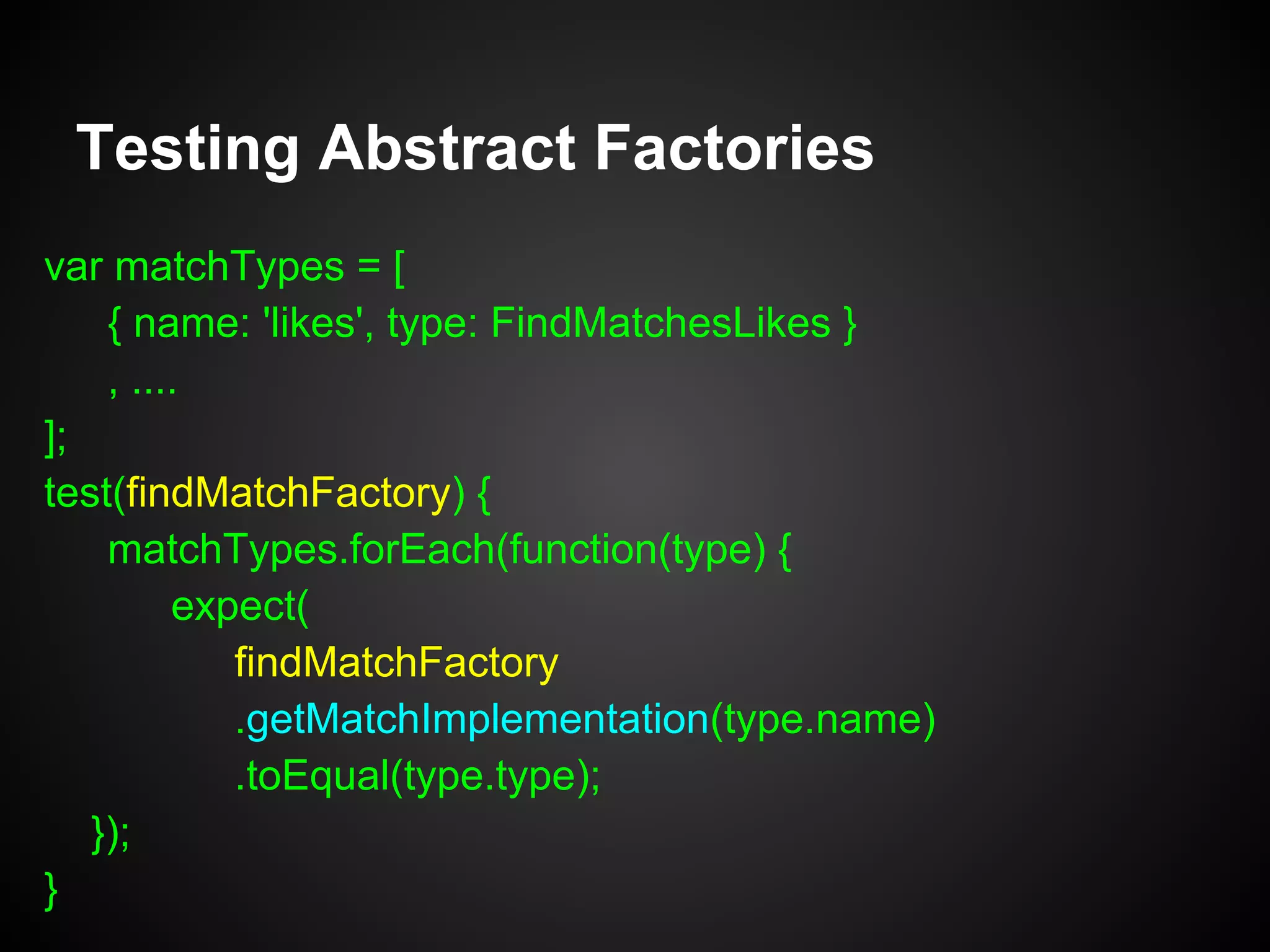
Testing Abstract Factories
var matchTypes = [
{ name: 'likes', type: FindMatchesLikes }
, ....
];
test(findMatchFactory) {
matchTypes.forEach(function(type) {
expect(
findMatchFactory
.getMatchImplementation(type.name)
.toEqual(type.type);
});
}
Mocking Abstract Factories
var TestFactoryImpl = function(expectedType, mockMatch) {
this.expectedType = expectedType;
this.mockMach = mockMatch;
};
TestFactoryImpl.prototype = Object.create(FindMatchFactory);
TestFactoryImpl.prototype.getMatchImplementation(type) {
expect(type).toEqual(this.expectedType);
return this.mockMatch;
};
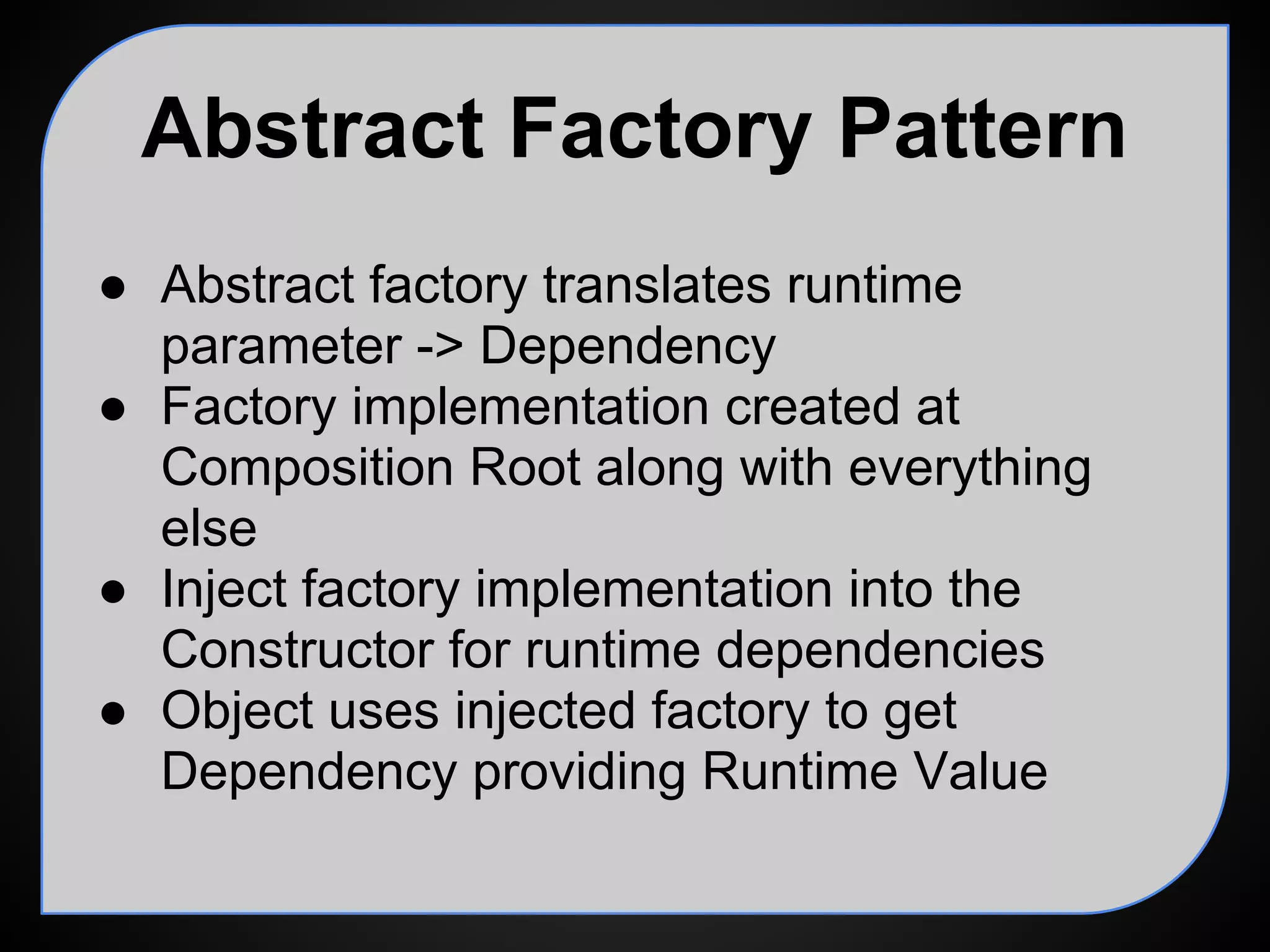
Abstract Factory Pattern
•  Abstract factory translates runtime
parameter -> Dependency
•  Factory implementation created at
Composition Root along with everything
else
•  Inject factory implementation into the
Constructor for runtime dependencies
•  Object uses injected factory to get
Dependency providing Runtime Value
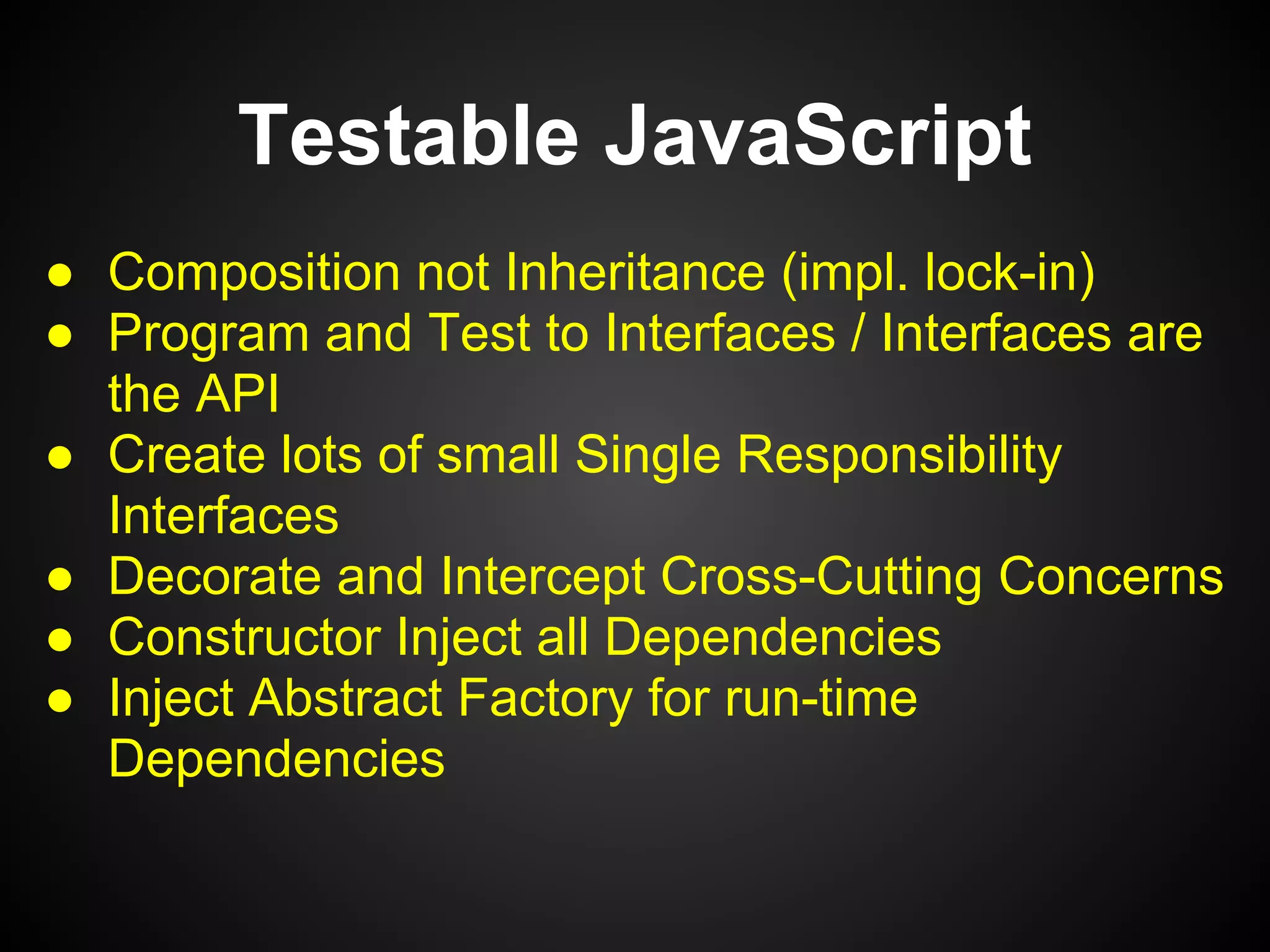
Testable JavaScript
•  Composition not Inheritance (impl. lock-in)
•  Program and Test to Interfaces / Interfaces are
the API
•  Create lots of small Single Responsibility
Interfaces
•  Decorate and Intercept Cross-Cutting Concerns
•  Constructor Inject all Dependencies
•  Inject Abstract Factory for run-time
Dependencies
Ensuring Testability

Testable JavaScript: Application Architecture

  • 1.
    Testable JavaScript Architecting YourApplication for Testability Mark Ethan Trostler Google Inc. twitter: @zzoass mark@zzo.com
  • 2.
  • 4.
  • 5.
    Interfaces not Implementation varUserRepository = { get: function(id) {} , save: function(user) {} , getAll: function() {} , edit: function(id, user) {} , delete: function(id) {} , query: function(query) {} };
  • 6.
    Interfaces not Implementation functiontest(repo) { var id = 99, user = { id: id, ... }; repo.save(user); expect(repo.get(id)).toEqual(user); } Test the interface
  • 7.
    Interfaces not Implementation varUserRepoRedis = function(host, port, opt) { this.redis = redis.createClient({ ... }); }; UserRepoRedis.prototype = Object.create(UserRepo); UserRepoRedis.prototype.save = function(user) { ... };
  • 8.
    Interfaces not Implementation • Objectis interface - no initialization • Implementation has constructor with injected dependencies • Prototype is Object.create(Interface) • Override with prototype functions
  • 9.
    Interfaces not Implementation functiontest(repo) { var user = { ... }; repo.save(user); expect(repo.get(id)).toEqual(user); } var repo = new UserRepoRedis(host, port, opt); test(repo); Test the interface
  • 10.
    Interfaces not Implementation varUserRepoS3 = function(key, secret, bucket) { this.s3 = knox.createClient({...}); }; UserRepoS3.prototype = Object.create(UserRepo); UserRepoS3.prototype.save = function(user) { ... }
  • 11.
    Interfaces not Implementation functiontest(repo) { var id = 99, user = { id: id, ... }; repo.save(user); expect(repo.get(id)).toEqual(user); } var repo = new UserRepoS3(key, secret, bucket); test(repo); Test the interface
  • 12.
    Single Responsibility Principle Everyinterface should have a single responsibility, and that responsibility should be entirely encapsulated by the interface. Responsibility = Reason To Change
  • 13.
    Interface Segregation Principle Noobject should be forced to depend on methods it does not use.
  • 14.
    Interface Pattern • Single ResponsibilityPrinciple • Match Sets with Gets • More Smaller / Fewer Bigger • Interface Segregation Principle • Test and Program to Interface Only
  • 15.
    Using Interfaces You've creatednice interfaces - use them wisely! // DO NOT DO THIS! var UserController = function() { this.userRepo = new UserRepoRedis(); };
  • 16.
    Using Interfaces You've creatednice interfaces - use them wisely! // DO THIS - Inject the dependencies! var UserController = function(userRepo) { this.userRepo = userRepo; };
  • 17.
    Liskov Substitution Principle Anyobjects that implement an interface can be used interchangeably
  • 18.
    Constructor Injection All dependenciesshould be injected into your object's constructor*. •  Make dependencies explicit •  Loose coupling •  Cannot instantiate a non-usable Object * Except: •  runtime dependencies •  objects with a shorter lifetime
  • 19.
    Instantiating Implementations So doall dependees need to provide fully initialized objects to their dependents when instantiating them? NO - THEY DO NOT INSTANTIATE THEM! Object Creation vs. Object Use •  ensures a loosely coupled system •  ensures testability
  • 20.
    Object Creation vs.Object Use creation Happens one time at the Composition Root. All Objects* are created/wired together at this time •  startup •  Request use Happens all the time throughout the application
  • 21.
    Object Creation What createsthe objects? Forces specification of dependencies and their lifespan •  DIY DI •  wire.js / cujojs •  Inverted •  Intravenous •  AngularJS whole lotta others...
  • 22.
    Cross-Cutting Concerns What aboutthe crap I might need? •  Logging •  Auditing •  Profiling •  Security •  Caching •  .... "Cross-cutting concerns"
  • 23.
    Cross-Cutting Concerns // DONOT DO THIS: UserRepoRedis = function(...) { this.redis = ... this.logger = new Logger(); // or Logger.get() this.profiler = new Profiler(); // or Profiler.get() }; •  tightly coupled to Logger & Profiler implementations •  PITA to test
  • 24.
    Cross-Cutting Concerns // DONOT DO THIS: UserRepoRedis = function(..., logger, profiler) { this.redis = ... this.logger = logger; this.profiler = profiler; }; Injection - so looks good BUT violating SRP!
  • 25.
    Cross-Cutting Concerns // DONOT DO THIS: UserRepoRedis.prototype.save = function(user) { logger.log('Saving user: ' + user); profiler.startProfiling('saveUser'); ... do redis/actual save user stuff ... profiler.stopProfiling('saveUser'); logger.log('that took: ' + (start - end)); };
  • 26.
    Cross-Cutting Concerns •  Keepdifferent functionality separate •  Single Responsibility Principle •  Interface Segregation Principle
  • 27.
    var LoggerFile =function(file) { // Implementation this.file = file; } LoggerFile.prototype = Object.create(Logger); LoggerFile.prototype.log = function(msg) { this.file.write(msg); }; Logging Interface and Implementation var Logger = { // Interface log: function(msg) {} , getLastLog: function() {} // get it out! };
  • 28.
    Mixin method -quick aside... // Composition not inheritance var MIXIN = function(base, extendme) { var prop; for (prop in base) { if (typeof base[prop] === 'function' && !extendme[prop]) { extendme[prop] = base[prop].bind(base); } } };
  • 29.
    Decorator var UserRepoLogger =function(repo, logger) { this.innerRepo = repo; this.logger = logger; MIXIN(repo, this); // Mixin repo's methods }; UserRepoLogger.prototype.save = function(user) { this.logger.log('Saving user: ' + user); return this.innerRepo.save(user); };
  • 30.
    Decorator // UserRepoLogger willIntercept save // all other methods will fall thru to // UserRepoRedis // This userRepo implements the UserRepo // interface therefore can be used anywhere var userRepo = new UserRepoLogger( new UserRepoRedis() , new LoggerFile() );
  • 31.
    var ProfilerTime =function() { this.profiles = {}; }; ProfilerTime.prototype = Object.create(Profiler); ProfilerTime.prototype.start = function(id) { this.profiles[id] = new Date().getTimestamp(); }; ProfilerTime.prototype.stop = function(id) { ... }; .... Profile Interface and Implementation var Profiler = { // Interface start: function(id) {} , stop: function(id) {} , getProfile: function(id) {} // get it out! };
  • 32.
    Decorator var UserRepoProfiler =function(repo, profiler) { this.innerRepo = repo; this.profiler = profiler; MIXIN(repo, this); // Mixin repo's methods }; UserRepoProfiler.prototype.save = f(user) { this.profiler.start('save user'); this.innerRepo.save(user); this.profiler.stop('save user');
  • 33.
    Intercept var redisRepo =new UserRepoRedis(); var profiler = new ProfilerTime(); var logger = new LoggerFile(); // Profiling UserRepo var userRepoProf = new UserRepoProfiler(redisRepo, profiler); // Logging Profiling UserRepo var userRepo = new UserRepoLogger(userRepoProf, logger);
  • 34.
    Testing Decorators Create theDecorator and Test the Interface: function testUserRepoLogger(repo) { var id = 99, user = { id: id, ... }, loggerMock = new LoggerMock(), testRepo = new UserRepoLogger(repo, loggerMock); testRepo.save(user); // verify loggerMock }
  • 35.
    Testing Decorators var repo= new UserRepoMock(); var logger = new LoggerMock(); var profiler = new ProfileMock(); var userRepo = new UserRepoProfile( new UserRepoLogger(repo, logger), profiler); // test UserRepo interface testRepo(userRepo); // verify logger and profiler mocks
  • 36.
    Decorator Pattern •  Constructoraccepts 'inner' Object of the same type and any other necessary dependencies. •  Mixin with 'inner' Object to get default behavior for non-decorated methods. •  Decorate necessary interface methods and (optionally) delegate to 'inner' Object.
  • 37.
    var FindMatchesDistance =f(userRepo) { ... }; FindMatchesDistance.prototype = Object.create(FindMatches); var FindMatchesActivites = f(userRepo) { ... }; var FindMatchesLikes = f(userRepo) { ... }; Runtime/Short-lived Dependencies var FindMatches = { matches: function(userid) {} };
  • 38.
    Runtime/Short-lived Dependencies // UserController needs a findMatches // implementation - but which one??? var UserController = function(findMatches, ...) { .... } Inject all three?? What if I make more? What if other classes need a dynamic findMatch implementation?
  • 39.
    var FindMatchFactoryImp =function(repo) { this.repo = repo; }; FindMatchFactoryImpl.prototype = Object.create(FindMatchFactory); Runtime/Short-lived Dependencies var FindMatchFactory = { getMatchImplementation: function(type) {} };
  • 40.
    Runtime/Short-lived Dependencies getMatchImplementation =function(type) { switch(type) { case 'likes': return new FindMatchesLikes(this.repo); break; .... default: return new FindMatchesActivites(this.repo); } };
  • 41.
    Runtime/Short-lived Dependencies var UserController= function(findMatchFactory) { this.findMatchFactory = findMatchFactory; }; UserController.prototype = Object.create(Controller); UserController.prototype.findMatches = function(type, uid) { var matcher = this.findMatchFactory.getMatchImplementation(type); return matcher.matches(uid); };
  • 42.
    Testing Abstract Factories varmatchTypes = [ { name: 'likes', type: FindMatchesLikes } , .... ]; test(findMatchFactory) { matchTypes.forEach(function(type) { expect( findMatchFactory .getMatchImplementation(type.name) .toEqual(type.type); }); }
  • 43.
    Mocking Abstract Factories varTestFactoryImpl = function(expectedType, mockMatch) { this.expectedType = expectedType; this.mockMach = mockMatch; }; TestFactoryImpl.prototype = Object.create(FindMatchFactory); TestFactoryImpl.prototype.getMatchImplementation(type) { expect(type).toEqual(this.expectedType); return this.mockMatch; };
  • 44.
    Abstract Factory Pattern • Abstract factory translates runtime parameter -> Dependency •  Factory implementation created at Composition Root along with everything else •  Inject factory implementation into the Constructor for runtime dependencies •  Object uses injected factory to get Dependency providing Runtime Value
  • 45.
    Testable JavaScript •  Compositionnot Inheritance (impl. lock-in) •  Program and Test to Interfaces / Interfaces are the API •  Create lots of small Single Responsibility Interfaces •  Decorate and Intercept Cross-Cutting Concerns •  Constructor Inject all Dependencies •  Inject Abstract Factory for run-time Dependencies
  • 46.