Earth Science Chapter 22

Loading...

Flash Player 9 (or above) is needed to view presentations.
We have detected that you do not have it on your computer. To install it, go here.

0 comments

Post a comment

    Post a comment
    Embed Video
    Edit your comment Cancel

    Notes on slide 1

    Stop Period 1 (Wednesday October 21)

    Favorites, Groups & Events

    Earth Science Chapter 22 - Presentation Transcript

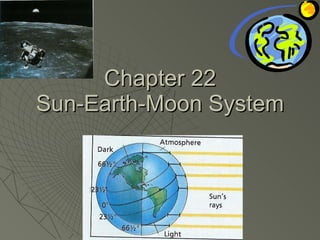
    1. Chapter 22 Sun-Earth-Moon System
    2.  
    3. 22.1 Planet Earth
      • Planet Earth Data
        • The position of the Earth, Sun, and moon affect us daily
        • Seasons change, day turns to night, tides rise & fall
        • The Earth’s Shape
          • The Earth was once believed to be flat (YES, it is roundish)
          • Aristotle reasoned that the Earth was round because it cast a round shadow (Not flat) on the Moon during eclipses
          • Sailors used line of sight to show the Earth was curved
      Pgs. 613 - 622
    4. Earth the Oblique spheroid
      • Today we know the Earth is almost round
        • It is a slightly flattened sphere (Oblique Spheroid)
          • Sphere: round three dimensional object
          • Slightly bulged at the Equator, Flatter at the poles
        • The axis runs through the poles
          • Axis: line around which the Earth spins (Rotation)
          • Rotation causes day and night
        • The Equator: line bisecting the Earth (90 O from Poles)
      • Only known planet to have liquid water
      • Made up of 70% water.
      • 97% of all water is salted.
      • Only known planet to have life
    5. Earth Data (the Specifics)
      • Diameter: (Pole to Pole) = 7,901 mi.
      • Diameter: (at Equator) = 7,926 mi
      • Earth rotates at about 1000 mi/hr.
      • Mass: 5.98 x 10 27 g = 5.98 x 10 23 kg
      • Density: 5.52 g/cm 3
      • Average distance from the Sun = 149,600,000 km
      • Period of Rotation (1 day) = 23hr. 56 min.
      • Pd. of Revolution (1 year) = 365 days 6 hr. 9 min.
      • Polar tilt: 23.5 0 from vertical
      • Average Temperature is 60 o F
      • Hottest Temperature: 134 o F in Death Valley California (1913)
      • Coldest Temperature: -129 o F in Vostok, Antartica (1983)
      • This means the earth is constantly moving around the sun.
    6.  
    7. Earth’s Rotation
      • The Earth rotates, the sun appears to move across the sky (from East to West)
      • Night is caused by ½ the Earth being in shadow
    8. Earth’s Magnetic Field
      • The Earth acts as a giant magnet
        • It produces a magnetic field just like a bar magnet
        • The Magnetic field is produced from under the surface
        • It radiates out into space
        • It is affected by energy from the sun (causes distortion)
    9. Magnetic North
      • Earth’s magnetic axis, does not line up with it’s polar axis
        • A compass points to magnetic North (not North Pole)
        • Difference is 11.5 0 from polar North
    10. Earth’s Orbit
      • REVOLUTION – Yearly orbit around the sun.
      • Just like the Moon is a satellite of the Earth, the Earth is a satellite of the sun.
      • The Earth revolves around the sun
      • Earth’s orbit is an ellipse
        • Ellipse: off center oval (elongated closed curve)
        • Distance from the sun changes during the year
          • Closest to the sun = Perihelion Jan 3 rd and is about 91,500,000 miles from the sun.
          • Farthest from the sun = Aphelion July 4 th and is about 94,500,000 miles from the sun.
    11.  
    12. The Seasons
      • Seasons: Annual change in climate
        • Due to the Earth’s tilt on it’s axis 23.5 0
        • Seasons are opposite between hemispheres
          • Daylight hrs are longer for the pole pointed toward the sun
          • More solar energy = warmer temperatures
    13. Equinoxes
      • Equinox: Equal amounts of sunlight
        • Daylight = 12 hrs; Night = 12 hrs.
        • Sunlight hits directly on the Equator
        • Northern Hemisphere:
          • Spring (VERNAL) Equinox (Marks beginning of Spring) March 20 th or 21 st
          • Autumn Equinox (Beginning of Fall) September 22 nd or 23 rd
        • Reversed for the Southern Hemisphere
    14. Solstices
      • Solstice: “longest” of the year
        • Sun reaches its farthest point North or South
        • Summer Solstice: (Northern Hemisphere)
          • Occurs on June 21 st or 22 nd (Beginning of Summer)
          • Sunlight reaches the Tropic of Cancer
          • “ Longest day of the year” = 16 hrs. of sunlight
          • North Pole = 24 hrs of daylight
          • South Pole = 24 hrs of night
    15. Winter Solstices
      • Sun directly on Tropic of Capricorn
        • Occurs on December 21 st or 22 nd
          • Northern Hemisphere = Beginning of Winter
          • “ Longest night of the Year” (16 hrs. of night)
          • North Pole: 24 hrs. of night
          • South Pole: 24 hrs. of daylight
    16. 22.2 Earth’s Moon
      • You know the moon looks different over the month
        • You see different amounts visible
        • It rises at different times (sometimes even during the day)
      • The Moon’s Rotation & Revolution
        • The moon rotates on its axis (27.3 days = 1 rotation)
        • It revolves around the Earth (27.3 days = 1 revolution)
        • Unique situation: We always see the same side of the moon
      Pgs. 623 - 631
    17. Why the Moon Shines
      • The moon is not like the sun
      • It does not create it’s own light
      • It reflects sunlight = Moon light
        • Only the side of the moon facing the sun can be seen
        • Other side in shadow
    18. Moon Phases
      • Phases: Daily change in the moon’s appearance
        • Occur because the moon reflects sunlight & orbiting Earth
        • Our view point & Moon’s position determines what we see
      • Waxing: More & more of the moon becomes visible
        • Occurs between New moon and Full moon
      • Waning: Less & less of the moon is visible
        • Occurs between Full moon and New Moon
      • There are Eight Main Phases:
      • 1.) New Moon 5.) Full Moon
      • 2.) Waxing Crescent 6.) Waning Gibbous
      • 3.) First Quarter 7.) Last Quarter
      • 4.) Waxing Gibbous 8.) Waning Crescent
    19. Phases of the Moon
      • 1.) NEW MOON – When the moon is completely in shadow
      • 2.) WAXING CRESCENT – Right side of moon begins to become visible, Left side in shadow.
      • 3.)FIRST QUARTER – Right half is visible, left half in shadow.
      • 4.)WAXING GIBBOUS – More than half of the lit side is visible, moon takes on an egg shape
      • 5.)FULL MOON – When all of the moon’s surface facing earth is lit up and visible.
      • 6.)WANING GIBBOUS – Moon begins to appear less lit up, takes on an egg shape again (Left side still shines, Right side in shadow)
      • 7)THIRD (LAST) QUARTER – Left half of moon visible
      • 8) WANING CRESCENT – only a sliver of the left side is visible.
      • NEW MOON
      • WAXING CRESCENT
      • FIRST QUARTER
      • WAXING GIBBOUS
      • FULL MOON
      • WANING GIBBOUS
      • THIRD QUARTER
      • WANING CRESCENT
    20. Phases of the Moon
    21.  
      • Average Distance from the Earth to the Moon: 238,857 miles
      • The Harvest Moon is the FULL MOON nearest to the AUTUMNAL EQUINOX , which occurs (in the NORTHERN HEMISPHERE) on or about SEPT. 23rd
      • The Harvest Moon is also known as the Wine Moon, the Singing Moon and the Elk Call Moon. In MYTH and FOLKLORE the full moon of each month is given a name. There are many variations but the following list gives the most widely known names:
      • January – Wolf Moon July – Hay Moon
      • February – Ice Moon August – Corn Moon
      • March – Storm Moon Sept. – HARVEST MOON
      • April – Growing Moon Oct. – Hunter’s Moon
      • May – Hare Moon Nov. Snow Moon
      • June – Mead Moon Dec. – Winter Moon
      • When there are 2 full moons in a month the second is called a BLUE MOON .
    22.  
    23. Eclipses:
      • Eclipses occur when the sun, Earth, & Moon align
      • Caused by the position of the moon
        • The moon’s orbit is not on the same plane as Earth’s
        • Can only occur when orbits cross
        • Shadows are the reason for the phenomena
        • The Moon’s orbit is tilted about 5 degrees from the Earth’s
    24. Parts of a Shadow:
      • Shadows have 2 parts:
        • Umbra: Darkest part (center)
        • Penumbra: Lighter part (outside)
    25. Solar Eclipses
      • Solar Eclipse: Moon’s shadow covers part of the Earth
        • Blocks view of the sun
        • Only occur during New Moon
        • Occur every year, only seen in specific areas
      • Total Solar Eclipse:
        • The moon blocks out the sun
        • Only the Corona is seen glowing
      • Partial Solar Eclipse:
        • Moon’s penumbra shades part of sun
      • Total Solar Eclipse Partial Solar Eclipse
    26. Lunar Eclipses
      • When the moon passes into the Earth’s Shadow
        • Partial eclipse occur when the moon is in the Penumbra
        • Total eclipse occur when the moon is in the Umbra
        • Total Eclipse must occur during Full moons (about once a year)
        • Moon turns blood red in color
    27. Stages of a Lunar Eclipse
    28. Moon’s Surface Tycho Mare Imbrium Copernicus Mare Serenitatis Mare Tranquillitatus Notice the rays from Tycho Kepler
    29. Moon Surface Features
      • We can see light and dark parts with our eyes
        • Maria- Dark colored lava plains with circular basins
        • Highlands- Areas of light colored crust
      • Lunar Highlands- made up of mountain chains
        • Found around maria edges, and extinct volcanoes
      • The Moon is riddled with craters
      • Lunar Dirt: Called Regolith (rock particles and dust)
        • Not soil- contains no water or organic material
    30. The Moon’s Interior
      • Apollo Missions left instruments to study the moon
        • Learned about what is below the moon’s surface
        • Surface:
          • 35 miles thick facing the Earth
          • 90 miles on other side
        • Solid Mantle: Lies below the surface (600 miles deep)
        • Partially molten zone: Lies below solid mantle
        • Core: Iron-rich & solid
      • The Moon is prone to Moonquakes due to structure
    31.  
    32. Origin of the Moon
        • Impact theory:
          • A Mars sized object collided with the Earth (6.4 b.y.a.)
          • Vaporized material thrown into space
          • Material condensed & formed the moon
    33. 22.3 Exploration of the Moon
      • No manned missions to the moon since Apollo
      • None scheduled missions either
        • In 1994, one spacecraft was placed in lunar orbit
        • Clementine: two month mission to survey the moon
      • Clementine the Spacecraft
        • Carried & tested sensors to track cold objects in space
          • Cold objects include satellites, warheads & Asteroids
        • Also compiled detailed maps of the moon’s surface
      Pgs. 632-633
      • Moon’s average day time temperature is 214 o F
      • Moon’s average night time temperature is -300 o F
      • Moon’s Gravity is 6x lighter than the Earths.
      • Moon has not atmosphere so it is always black there.
      • Moon’s diameter is 2160 miles
    34. Moon Missions
      • 12 Americans landed on the moon between 1969-1972 during the Apollo Program
      • July 20,1969 – Apollo 11 first manned lunar landing. Neil Armstrong and Buzz Aldrin walked on the moon.
    35.  
    SlideShare Zeitgeist 2009

    + Mr.  MotukMr. Motuk Nominate

    custom

    132 views, 0 favs, 1 embeds more stats

    More info about this document

    © All Rights Reserved

    Go to text version

    • Total Views 132
      • 129 on SlideShare
      • 3 from embeds
    • Comments 0
    • Favorites 0
    • Downloads 3
    Most viewed embeds
    • 3 views on http://blendedschools.blackboard.com

    more

    All embeds
    • 3 views on http://blendedschools.blackboard.com

    less

    Flagged as inappropriate Flag as inappropriate
    Flag as inappropriate

    Select your reason for flagging this presentation as inappropriate. If needed, use the feedback form to let us know more details.

    Cancel
    File a copyright complaint
    Having problems? Go to our helpdesk?

    Categories