Power Management for the Nokia Internet Tablets

Loading...

Flash Player 9 (or above) is needed to view presentations.
We have detected that you do not have it on your computer. To install it, go here.

0 comments

Post a comment

    Post a comment
    Embed Video
    Edit your comment Cancel

    3 Favorites

    Power Management for the Nokia Internet Tablets - Presentation Transcript

    1. Nokia Internet Tablet Power Management Klaus K Pedersen Igor Stoppa This material, including documentation and any related computer programs, is protected by copyright controlled by Nokia. All rights are reserved. 1 Copyright © 2007 Nokia. All rights reserved.
    2. Overview •Current Solutions: •Sleep while Idle •Dynamic Tick •Future: •Dynamic Voltage and Frequency Scaling •CPUFreq •Dynamic Power Switching 2 Copyright © 2007 Nokia. All rights reserved.
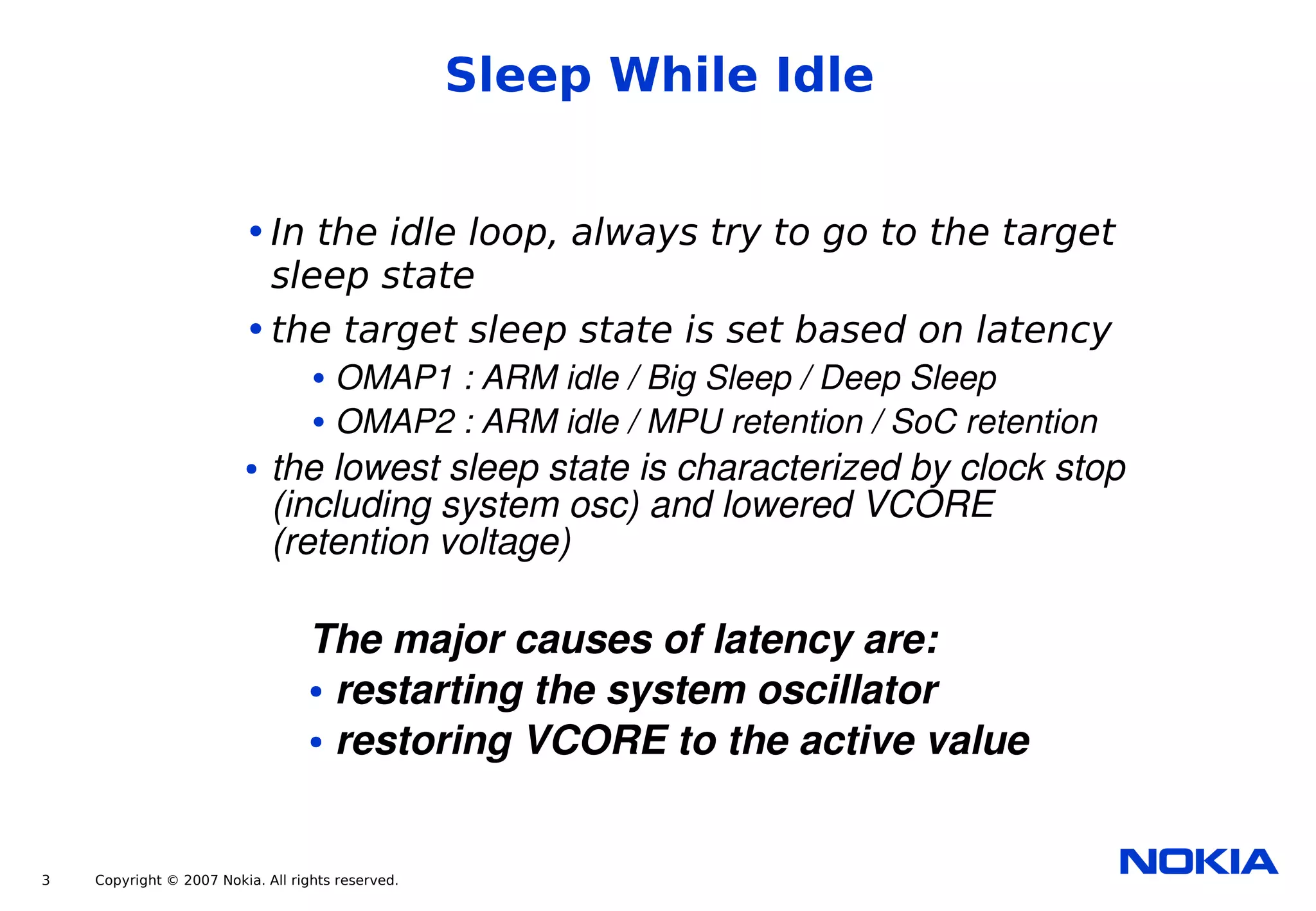
    3. Sleep While Idle • In the idle loop, always try to go to the target sleep state • the target sleep state is set based on latency • OMAP1 : ARM idle / Big Sleep / Deep Sleep • OMAP2 : ARM idle / MPU retention / SoC retention the lowest sleep state is characterized by clock stop ● (including system osc) and lowered VCORE (retention voltage) The major causes of latency are: ● restarting the system oscillator ● restoring VCORE to the active value 3 Copyright © 2007 Nokia. All rights reserved.
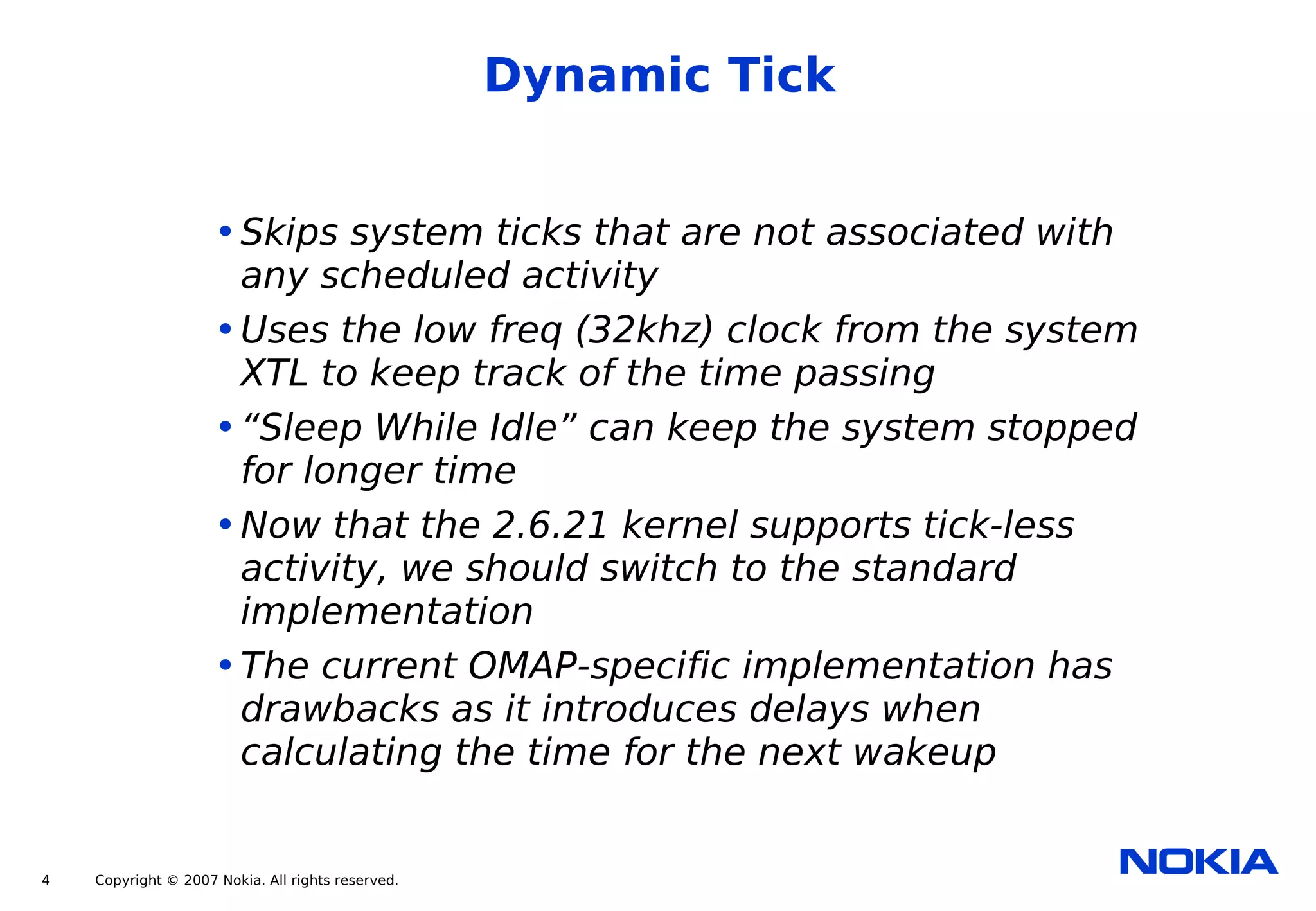
    4. Dynamic Tick • Skips system ticks that are not associated with any scheduled activity • Uses the low freq (32khz) clock from the system XTL to keep track of the time passing • “Sleep While Idle” can keep the system stopped for longer time • Now that the 2.6.21 kernel supports tick-less activity, we should switch to the standard implementation • The current OMAP-specific implementation has drawbacks as it introduces delays when calculating the time for the next wakeup 4 Copyright © 2007 Nokia. All rights reserved.
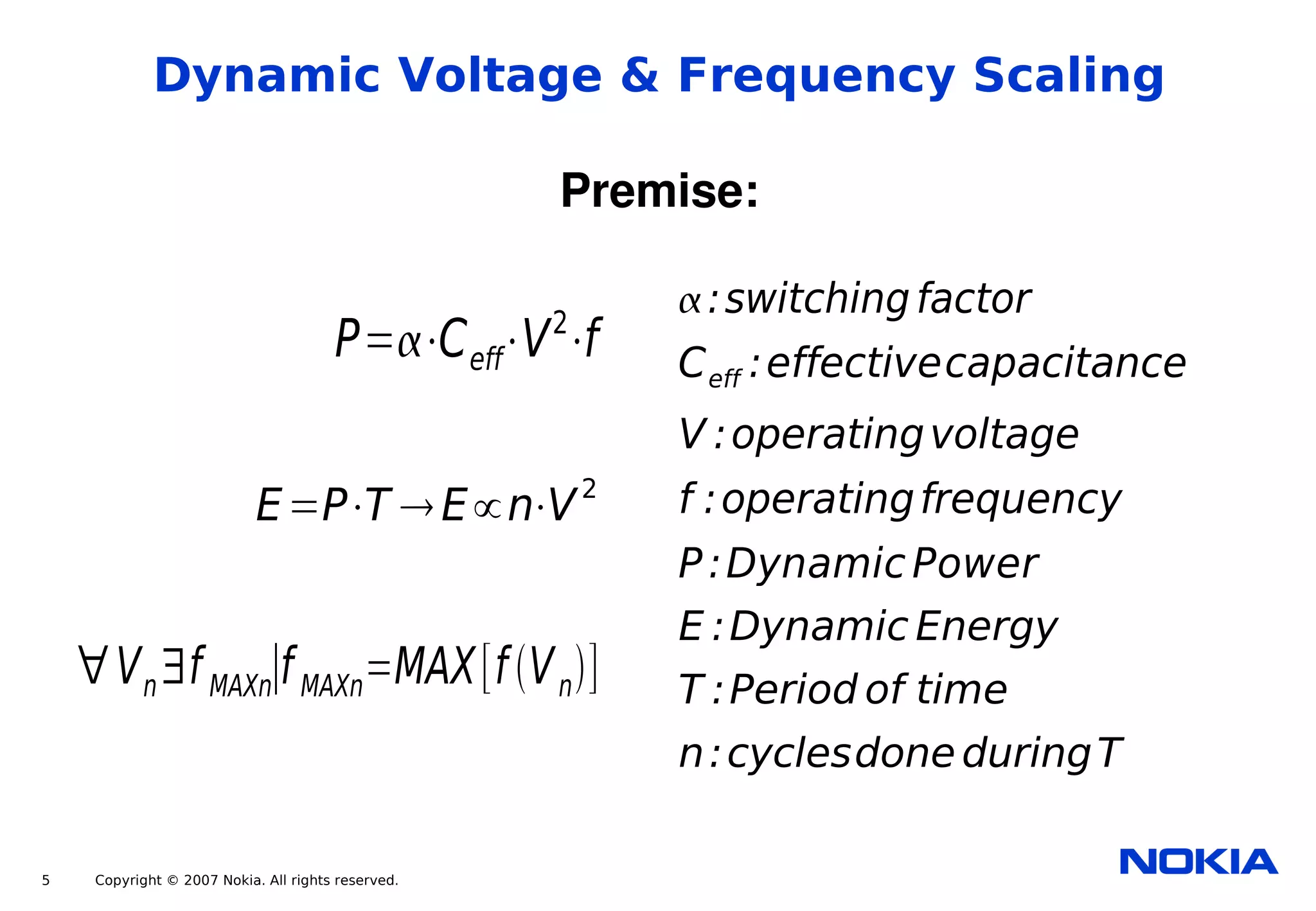
    5. Dynamic Voltage & Frequency Scaling Premise:  :switching factor 2 P=⋅C eff⋅V ⋅f C eff :effectivecapacitance V : operating voltage 2 f :operating frequency E =P⋅T  E ∝n⋅V P : Dynamic Power E : Dynamic Energy ∀ V n ∃f MAXn∣f MAXn=MAX [f V n ] T : Period of time n : cyclesdone during T 5 Copyright © 2007 Nokia. All rights reserved.
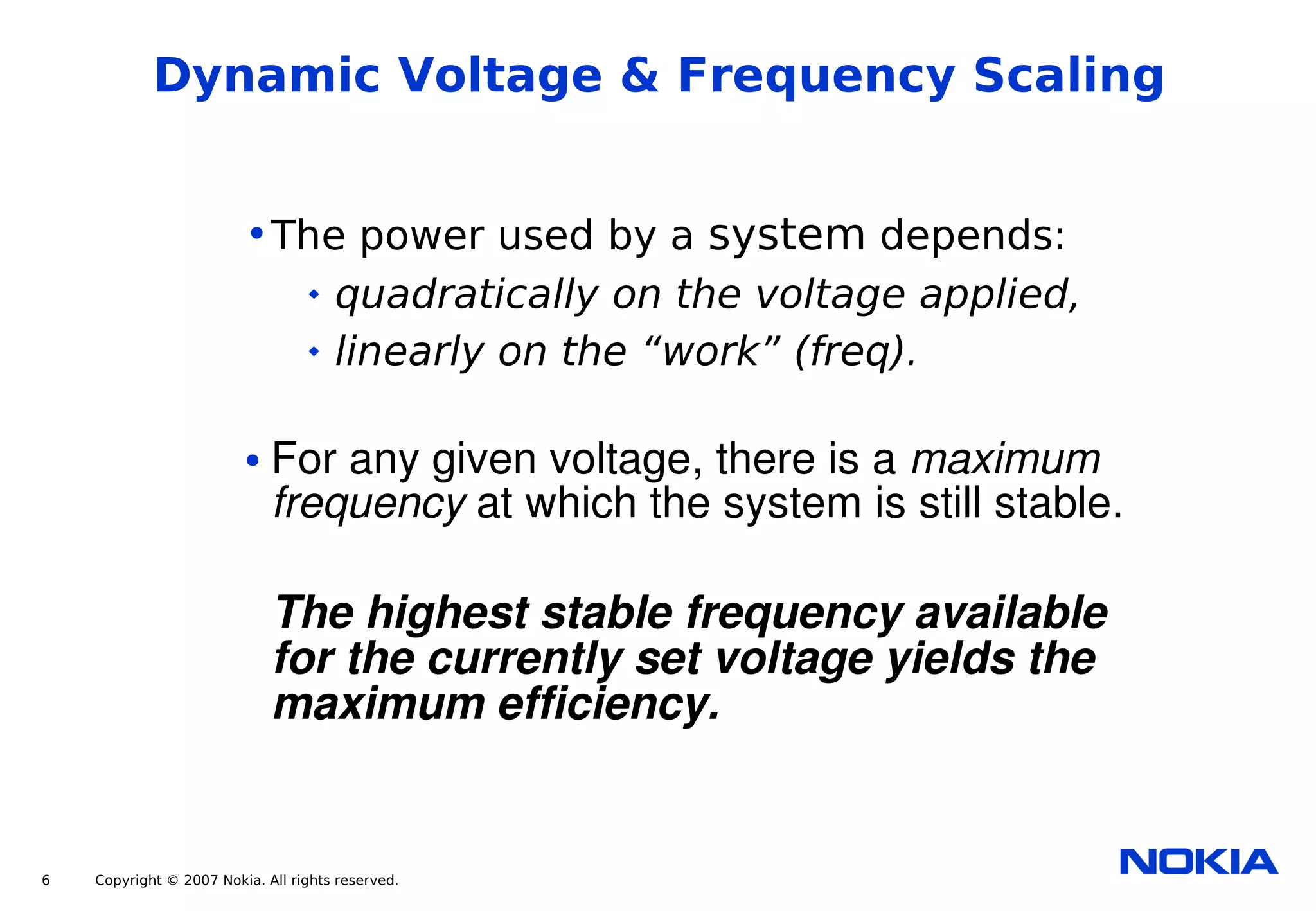
    6. Dynamic Voltage & Frequency Scaling • The power used by a system depends:  quadratically on the voltage applied,  linearly on the “work” (freq). For any given voltage, there is a maximum ● frequency at which the system is still stable. The highest stable frequency available for the currently set voltage yields the maximum efficiency. 6 Copyright © 2007 Nokia. All rights reserved.
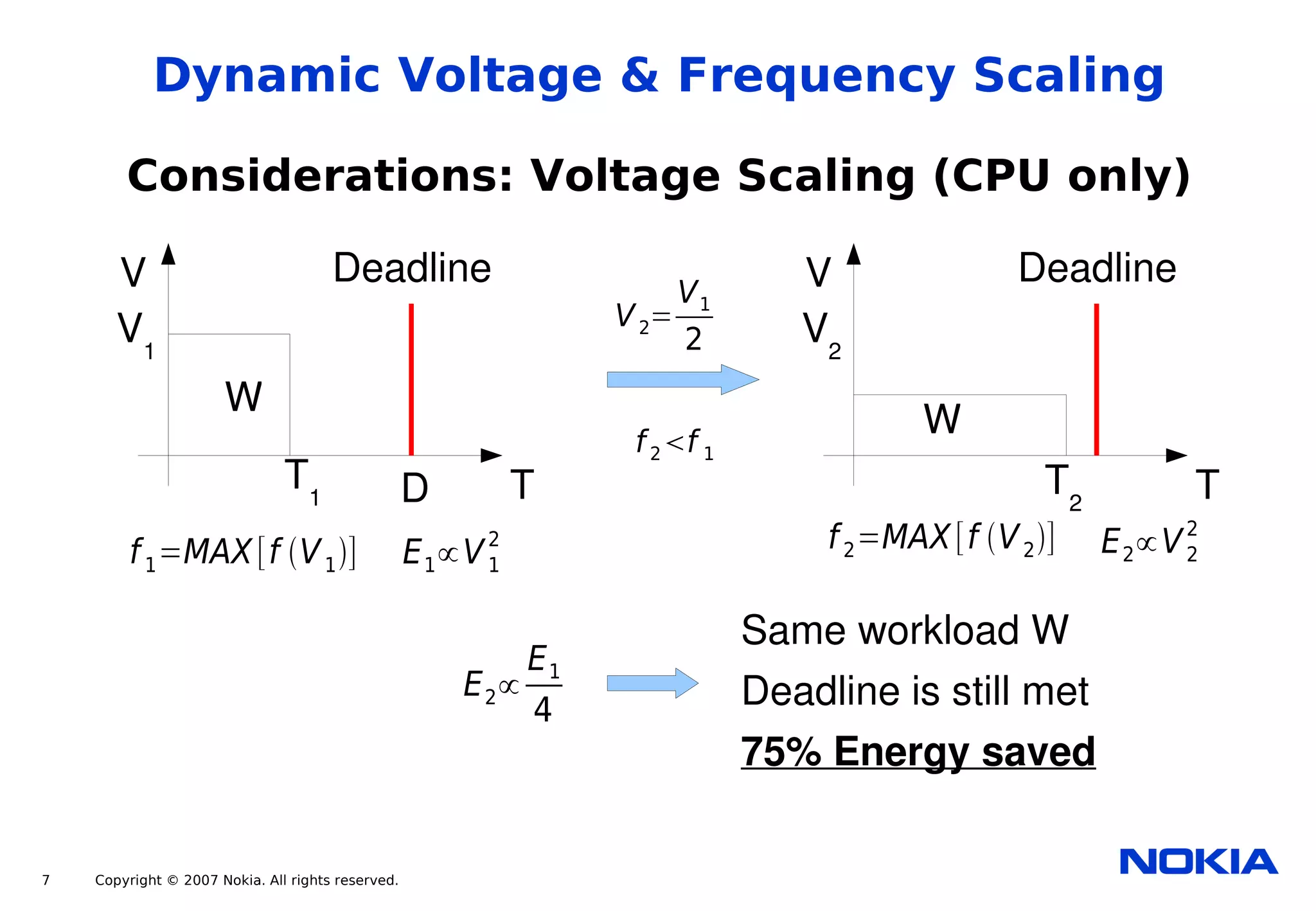
    7. Dynamic Voltage & Frequency Scaling Considerations: Voltage Scaling (CPU only) Deadline Deadline V V V1 V 2= V1 V2 2 W W f 2 f 1 T1 T2 T T D 2 f 2 =MAX [f V 2 ] E 2 ∝V 2 2 f 1 =MAX [f V 1 ] E 1 ∝V 1 Same workload W E1 E2∝ Deadline is still met 4 75% Energy saved 7 Copyright © 2007 Nokia. All rights reserved.
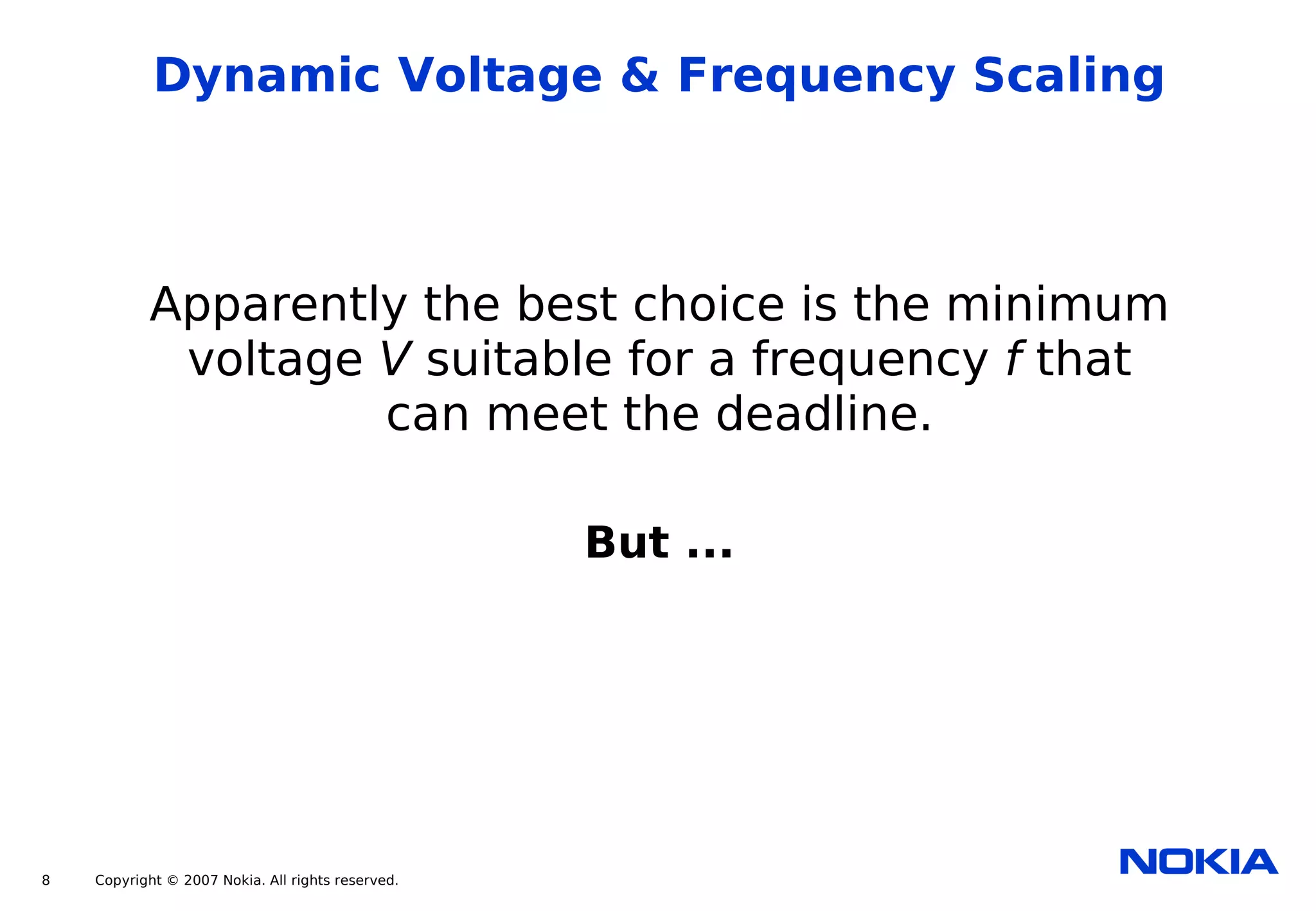
    8. Dynamic Voltage & Frequency Scaling Apparently the best choice is the minimum voltage V suitable for a frequency f that can meet the deadline. But ... 8 Copyright © 2007 Nokia. All rights reserved.
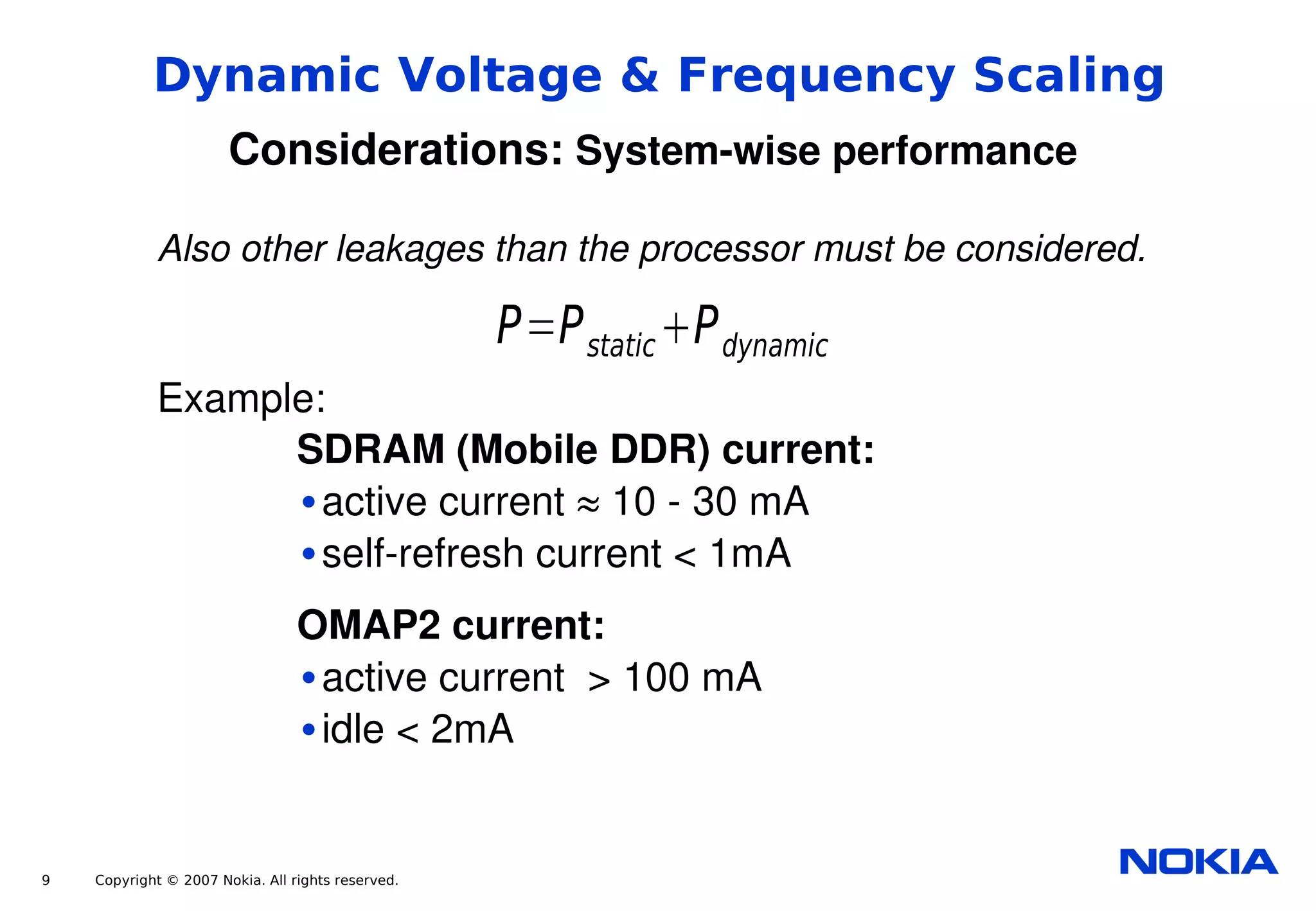
    9. Dynamic Voltage & Frequency Scaling Considerations: System-wise performance Also other leakages than the processor must be considered. P=P static P dynamic Example: SDRAM (Mobile DDR) current: •active current ≈ 10 - 30 mA •self-refresh current < 1mA OMAP2 current: •active current > 100 mA •idle < 2mA 9 Copyright © 2007 Nokia. All rights reserved.
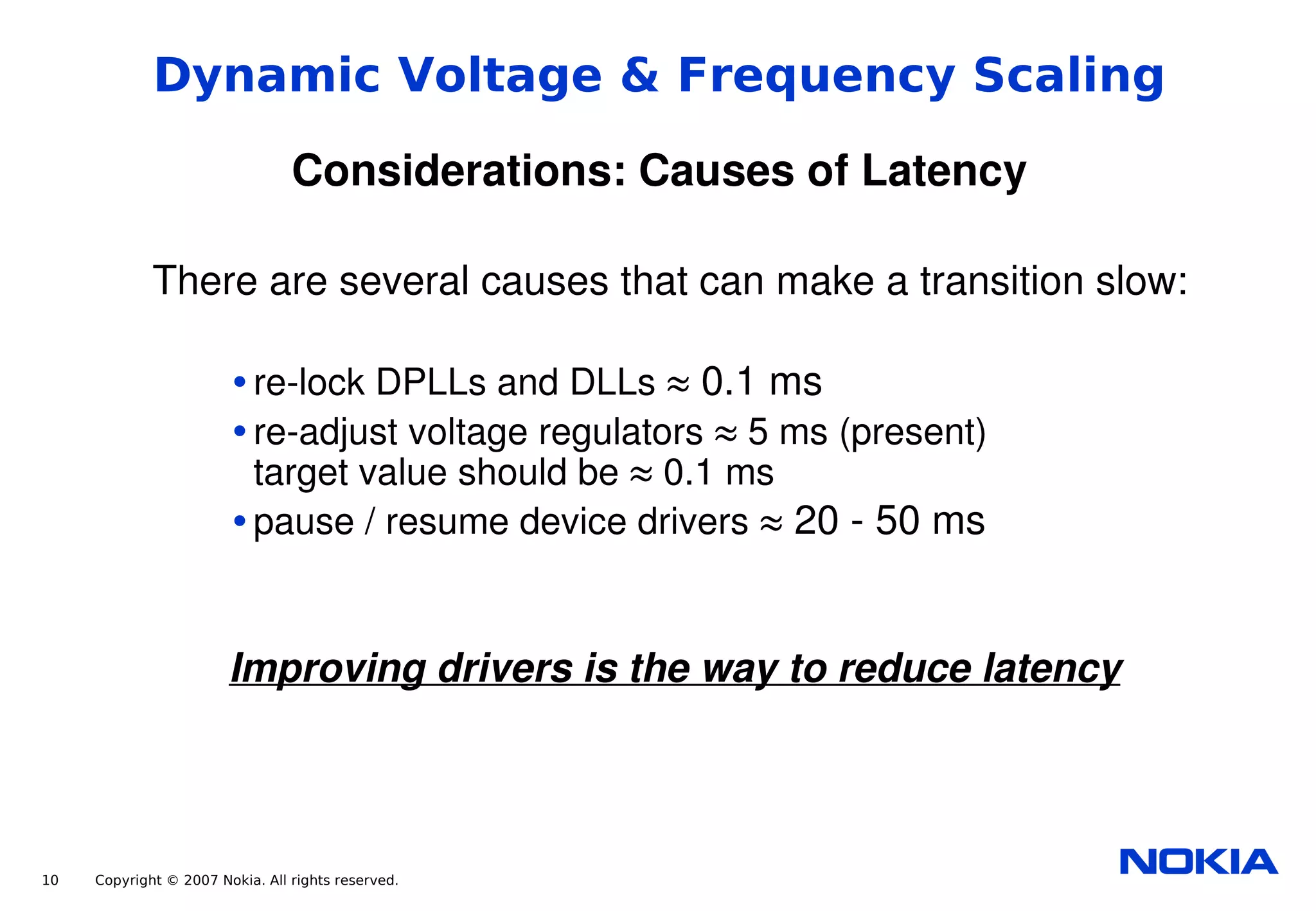
    10. Dynamic Voltage & Frequency Scaling Considerations: Causes of Latency There are several causes that can make a transition slow: •re-lock DPLLs and DLLs ≈ 0.1 ms •re-adjust voltage regulators ≈ 5 ms (present) target value should be ≈ 0.1 ms •pause / resume device drivers ≈ 20 - 50 ms Improving drivers is the way to reduce latency 10 Copyright © 2007 Nokia. All rights reserved.
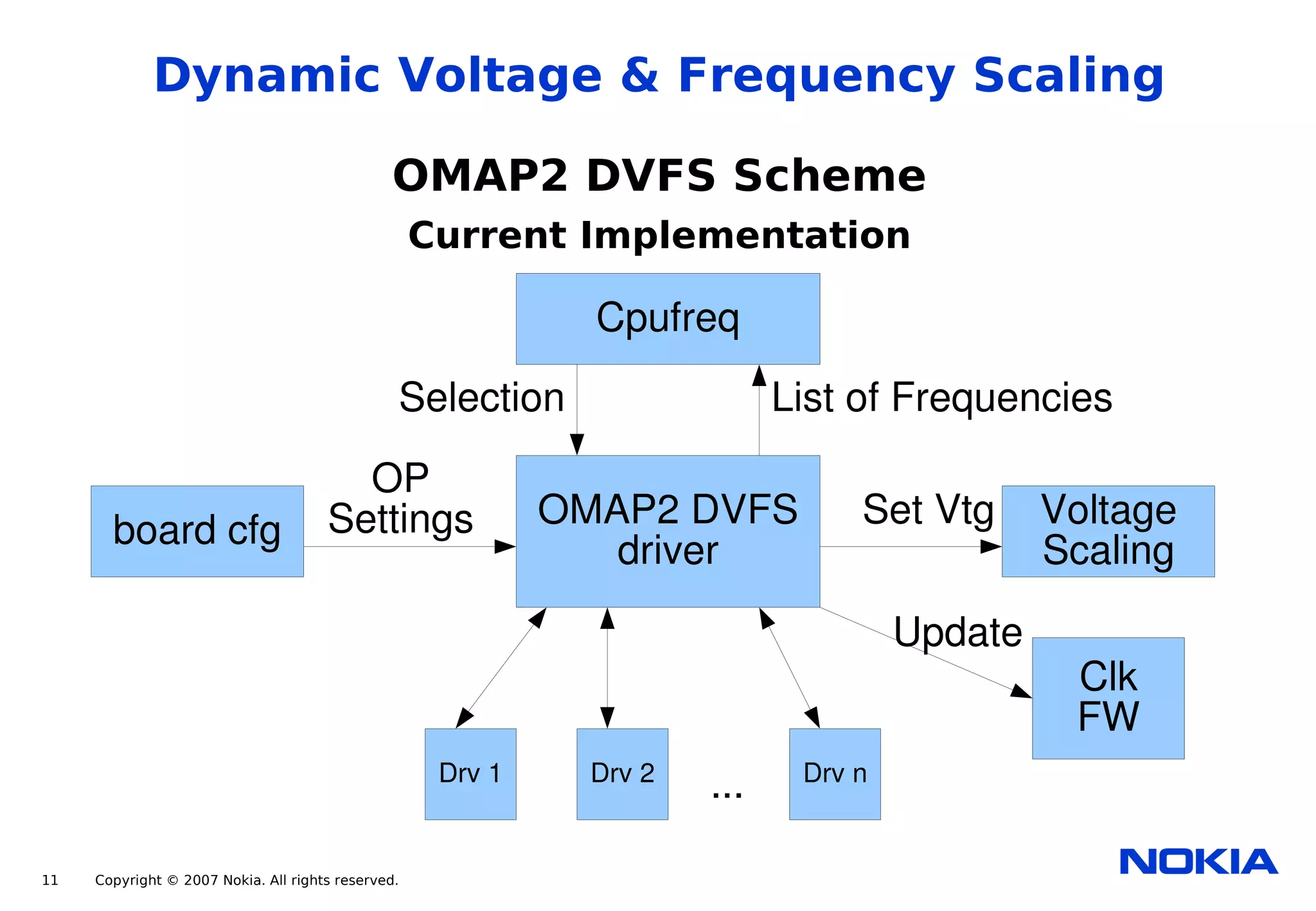
    11. Dynamic Voltage & Frequency Scaling OMAP2 DVFS Scheme Current Implementation Cpufreq Selection List of Frequencies OP Set Vtg OMAP2 DVFS Voltage Settings board cfg driver Scaling Update Clk FW Drv 1 Drv 2 Drv n ... 11 Copyright © 2007 Nokia. All rights reserved.
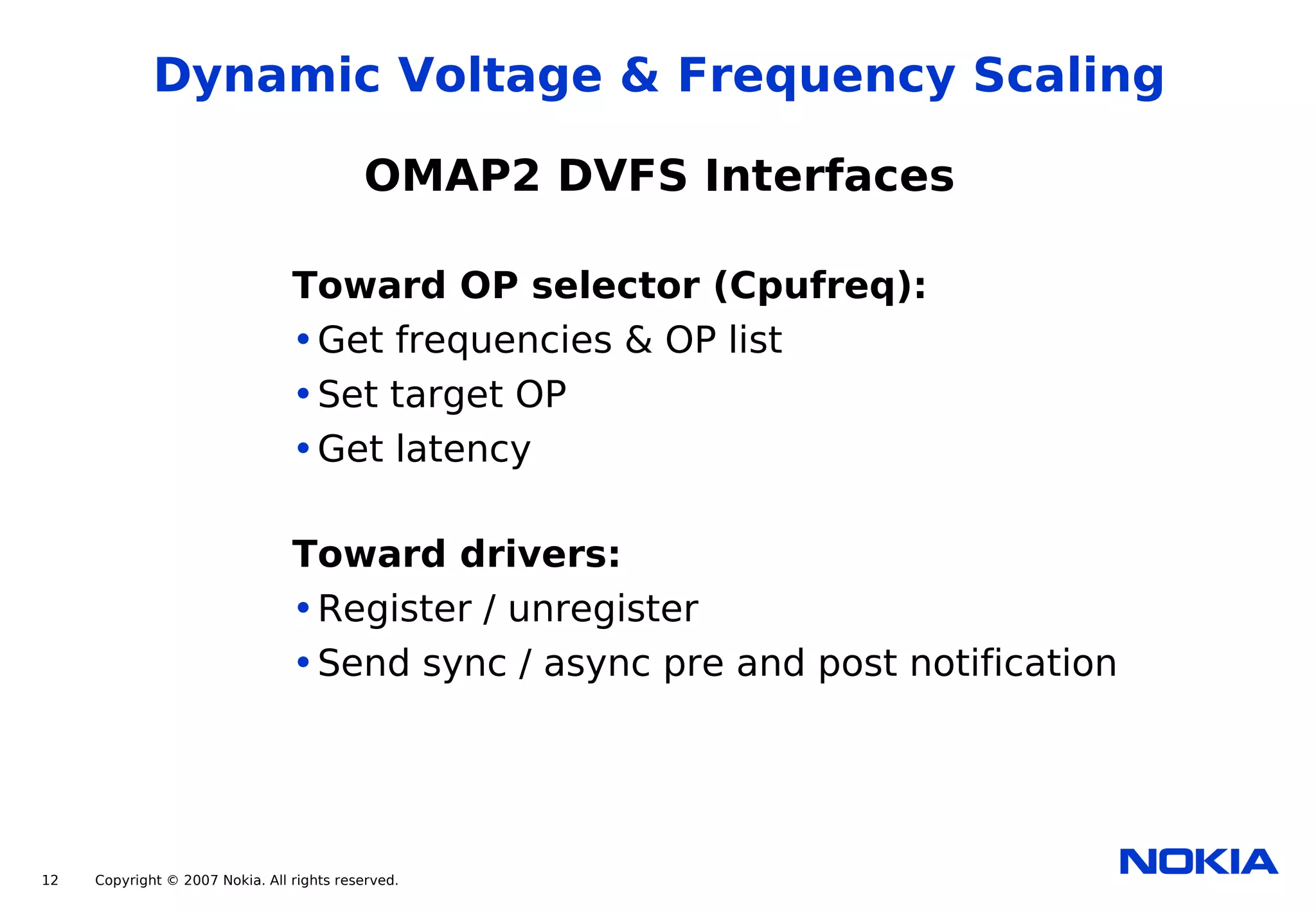
    12. Dynamic Voltage & Frequency Scaling OMAP2 DVFS Interfaces Toward OP selector (Cpufreq): •Get frequencies & OP list •Set target OP •Get latency Toward drivers: •Register / unregister •Send sync / async pre and post notification 12 Copyright © 2007 Nokia. All rights reserved.
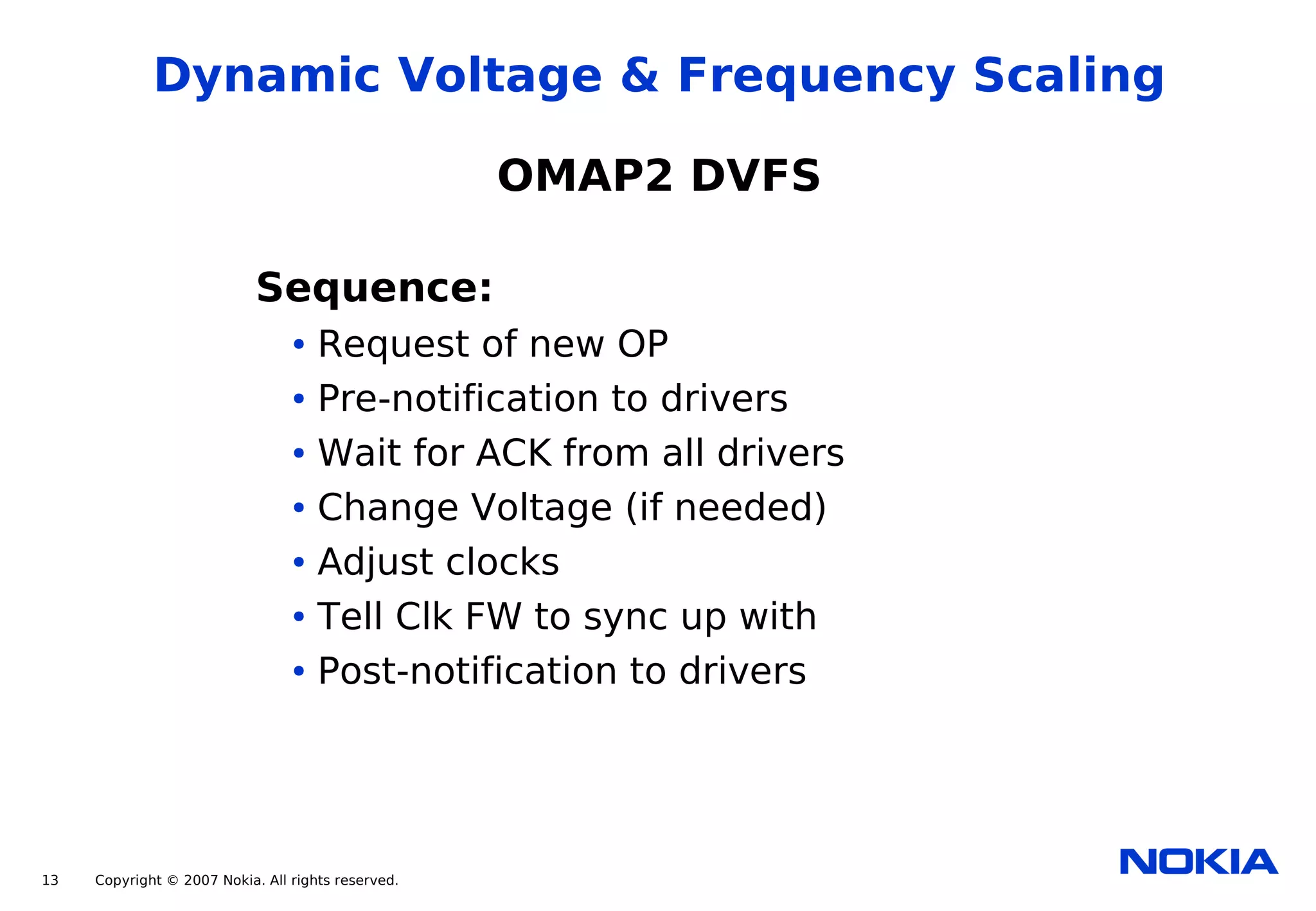
    13. Dynamic Voltage & Frequency Scaling OMAP2 DVFS Sequence: Request of new OP ● Pre-notification to drivers ● Wait for ACK from all drivers ● Change Voltage (if needed) ● Adjust clocks ● Tell Clk FW to sync up with ● Post-notification to drivers ● 13 Copyright © 2007 Nokia. All rights reserved.
    14. CPUFREQ: Lessons learned •Expressing Constraints •Determinism •non-polling governor •ondemand transition_latency misuse 14 Copyright © 2007 Nokia. All rights reserved.
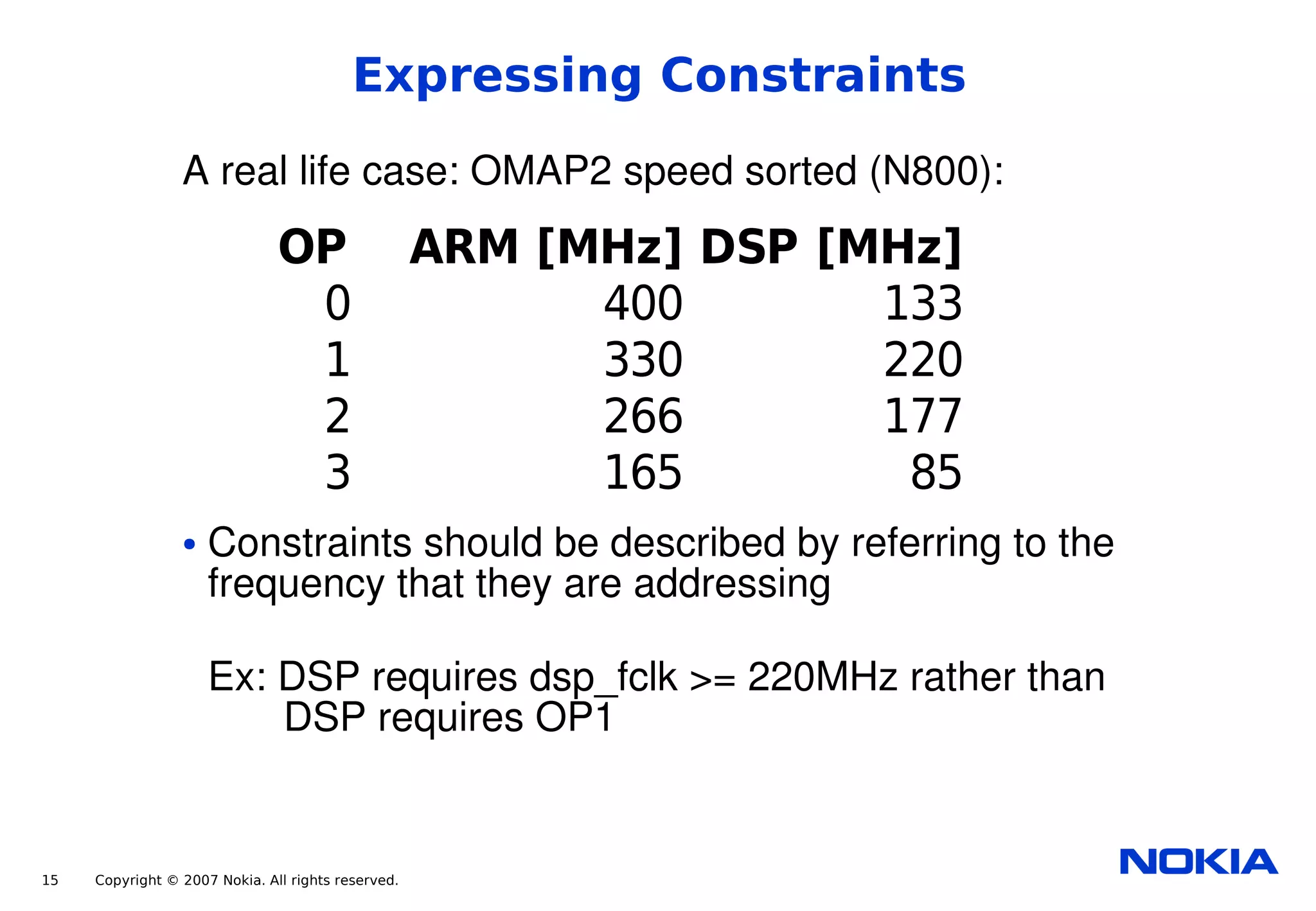
    15. Expressing Constraints A real life case: OMAP2 speed sorted (N800): OP ARM [MHz] DSP [MHz] 0 400 133 1 330 220 2 266 177 3 165 85 Constraints should be described by referring to the ● frequency that they are addressing Ex: DSP requires dsp_fclk >= 220MHz rather than DSP requires OP1 15 Copyright © 2007 Nokia. All rights reserved.
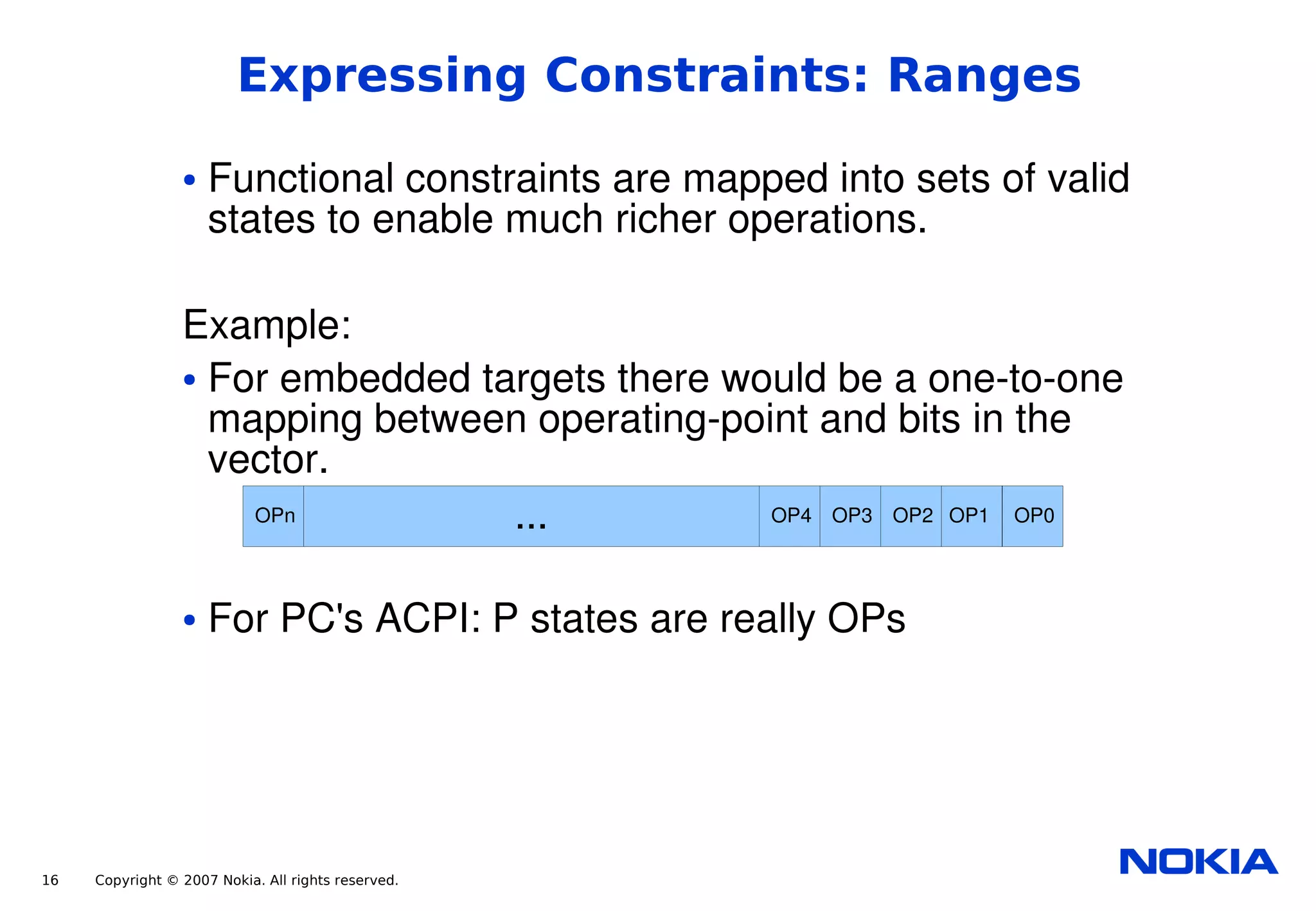
    16. Expressing Constraints: Ranges Functional constraints are mapped into sets of valid ● states to enable much richer operations. Example: ● For embedded targets there would be a one-to-one mapping between operating-point and bits in the vector. ... OPn OP4 OP3 OP2 OP1 OP0 For PC's ACPI: P states are really OPs ● 16 Copyright © 2007 Nokia. All rights reserved.
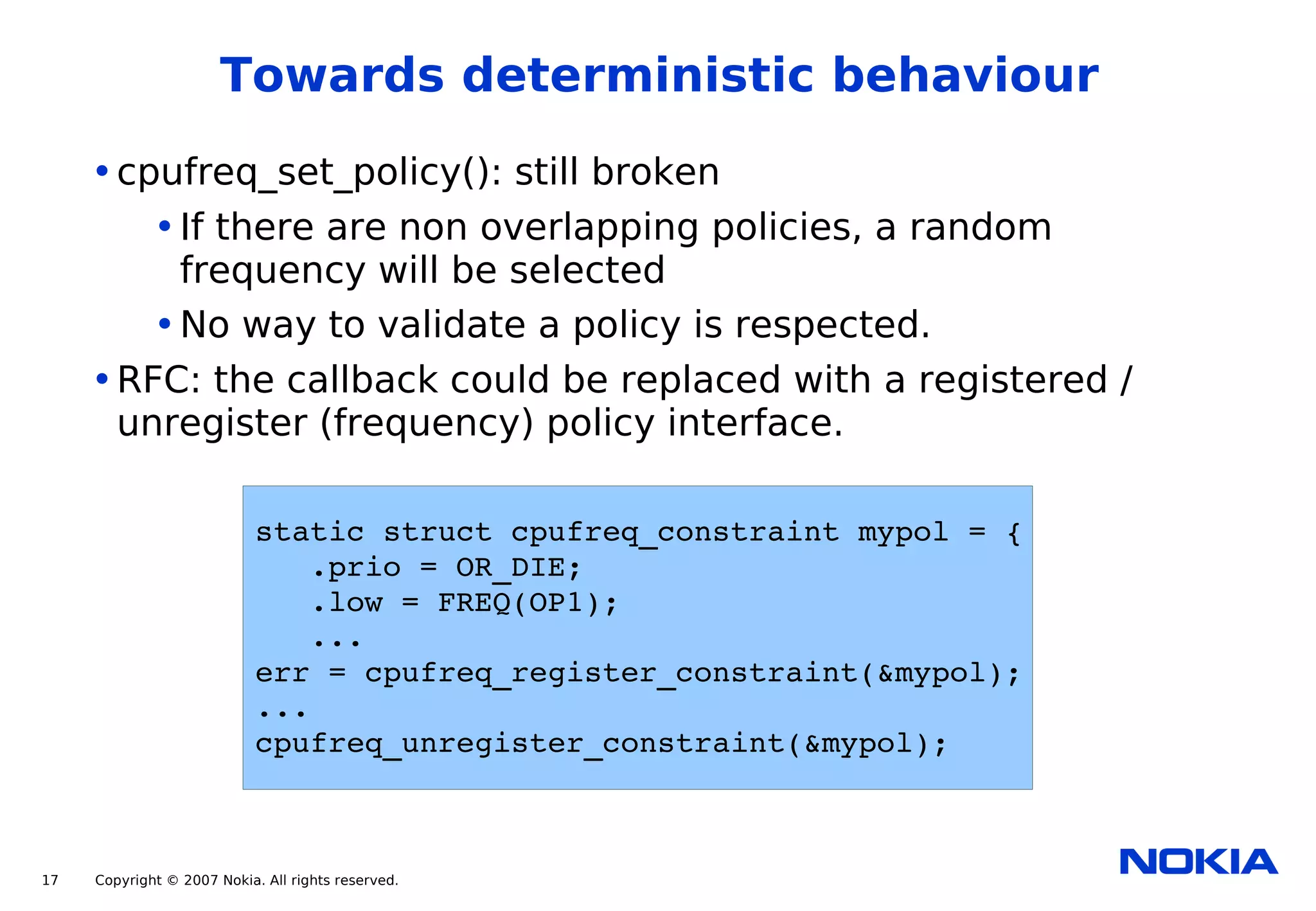
    17. Towards deterministic behaviour •cpufreq_set_policy(): still broken • If there are non overlapping policies, a random frequency will be selected • No way to validate a policy is respected. •RFC: the callback could be replaced with a registered / unregister (frequency) policy interface. static struct cpufreq_constraint mypol = {    .prio = OR_DIE;    .low = FREQ(OP1);    ... err = cpufreq_register_constraint(&mypol); ... cpufreq_unregister_constraint(&mypol); 17 Copyright © 2007 Nokia. All rights reserved.
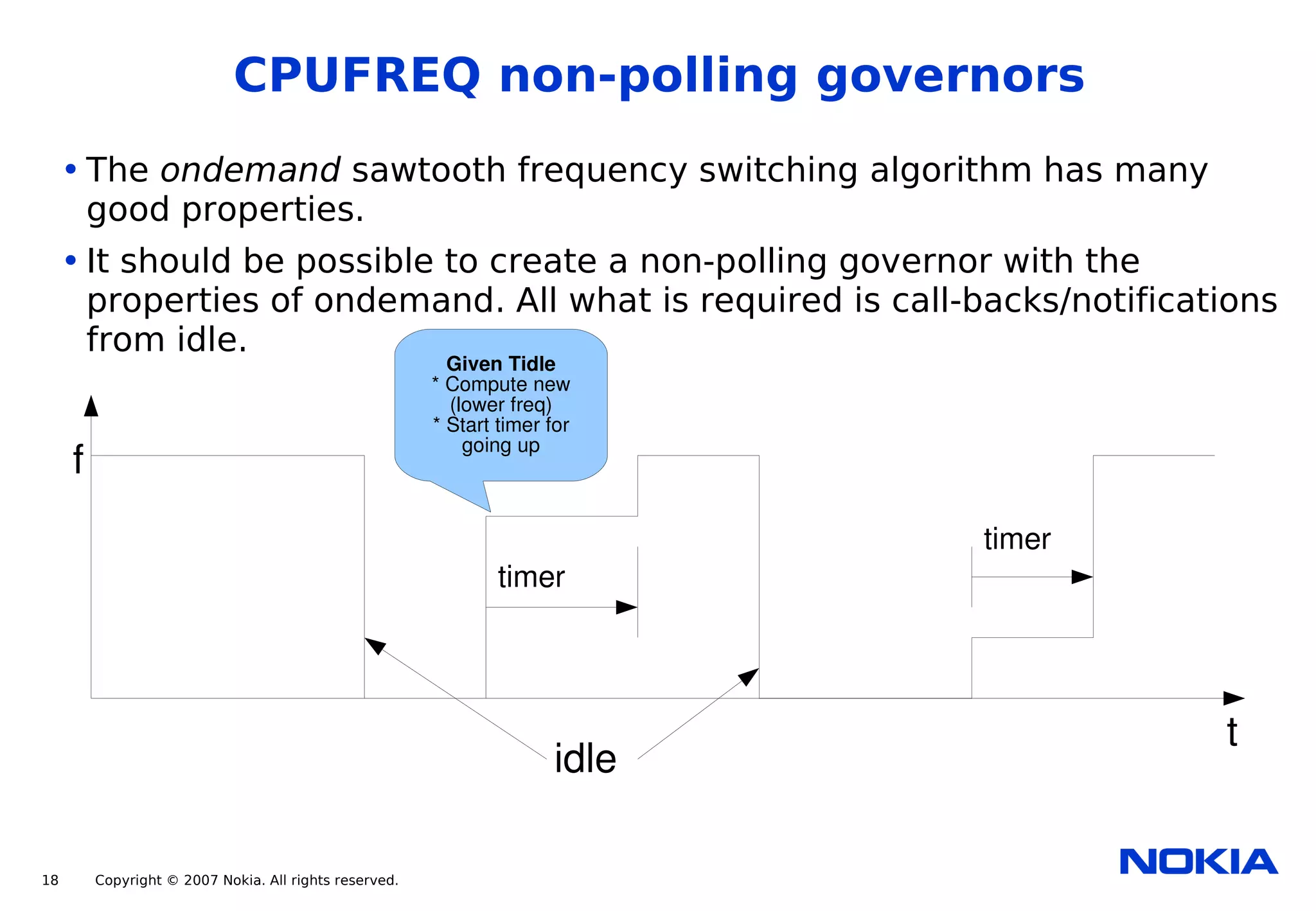
    18. CPUFREQ non-polling governors • The ondemand sawtooth frequency switching algorithm has many good properties. • It should be possible to create a non-polling governor with the properties of ondemand. All what is required is call-backs/notifications from idle. Given Tidle * Compute new (lower freq) * Start timer for going up f timer timer t idle 18 Copyright © 2007 Nokia. All rights reserved.
    19. CPUFREQ: transition_latency misuse •ondemand uses transition_latency to calculate the polling interval (1000x). •this weird relation is artificial. •Introduce: •polling_interval •relax_interval i.e. the minimum time to stay on a newly selected frequency. 19 Copyright © 2007 Nokia. All rights reserved.
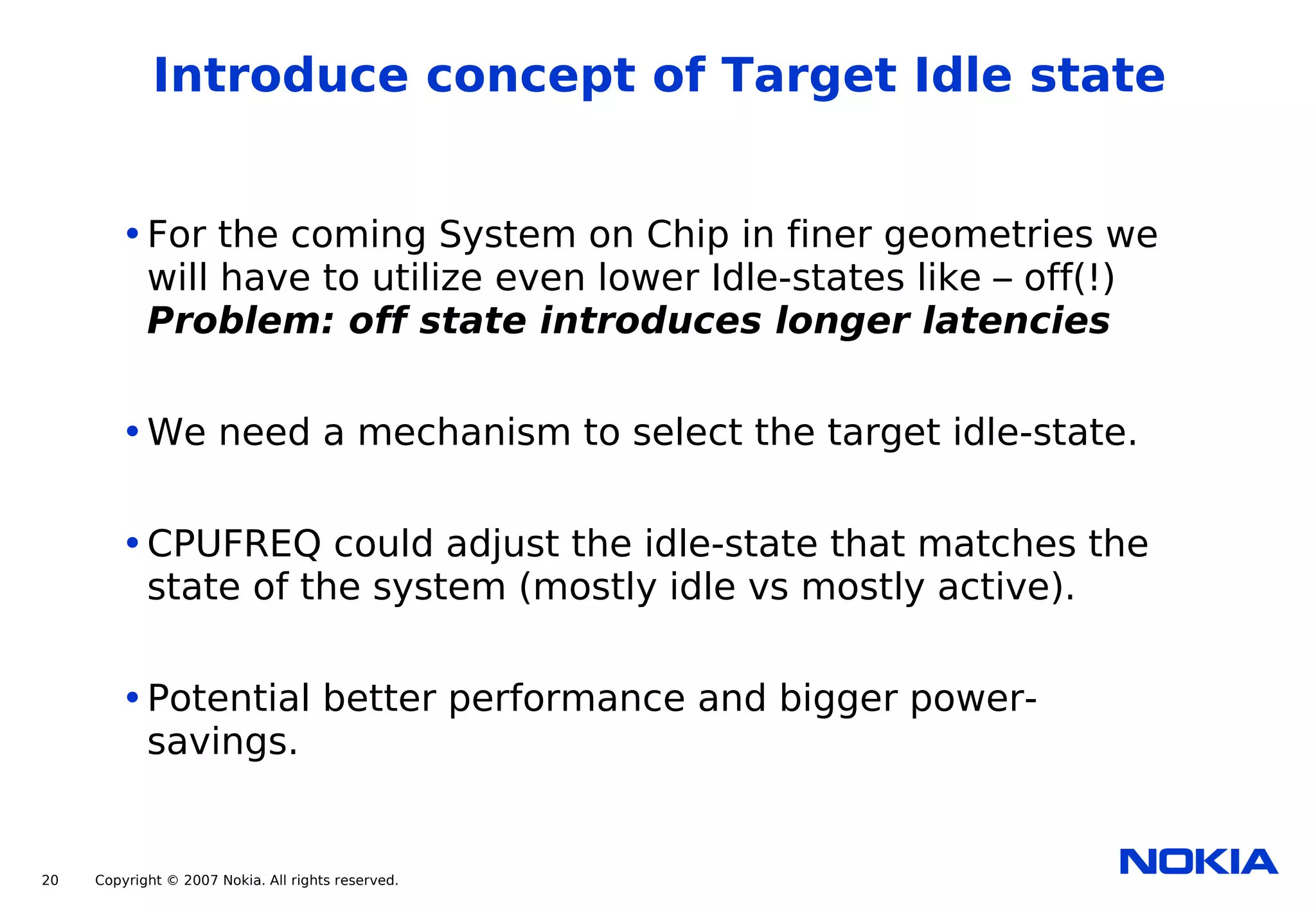
    20. Introduce concept of Target Idle state •For the coming System on Chip in finer geometries we will have to utilize even lower Idle-states like – off(!) Problem: off state introduces longer latencies •We need a mechanism to select the target idle-state. •CPUFREQ could adjust the idle-state that matches the state of the system (mostly idle vs mostly active). •Potential better performance and bigger power- savings. 20 Copyright © 2007 Nokia. All rights reserved.
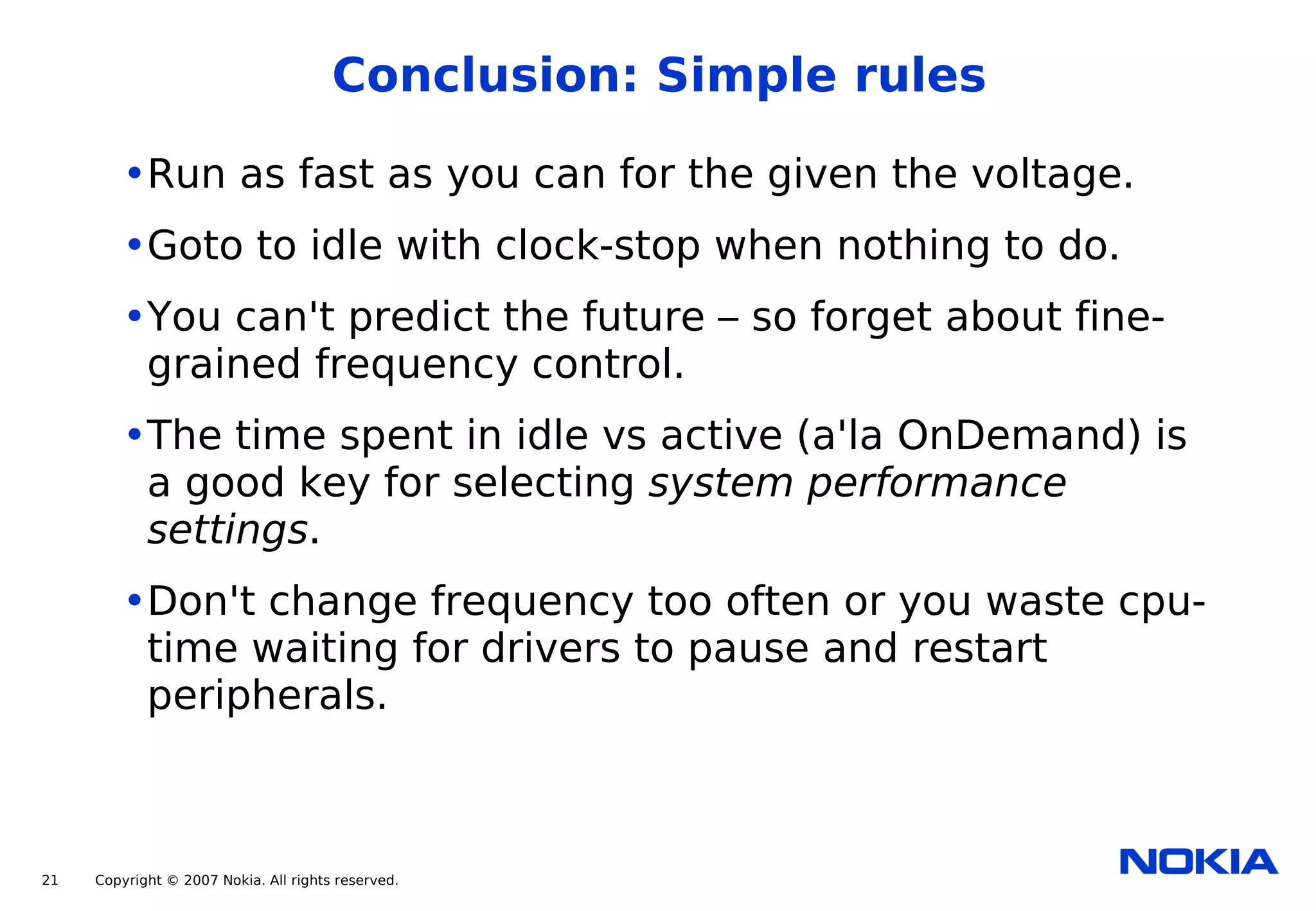
    21. Conclusion: Simple rules •Run as fast as you can for the given the voltage. •Goto to idle with clock-stop when nothing to do. •You can't predict the future – so forget about fine- grained frequency control. •The time spent in idle vs active (a'la OnDemand) is a good key for selecting system performance settings. •Don't change frequency too often or you waste cpu- time waiting for drivers to pause and restart peripherals. 21 Copyright © 2007 Nokia. All rights reserved.
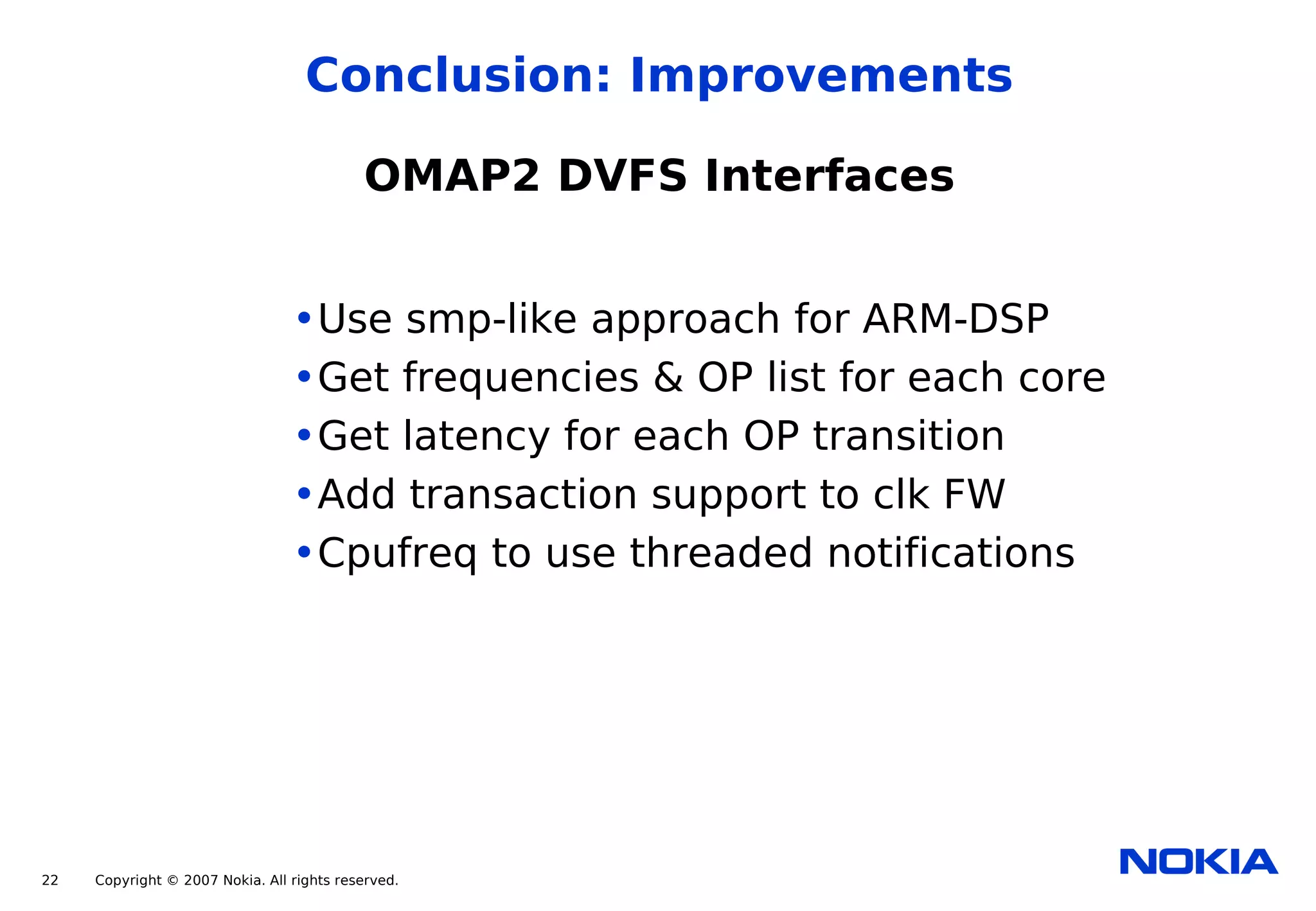
    22. Conclusion: Improvements OMAP2 DVFS Interfaces •Use smp-like approach for ARM-DSP •Get frequencies & OP list for each core •Get latency for each OP transition •Add transaction support to clk FW •Cpufreq to use threaded notifications 22 Copyright © 2007 Nokia. All rights reserved.
    23. Conclusion: Challenges •Non-SMP systems, with independent OS but intermingled clock and voltage control •Relative high current usage by support components -> nullifies benefit of low frequency and voltage operation point in a dynamic idle system. 23 Copyright © 2007 Nokia. All rights reserved.

    + igor_stoppa_nokiaigor_stoppa_nokia, 3 years ago

    custom

    5831 views, 3 favs, 4 embeds more stats

    Current implementation, work in progress and future more

    More info about this presentation

    © All Rights Reserved

    • Total Views 5831
      • 5827 on SlideShare
      • 4 from embeds
    • Comments 0
    • Favorites 3
    • Downloads 266
    Most viewed embeds
    • 1 views on http://livebackgammon.info
    • 1 views on http://www.geoffblake.com
    • 1 views on http://www.mvyx.com
    • 1 views on http://www.o53.net

    more

    All embeds
    • 1 views on http://livebackgammon.info
    • 1 views on http://www.geoffblake.com
    • 1 views on http://www.mvyx.com
    • 1 views on http://www.o53.net

    less

    Flagged as inappropriate Flag as inappropriate
    Flag as inappropriate

    Select your reason for flagging this presentation as inappropriate. If needed, use the feedback form to let us know more details.

    Cancel
    File a copyright complaint
    Having problems? Go to our helpdesk?

    Categories