ICTs for development: from e-Readiness to e-Awareness

Loading...

Flash Player 9 (or above) is needed to view presentations.
We have detected that you do not have it on your computer. To install it, go here.

0 comments

Post a comment

    Post a comment
    Embed Video
    Edit your comment Cancel

    3 Favorites & 1 Group

    ICTs for development: from e-Readiness to e-Awareness - Presentation Transcript

    1. ICTs for development: from e-Readiness to e-Awareness Ismael Peña - López ictlogy.net School of Law and Political Science Universitat Oberta de Catalunya Barcelona, November 20, 2007
    2. Executive Master in e-Governance e-Gov 2007/2008 New Institutional Designs for a Changing World. Module 3. Barcelona Week.
      • Information and Communication Technologies for Development: ICT4D
      • The concept of access and the measurement of the Knowledge Society
      • Digital Divide: a holistic approach
      • e-Readiness and Web 2.0 for e-Governance in Developing Countries
      Index
    3. ICTs for Development
    4. NEW Information and Communication Technologies
      • Old ones:
        • radio
        • phone
        • TV
        • printed press
      • New ones:
        • digital content
        • Internet (e-mail, WWW…)
        • mobile phone
    5. INFORMATION and COMMUNICATION TechnologIES
      • Information:
        • databases
        • information
        • knowledge management
      • Communication:
        • broadcasting
        • p2p
        • networking
      • Technologies
        • multiplatform
        • multichannel
        • empowering
    6. Information Society? (1/3)
      • (back to the ) Production function
      • Land and Labour
      • Industrial Revolution: Land, Labour and Capital
      • … Revolution? Land, Labour, Capital and Information/Knowledge/Technology/…
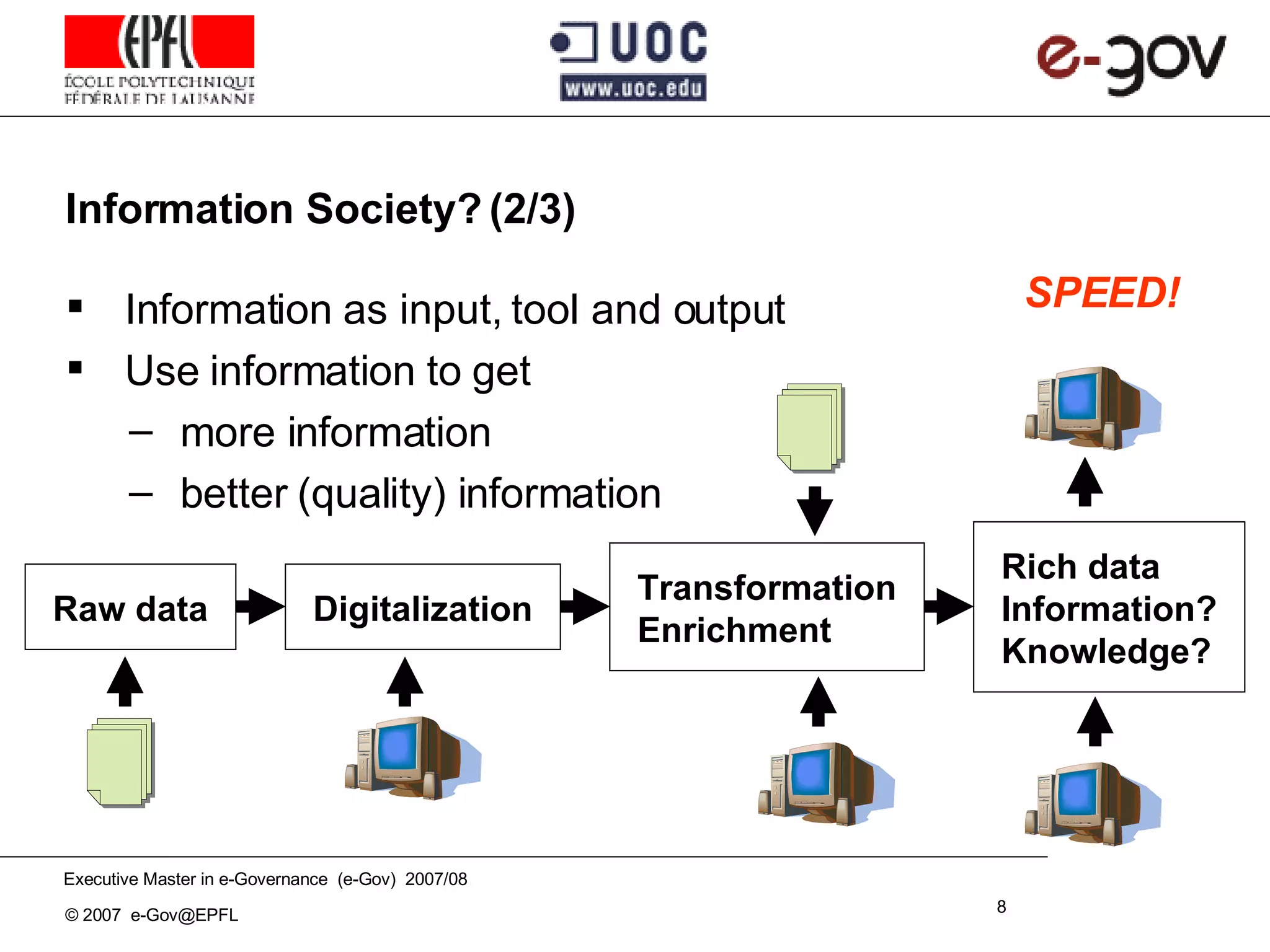
    7. Information Society? (2/3)
      • Information as input, tool and output
      • Use information to get
        • more information
        • better (quality) information
      Raw data Digitalization Transformation Enrichment Rich data Information? Knowledge? SPEED!
    8. Information Society? (3/3)
      • Information Society
      • Informational Society
      • Knowledge Based Society
      • Networked Society
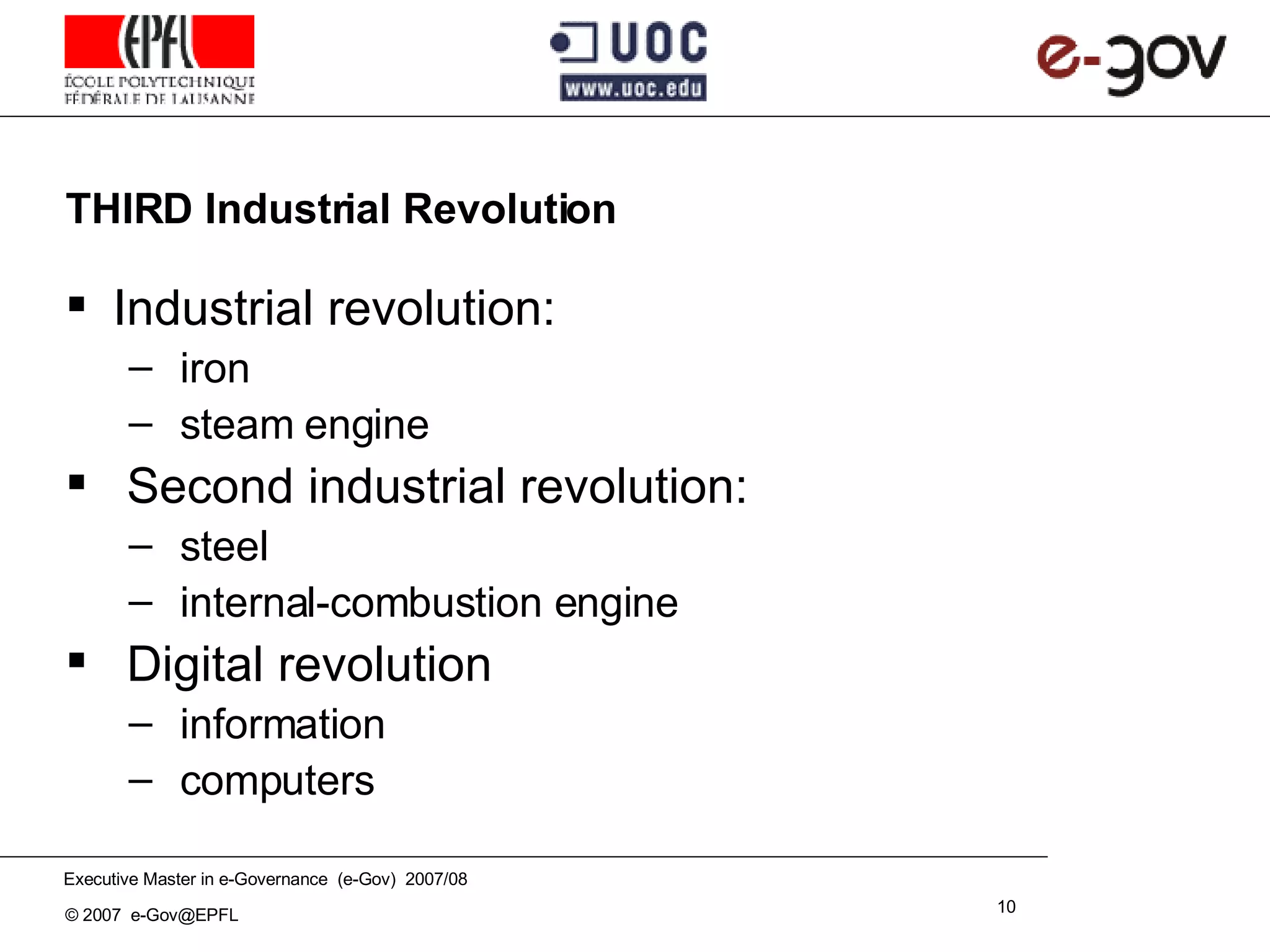
    9. THIRD Industrial Revolution
      • Industrial revolution:
        • iron
        • steam engine
      • Second industrial revolution:
        • steel
        • internal-combustion engine
      • Digital revolution
        • information
        • computers
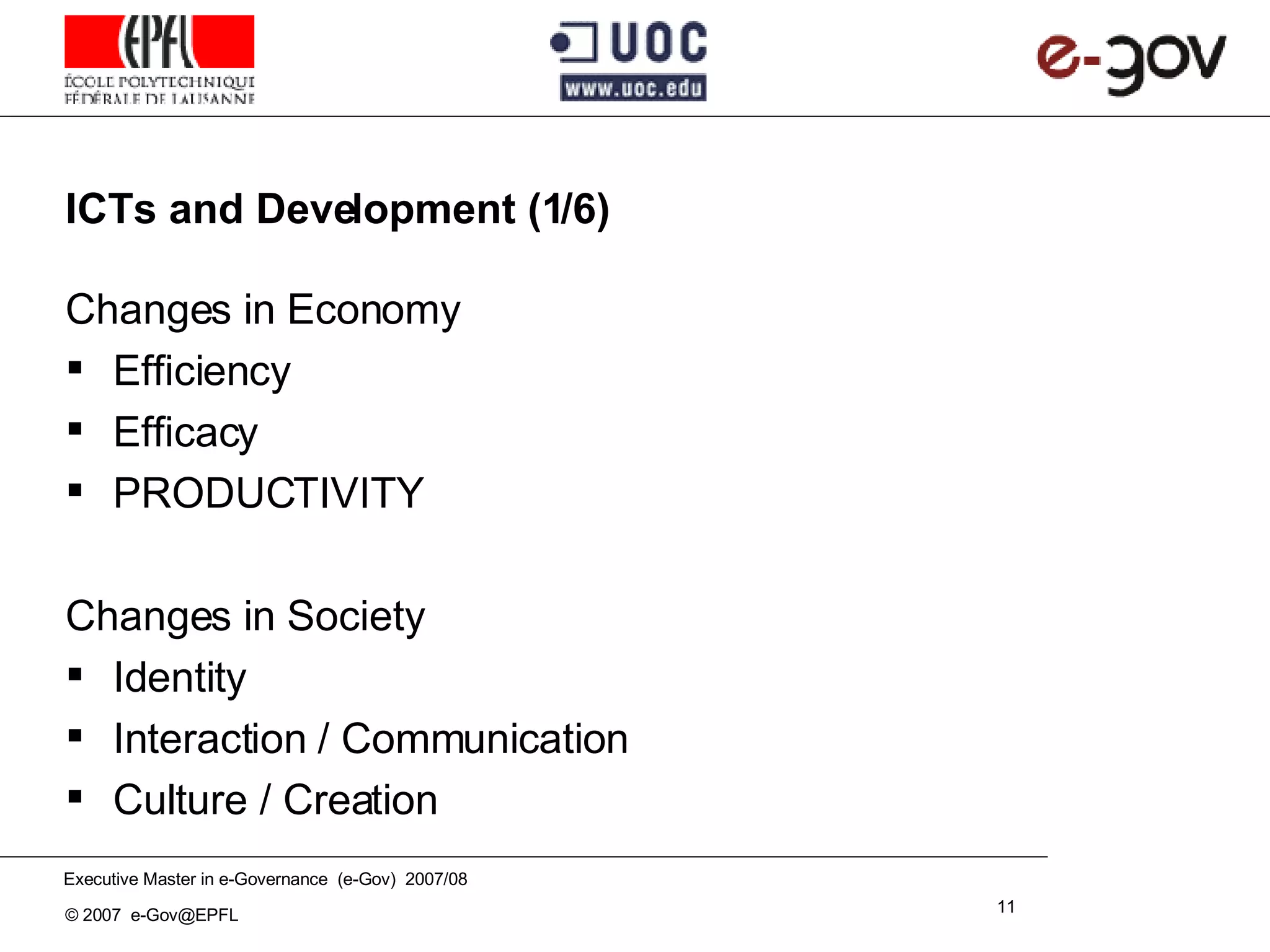
    10. ICTs and Development (1/6)
      • Changes in Economy
      • Efficiency
      • Efficacy
      • PRODUCTIVITY
      • Changes in Society
      • Identity
      • Interaction / Communication
      • Culture / Creation
    11. ICTs and Development (2/6) Christine Zhen-Wei Qiang, Alexander Pitt and Seth Ayers. World Bank (2003) ICT & Development
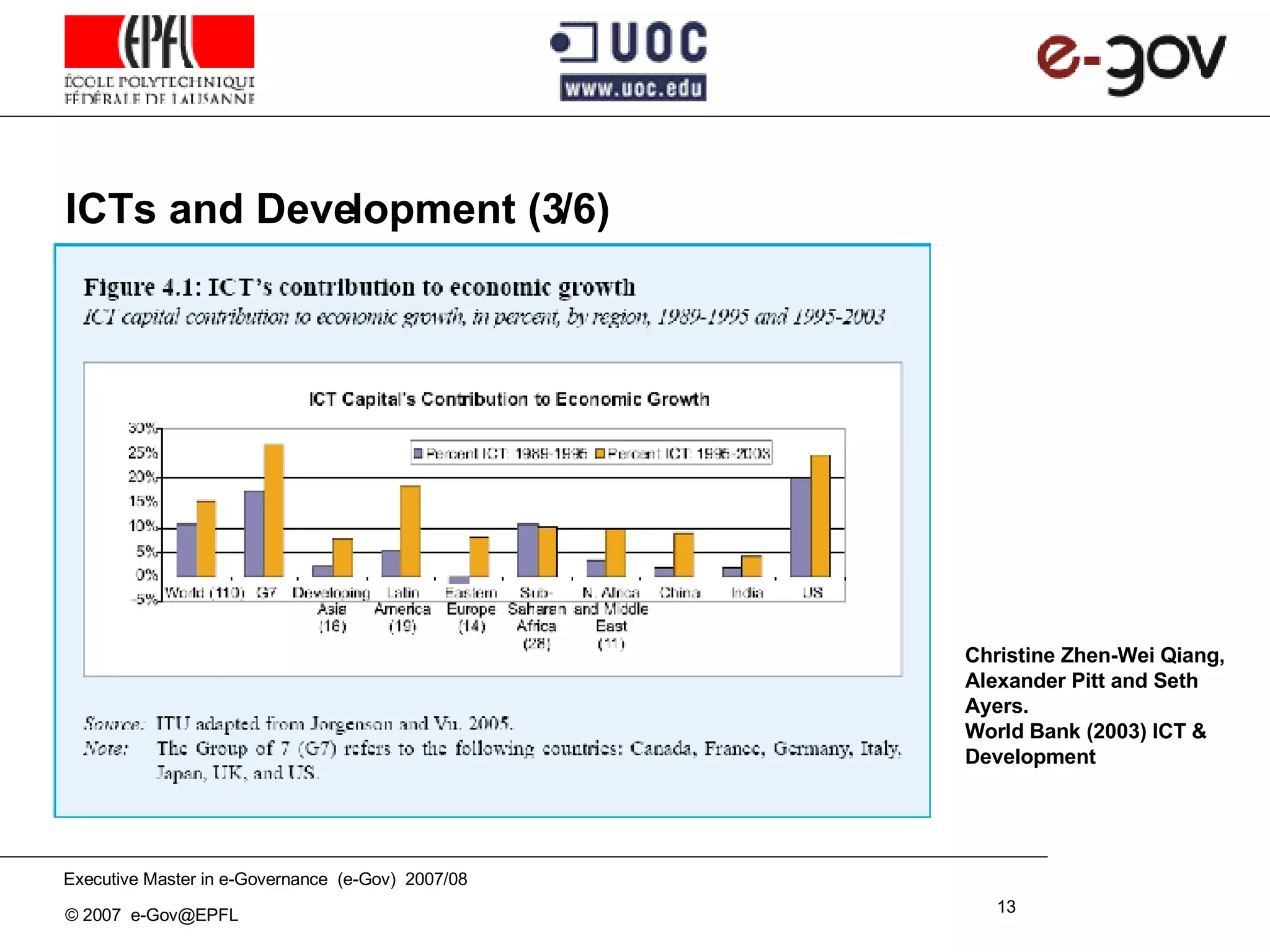
    12. ICTs and Development (3/6) Christine Zhen-Wei Qiang, Alexander Pitt and Seth Ayers. World Bank (2003) ICT & Development
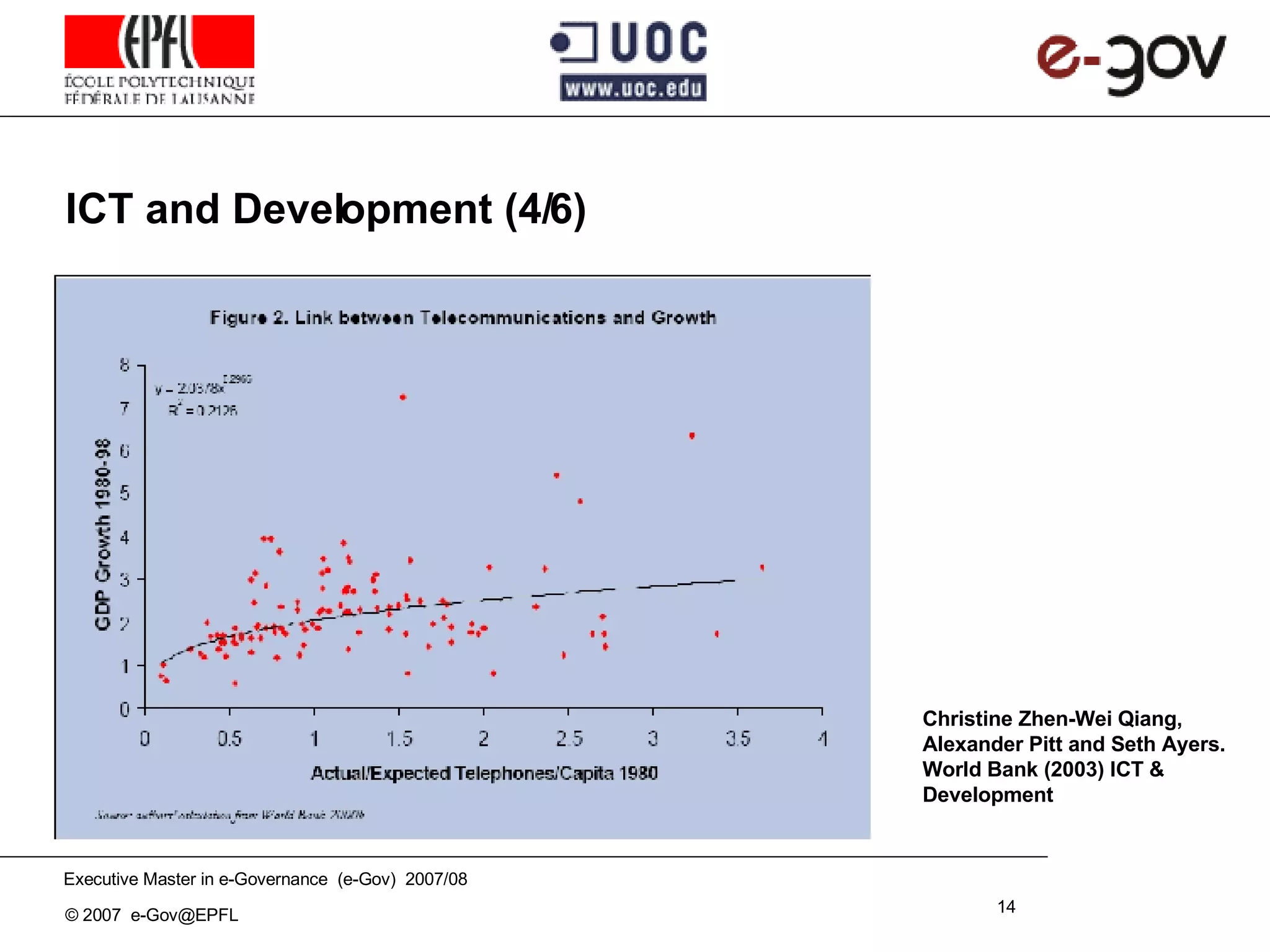
    13. ICT and Development (4/6) Christine Zhen-Wei Qiang, Alexander Pitt and Seth Ayers. World Bank (2003) ICT & Development
    14. ICTs and Development: the MDG (5/6)
      • ICTs necessary for
      • Investment
      • Livelihood support
      • Entrepreneurship
      • ICTs facilitate
      • Cost-effective public services
      • Cost-effective private services
      Nishimoto, S. & Lal, R. (2005). “Development divides and digital bridges: why ICT is key for achieving the MDGs”. In Commonwealth Secretariat (Ed.)
    15. ICTs and Development: key issues (6/6)
      • Health
      • e-Health
      • Genomics
      • Education
      • e-Learning
      • Blended Learning
      • m-Learning
      • Governance
      • e-Governance
      • e-Government
      • e-Administration
      • e-Democracy
      • e-Participation
    16. Access and measurement of the Information Society
    17. What is Access
      • The Broadcasting model
      • Emphasis on the active receiver
      • Freedom of choice
      • Access = Range of products on offer
      • Telecommunications model
      • Emphasis on the sender
      • Capacity to get one’s message out
      • Access = Means of communication
      Raboy, M. (1998). “Global Communication policy and human rights”. In Noll, R. G. & Price, M. E. (Eds.), A communications cornucopia: Markle Foundation essays on information policy
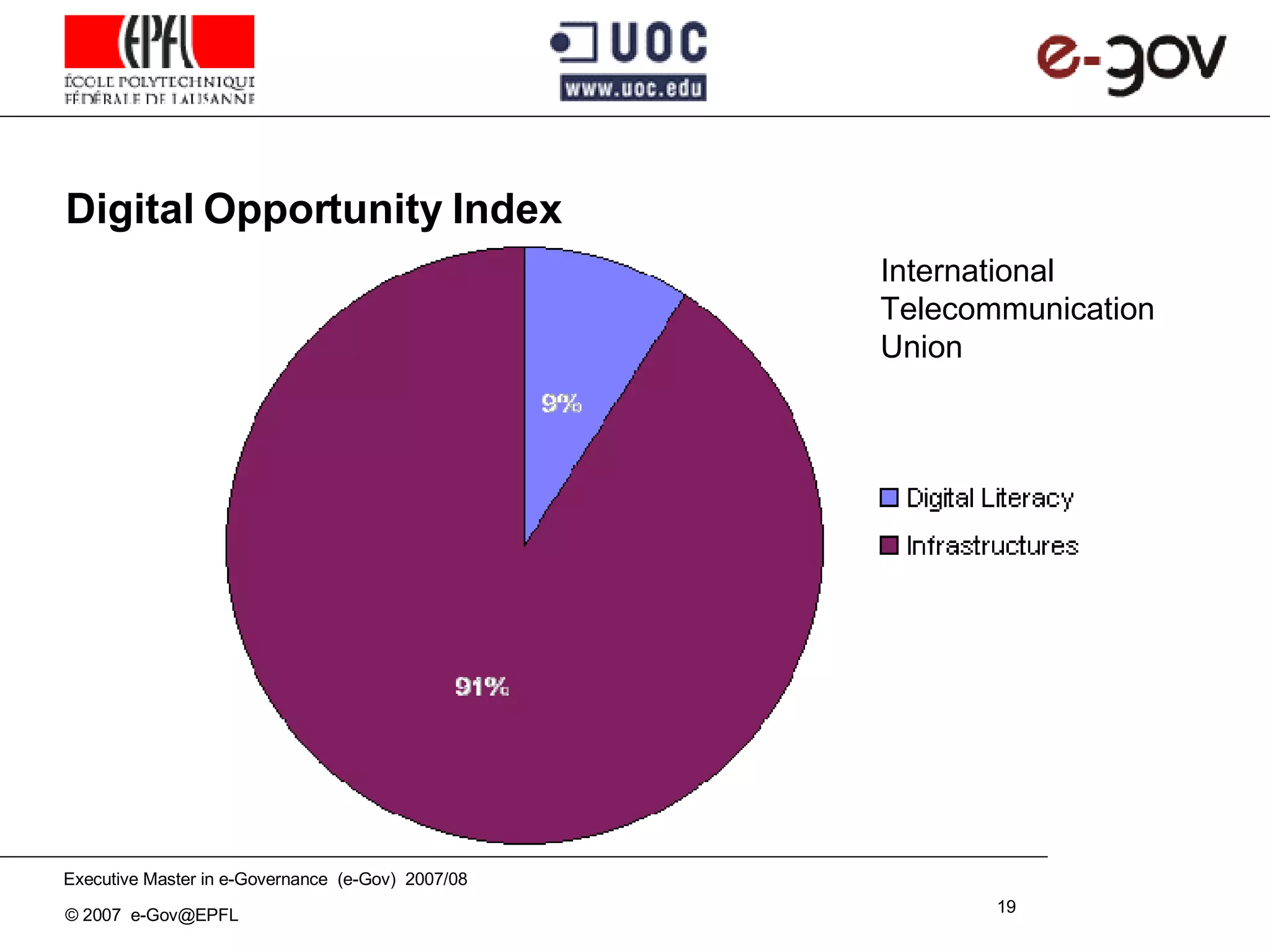
    18. Digital Opportunity Index International Telecommunication Union
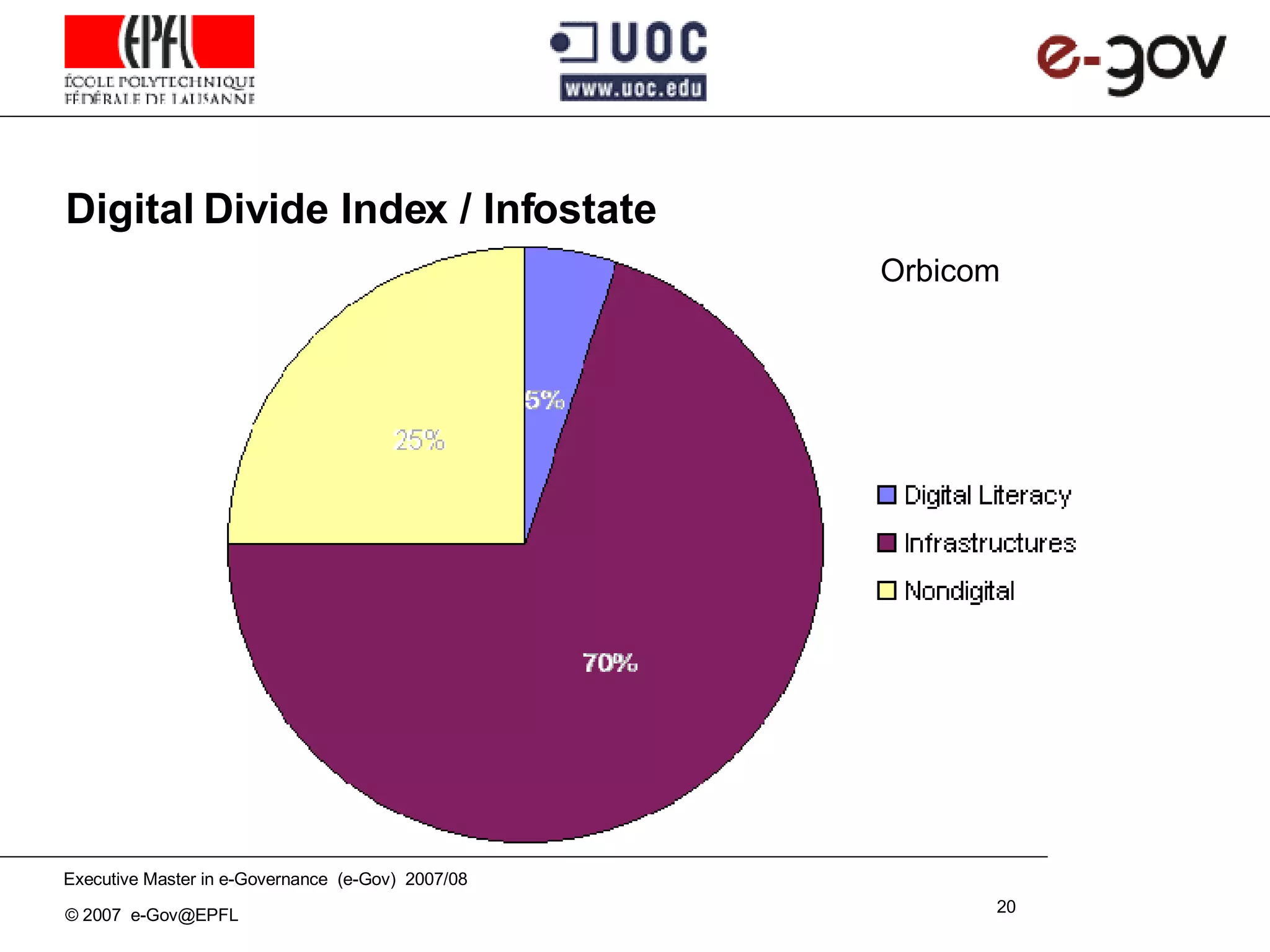
    19. Digital Divide Index / Infostate Orbicom
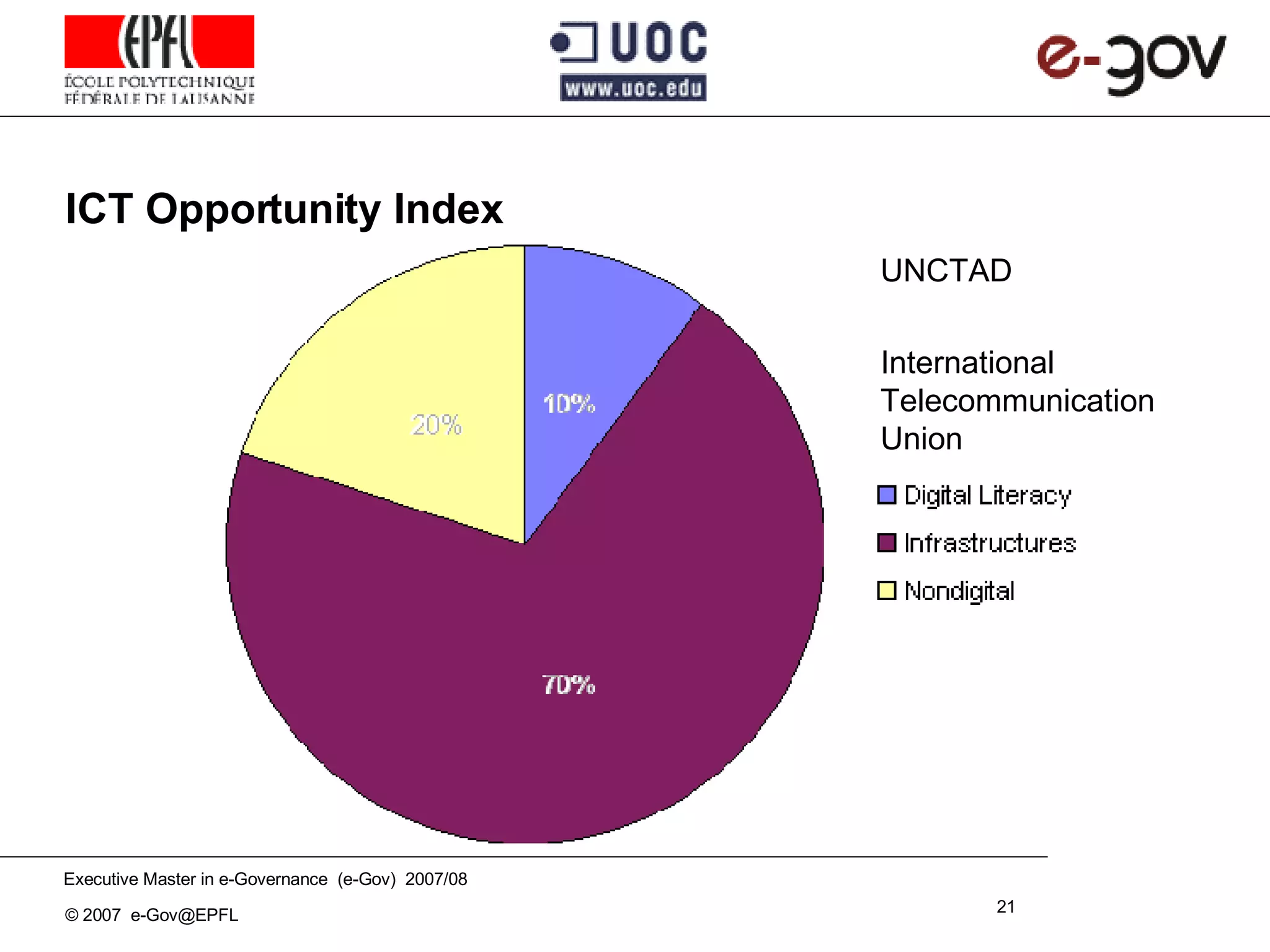
    20. ICT Opportunity Index UNCTAD International Telecommunication Union
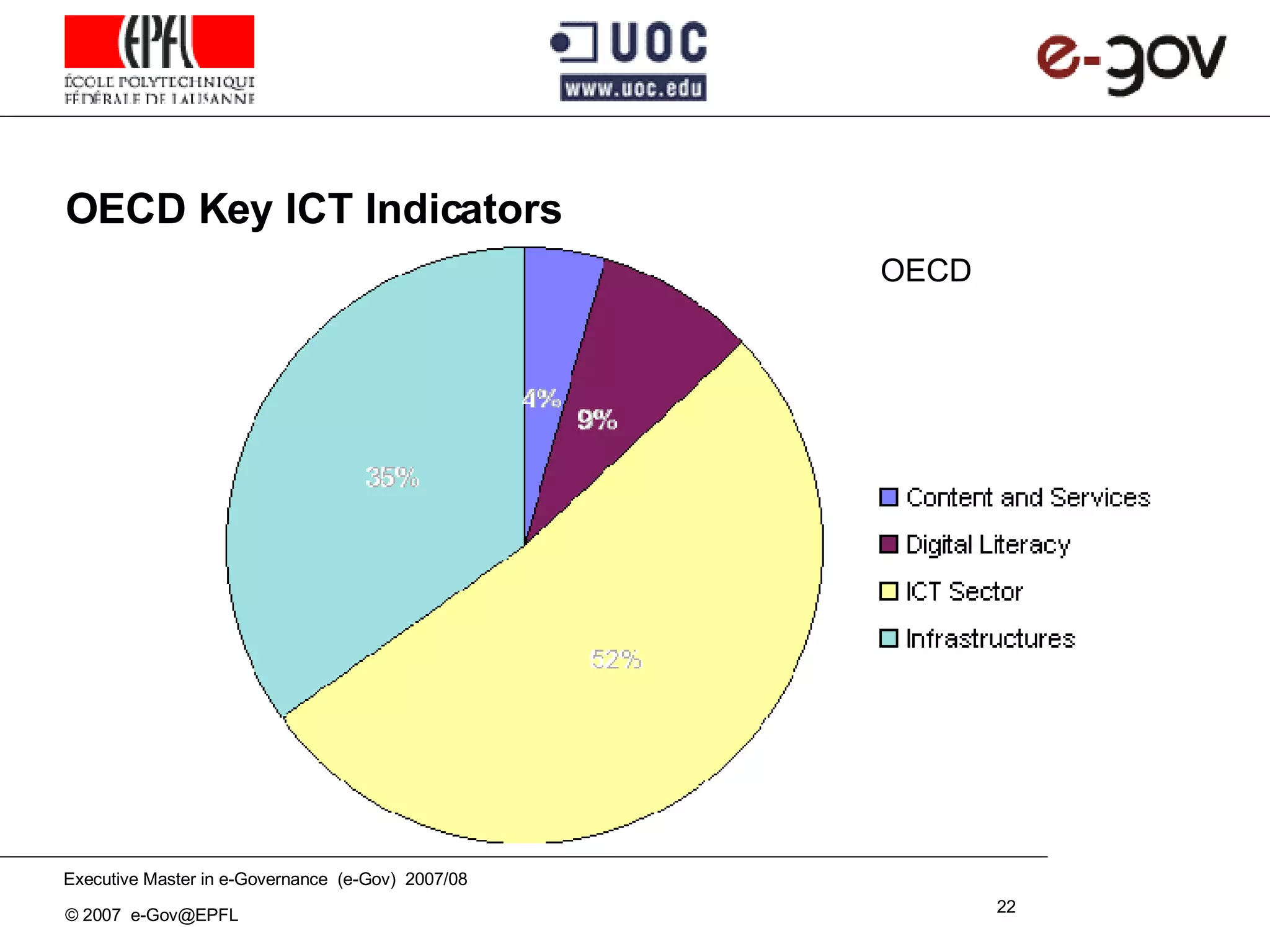
    21. OECD Key ICT Indicators OECD
    22. e-Readiness Rankings The Economist Intelligence Unit
    23. Networked Readiness Index World Economic Forum
    24. Digital Divide: a holistic approach
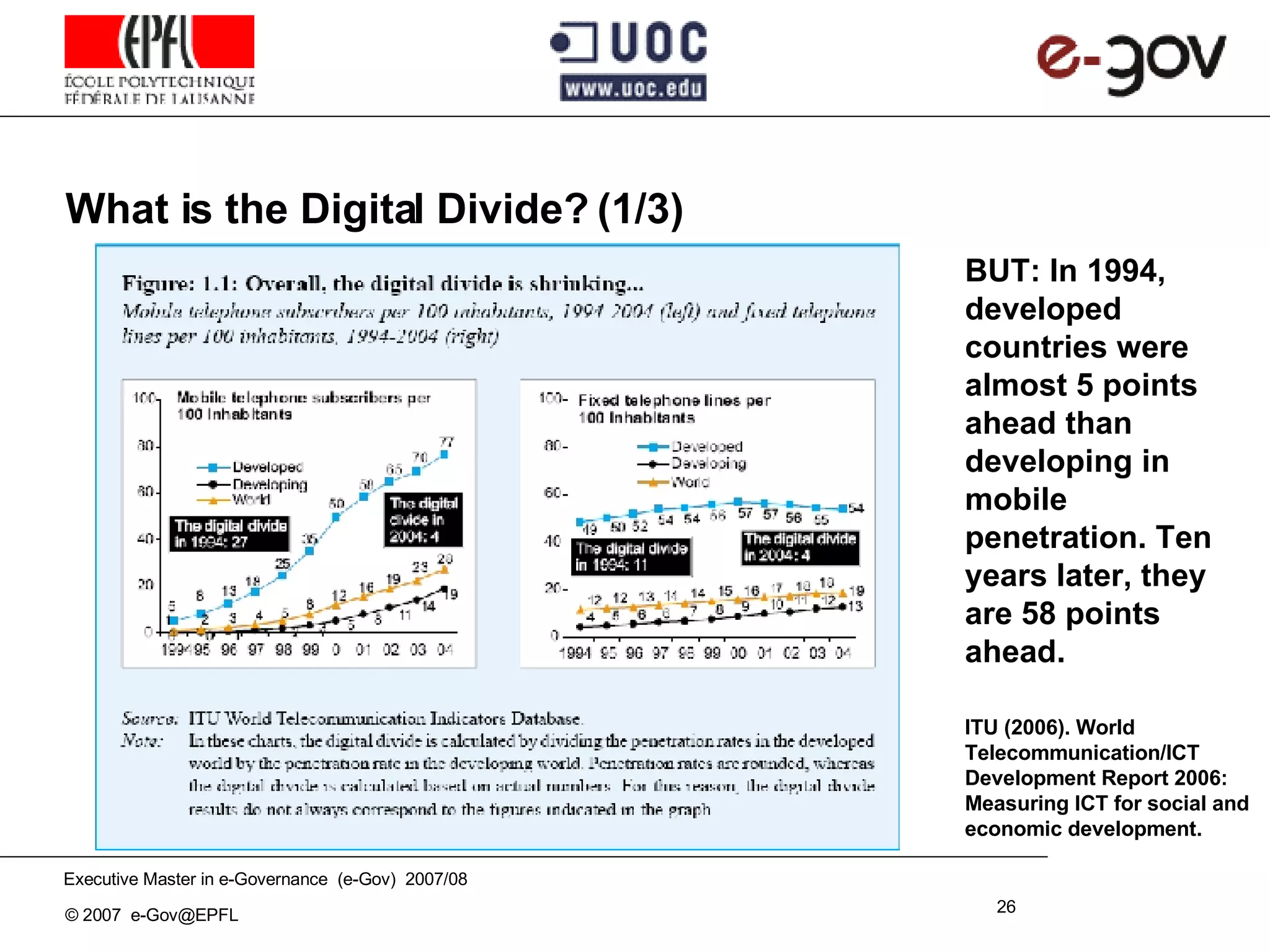
    25. What is the Digital Divide? (1/3) ITU (2006). World Telecommunication/ICT Development Report 2006: Measuring ICT for social and economic development. BUT: In 1994, developed countries were almost 5 points ahead than developing in mobile penetration. Ten years later, they are 58 points ahead.
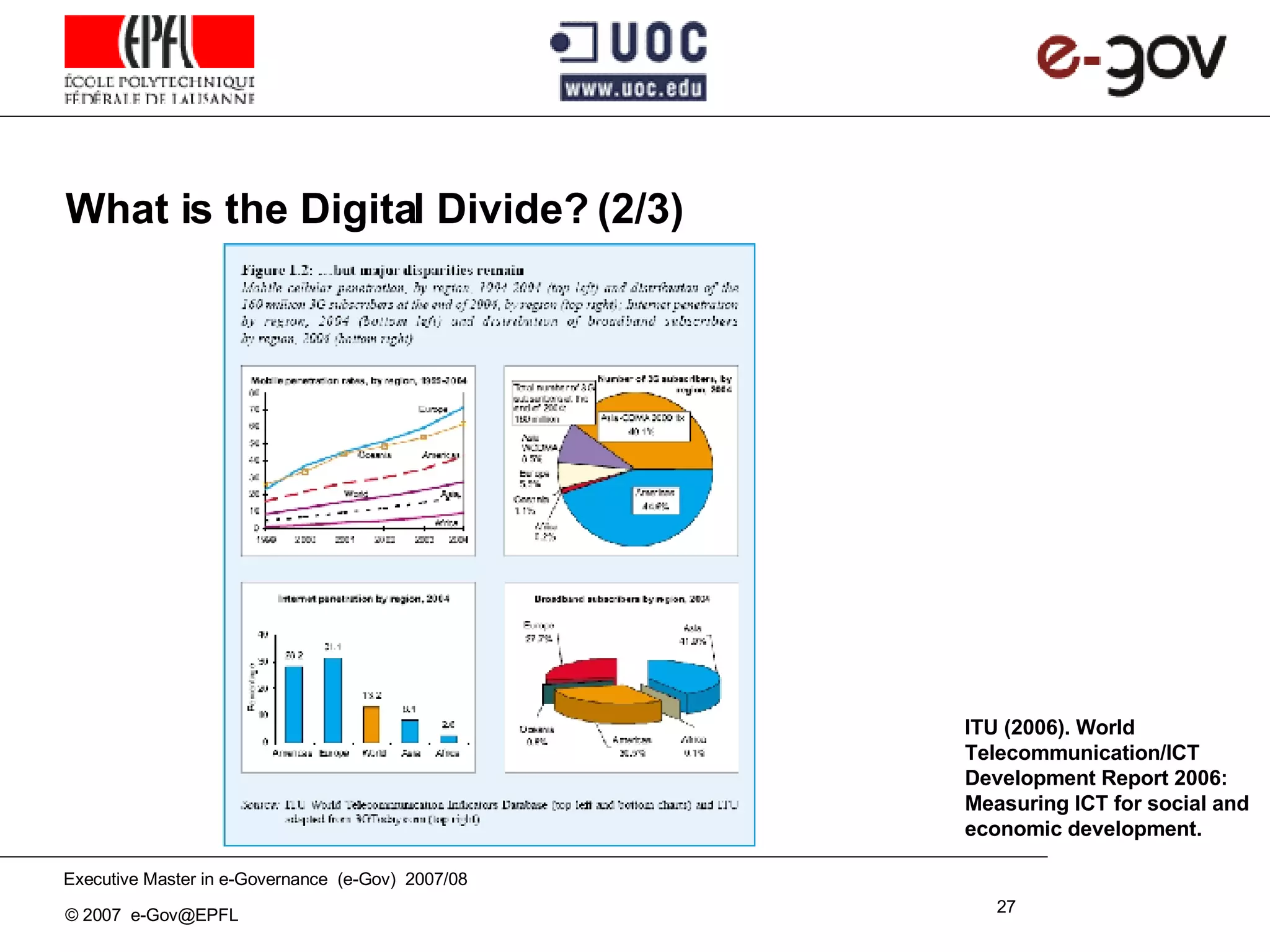
    26. What is the Digital Divide? (2/3) ITU (2006). World Telecommunication/ICT Development Report 2006: Measuring ICT for social and economic development.
    27. What is the Digital Divide? (3/3)
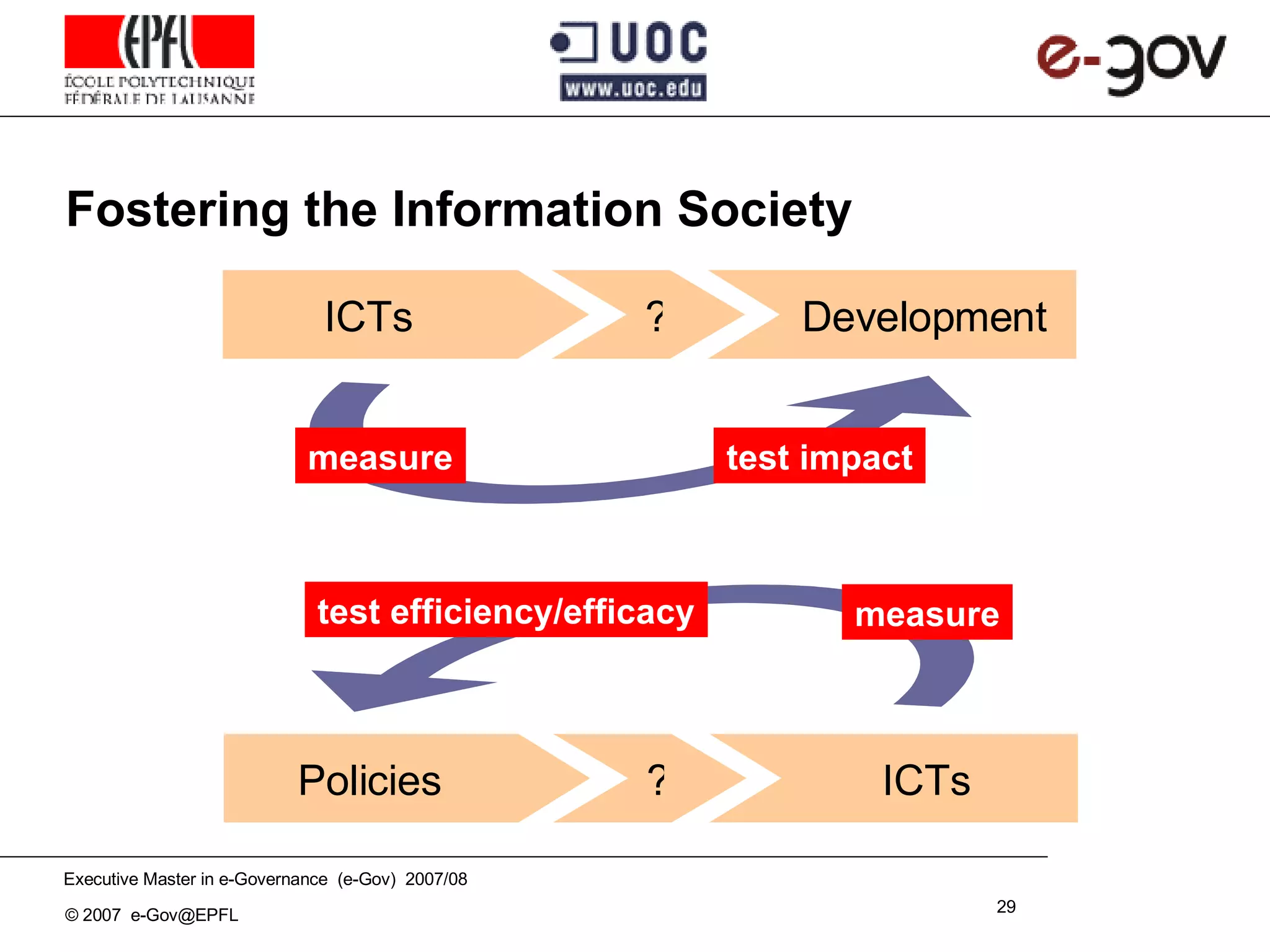
    28. Fostering the Information Society ? Development ICTs ? ICTs Policies measure test impact measure test efficiency/efficacy
    29. 5 tier approach to e-Readiness Digital Literacy Content and Services Legal framework ICT Sector Infrastructures
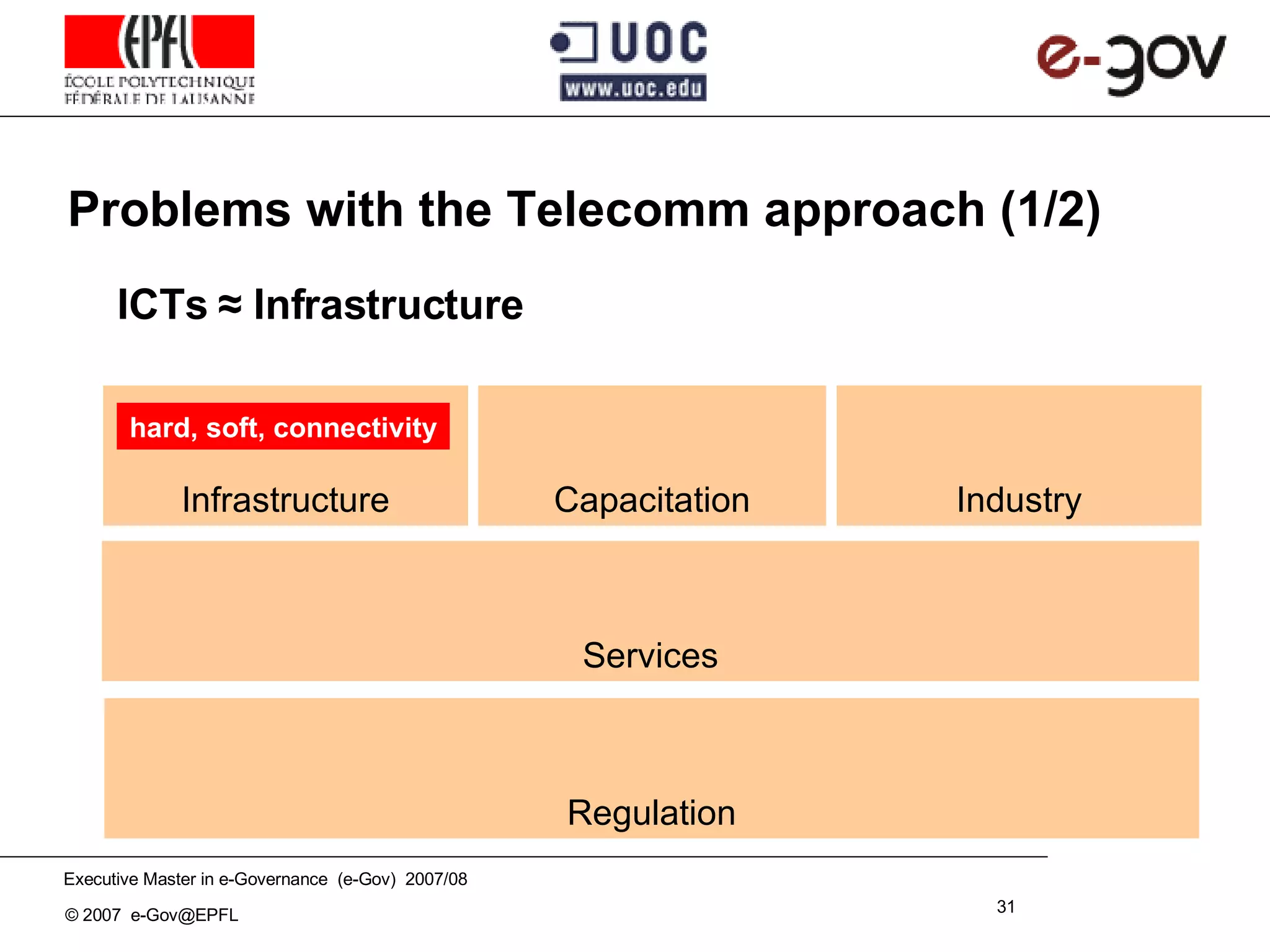
    30. Problems with the Telecomm approach (1/2) Infrastructure Capacitation Regulation Services Industry ICTs ≈ Infrastructure hard, soft, connectivity
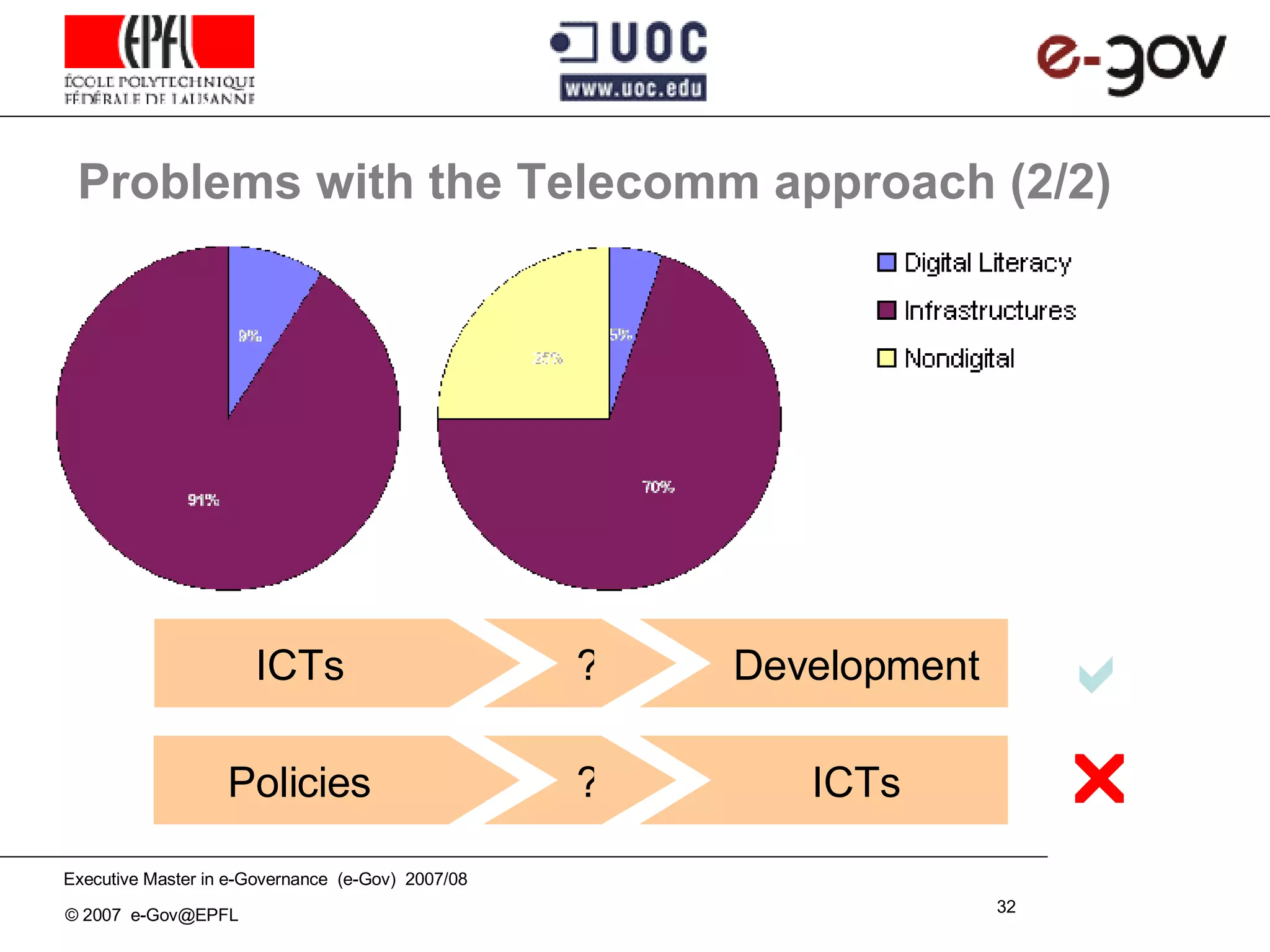
    31. Problems with the Telecomm approach (2/2) ? Development ICTs  ? ICTs Policies 
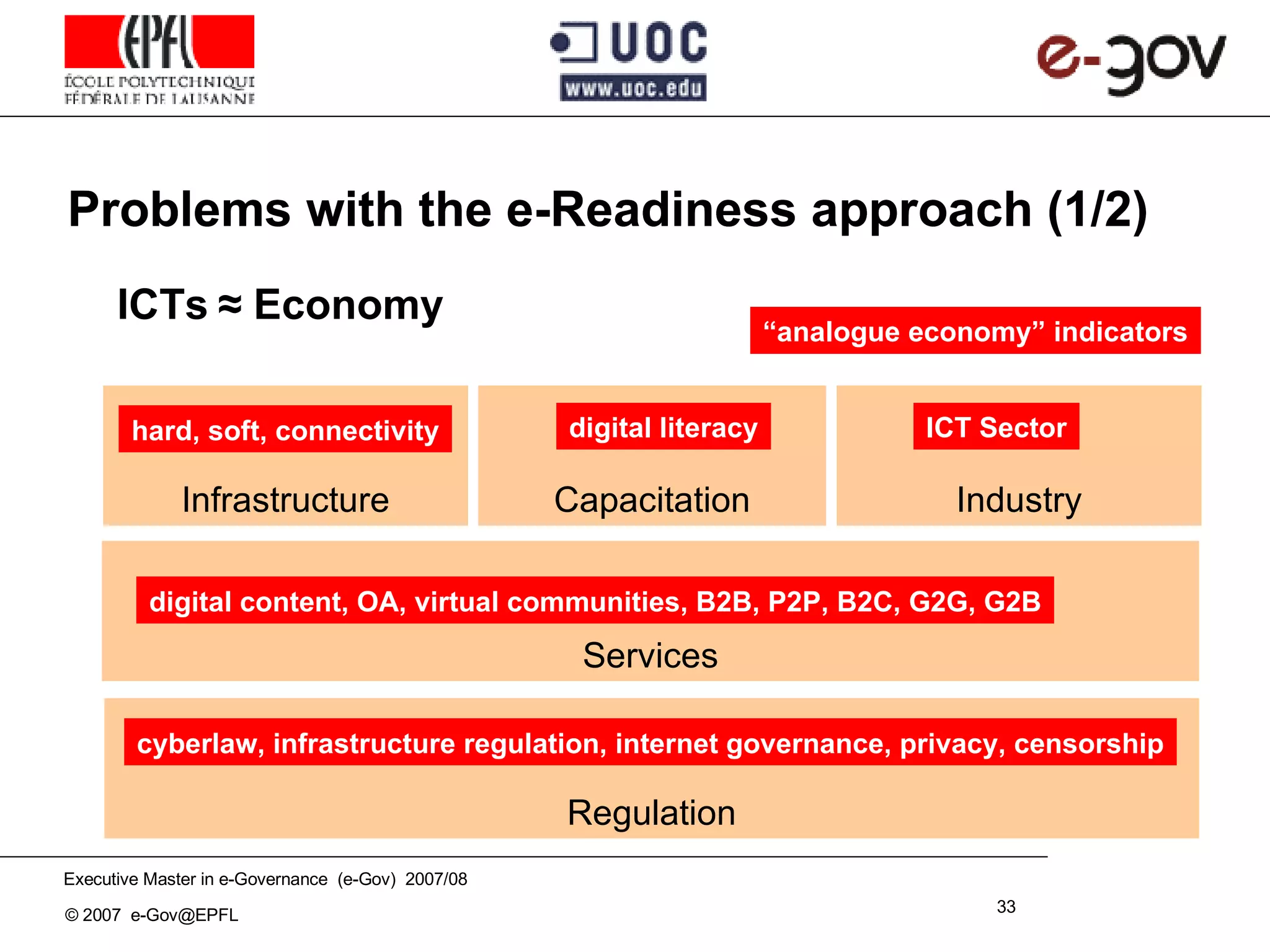
    32. Problems with the e-Readiness approach (1/2) Infrastructure Capacitation Regulation Services Industry ICTs ≈ Economy hard, soft, connectivity digital literacy ICT Sector digital content, OA, virtual communities, B2B, P2P, B2C, G2G, G2B cyberlaw, infrastructure regulation, internet governance, privacy, censorship “ analogue economy” indicators Problems with the e-Readiness approach (1/2)
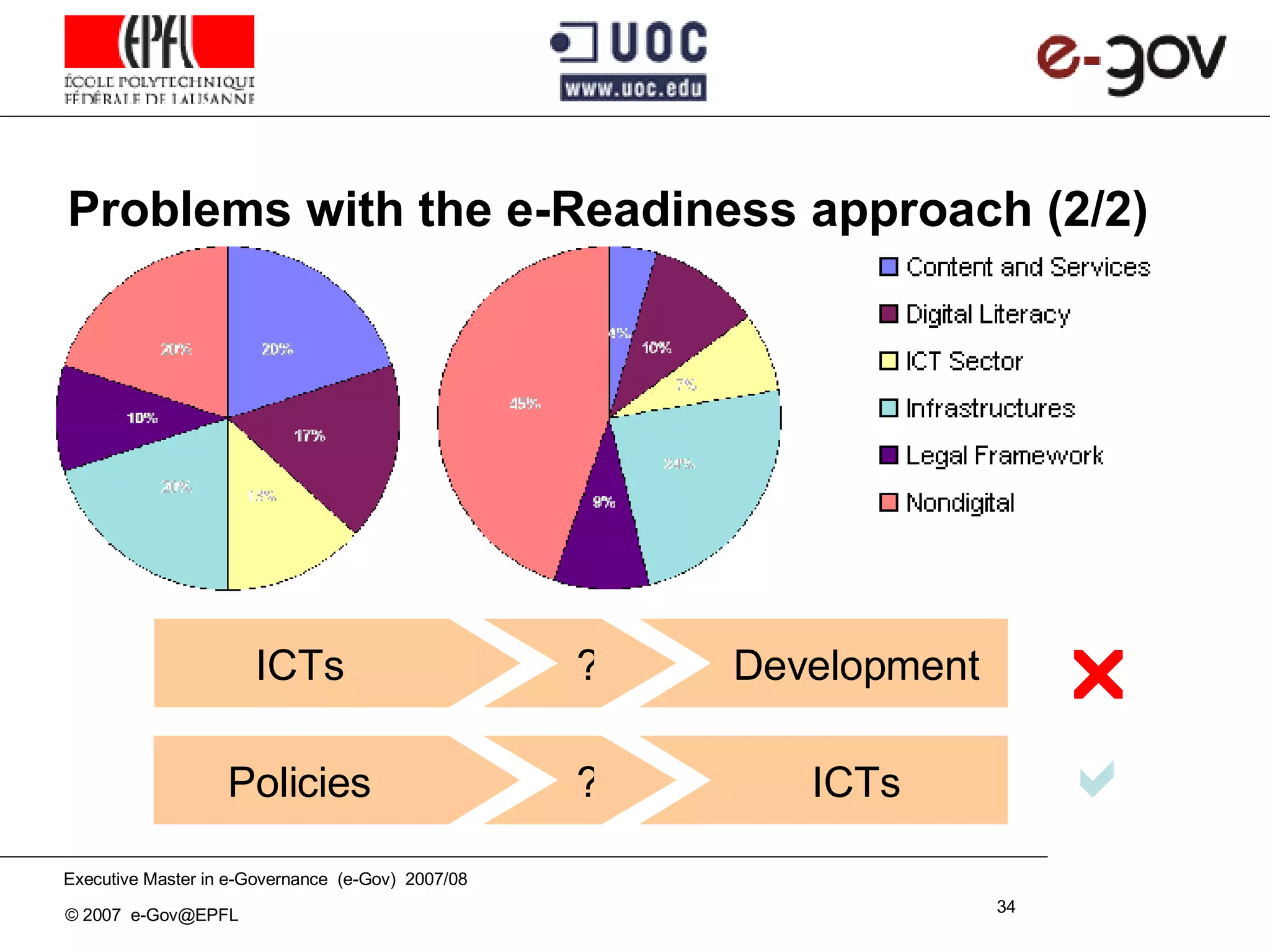
    33. Problems with the e-Readiness approach (2/2) ? Development ICTs  ? ICTs Policies 
    34. e-Readiness for e-Governance
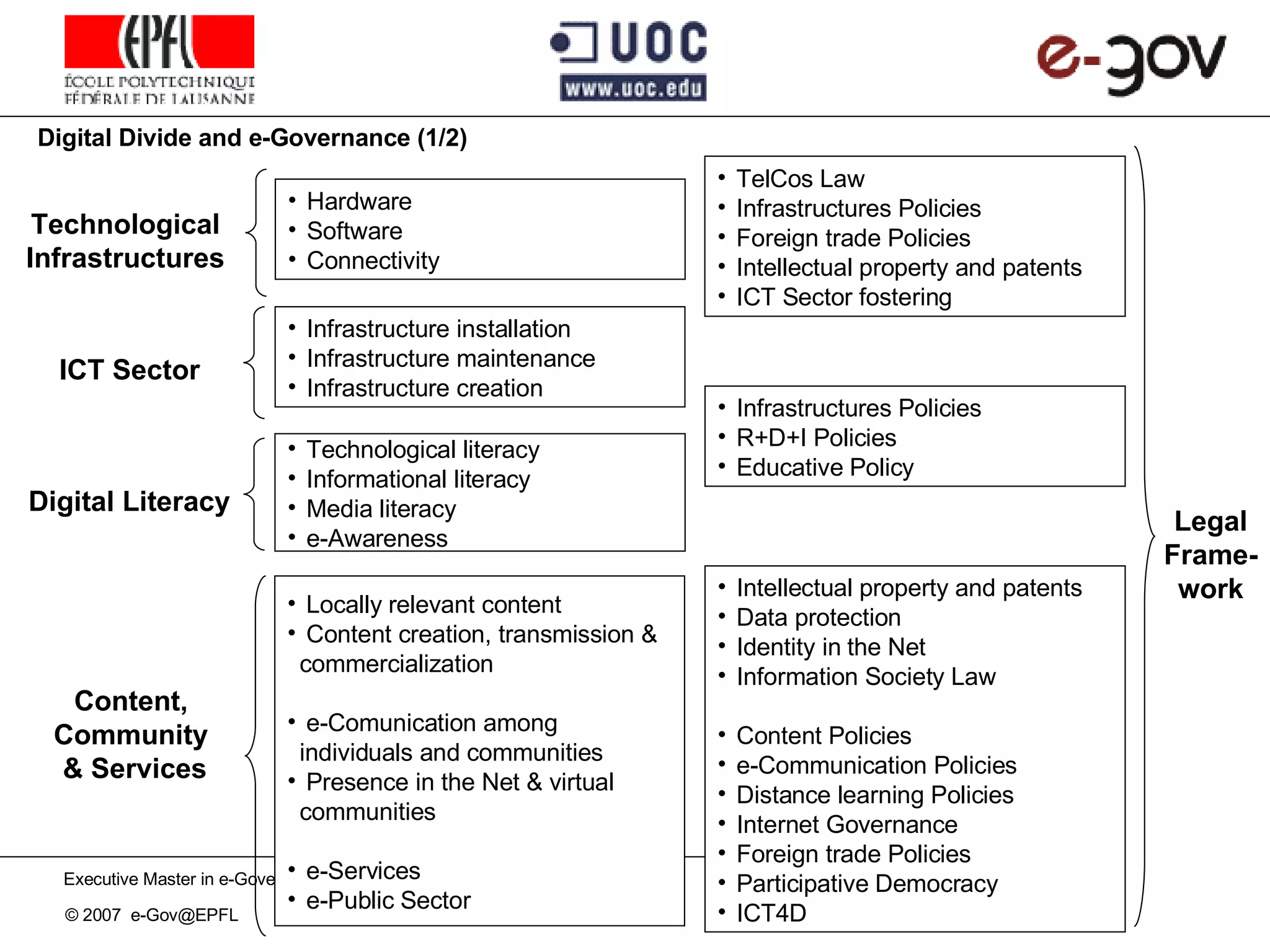
    35. Digital Divide and e-Governance (1/2)
      • Technological literacy
      • Informational literacy
      • Media literacy
      • e-Awareness
      Digital Literacy
      • Hardware
      • Software
      • Connectivity
      Technological Infrastructures
      • Locally relevant content
      • Content creation, transmission & commercialization
      • e-Comunication among individuals and communities
      • Presence in the Net & virtual communities
      • e-Services
      • e-Public Sector
      Content, Community & Services
      • TelCos Law
      • Infrastructures Policies
      • Foreign trade Policies
      • Intellectual property and patents
      • ICT Sector fostering
      Legal Frame- work
      • Infrastructures Policies
      • R+D+I Policies
      • Educative Policy
      • Intellectual property and patents
      • Data protection
      • Identity in the Net
      • Information Society Law
      • Content Policies
      • e-Communication Policies
      • Distance learning Policies
      • Internet Governance
      • Foreign trade Policies
      • Participative Democracy
      • ICT4D
      • Infrastructure installation
      • Infrastructure maintenance
      • Infrastructure creation
      ICT Sector
    36. Digital Divide and e-Governance (2/2)
      • Infrastructures in institutions
      • Infrastructures for agents working with the institutions
      • Connection among institutions and with agents
      • Infrastructures maintenance
      • Creation of specific databases, applications for public/private sectors
      • Human resources capacitation
      • Awareness en corresponding e-sector
      • Information and user/customer feedbacking
      • Transparency & monitoring
      • Processes shared management
      • Data sharing and agents relationship / networking
      • Participation in decision stages
      • Digital Literacy
      • Infrastructure creation/maintenance capacitation
      • Functional literacy
      • Technological infrastructures
      • PC in institutions and agents
      • Affordable generic and specific software
      • Affordable quality connectivity
      • Content, Community & Services
      • Information about institutions and agents
      • Specific/sectorial information, content, procedures
      • Use of the Net among agents and institutions
      • e-Services
      • e-Public Sector
      ICT Sector & Content and Services e-Readiness
      • Realistic and progressive goals setting in the field of digital divide and e-sectors development
      • Identification of promoters (agents, institutions)
      • Sponsors participation and involvement
      • Prescriptors system
      • Internal organization and coordination. Legal and political accompanying measures
      Leadership
    37. Barcelona, November 20th, 2007. Universitat Oberta de Catalunya
      • To cite this work :
      • Peña - López, Ismael. (200 7 ) ICT for Development: from e-Readiness to e-Awareness
      • <http://ictlogy.net/presentations/ 20071120_ ismael_pena_ ict4d_from_e-readiness_to_e-awareness .pdf> [ downloaded dd/mm/aaaa]
      • To contact the author :
      • http:// ismael .ictlogy.net
      More information please visit http://creativecommons.org/licenses/by-nc-nd/2.5/ All the information in this document under a Creative Commons license: Attribution – Non Commercial – No Derivs

    + Ismael Peña-LópezIsmael Peña-López, 2 years ago

    custom

    1427 views, 3 favs, 1 embeds more stats

    Seminar given in Barcelona, November 20th, 2007 at more

    More info about this document

    CC Attribution-NonCommercial-NoDerivs LicenseCC Attribution-NonCommercial-NoDerivs LicenseCC Attribution-NonCommercial-NoDerivs License

    Go to text version

    • Total Views 1427
      • 1354 on SlideShare
      • 73 from embeds
    • Comments 0
    • Favorites 3
    • Downloads 0
    Most viewed embeds
    • 73 views on http://ictlogy.net

    more

    All embeds
    • 73 views on http://ictlogy.net

    less

    Flagged as inappropriate Flag as inappropriate
    Flag as inappropriate

    Select your reason for flagging this presentation as inappropriate. If needed, use the feedback form to let us know more details.

    Cancel
    File a copyright complaint
    Having problems? Go to our helpdesk?

    Categories