AAS National Conference 2008: Robert Lin

Loading...

Flash Player 9 (or above) is needed to view presentations.
We have detected that you do not have it on your computer. To install it, go here.

0 comments

Post a comment

    Post a comment
    Embed Video
    Edit your comment Cancel

    Favorites, Groups & Events

    AAS National Conference 2008: Robert Lin - Presentation Transcript

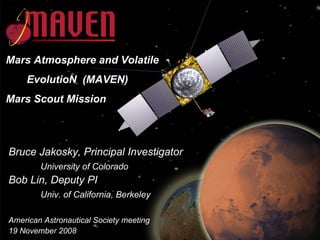
    1. Bruce Jakosky, Principal Investigator University of Colorado Bob Lin, Deputy PI Univ. of California, Berkeley American Astronautical Society meeting 19 November 2008 Mars Atmosphere and Volatile EvolutioN (MAVEN) Mars Scout Mission
    2. What Science Questions Will MAVEN Address?
      • MAVEN will determine the role that loss of volatiles to space has played through time, providing definitive answers about Mars climate history:
      • What is the current state of the upper atmosphere and what processes control it?
      • What is the escape rate at the present epoch and how does it relate to the controlling processes?
      • What has the total loss to space been through time?
      MAVEN Presentation to MEPAG, 18 September 2008 • CU/LASP, GSFC, UCB/SSL, LM, JPL
    3. Why These Science Questions?
      • The history of liquid water and of the atmosphere determine Mars’ potential for life throughout time.
      • There is abundant evidence for climate change and atmospheric evolution.
      • Loss of atmospheric CO 2 , N 2 , and H 2 O to space has been an important mechanism for atmospheric evolution, and may have been the dominant mechanism.
      Only by understanding the role of escape to space will we be able to fully understand the history of the atmosphere, climate, and water, and thereby understand Martian habitability.
    4. MAVEN will continue the successful “follow the water” theme. MGS, MPF, ODY, MER, MRO, MEx, now PHX, upcoming MSL, are focused largely on the history of the surface. MAVEN’s comprehensive approach will provide the history of the atmosphere as the other necessary half of the story.
    5. Mars Magnetic Field (from MGS Magnetometer/ Electron Reflectometer) )
    6. MAVEN Presentation to MEPAG, 18 September 2008 • CU/LASP, GSFC, UCB/SSL, LM, JPL
    7. Some of the evidence for the Importance of Loss to Space
      • Isotopic fractionation that cannot be explained except by loss to space.
      • Direct detection of energetic ions moving away from the planet by Mars Express .
      • Energetic pickup ions detected by Phobos .
      • MGS observations of dramatic atmospheric depletion in response to a solar energetic particle (SEP) event.
    8. MAVEN Will Measure the Drivers, Reservoirs, and Escape Rates
      • MAVEN will determine the present state of the upper atmosphere and today’s rates of loss to space.
      • Essential measurements allow determination of the net integrated loss to space through time.
    9. Constraining the Total Atmospheric Loss Through Time History of Solar Activity Physical & Empirical Models Isotope Ratios Photochemical and Jeans escape Ion outflow Sputtering Solar wind pickup Ion bulk escape NGIMS IUVS
      • Sun-pointed spacecraft with body-mounted instruments.
      • Three boom- and solar-panel-mounted instruments.
      • Articulated payload platform (APP) to align FOVs of NGIMS, STATIC, and IUVS with velocity vector and planet.
      MAVEN Spacecraft
    10. Launch: November 18, 2013 One Year of Science Operations MAVEN Mission Architecture Ten Month Ballistic Cruise to Mars Orbit Insertion: 16 Sept 2014
    11. “ Deep Dips” Down to the Homopause
      • Nominal periapsis near 150 km.
      • Five “deep-dip” campaigns with periapsis near 125 km.
    12. The MAVEN Institutional Partnerships
      • Project management — GSFC (Goddard Space Flight Center)
      • Spacecraft contractor — LM (Lockheed Martin)
      • Instrument providers —
      • LASP (Laboratory for Atmospheric & Space Physics ), U. of Colorado
      • SSL (Space Sciences Laboratory), U. of California, Berkeley
      • GSFC
      • Science team — LASP, SSL, GSFC, JPL, CESR (Centre d’Etude Spatiale des Rayonnements) Toulouse  
      • Navigation — JPL
      • Mission operations — LM
      • Science operations and science data center — LASP
      • Education and public outreach — LASP

    + American astronautical SocietyAmerican astronautical Society, 7 months ago

    custom

    179 views, 0 favs, 1 embeds more stats

    Session 4: Mars – The Best is Yet to Come

    19 Nov more

    More Info

    © All Rights Reserved

    Go to text version
    • Total Views 179
      • 177 on SlideShare
      • 2 from embeds
    • Comments 0
    • Favorites 0
    • Downloads 0
    Most viewed embeds
    • 2 views on http://www.astronautical.org

    more

    All embeds
    • 2 views on http://www.astronautical.org

    less

    Flagged as inappropriate Flag as inappropriate
    Flag as innappropriate

    Select your reason for flagging this presentation as inappropriate. If needed, use the feedback form to let us know more details.

    Cancel

    Categories