
Elementary level schooling reforms of János Apáczai Csere in the 17th century
•
1 like•230 views

Katalin KÉRI AMBRUS Université de Pécs, Hongrie / University of Pécs, Hungary / Universidad de Pécs, Hungría Les idées de réforme de János Apáczai Csere sur l'éducation populaire au dix-septicme siccle / Elementary level schooling reforms of János Apáczai Csere in the 17th century / Las ideas de la reforma de János Apáczai Csere sobre la educación popular en el siglo XVII.

Recommended
More Related Content
Similar to Elementary level schooling reforms of János Apáczai Csere in the 17th century
Similar to Elementary level schooling reforms of János Apáczai Csere in the 17th century (20)
More from Ambrus Attila József
More from Ambrus Attila József (20)
Recently uploaded
Recently uploaded (20)
Elementary level schooling reforms of János Apáczai Csere in the 17th century
- 1. Katalin KÉRI: Elementary level schooling reforms of János Apáczai Csere in the 17th century 31st session of the International Standing Conference for the History of Education (ISCHE 31) August 26 – 29, 2009 Utrecht University
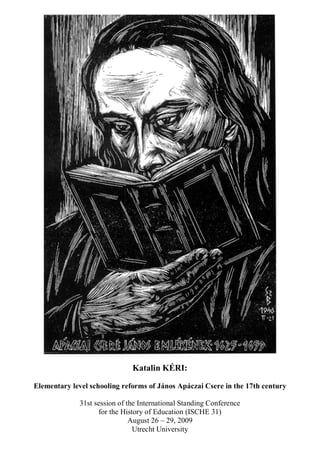
- 2. János Apáczai Csere (1625-1659), one of the prominent figures of the Hungarian history of education, was born and later lived in Transylvania. He was an important pedagogical thinker, school-organizer, textbook-writer of his era. His walk of life is a good example of the carrier typical of a contemporary protestant intellectual thinker: the knowledge that he gained in his homeland could only be unfolded in western-European peregrination. He carried from the West to Transylvania various ideas regarding the reform of the content and structure of contemporary school system, the formation of elementary level education. He drew up his critique and recommendations concerning the whole Transylvanian society based on his experiences in the Low Countries. After secondary school he learned theology in Franeker, Leyden, Utrecht and Harderwijk, and later was awarded the Doctor of Theology. During his university years he studied Descartes, other prominent scientists, and the puritan ideas. He wrote the Hungarian Encyclopaedia which was his greatest achievement in Utrecht. It was the first book in Hungarian that contained all information about threads of science in the students’ mother tongue. Apáczai returned to Transylvania in 1653, and continued teaching and writing books until his death in 1659. My paper focuses on the theoretical and practical works of János Apáczai Csere that aimed to create a comprehensive elementary level educational system. Apáczai, like his contemporary pedagogical thinkers laid special emphasis on the broadening of the network of elementary schools and the reform of secondary schooling. My paper is based mostly on his inaugural lecture ’De summa scholarum necessitate’ from 1656. This work consists of five main parts, and from a rhetorical and logical sense can be regarded as a masterpiece, in which Apáczai criticized his contemporary pedagogical thinkers and the society. He thought that the nobles, the teachers, and the monarchy all altogether were responsible for the cultural backwardness of Transylvania. In the introduction to the speech he stressed that much needed school and he who does not see their use is indiscriminate and insensitive. It highlights that in primary school education should be in mother tongue and the religious instruction is also necessary. In his opinion, one of the fruits of primary schools is no doubt that small children can get used to it with discipline, to obedience to their superiors, thus preparing their inclusion in society. It also stresses that these primary schools allow children to be in communication with other, to practice in speech in mother tongue. He speaks with enthusiasm about writing and the study thereof, including its usefulness in everyday life, for example in legal matters. In his view, Christianity is declining in libertinism and atheism without primary schools. He cited the example of Luther and other reformers who recognized the enormous role of elementary schools in the spread and maintenance of religion. However he highlighted in his speech that culture, level of education can not target the sky if the school system in the middle and high school did not follow the network of primary schools. In this speech he outlined the plan for the establishment of a comprehensive education system. Based on theses platoniennes and books of the Old Testament, Apáczai stresses the importance not only that people be educated but also as heads of state have always a universal wisdom. He thought that there was a great need for puritan ethics regarding religion and science. To achieve this aim he ordered the reformation of elementary level schooling, and the formal education of people. His dream was the education of virtuous and learned citizens. Like Comenius, Vives and Erasmus he believed in the pedagogy of love, which ultimate aim was a happy and contented world. Though his ideas did not have an impact during his lifetime, Apáczai could be regarded as one of the major pioneers of elementary level schooling of his time. It was only later, in the 19th century that his ideas were rediscovered and used extensively. Dr. Katalin KÉRI University of Pécs, Hungary H-7624 Pécs, Ifjúság útja 6. kerik@btk.pte.hu http://kerikata.hu