Citizen Consultation from Above and Below: The Australian Perspective - Presentation Transcript
Citizen Consultation from Above and Below: The Australian Perspective Dr Axel Bruns Associate Professor, ARC Centre of Excellence for Creative Industries and Innovation Creative Industries Faculty, Queensland University of Technology a.bruns@qut.edu.au – http://snurb.info/ – http://produsage.org/ Dr Jason Wilson School of Social Sciences, Media and Communication University of Wollongong jasonw@uow.edu.au – http://gatewatching.org/
E-Democracy in Australia
Current environment:
Change of government (conservative Labor) in late 2007
exploration of social media during election campaign
Reshaping of ministries
new Department of Broadband, Communication, and the Digital Economy (DBCDE)
New policy initiatives
plans for A$43b National Broadband Network (NBN)
plans for compulsory ‘cleanfeed’ Internet filter
support for new e-government / e-democracy initiatives – establishment of Government 2.0 Task Force
individual social media initiatives – middle ground
personal blogs / Twitter feeds / … of politicians
each with its own pitfalls…
Top-Down Consultation: The DBDE Blog
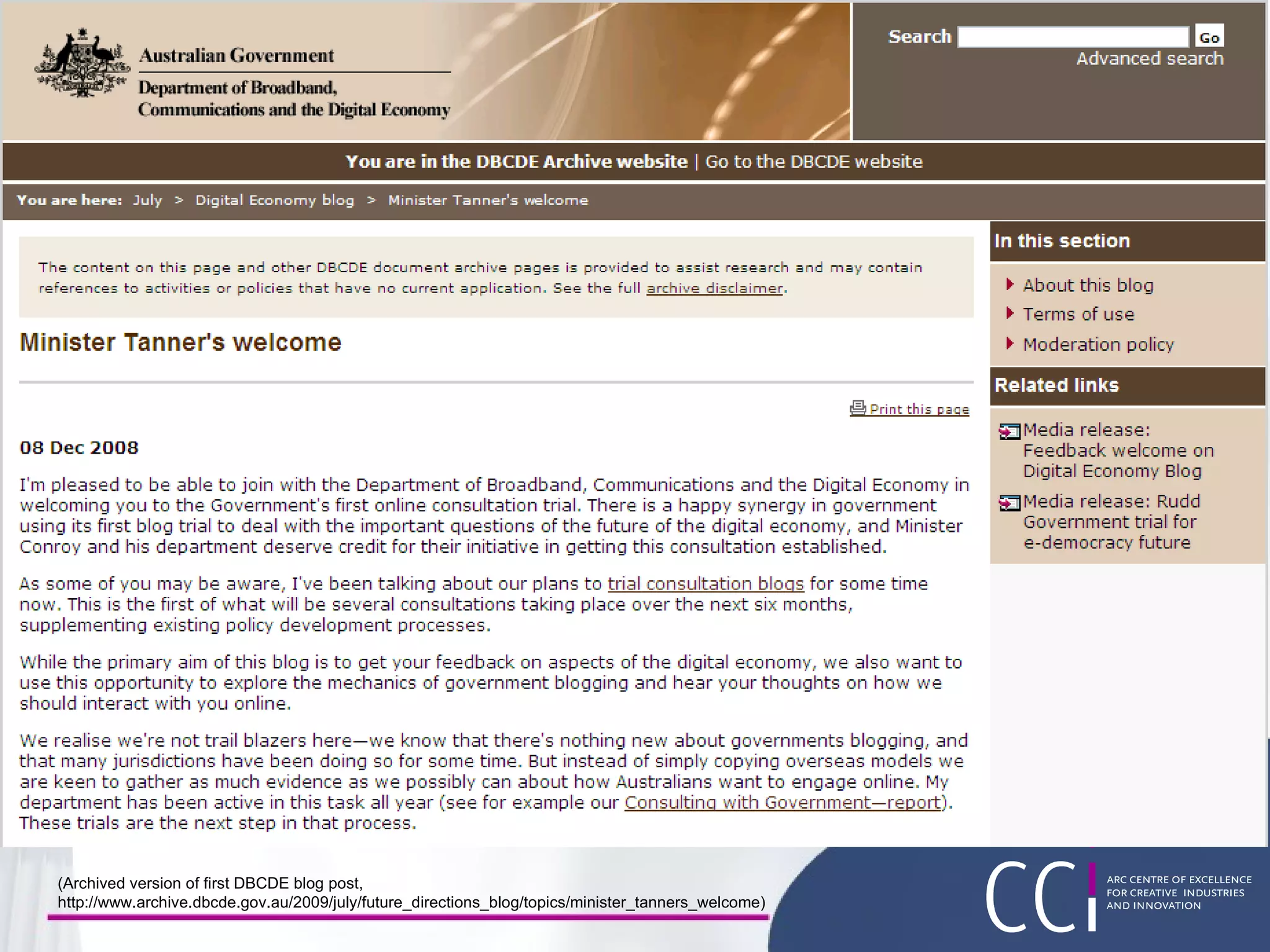
Digital Economy blog :
launched 8 December 2008 for two-week trial
operated by DBCDE minister Senator Stephen Conroy and his staff
building on 2008 report into online government consultation by Australian Government Information Management Office (AGIMO), commissioned by previous government
foreshadowed by Finance Minister Linday Tanner in The Age newspaper article, and launched with a guest post by Tanner
(Archived version of first DBCDE blog post, http://www.archive.dbcde.gov.au/2009/july/future_directions_blog/topics/minister_tanners_welcome)
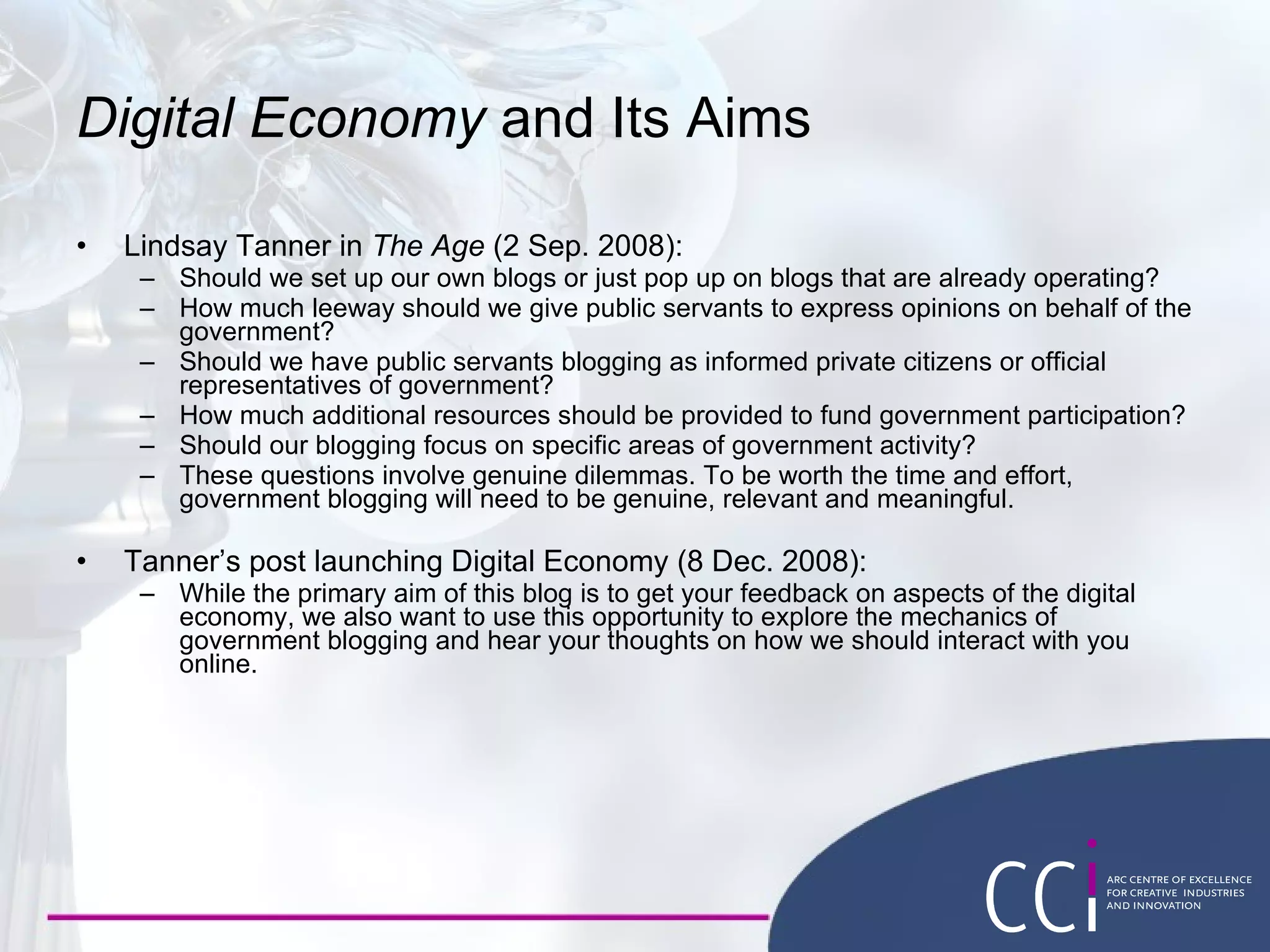
Digital Economy and Its Aims
Lindsay Tanner in The Age (2 Sep. 2008):
Should we set up our own blogs or just pop up on blogs that are already operating?
How much leeway should we give public servants to express opinions on behalf of the government?
Should we have public servants blogging as informed private citizens or official representatives of government?
How much additional resources should be provided to fund government participation?
Should our blogging focus on specific areas of government activity?
These questions involve genuine dilemmas. To be worth the time and effort, government blogging will need to be genuine, relevant and meaningful.
Tanner’s post launching Digital Economy (8 Dec. 2008):
While the primary aim of this blog is to get your feedback on aspects of the digital economy, we also want to use this opportunity to explore the mechanics of government blogging and hear your thoughts on how we should interact with you online.
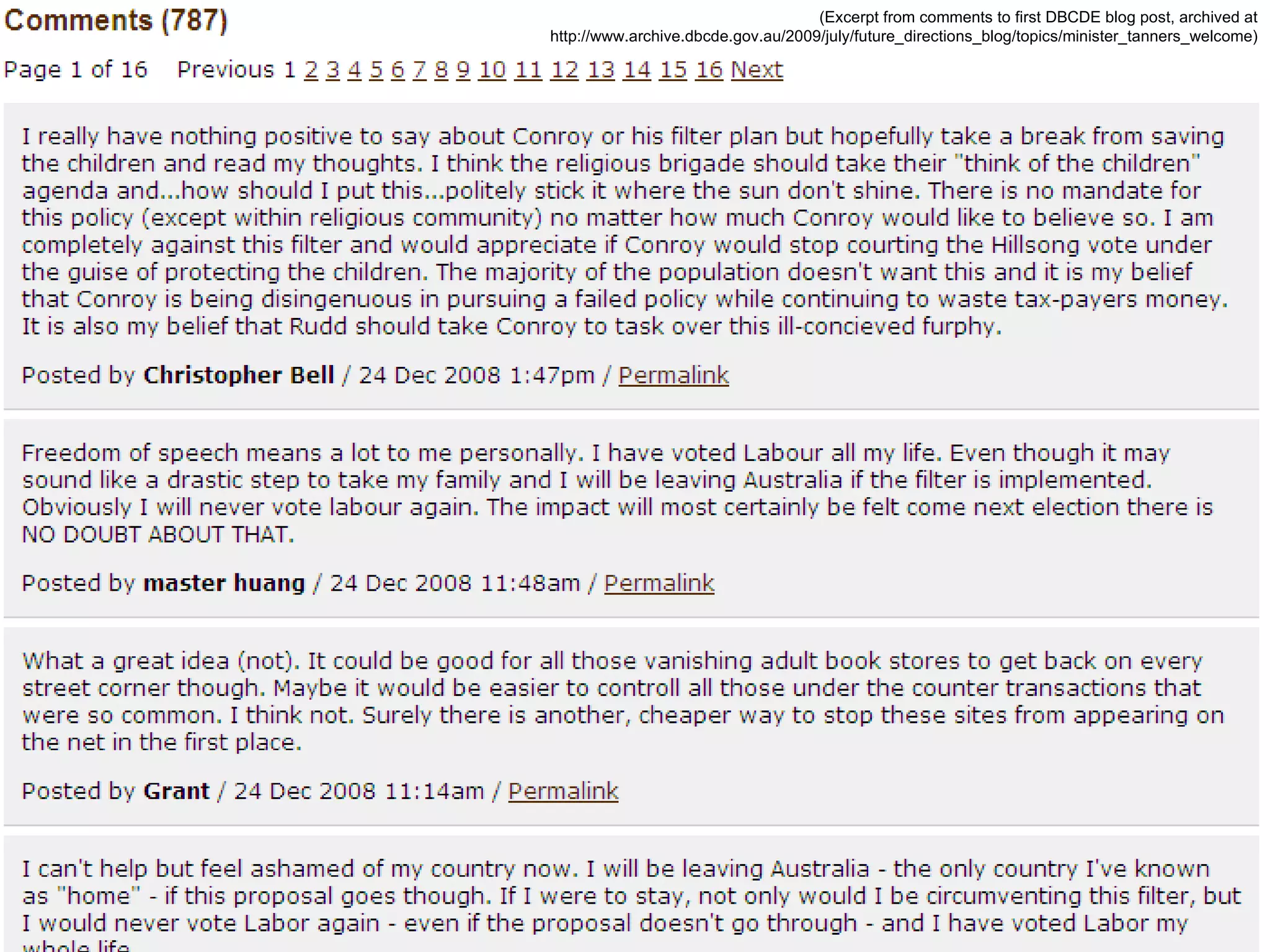
(Excerpt from comments to first DBCDE blog post, archived at http://www.archive.dbcde.gov.au/2009/july/future_directions_blog/topics/minister_tanners_welcome)
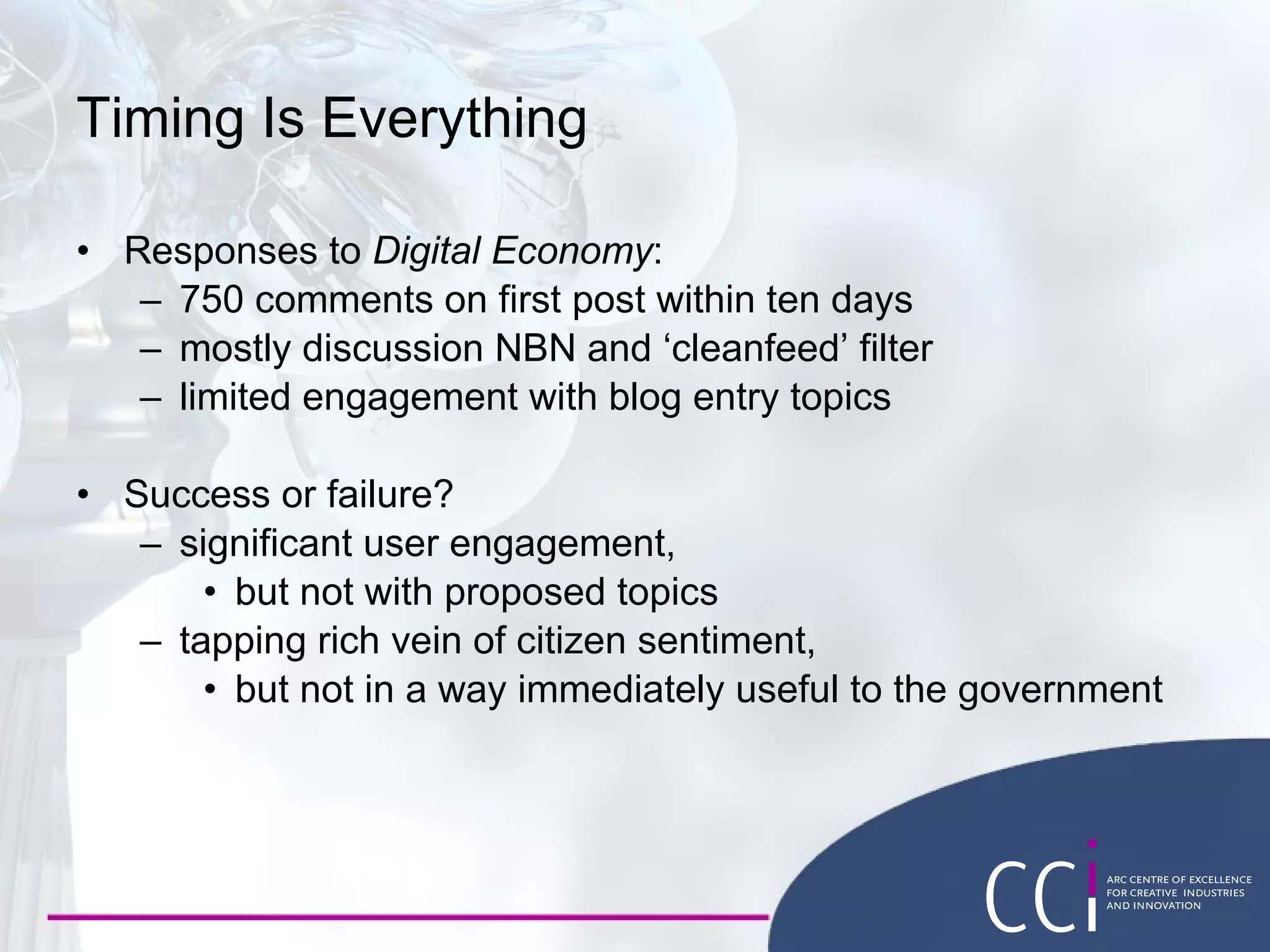
Timing Is Everything
Responses to Digital Economy :
750 comments on first post within ten days
mostly discussion NBN and ‘cleanfeed’ filter
limited engagement with blog entry topics
Success or failure?
significant user engagement,
but not with proposed topics
tapping rich vein of citizen sentiment,
but not in a way immediately useful to the government
Build It, and They Will Comment
Problems with Digital Economy approach:
initial attempts to avoid hot-button issues
only belated engagement with user interests
DBCDE staff apparently overwhelmed by level of response
‘ cold’ launch – commenters failed to act as community
first government blog always likely to be swamped with submissions (on- and off-topic)
limited timeframe – no chance for development of self-organising social structures in user community
seeking out existing online expert communities may have been preferable – e.g. Whirlpool.net.au
Political Informatics: Project Democracy
NGO-supported bottom-up citizen engagement:
new services to track the political process
UK: MySociety’s TheyWorkForYou.com
automated processing of the parliamentary record (Hansard)
access to representatives’ speeches, voting records, etc.
recognised as influencing parliamentarians’ actions
Australia: GetUp!’s Project Democracy
focus on federal Senate (upper house)
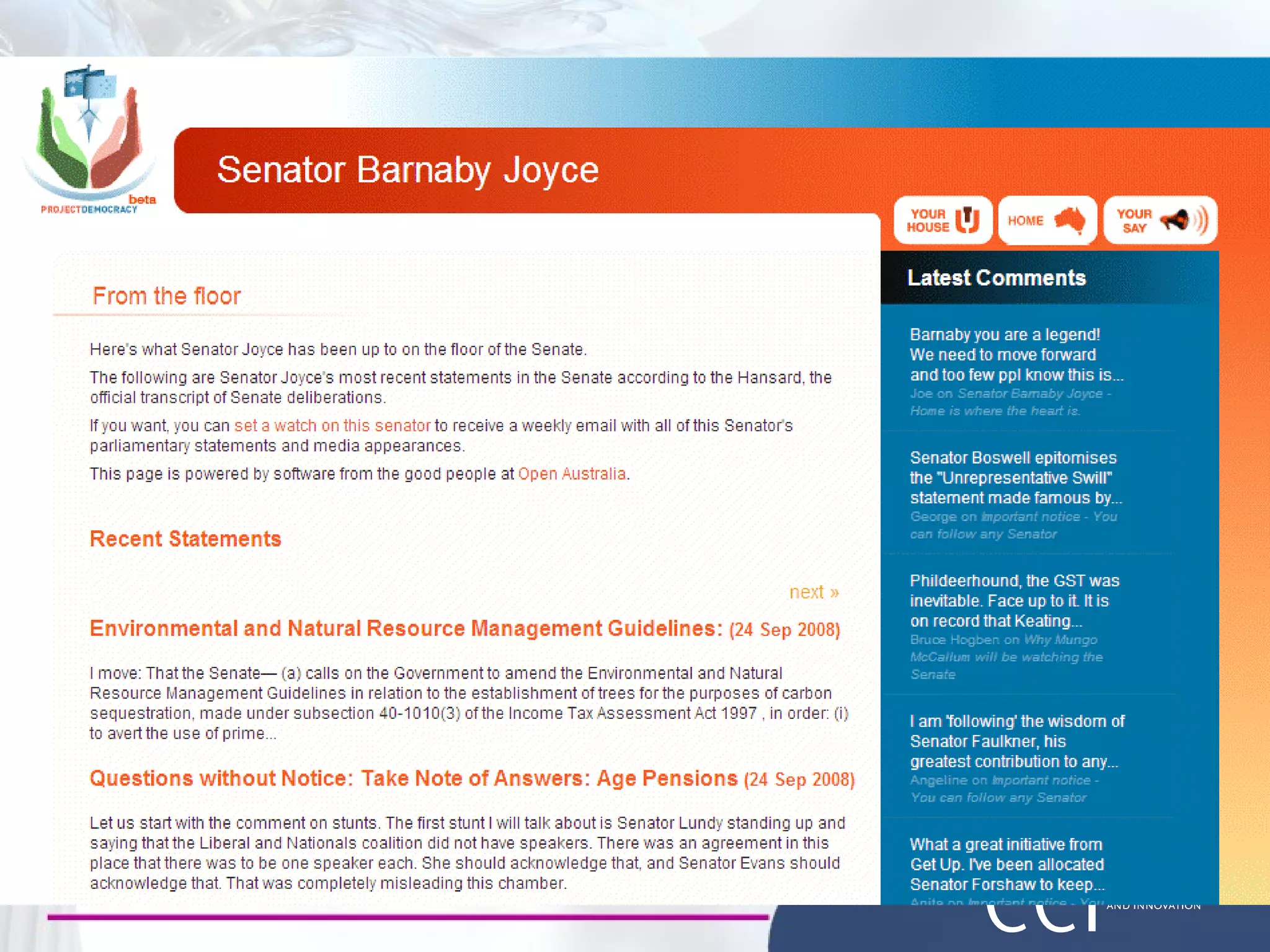
Project Democracy
GetUp! initiative Project Democracy :
Tracking the Senate (Australia ’ s federal upper house)
Information about Senators
Comprehensive access to all Senate speeches
Aggregation of online media reports on Senate and Senators
Blogs and fora for discussions between participants
Possibilities:
More direct citizen participation in political discussions
May force Senators to respond to comments and criticism
Discovery and sharing of new political ideas
Emergence of new political talent
Opportunities and Problems
Political informatics:
new forms of access to political process
disintermediation – citizens no longer reliant on journalistic reporting
valuable resource, more user-friendly than Hansard itself
potential for direct engagement with politicians via Project Democracy
Limitations:
dependent on availability of parliamentary transcripts in standard formats
may speak only to the already converted (Coleman’s ‘political junkies’)
no overarching political narratives as provided by journalism
limited response from politicians themselves
Middle Ground between Top-Down and Bottom-Up?
Social media and social networking:
successfully used in US election (e.g. MyBarackObama.com )
exploratory uses in Australia ( YouTube, Facebook, Twitter )
Uses beyond major campaigns:
politicians’ individual social media profiles
ability for users to ‘follow’ or ‘friend’
potential for direct communication with citizens,
but also loss of message control
Australian Politicians’ Social Media Styles
‘ Managers’:
e.g. Prime Minister Rudd, Shadow Treasurer Hockey
use of social media as channels for political messages
content curated by staffers
very limited direct engagement with citizens
effective for direct, unmediated transmission of messages
but disappointing for social media users expecting more genuine engagement
Australian Politicians’ Social Media Styles
‘ e-Democrats’:
e.g. Opposition Leader Malcolm Turnbull
use of social media as channels for political messages
content updates often by politicians themselves
some engagement in direct dialogue with users
effective for direct, unmediated transmission of messages,
and appreciated by social media users,
but difficult to manage for most leading politicians
Australian Politicians’ Social Media Styles
‘ Social politicians’:
e.g. Tasmanian Premier David Bartlett
use of social media for everyday purposes
content updated by politicians themselves
direct engagement with users
effective for portraying politicians as human and authentic,
but loss of message control and danger of banality,
and potential conflict between personal and professional personae
Futures for Citizen Consultation?
Top-down:
need for further exploration, better preparation
government expertise for engagement with online communities is limited
Bottom-up:
highly innovative, but problems in realising full potential
may only have real impact in collaboration with media or governments
Social media:
perhaps best chance for real, deep engagement
significant problems in scaling up beyond individuals
Most likely need to interweave all three approaches…
Viral Marketing
Axel Bruns
Associate Professor
ARC Centre of Excellence for Creative Industries and Innovation
Creative Industries Faculty
Queensland University of Technology
Brisbane, Australia
[email_address]
http://snurb.info/
http://produsage.org/
http://gatewatching.org/
Blogs, Wikipedia, Second Life, and Beyond:From Production to Produsage (Peter Lang, 2008)
Uses of Blogs , eds. Axel Bruns and Joanne Jacobs (Peter Lang, 2006)
Gatewatching: Collaborative Online News Production (Peter Lang, 2005)
Jason Wilson Lecturer School of Social Sciences, Media and Communication University of Wollongong Wollongong, Australia [email_address] http://gatewatching.org/
Paper by Axel Bruns and Jason Wilson, presented at more
Paper by Axel Bruns and Jason Wilson, presented at Conference on Electronic Democracy (EDEM), Vienna, 7-8 Sep. 2009.
Abstract:
In Australia, a range of Federal Government services have been provided online for some time, but direct, online citizen consultation and involvement in processes of governance is relatively new. Moves towards more extensive citizen involvement in legislative processes are now being driven in a “top-down” fashion by government agencies, or in a “bottom-up” manner by individuals and third-sector organisations. This chapter focusses on one example from each of these categories, as well as discussing the presence of individual politicians in online social networking spaces. It argues that only a combination of these approaches can achieve effective consultation between citizens and policymakers. Existing at a remove from government sites and the frameworks for public communication which govern them, bottom-up consultation tools may provide a better chance for functioning, self-organising user communities to emerge, but they are also more easily ignored by governments not directly involved in their running. Top-down consultation tools, on the other hand, may seem to provide a more direct line of communication to relevant government officials, but for that reason are also more likely to be swamped by users who wish simply to register their dissent rather than engage in discussion. The challenge for governments, politicians, and user communities alike is to develop spaces in which productive and undisrupted exchanges between citizens and policymakers can take place. less
0 comments
Post a comment