DEVELOPMENT CHALLENGES,
SOUTH-SOUTH SOLUTIONS
E-newsletter of the Special Unit for South-South Cooperation in UNDP
……………………………………………………………………………………………….….
1. Indonesian Wooden Radio Succeeds with Good Design
One Indonesian industrial designer has pioneered an innovative business that has
rejuvenated the economy of a farming village and improved the sustainability of local
forests - and he's doing it all with wood.
A range of wooden radios (wooden-radio.com) hold pride of place for the Magno brand
(http://www.magno-design.com/?id=wr01a), which has carved out a niche as a maker of
high-quality, crafted products that marry traditional skills with modern design. Magno is
creating jobs and skills while also creating a unique, exportable product that commands
a good price.
Indonesian designer Singgih Susilo Kartono developed the radio design concepts while
at the Faculty of Fine Art and Design in Bandung, Java, Indonesia in the 1990s.
He takes an organic approach to designing, enjoying the journey and not necessarily
being sure where he is going.
"I never start my design according to the market research or demand. I design by
absorbing events, global or local events and even mundane daily life things that happen
around me. Consequently, I start to think what will be good and better for these
people," he explains in his brochure.
The workshop in which the radios are made is a handsome wooden-roofed building and
craftspeople sit at long wooden tables to assemble the models.
Each radio is made from a single piece of wood and takes a craftsperson 16 hours to
construct, drawing on traditional woodworking skills. The radios are made from Indian
rosewood, which is often used to manufacture many musical instruments because of its
excellent sound resonance.
The radios are made in stages, with more than 20 steps involved in assembling each
one. The individual parts are precision cut by machines before being assembled using a
tongue and groove (http://en.wikipedia.org/wiki/Tongue_and_groove) construction
technique.
Some radio models have a chunky, retro appearance and mix dark and light wood to
give an eye-pleasing contrast. Others are more modern designs with a sleek profile.
There is a large version, a 'Mini', a sleek modern Cube' version and a rectangular version.
There is also a round clock and a wooden desktop office set with various essentials like
a wooden stapler.
The radios sell for between Euros 99 (US $124) and Euros 220 (US $276), and are
shipped to Europe via Singapore to Hamburg in Germany.
"To me, wood is somewhat a perfect material - especially if I compare it to synthetic
ones," Kartono said. "In wood we could find strength and weakness, advantages and
disadvantages or roughness and also softness. Wood is hard and solid but yet it is 100
per cent eco-friendly as it is degradable and leaves no waste materials on the earth."
Great care is taken in selecting the wood and ensuring it is from local, sustainable
plantation sources. According to its website, Magno used 80 trees in 2010 for its radios
but in turn planted 8,000 trees around the village. This regeneration has become part of
the process of creating the radios.
Magno has won numerous awards, including the Brit Design Award (UK), Design Plus
Award (Germany), Good Design Award/G-Mark (Japan) and the Indonesia Good Design
Selection Awards.
"The wood I use for the manufacturing process may need as long as 50 years to reach
maturity," Kartono said. "I want people not only to think about exotic or precious woods
but likewise about the fact that good things require time. All objects that surround us
should be thought-provoking. Craftsmanship originally was the art of dealing with raw
June 2012 Subscribe Unsubscribe Contact Us
In this issue:
Indonesian Wooden Radio Succeeds
with Good Design
Gobi Desert Wine to Tackle Poverty and
Boost Incomes
Mauritanian Music Shop Shares Songs
and Friendship
Global South Eco-cities Show How the
Future Can Be
New Journal Celebrates Vibrancy of
Modern Africa
…………………………………
Featured links:
Babajob.com
Equator Initiative
Kiva.org
SSC Website
FUNDING
………………………………..
Quick links:
Window on the World
Upcoming Events
Awards and Funding
Training and Job Opportunities
Past Issues
………………………………..
Bookmark with:
what is this?
………………………………..
………………………………..
what is this?
………………………………..
materials in a sensible and economical way."
As Kartono tells it, he faced the typical university graduate's dilemma about his career path. Should he work as an in-house
designer in a city or return to his home village of Kandangan and start a business? His choice was unusual. Once somebody
with a university education leaves a small village, it is rare they return. And at first, Kartono did not.
But he was drawn back by the dire situation in the village, and decided to apply his knowledge of product design to revive its
economic fortunes. He started by visiting just twice a year because that was all he could afford. This had the advantage of
giving him perspective on the situation in the village.
"At first glance, these changes (happening to the village) were seen as a 'progress,'" he said. "But when I looked more closely I
concluded that it was only the 'surface' which experienced change. The basic structure of the village did not undergo any
changes; moreover, some was actually deteriorating."
He concluded that the village was being damaged by various government attempts to modernize agricultural practices. The
debt problems this caused meant many farmers lost their farms and were forced to seek work in the city or look for another
way to make money.
Craft work seemed to be the answer to this problem. It has many advantages, as Kartono sees it. It is something that can grow
and fits well with village lifestyles. It is labour intensive, doesn't need sophisticated technology and can use already existing
local resources.
Kartono was inspired by one of his teachers at university, an advocate of the 'New Craft' approach, which applies modern
management techniques to traditional craftsmanship. The idea is simple but very effective. It begins with making sure every
step of the manufacturing process is standardized to ensure consistent quality and materials. A new product or design is first
broken down into steps and a product manual is put together. Only then is the manufacturing process carried out.
While the New Craft method sounds simple and obvious, many craft makers do not take this approach. By following this
methodology, it is possible to quickly train new craft workers and start up manufacturing in a new village or community. Craft is
increasingly being seen as a good way to re-employ people who formerly worked in farming. The New Craft approach can
create high-quality products that would sell well in the export market. A common problem with crafts is either poor quality
control or inconsistent manufacturing methods. This can feed stereotypes of craft products and make them look second-rate in
comparison to machine-manufactured products in the marketplace.
"Design for us is more than just creating a well-designed product that is produced and consumed in colossal amount," Kartono
said. "Design must be a way to solve and minimize problems."
LINKS:
1) Cradle to Cradle: Remaking the Way We Make Things by William McDonough and Michael Braungart. It is a manifesto
calling for the transformation of human industry through ecologically intelligent design. Website:
http://www.mcdonough.com/cradle_to_cradle.htm
2) Rio+20: At the Rio+20 Conference, world leaders, along with thousands of participants from governments, the private
sector, NGOs and other groups, will come together to shape how we can reduce poverty, advance social equity and
ensure environmental protection on an ever more crowded planet to get to the future we want. Website:
http://www.uncsd2012.org/
2. Gobi Desert Wine to Tackle Poverty and Boost Incomes
In the arid Gobi desert spanning the two Asian nations of China and Mongolia is a bold attempt to make wine and reduce
poverty. The environment is harsh, with temperatures swinging from sub-zero winter cold to sweltering summer heat. The
desert is also home to high winds and notorious dust storms that plague China’s capital Beijing every year.
China’s wine industry is booming as people have embraced the drink's perceived health-giving qualities and are using it to
celebrate new-found wealth as the economy has flourished. Current wine consumption in China is half a litre per person per
year, low compared to the French average of 55 litres a year. But this is growing quickly.
Well-known brands include Great Wall, Dynasty and Changyu (http://www.changyu.com.cn/english/index.html), which is
considered the world’s 10th largest wine producer.
One innovative winery is using this wine boom to tackle poverty and increase local wealth.
Chateau Hansen (hansenwine.com) in Inner Mongolia has been operating since the 1980s, but recent expansion and
modernization have significantly increased its earning power and the number of people it employs. Located in an area with
high levels of poverty, it has developed a successful wine business in the desert by tapping the plentiful water supplies from the
Yellow River. The area is now considered one of the best for growing wine grapes in China.
Located near Wuhai city (http://en.wikipedia.org/wiki/Wuhai), 670 kilometres west of Beijing, Chateau Hansen has 250 hectares
of Merlot, Cabernet Sauvignon and Cabernet Gernischt grapevines.
The vines are buried under the sand to protect them from the harsh weather in the winter.
"The lowest temperature gets down to is below -20 degrees C (Celsius), but in summer, it can reach 38 or 40 degrees C (102 or
104 F)," Li Aixin, Chateau Hansen's head of viticulture, told MSNBC. "Here the four seasons are good for the growth of the
grapes, but in the winter we need to bury them in the earth" to keep them from freezing.
Hansen has been ambitious in its approach. It has a European-style chateau, hotel and even a French wine expert, Bruno
Paumard, on site to help with the wine making. The chateau’s cellar now stores 1,000 barrels of wine.
Paumard arrived in China in 2005. He has thrown himself into Chinese culture and tasted and tested the country’s wines.
Hansen has produced 400,000 bottles of wine, mostly sold in China, where red wine drinking has become a big part of the
culture of celebration.
Hansen sells the majority of its wine to government organizations and regional enterprises. It has seen its profits double to 100
million yuan (US $18 million) in 2011 and hopes sales will double again in 2012.
"Eighty per cent of the market in China is really the local governments who encourage the enterprises in their cities to consume
red wine, of a certain brand, at their banquets in the place of Chinese ‘baijiu' for their incessant and never-ending toasts," said
Paumard, referring to China's home-grown rice wine. "So it's actually a market that's totally unique."
Hansen’s Cotes du Fleuve Jaune du Desert de Gobi has become one of the biggest award-winning wines in China. It received a
bronze medal from the International Wine Challenge of Blaye, near Bordeaux, France.
China now stands as the world's fifth-largest consumer of wine (International Wine and Spirit Research study)
(http://www.iwsr.co.uk/). The market in China is forecast to grow by 54 per cent from 2011 to 2015, adding up to a billion
bottles.
A map of China’s vineyards and their terroir or soil conditions shows a diverse wine-making sector
(http://www.hansenwine.com/english/vineyardlink.html).
In this busy marketplace, Hansen prides itself on being organic. It also has the goal of turning the arid desert into green
vineyards using irrigation from the Yellow River and groundwater. It wants to create employment and raise living standards in
the region and is fitting into a national strategy to raise living standards for poor regions.
There is a training programme for the around 400 workers employed by the winery. No pesticides are used and only sheep
dung is used as a fertilizer provided by 3,000 sheep on site. Trees also play a role in providing humus
(http://en.wikipedia.org/wiki/Humus) for the vines. There is also accommodation in a nearby village for the employees.
There are 250 hectares of vineyards and the grapes are harvested by hand. Expansion began in 2001 when the chateau and
winery were built. It is strategically located just 500 metres from an airport and the chateau has a luxury hotel. Around 20,000
people visit a year, according to Hansen’s website, bringing in further income for the winery. The winery also uses Mongolian
culture and cuisine as a selling point to attract tourists.
The chief executive of Hansen is Han Jianping, who made his first fortune in real estate development.
Han believes that "the momentum of growth in the wine industry is huge."
"With a great foundation of more than 1 billion people as we have in China, and (the industry) growing at 20 or 30 per cent a
year, there is a huge potential for more growth," he said.
LINKS:
1) China Wine Online: An information service that also produces the China Wine Business magazine and runs the China
Wine Study Tour. Website: http://www.winechina.com/en/index.asp
2) The 10th
Shanghai International Wine and Spirits Expo 2013: Website:
http://www.winefair.com.cn/sugar/en/index.asp
3. Mauritanian Music Shop Shares Songs and Friendship
Around the world, traditional music stores selling vinyl records, tapes and CDs (compact discs) are closing down. Digital
downloads distributed over the Internet and mobile phones make it unnecessary to build a music collection in these hard
formats.
While this has been a revolution that has made acquiring music as simple as firing up a digital download service like iTunes, it
has many downsides as well. One of them has been the loss of vast swathes of musical history, as many songs recorded in the
past have not made their way into digital downloads. And how can you find music online if you only remember part of a tune
or song and can’t remember its title or the musician?
The background and knowledge that was once imparted by an informed person in a music store has been lost in the world of
digital downloads.
A Mauritanian music shop is showing how a traditional record store can stay relevant and commercially viable in the 21st
century. Entrepreneur Mohamed Vall's Saphire d'Or store in Mauritania’s capital Nouakchott
(http://en.wikipedia.org/wiki/Nouakchott), is a treasure trove of the sort of long-lost recorded songs that normally vex lovers of
African music. Pictures of the shop can be seen at the sahelsounds blog (http://sahelsounds.com/?p=887).
Vall has run the shop for three decades and amassed a large collection of rare African music on records and tapes. He has
married this trove of African creativity to a clever business model: Vall doesn’t let customers buy the precious records
themselves but instead will transfer the songs to a disc or a USB stick (http://en.wikipedia.org/wiki/USB_flash_drive) for US 30
cents each.
He has also used traditional hospitality to create an atmosphere that encourages people to interact and keep coming back.
“I have the biggest collection in Mauritania," Vall told The Guardian newspaper. "Any music you want from Africa – I mean the
kind of music that puts Africa on the map – I have it."
The shop is down an alleyway in the bustling capital and offers a refuge for music lovers.
The atmosphere encourages friendly conversation and lets customers take their time making a selection. Customers can relax in
armchairs while browsing and drink some traditional mint tea or enjoy a snack from a communal bowl.
The shop uses traditional Mauritanian nomadic hospitality to improve the customer experience. It also uses the music it sells to
heal rifts between the different cultures that cross Mauritania, as it bridges Arabic-speaking North Africa and the majority black
sub-Saharan Africa.
"When you are here, it doesn't matter who you are," Vall said. "We get youngsters wanting 1940s ballads and old people whose
minds are musical museums. We get toubabs (white people) who heard one song decades ago."
One of the treasure troves held in the shop is the recordings made by West African orchestras during the post-colonial period.
The shop also acts as an interactive museum and archive of many African musical greats, from Senegal's Youssou N’Dour to
Nigerian afrobeat pioneers, Guinean pop legends and Maliaian and Congolese musicians.
Its collection ranges beyond Africa to take in musical genres from around the world, from blues to salsa to rock.
"The music allows you to travel in your head," said one customer, teacher Abdoul Kaba."When I first came to Mauritania from
Guinea, I went round and round looking for zouk (West African funk) music that everybody listens to in Guinea until I ended up
here."
The shop also serves as a sanctuary for many from life’s everyday hardships.
"It's not about the music any more. People come back because in here you can be free. You can listen to music and forget this
hard life," Kaba said.
LINKS:
1) The African Music Encyclopedia: Search by alphabetical listing the continent’s musicians. Website:
http://africanmusic.org/
2) African Musicians Profiles: African Musicians Profiles (AMP) is a website for the promotion and publicity of African
musicians. Each musician “has a profile, and there are pages on news of recent and future events, special features,
recommended CDs, relevant reading (biographies, reference books and magazines) and photos”. Website:
http://www.africanmusiciansprofiles.com/
4. Global South Eco-cities Show How the Future Can Be
The world is currently undergoing a high-stress transition on a scale not seen since the great industrial revolution that swept
Europe in the 19th and 20th centuries. Today's urban and industrial transition involves many more people and is taking place
on a greater proportion of the planet. With rapid urbanization comes a demand for middle class lifestyles, with their high-
energy usage and high consumption of raw materials.
This is stretching the planet’s resources to breaking point. And as many have pointed out, if the world’s population is to
continue past today’s 7 billion to reach 9 billion and beyond, new ways of living are urgently required. Radical thinking will be
necessary to match the contradictory goals of raising global living standards for the world’s poor with pressured resources and
environmental conditions.
But there are innovative projects already under development to build a new generation of 21st-century cities that use less
energy while offering their inhabitants a modern, high quality of life. Two examples are in China and the Middle East.
Both projects are seen as a way to earn income and establish viable business models to build the eco-cities of the future. Each
project is seeking to develop the expertise and intellectual capacity to build functioning eco-cities elsewhere. In the case of the
Masdar City project in the United Arab Emirates, international businesses are being encouraged to set up in Masdar City and to
develop technologies that can be sold to other countries and cities – in short, to create a green technology hub akin to
California’s hi-technology hub ‘Silicon Valley’. Masdar City is also being built in stages as investors are found to help with
funding. Both projects hope to prove there is money to be made in being green and sustainable.
The Tianjin Eco-city (tianjinecocity.gov.sg) project is a joint venture between China and Singapore to build a 30 square
kilometre city to house 350,000 residents.
Tianjin (http://en.wikipedia.org/wiki/Tianjin) is a large industrial city southeast of China’s capital, Beijing. It is a place that wears
the effects of its industrial expansion on the outside. Air pollution is significant and the city has a grimy layer of soot on most
outdoor infrastructure.
China has received a fair bit of criticism for its polluted cities as the country has rapidly modernized in the past two decades.
This sprint to be one of the world’s top economic powers has come at a cost to the environment. In this respect, China is not
unusual or alone. Industrialization can be brutal and polluting, as Europe found out during its earlier industrial revolution.
But China is recognizing this can’t go on forever and is already piloting many initiatives to forge a more sustainable future and
bring development and high living standards back in line with what the environment can handle.
Sino-Singapore Tianjin Eco-city is the second large-scale collaboration between the Chinese government and Singapore. The
first was the Suzhou Industrial Park (http://www.sipac.gov.cn/english/).The Tianjin project came up in 2007 as both countries
contemplated the challenges of rapid urbanization and sustainable development.
The project's vision, according to its website, is to be “a thriving city which is socially harmonious, environmentally-friendly and
resource-efficient – a model for sustainable development."
The philosophy behind the project is to find a way of living that is in harmony, with the environment, society and the economy.
It is also about creating something that could be replicated elsewhere and be scaled up to a larger size.
The city is being built 40 kilometres from Tianjin centre and 150 kilometres from Beijing. It is located in the Tianjin Binhai New
Area, considered one of the fastest growing places in China.
Construction is well underway and can be followed on the project’s website (http://www.tianjinecocity.gov.sg/gal.htm). It will be
completed in 2020.
This year, the commercial street was completed and is ready for residents to move in.
Residents will be encouraged to avoid motorized transport and to either use public transport or people-powered transport
such as bicycles and walking.
An eco-valley runs down the centre of the city and is meant to be a place for pedestrians and cyclists to enjoy.
The basic building block of the Eco-city - its version of a city block - is called the Eco Cell. Each Eco Cell measures 400 metres by
400 metres, a comfortable walking distance. Four Eco Cells make a neighbourhood. Several Eco Neighbourhoods make an Eco
District and there are four Eco Districts in the Eco-city. It is a structure with two ideas in mind: to keep development always on a
walkable, human scale and also to provide a formula for scaling up the size of the Eco-city as the number of residents increases.
It is a logical approach and seeks to address one of the most common problems with conventional cities: sprawling and
unmanageable growth that quickly loses sight of human need.
Agreement was also reached on the standards that should be achieved for a wide variety of criteria, from air and water quality
to vegetation, green building standards, and how much public space there should be per person.
An ambitious project in the United Arab Emirates is trying to become both the world’s top centre for eco cities and a living
research centre for renewable energy. Masdar City (http://www.masdarcity.ae/en/)is planned to be a city for 40,000 people. It is
billed as a high-density, pedestrian-friendly development where current and future renewable energy and clean technologies
will be "marketed, researched, developed, tested and implemented."
The city hopes to become home to hundreds of businesses, a research university and technology clusters.
This version of an eco-city is being built in three layers in the desert, 17 kilometres from the Emirati capital Abu Dhabi. The
goal is to make a city with zero carbon emissions, powered entirely by renewable energy. It is an ambitious goal but there are
examples in the world of cities that use significant renewable energy for their power, such as Reykjavik, Iceland in Northern
Europe, which draws much of its energy from renewables and geothermal sources.
Masdar City is designed by world-famous British architect Norman Foster (fosterandpartners.com) and will be 6.5 square
kilometres in size.
The design is highly innovative. The city will be erected on 6 metre high stilts to increase air circulation and reduce the heat
coming from the desert floor. The city will be built on three levels or decks, to make a complete separation between transport
and residential and public spaces.
The lowest deck will have a transportation system based on Personal Rapid Transport Pods. These look like insect eyes and are
automated, controlled by touch screens, using magnetic sensors for propulsion. On top of this transport network will be the
pedestrian streets, with businesses, shops and homes. No vehicles will be allowed there, and people will only be able to use
bicycles or Segway (segway.com) people movers to get around. An overhead light railway system will run through the city
centre, all the way to Abu Dhabi City.
"By layering the city, we can make the transport system super-efficient and the street level a much better experience," Gerard
Evenden, senior partner at Foster + Partners, told The Sunday Times. "There will be no car pollution, it will be safer and have
more open spaces. Nobody has attempted anything like this."
Masdar City is being built in stages as funding comes, with the goal of completion by 2016. It hopes to achieve its aspiration to
be the most technologically advanced and environmentally friendly city in the world.
As for water supplies in the desert, there is a plan: dew collected in the night and morning and a solar-powered desalination
plant turning salt water into drinking water.
Electricity will come from a variety of sources. Solar panels will be on every roof and double as shade on alleyways. Non-organic
waste will be recycled, while organic waste will be turned into fuel for power plants. Dirty water will be cleaned and then used
to irrigate green spaces. Because of the design, the planners hope the city will just use a quarter of the energy of a conventional
city.
To keep the city smart and the project on top of developments in renewable energy, the Masdar Institute of Science and
Technology (http://www.masdar.ac.ae/) will specialize in renewable energy technology.
The cost for the city was pegged at US $22 billion in 2009.
The chief executive of Masdar – Abu Dhabi’s renewable-energy company - is Sultan Al Jaber. He sees the city as a beacon to
show the way for the rest of the Emirate to convert from a highly inefficient consumer of energy to a pioneer in green
technology.
"The problem with the renewable-energy industry is that it is too fragmented,” he told The Sunday Times. “This is where the
idea for Masdar City came from. We said, ‘Let’s bring it all together within the same boundaries, like the Silicon Valley model (in
California, USA).’”
The project needs to gather much of its funding as it progresses. The United Nations' Clean Development Mechanism
(http://cdm.unfccc.int/)is helping with financing. Companies can earn carbon credits if they help fund a low-carbon scheme in
the global South.
The sultan is ambitious and sees this as a “blueprint for the cities of the future."
It has been able to bring on board General Electric (GE) and the Massachusetts Institute of Technology (MIT) to sponsor the
university.
It is possible to visit Masdar City and take a tour (http://www.masdarcity.ae/en/105/visit-masdar-city/) and it is also possible to
view online what has been built so far (http://www.masdarcity.ae/en/32/built-environment/)
LINKS:
1) Center for Innovation, Testing and Evaluation (CITE): Located in Texas, USA, CITE is a fully functioning city with no
residents to test new technologies before they are rolled out in real cities. Website:
http://www.pegasusglobalholdings.com/test-center.html
2) Digital Cities of the Future: In Digital Cities, people will arrive just in time for their public transportation as exact
information is provided to their device. The Citizen-Centric Cities (CCC) is a new paradigm, allowing governments and
municipalities to introduce new policies. Website: http://eit.ictlabs.eu/action-lines/digital-cities-of-the-future/
3) Eco-city Administrative Committee: Website: http://www.eco-city.gov.cn/
4) Sino-Singapore Tianjin Eco-city, Investment and Development Co., Ltd. Website: tianjineco-city.com
5) ‘The Future Build’ initiative, a new green building materials portal from Masdar City. Website: thefuturebuild.com
6) UNHABITAT: The United Nations Human Settlements Programme is the UN agency mandated to promote socially
and environmentally sustainable towns and cities with the goal of providing adequate shelter for all. Website:
www.unhabitat.org
5. New Journal Celebrates Vibrancy of Modern Africa
Africa has seen huge changes to its communications and media in the past five years. The rise and rise of mobile phones, the
expansion of the Internet and the explosion in African blogging and social media, on top of flourishing print and broadcast
media, all bring an increasing range of options for telling African stories and increasing dialogue.
With all this new media creating new communications channels – and all the turmoil and change affecting millions as
economies and countries change – people need the ability to make sense of it all. One magazine is trying to play that role.
An entrepreneur and multimedia innovator has created a unique publication that is capturing the spirit, ideas and stories of
modern Africa. It is a high-quality product, has gathered together talented writers and photographers and is gaining a growing
global audience.
Chimurenga Magazine (http://www.chimurenga.co.za/) based in Cape Town, South Africa, calls itself a "pan African publication
of writing, art and politics." Named for the Zimbabwean Shona word for “revolutionary struggle,” it is published three times a
year. Editor Ntone Edjabe is from Cameroon and came to Cape Town in the 1990s after the end of South Africa's racist
Apartheid regime.
With more than 100 contributors, the magazine offers insight into contemporary Africa, what occupies people’s thoughts and
how their lives are actually lived.
It is involved in a wide range of other activities, including co-curating a Global South Dialogue Series. And its readership is truly
diverse.
“We have readers who are long-term prisoners at Pretoria Central Prison, who have subscriptions that they get to us in coins,
and readers who are successful businessmen," Edjabe said to The Financial Times Magazine.
Chimurenga is out to challenge perceptions of Africa. Practicing the art of long-form journalism more associated with
established high-end publications like The New Yorker (newyorker.com), the magazine sets out to challenge perceptions about
Africa.
"Discourse on Africa is geared towards simplicity," Edjabe told CNN. "Everything must be simple - 'he's a poor black man, he's a
victim' - like there has to be a simple story, in a way this is what signifies Africa and global consciousness.
"The moment you bring a degree of complexity to it, it kind of throws people off, they just don't know where to look anymore.
It's like, 'what's going on?' So Chimurenga in a way does not try to maintain the superficiality of this narrative - we engage with
life, we try to present life as complex as it really is."
Stories in the journal include Billy Kahora writing on the decay of a neighbourhood in Nairobi, Kenya, Michael Abrahams writing
about his time in the Cape Town mental hospital after a suicide attempt, and Sean O’Toole following a Zimbabwean immigrant
on his journey into South Africa.
The magazine's website carries back issues of the journal, along with a shop selling magazines, books and t-shirts and the
"Chimurenga Library," an archive of pan-African, independent periodicals. There's also live online streaming of music - "from
ancient techno to future roots" - through the Pan African Space Station radio station, there is a biennial publication of urban
life it calls "Africa-style," and the writings of 14 African writers who visited 14 African cities to check-up on life in urban areas.
As an example of the creativity of Chimurenga’s talent, a special issue of the magazine tried to better understand the impact of
violence in South Africa in May 2008 that led to the deaths of 62 people. It did this by creating a fictitious newspaper called The
Chimurenga Chronic (http://www.chimurenga.co.za/chimurenga-magazine/current-issue) set during the violence.
The writers are a mix of Anglophones and Francophones, all based in Africa. Common subjects focus on the world of lower-
middle class Africa. Examples of past issues show the variety of its content: Conversations With Poets Who Refuse To Speak,
Futbol, Politricks & Ostentatious Cripples, Conversations in Luanda and Other Graphic Stories, *We're all Nigerian!
Well-travelled editor Edjabe has studied and lived in Lagos, Nigeria and Johannesburg, South Africa. He has worked as a disc
jockey, music writer and basketball coach. He launched Chimurenga in 2002. He told The Financial Times Magazine “I printed
1,000 copies, which I carried around in my bag. I sold it mainly to friends.”
It was supposed to be a one-off publication but became a journal, initially written mostly by his friends.
“I found out later that this is how most journals actually begin," he said. "At the time I thought it was unique.”
He aspired to get Africans writing about the Africa they saw and lived in. The challenge was changing the dynamic he found of
writers only considering something worth writing about if it had been featured in non-African media.
Edjabe had already made his mark with an innovative initiative to show the diversity of what Africa has to offer. Three years
after arriving in South Africa he started the Pan African Market (PAM) in Cape Town. An African cultural centre, it began as a
craft market with various traders able to run their individual businesses and leasing stall space from the market. PAM became
very successful because it brought together Africans from across the continent and offered a vibrant mix of artists, small
businesses and food. It now has 33 stores and stalls from 14 countries of Africa. Shoppers can find arts and crafts, hair dressing,
tailoring, holistic healing and catering.
Hard copies of Chimurenga are distributed around Africa and sent to Europe, the United States and India.
"There's a feeling about writing something, sharing something that is beautiful and truthful from one's perspective," Edjabe told
CNN.
LINKS:
1) How to Start a Magazine: Simple online advice on starting and running a magazine. Website:
http://www.ehow.com/how_16579_start-magazine.html
2) Venture Capital for Africa: VC4Africa is the largest online community of investors, angels and entrepreneurs working
to build businesses on the continent. Website: http://vc4africa.biz/landing/?redir_to=%2F
Check out our website archive: southerninnovator.org
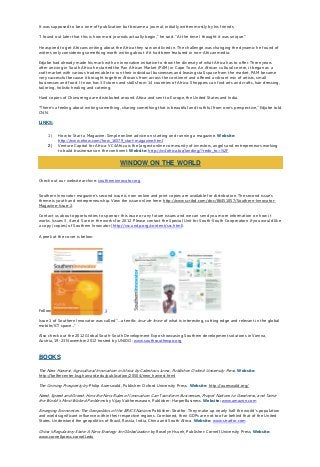
Southern Innovator magazine’s second issue is now online and print copies are available for distribution. The second issue’s
theme is youth and entrepreneurship. View the issue online here: http://www.scribd.com/doc/86451057/Southern-Innovator-
Magazine-Issue-2.
Contact us about opportunities to sponsor this issue or any future issues and we can send you more information on how it
works. Issues 3, 4 and 5 are in the works for 2012. Please contact the Special Unit for South-South Cooperation if you would like
a copy (copies) of Southern Innovator (http://ssc.undp.org/content/ssc.html).
A peek at the cover is below:
Follow us on Twitter @SouthSouth1
Issue 1 of Southern Innovator was called “...a terrific tour de force of what is interesting, cutting edge and relevant in the global
mobile/ICT space...”
Also check out the 2012 Global South-South Development Expo showcasing Southern development solutions in Vienna,
Austria, 19-23 November 2012 hosted by UNIDO: www.southsouthexpo.org
BOOKS
The New Harvest: Agricultural Innovation in Africa by Calestous Juma, Publisher: Oxford University Press. Website:
http://belfercenter.ksg.harvard.edu/publication/20504/new_harvest.html
The Coming Prosperity by Philip Auerswald, Publisher: Oxford University Press. Website: http://auerswald.org/
Need, Speed and Greed: How the New Rules of Innovation Can Transform Businesses, Propel Nations to Greatness, and Tame
the World’s Most Wicked Problems by Vijay Vaitheeswaran, Publisher: HarperBusiness. Website: www.amazon.com
Emerging Economies: The Geopolitics of the BRICS Nations Publisher: Stratfor. They make up nearly half the world's population
and wield significant influence within their respective regions. Combined, their GDPs are not too far behind that of the United
States. Understand the geopolitics of Brazil, Russia, India, China and South Africa. Website: www.stratfor.com
China’s Regulatory State: A New Strategy for Globalization by Roselyn Hsueh, Publisher: Cornell University Press. Website:
www.cornellpress.cornell.edu
WINDOW ON THE WORLD
Living in the Endless City edited by Ricky Burdett and Deyan Sudjic, Publisher: Phaidon. The city is the subject of the 21st
century. All over the world, populations are shifting towards urban centres. Living in the Endless City depicts an authoritative
survey of cities of today and the prospects for our urban future of tomorrow. 36 contributors from across Europe, South
America, China, Africa and the U.S. set the agenda for the city - detailing its successes as well as its failures. Website:
http://www.urban-age.net/publications/living-in-the-endless-city/
Consumptionomics: Asia’s Role in Reshaping Capitalism by Chandran Nair, Publisher: Infinite Ideas. Website: www.amazon.com
World 3.0: Global Prosperity and How to Achieve It by Pankaj Ghemawa, Publisher: Harvard Business School Press. Website:
www.amazon.com
The China Miracle: Development Strategy and Economic Reform by Justin Yifu Lin, Publisher: The Chinese University Press.
Website: www.eurospanbookstore.com
The End of Cheap China: Economic and Cultural Trends that will Disrupt the World by Shaun Rein, Publisher: John Wiley and
Sons. Website: www.amazon.com
Global Slump: The Economics and Politics of Crisis and Resistance by David McNally, Publisher: PM Press. Global Slump analyzes
the global financial meltdown as the first systemic crisis of the neoliberal stage of capitalism. It argues that – far from having
ended – the crisis has ushered in a whole period of worldwide economic and political turbulence. In developing an account of
the crisis as rooted in fundamental features of capitalism, Global Slump challenges the view that its source lies in financial
deregulation. Website: https://secure.pmpress.org/index.php?l=product_detail&p=271
Creative Ecologies: Where Thinking is a Proper Job by John Howkins, Publisher: UQP. Website:
www.creativeeconomy.com/think.htm
Breakout Nations by Ruchir Sharma, Publisher: Penguin. Breakout Nations offers journeys through more than two dozen of the
most interesting economies in the emerging world. Website: http://breakoutnations.com/
Light Manufacturing in Africa by Hinh T. Dinh et al, Publisher: World Bank. This book examines how light manufacturing can
offer a viable solution for sub-Saharan Africa’s need for structural transformation and productive job creation, given its
potential competitiveness based on low wage costs and an abundance of natural resources that supply raw materials needed
for industries. Website: http://issuu.com/world.bank.publications/docs/9780821389614
Why Nations Fail: The Origins of Power, Prosperity and Poverty by Daron Acemoglu and James A. Robinson, Publisher: Profile
Books. Website: www.amazon.com
Arrival City by Doug Saunders, Publisher: Pantheon. A third of humanity is on the move. History’s largest migration is creating
new urban spaces that are this century’s focal points of conflict and change — centres of febrile settlement that will reshape our
cities and reconfigure our economies. Website: http://arrivalcity.net/
China: And the End of Poverty in Africa – Towards Mutual Benefit? by Penny Davis, Publisher: Diakonia and the European
Network on Debt and Development. Website: www.eurodad.org/uploadedFiles/Whats_New/Reports/Kinarapport_A4.pdf
Globalization and Competition: Why Some Emergent Countries Succeed while Others Fall Behind by Luiz Carlos Bresser Pereira,
Publisher: Cambridge University Press. Website: www.networkideas.org/book/jan2010/bk12_GACL.htm
State of the Field in Youth Enterprise, Employment, and Livelihoods Development Publisher: Making Cents International. This
practical resource features learning from over 80 leading organizations that are working around the world to increase and
improve economic opportunities for young people. Topics include youth enterprise development; workforce development;
youth-inclusive financial services; working with adolescent girls and young women; and monitoring, evaluation and impact
assessment.
Website: www.YouthEconomicOpportunities.org/media.asp
PAPERS AND REPORTS
African Economic Outlook 2012: Promoting Youth Employment Publisher: Various. With almost 200 million people aged
between 15 and 24, Africa has the youngest population in the world. This number will double by 2045. Many jobs have been
created over the last decade, but the pace needs to accelerate significantly to match the demand of Africa's next generations.
Website: http://www.africaneconomicoutlook.org/en/
State of China’s Cities: 2010/2011: Better City, Better Life Publisher: UNHABITAT. Website:
www.scribd.com/doc/39882697/State-of-China-s-Cities-Report-2010-2011
Still our Common Interest: Commission for Africa Report 2010 Publisher: Commission for Africa Website:
www.commissionforafrica.info/2010-report
World Economic Outlook Update: Restoring Confidence without Harming Recovery Publisher: IMF. Website:
www.imf.org/external/pubs/ft/weo/2010/update/02/index.htm
Empowering People and Transforming Society: The World Economic Forum’s Technology Pioneers 2011 Publisher: World
Economic Forum. Website: www.scribd.com/doc/35953976/Technology-Pioneers-2011
The Emerging Middle Class in Developing Countries Publisher: OECD. Website:
www.oecdilibrary.org/oecd/content/workingpaper/5kmmp8lncrns-en (PDF - 2.09 mb)
The Implications of China’s Ascendancy for Africa by Hany Besada, Publisher: The Centre for International Governance
Innovation. Working Shifting Global Power. This paper examines the extent to which China’s engagement with Africa has
produced mutual benefits for both and whether Africa is reaping the necessary benefits required for poverty alleviation and
economic development. Website: http://www.cigionline.com/sites/default/files/Paper_40-web.pdf
Global Economic Decoupling Alive and Well Emerging economies decouple from the US, come closer to Europe. Website:
http://www.marketoracle.co.uk/Article23670.html
The Global Financial Crisis and Africa’s “Immiserizing Wealth” Research Brief, United Nations University, Number 1 2010.
Website: www.unu.edu/publications/briefs/policy-briefs/2010/UNU_ResearchBrief_10-01.pdf
Africa begins to make poverty history: US economists challenge conventional view that the continent is a basket case Website:
www.guardian.co.uk/business/2010/mar/03/africa-makes-povery-history
ON THE WEB
Blogs and Websites
Polis: A collaborative blog about cities around the globe. Website: http://www.thepolisblog.org/2012/03/coca-cola-in-
africa.html
mDirectory: The mDirectory is the most comprehensive database of information on mobile tech for social change on the Web:
case studies, mobile tools, research, and how-to guides. Website: http://mobileactive.org/directory
Global Development: Launched in September 2010, this website from the Guardian newspaper tracks progress on the MDGs,
encourages debate on its blogs, offers a rich store of datasets from around the world, and features monthly podcasts and
resources for schools. Website: www.guardian.co.uk/global-development
Latameconomy Website Launches
Latameconomy.org is the latest evolution of the annual Latin American Economic Outlook report, essentially bringing its
trusted, high quality content into the digital age. Its wide country coverage and methods of analysis are essential for anyone
seeking to understand the economic, social and political developments of Latin American countries.
Website: www.latameconomy.org/en/
International Development Economics Associates (IDEAs)
International Development Economics Associates (IDEAs) is a pluralist network of progressive economists across the world,
engaged in research, teaching and dissemination of critical analyses of economic policy and development.
Website: www.networkideas.org/
OECD: Tackling the economic crisis website
The global economic crisis is entering a new phase amid signs of a return to positive growth in many countries. But
unemployment is likely to remain high and much still needs to be done to underpin a durable recovery. This website will track
the recovery.
Website: http://www.oecd.org/document/24/0,3343,en_2649_201185_41707672_1_1_1_1,00.html
The Global Urbanist: News and analysis of cities around the world: planning, governance, economy, communities,
environment, international. Website: globalurbanist.com
ICT Update: A bimonthly printed bulletin, a web magazine, and an accompanying email newsletter that explores innovative
uses of information technology in agriculture and rural development in African, Caribbean and Pacific (ACP) countries. Website:
http://ictupdate.cta.int/en/Regulars/Perspectives/%28issue%29/56
Youth-Inclusive Financial Services (YFS-Link) Program website: The first space for financial services providers (FSPs) and
youth-service organizations (YSOs) to gather, learn and share about youth-inclusive financial services. Website: yfslink.org
Triple Crisis Blog: Global Perspectives on Finance, Development and Environment Website: http://triplecrisis.com/
Full Disclosure: The Aid Transparency Blog: A Devex blog, written by members of the international community. Website:
www.devex.com/en/blogs/full-disclosure
Africa Portal: An online knowledge resource offering researchers and opinion leaders a forum to share their insights on Africa
and publish their work on pressing areas of concern to policymakers and the public. It aims to fill the gap in accessibility to
research and information on policy issues on the continent. Website: africaportal.org
African Economic Outlook: A unique online tool that puts rigorous economic data, information and research on Africa at your
fingertips. A few clicks gives access to comprehensive analyses of African economies, placed in their social and political
contexts. This is the only place where African countries are examined through a common analytical framework, allowing you to
compare economic prospects at the regional, sub-regional and country levels. Website: africaneconomicoutlook.org/en
Africa Renewal: The Africa Renewal information programme, produced by the Africa Section of the United Nations
Department of Public Information, provides up-to-date information and analysis of the major economic and development
challenges facing Africa today. Website: www.un.org/ecosocdev/geninfo/afrec/
Timbuktu Chronicles: A blog by Emeka Okafor
“A view of Africa and Africans with a focus on entrepreneurship, innovation, technology, practical remedies and other self-
sustaining activities.” Website: http://timbuktuchronicles.blogspot.com/
AfriGadget: AfriGadget is a must-read for African invention junkies. They are always on the look out for ingenious innovation
that is new or a repurposing of existing technology in a new way, interesting in the sense that the story captures the
imagination of others, inspiring others to see solutions in uncommon ways, practical ideas that solve problems in a
demonstrable way, and entrepreneurs who are inventing new products or solutions. Website: afrigadget.com
Interesting Blogger
White African: About high-tech mobile and web technology change in Africa. Website: http://whiteafrican.com/
Social Media
Africa Entrepreneurship Platform
This ground breaking initiative is created as a forum to showcase innovative ideas and businesses from Africa that have the
ability to scale internationally, driving job creation and sustainable economic development between Africa and the Americas.
Website: www.sacca.biz
AfriGadget on Facebook: ‘Solving everyday problems with African ingenuity’:
Website: www.facebook.com/group.php?gid=2402629579
Start-up Funding
The SEED Initiative
Hosted by the UN Environment Programme's World Conservation Monitoring Centre (UNEP-WCMC), the SEED Initiative is a
global partnership for action on the Green Economy. The annual SEED Awards help to develop the most promising social and
environmental start-ups in emerging economies and developing countries.
Website: http://unep.org/newscentre/Default.aspx?DocumentID=2647&ArticleID=8798&l=en
The Pioneers of Prosperity Grant and Award
This competition is a partnership between the OTF Group and the John F. Templeton Foundation of the United States, and
promotes companies in East Africa by identifying local role models that act as examples of sustainable businesses in their
country/region. It is open to businesses from Kenya, Uganda, Tanzania, Burundi and Rwanda.
Five pioneers will receive US $50,000 to re-invest in their business. It is open to for-profit businesses that provide high wages to
their workers and that operate in sustainable ways.
Website: http://pioneersofprosperity.org/index.php
Oxford Said Business School Youth Business Development Competition
Open to youth between 16 and 21 across the world, the competition is run by students at Oxford University to promote social
enterprise. A prize fund of £2,000 in seed capital is up for grabs. It calls itself the ‘world’s first global youth development
competition’.
Website: www.sbs.ox.ac.uk/oba/se/ybd
Challenge
InnoCentive (www.innocentive.com/) is a challenge to the world’s inventors to find solutions to real scientific and technological
problems affecting the poor and vulnerable. It is an open marketplace where anybody with a problem can post it, and rewards
for effective solutions stretch up to US $100,000. They use rigorous intellectual property protection so ideas are not stolen
without credit being given to the inventor. Website: www.rockfound.org/about_us/news/2007/0720first_seeker.shtml
Video
Forum for the Future: Compelling animated videos exploring the hard choices of an urbanizing world and the need to
promote sustainable development and environmental harmony. Website: http://www.youtube.com/user/forumforthefuture96
Have an event you would like the South-South community to know about? Then send details to
developmentchallenges@googlemail.com.
2012
June
Rio+20: United Nations Conference on Sustainable Development 2012 Rio de Janeiro, Brazil (20-22 June 2012)
The United Nations Conference on Sustainable Development (UNCSD) is being organized in pursuance of General Assembly
Resolution 64/236 (A/RES/64/236). The Conference will take place in Brazil on 20-22 June 2012 to mark the 20th anniversary of
the 1992 United Nations Conference on Environment and Development (UNCED), in Rio de Janeiro, and the 10th anniversary of
the 2002 World Summit on Sustainable Development (WSSD) in Johannesburg. It is envisaged as a Conference at the highest
possible level, including Heads of State and Government or other representatives. The Conference will result in a focused
political document.
Website: http://www.uncsd2012.org/rio20/about.html
Forests and Trees: Serving the People of Africa and the World
Nairobi, Kenya (25-29 June 2012)
In June 2012, the International Union of Forest Research Organizations (IUFRO) in association with the Forestry Research
Network of Sub-Saharan Africa (FORNESSA) will celebrate its first Regional IUFRO-FORNESSA Congress together with ITTO-AFF
Forest Policy Day in Africa.
Website: http://fornis.net/congress/en/homepage
Agriculture Investment Summit: Europe
London, UK (26-28 June 2012)
The leading conference for investors looking to invest in agriculture as an asset class. The 5th annual Agriculture Investment
Summit will guide you through the complexities of investing in agriculture as an asset class. Learn how to make the most of
exposures in South America, Sub Saharan Africa, Central and Eastern Europe and Australia and New Zealand from Brasil Agro,
TIAA-CREF, PKA Pensionskasse and Feronia Inc - Africa during the regional streams.
Website: http://www.terrapinn.com/2012/agri/index.stm
UPCOMING EVENTS
July
Have an event you would like the South-South community to know about? Then send details to
developmentchallenges@googlemail.com.
August
Biodiversity Asia 2012: Science, Policy, and Governance
Bengaluru (Bangalore), India (7-10 August 2012)
This international conference is being organized in India to highlight the urgency of biodiversity conservation in Asia ahead of
the 11th Conference of the Parties (CoP) of the UN Convention on Biological Diversity (CBD) to be held in India in October
2012. Biodiversity Asia 2012 will bring together researchers, policy makers, managers, students, teachers, NGOs, activists, and
others working towards the conservation of Asia's biodiversity.
Website: http://www.scbasia2012.org/
3rd
International Conference on Research for Development
Bern, Switzerland (20-22 August 2012)
Participants in the conference are expected to bring in multiple national and international perspectives on development-
oriented research, policy dialogue, and practice aiming towards global transformation. The conference will have a strong focus
on the global South; but the role of the global North will also be addressed. Further emphasis will be given to discussing
research policy and funding in the North, including in Switzerland. In addition, the conference will take into account and
critically review the outcomes of the international ‘Planet under Pressure’ science conference (London in March 2012) and
Rio+20 (Rio de Janeiro in June 2012), and discuss the consequences of these global events for research partnerships.
Website: http://www.icrd.ch/
World Water Week
Stockholm, Sweden (26-31 August 2012)
Each year the World Water Week addresses a particular theme to enable a deeper examination of a specific water-related topic.
While not all events during the week relate to the overall theme, the workshops driven by the Scientific Programme Committee
and many seminars and side events do focus on various aspects of the theme. The current niche for 2009-2012 is "Responding
to Global Changes", which looks at the potential and necessary responses in water policy, management and development to
address pervasive and increasingly impacting global changes.
Website: http://www.worldwaterweek.org/
September
The Second Global Conference on Agriculture, Food Security and Climate Change
Ha Noi, Vietnam (3-7 September 2012)
Co-organized by Viet Nam and the Netherlands, in close collaboration with other partners, including FAO and the World Bank,
the conference will allow global leaders, practitioners, scientists, civil society and the private sector to share experiences and
demonstrate how early action on Climate-Smart Agriculture can act as a driver of green growth.
Website: http://www.afcconference.com/background-note
6th
International Hybrid Rice Symposium
Hyderabad, India (10-12 September 2012)
The symposium aims to create a discussion platform that tackles the issue of increasing rice yields to adapt to the worlds’
increasing demand for rice. The symposium will discuss the topics: Hybrid Rice Development; Hybrid Rice Seed Production;
Applications of Molecular Technology; Crop and Resource Management, and; Hybrid Rice Economics.
Website: http://hybrid-rice.org/
The World of Rural Co-operation International Roundtable Event - How Rural Co-operative Enterprises Build a Better
World
Dublin, Ireland (11-12 September 2012)
This invitation only roundtable event will be used to debate and discuss the impact and future of rural co-operation
worldwide. This prestigious event will be a unique opportunity to share knowledge and expertise with rural co-operators from
across the world to inform the development of a plan for the future development of rural co-operatives worldwide.
Website: http://www.rural2012.coop/
Annual Meeting of the New Champions 2012
Tianjin, People’s Republic of China (11-13 September 2012)
The Annual Meeting of the New Champions is the foremost global business gathering in Asia. After five years, it is widely
known as the Summer Davos – reflecting the “spirit of Davos” that for more than four decades has meant openness, collegiality
and frank, yet friendly, exchange among leaders from business, government, academia, civil society and media.
Website: http://www.weforum.org/events/annual-meeting-new-champions-2012
Making Cents’ 2012 Global Youth Economic Opportunities Conference
Washington, D.C., USA (11-13 September 2012)
The conference will take place September 11-13, 2012 at the Inter-American Development Bank’s Conference Centre in
Washington, DC. Submit a proposal to share your lessons learned, promising practices, and innovative ideas in one or more of
the following learning tracks: workforce development; adolescent girls and young women; youth-inclusive financial services and
financial capabilities; monitoring, evaluation and impact assessment; and youth enterprise development
Website: youtheconomicopportunities.org/how_to_submit.asp
Water Quality 2012
HangZhou, China (19-21 September 2012)
Water Quality 2012 will consider the range of issues and challenges that affect global water quality. By providing a forum for
researchers, industry, policymakers and other stakeholders, the conference will identify the key concerns and big challenges of
the future.
Website: http://www.accwa.net/the-project/water-quality-2012/
October
Digital UNDivided: Focus 100
New York, New York, USA (6 October 2012)
Connect with thought leaders, rockstar start-ups, and top brands who are using emerging technologies to engage black
women. Website: http://www.digitalundivided.com/
4th OECD World Forum on "Statistics, Knowledge and Policies" - Measuring Well-being and Fostering the Progress of
Societies
New Delhi, India (16-19 October 2012)
The goal of the 4th OECD World Forum on "Statistics, Knowledge and Policies" is to assess progress in implementing the
Istanbul Declaration (2007), to share results and lessons learned from work undertaken by OECD and other organizations, and
to give impetus to concrete measurement programmes based on existing national and regional statistical capacities,
mechanisms and tools.
Website: http://www.oecd.org/document/47/0,3746,en_2649_33715_49312751_1_1_1_1,00.html
Integrated Soil Fertility Management in Africa: From Microbes to Markets
Nairobi, Kenya (22-26 October 2012)
This conference assembles the strengths of several organizations and collaborative research projects committed to designing,
refining and delivering potent solutions to food insecurity and agricultural resource degradation in sub-Saharan Africa.
Website: http://www.isfmafrica2012.org/index.html
Second Global Conference on Agricultural Research for Development
Punta del Este, Uruguay (29 October – 1 November 2012)
The GCARD II will focus on the ways to implement the tasks identified in the GCARD RoadMap with special attention to
“Foresight and partnership for innovation and impact on small-holder livelihoods”.
Website: http://www.egfar.org/gcard-2012
2012 African Economic Conference
Kigali, Rwanda (30 October – 2 November 2012)
The main objective of the African Economic Conference is to provide a platform for experts on Africa, both within and outside
the continent, to reflect and dialogue on new directions for growth policy on the continent in order to determine the best
approaches to attain the Millennium Development Goals, achieve the objectives of NEPAD and accelerate Africa’s sustainable
development.
Website: http://www.africaneconomicconference.org/2012/index.htm
November
Implementing Rio+20 for Drylands and Desertification
Sede Boqer Campus, Israel (12-15 November 2012)
The International Conference on Drylands, Deserts and Desertification (DDD) has emerged as an important global gathering of
scientists, field workers, industry, government, CSOs, international development aid agencies and other stakeholders from over
60 countries concerned about land degradation in the drylands, and their sustainable use and development land degradation
and development.
Website: http://in.bgu.ac.il/en/desertification/Pages/default.aspx
December
Have an event you would like the South-South community to know about? Then send details to
developmentchallenges@googlemail.com.
World Summit Youth Award
The international contest for young people using the Internet and mobiles to take action on the UN Millennium Development
Goals. Website: www.youthaward.org
Grand Challenges Canada: Request for proposals
Grand Challenges Canada is pleased to announce a new initiative in its Maternal, Neonatal and Child Health grand challenge.
It’s called Saving Brains. Its goal is to unlock potential in children and dramatically transform lives in the developing world. The
money to fund this program comes from the Development Innovation Fund. In Budget 2008, the Government of Canada
committed $225 million CAD over five years to the Development Innovation Fund, to support the best minds in the world in a
collaborative search for solutions to global health challenges. For the Request for Proposals: Website:
http://www.grandchallenges.ca/wp-content/uploads/2011/05/Request_for_Proposals-Saving_Brains_EN.pdf
Zayad Future Energy Prize
The world is in desperate need of innovative solutions to create a new, sustainable energy future. No one knows
who or where the next great energy solution will come from. Solutions and technologies that could change the world are being
developed globally, and the $2.2 million Zayed Future Energy Prize, managed by Masdar in Abu Dhabi, recognizes and rewards
innovation, leadership, and long-term vision in renewable energy and sustainability.
Website: www.zayedfutureenergyprize.com/
Philips Liveable Cities Award
Philips is looking for individuals and community or non-government organizations and businesses with ideas for “simple
solutions” that will improve people’s health and well-being in a city to enter the Philips Liveable Cities Award. To help translate
these ideas into reality, three Award grants totalling €125,000 are on the line. One overall winning idea from any of the three
categories outlined below will receive a grant of €75,000, while the two additional ideas will receive grants of €25,000.
Website: http://www.because.philips.com/livable-cities-award/about-the-award
Piramal Foundation in India
AWARDS AND FUNDING
Has established a US $25,000 prize for ideas that help advance full access to effective public health care in India. The Piramal
Prize is a $25,000 Social Entrepreneurship Competition focused on democratizing health care in India that seeks to encourage
and support bold entrepreneurial ideas which can profoundly impact access to higher standards of health for India’s rural and
marginalized urban communities. The award recognizes high-impact, scalable business models and innovative solutions that
directly or indirectly address India’s health-care crisis.
Website: www.piramalprize.org
Special Award for South-South Transfer
The aim of the award is to identify, provide visibility, and honour those who have successfully shared their projects and
approaches internationally, thereby increasing the impact of the initiative. The winning practice receives US $15,000 to further
transfer the awarded practice to other communities in developing countries.
Website: www.southsouthexpo.org
South-South Experience Exchange Facility
Supported by Mexico, China, India, Denmark, Spain, The Netherlands, and the U.K. and now Colombia, the South-South
Experience Exchange Facility is a multi donor trust fund that promotes the idea that developing countries can learn from the
successes of other developing countries in overcoming similar challenges. In the past 12 months, the trust has given out 35
grants to countries for learning activities ranging from working with at risk youth in the Caribbean to outsourcing IT services in
Africa.
Website: www.southsouthcases.info
African Writers Fund
Together with the Ford Foundation, the Fund supports the work of independent creative writers living on the continent. The
Fund recognizes the vital role that poets and novelists play in Africa by anticipating and reflecting the cultural, economic and
political forces that continuously shape and reshape societies.
Website: http://www.trustafrica.org/index.php?option=com_content&task=view&id=91&Itemid=90&lang=fr
Joint NAM S&T Centre - ICCS Fellowship Programme
Centre for Science and Technology of the Non-Aligned and Other Developing Countries (NAM S&T Centre) and International
Center for Chemical Sciences (ICCS), (H.E.J. Research Institute of Chemistry and Dr. Panjwani Centre for Molecular Medicine and
Drug Research), University of Karachi, Karachi, Pakistan
Click here for more information
or contact:
namstct@vsnl.com,
namstct@bol.net.in,
apknam@gmail.com
PhD Plant Breeding Scholarships at the University of Ghana
The University of Ghana (www.ug.edu.gh) has been awarded a project support grant by the Alliance for a Green Revolution
(www.agra-alliance.org) in Africa (a joint venture between the Bill and Melinda Gates Foundation and the Rockefeller
Foundation, for the establishment of a West African Centre for Crop Improvement (WACCI). This is available to scientists
working at NARIs, universities and international centres in West Africa. Women scientists are especially encouraged to apply for
a fellowship under this programme. Website: www.acci.org.za/Default.asp?nav=Home&idno=10
Genesis: India’s Premier Social Entrepreneurship Competition
Is a social entrepreneurship competition aiming to bring together social entrepreneurs, students, NGOs, innovators, incubators,
corporations and financiers and encourage them to come up with innovative ideas which are socially relevant and feasible.
Website: http://genesis.iitm.ac.in/
Weitzenegger’s International Development Job Market: Website: www.weitzenegger.de/new/jobmarket.php
Global Knowledge Initiative
The Global Knowledge Initiative seeks to build global knowledge partnerships between individuals and institutions of higher
education and research. It seeks to help partners access the global knowledge, technology, and human resources needed to
sustain growth and achieve prosperity for all."
Website: www.globalknowledgeinitiative.org/
ExportHelp - Promoting and supporting access to the European market
The European Commission runs a database for the explicit support of market players in developing countries who want to bring
their products to the EU market. The database gives an overview on the EU´s preferential trade regimes established for
developing countries as well as lists all tariffs, taxes and other requirements for goods
imported into the EU.
Website: http://exporthelp.europa.eu
Development Executive Group Devex Networking Website
Over 90,000 global experts can network and connect and learn about more than 47,000 registered projects. Website:
www.devex.org
Website Offers Career Advice to Young Africans
Set up by the Commonwealth Secretariat, Africancareerguidance.com is aimed at providing career guidance to African youth
and helping them to link with prospective employers. AfricaRecruit is a human resources organization that provides skills
training for African professionals in the Diaspora and on the continent. The website has an inbuilt email subscriber list for all its
users and offers a searchable database of career profiles for job seekers and prospective employers. It also offers skills and
interest assessments and advice on CV and résumé preparation. It provides tips about interviewing techniques, as well as
information on internship and volunteer opportunities, and entrepreneurial skills.
Website: www.africacareerguidance.com
African Diaspora Skills Database
This database was compiled to provide an overview of qualified African Diaspora professionals with varied areas of expertise
and experience. The African Diaspora contributes substantially to the social, economic and political development of Africa, and
TRAINING AND JOB OPPORTUNITIES
this database is set up to further mobilize this considerable potential.
Website: www.diaspora-centre.org/NEWSLETTER/Database
Aid Workers Network (AWN)
Aid Workers Network (AWN) is an online platform for aid, relief and development workers to ask and answer questions of each
other, and to exchange resources and information. AWN is registered in the United Kingdom as a charity. You will
find discussions about a range of questions and issues on the AWN forum from aid, relief and development workers all over the
world and representing a variety of fields, with new threads or responses posted daily. The forum is a great way to get in
contact with
other aid and development workers in your geographic area or working in a similar area of work.
Website: www.aidworkers.net
Bizzlounge
Bizzlounge is where people committed to ethical behaviour meet, who want to establish and maintain business contacts in an
exclusive and relaxed environment.
Website:
http://bizzlounge.com
Business Action for Africa
Business Action for Africa is a network of businesses and business organizations working collectively to accelerate growth and
poverty reduction in Africa.
Website: http://businessactionforafrica.blogspot.com
Business Fights Poverty
Business Fights Poverty is a professional network for all those passionate about fighting world poverty through the power of
good business.
Website: http://businessfightspoverty.ning.com
Business in Development Network (BiD)
The BiD Network Foundation runs the BiD Challenge to contribute to sustainable economic development by stimulating
entrepreneurship in developing countries.
Website: www.bidnetwork.org
Zunia
By Development Exchange, it offers news, publications and networking opportunities with the world’s development community.
Website: www.zunia.org
Catalogue of Poverty Networks
UNDP is organizing an online catalogue of Poverty Networks as a means to facilitate access to knowledge and sharing this to a
wider audience in 189 countries. Poverty Networks are web-based platforms that provide space for sharing and
disseminating development-related information and initiatives. Below you will find information on IPC’s collaborating networks,
which help foster dialogue between researchers, policymakers, civil society and multilateral organizations.
Website: www.undp-povertycentre.org/povnet.do
Connections for Development (CfD)
CfD is a UK, Black and Minority Ethnic (BME) led, membership based organization committed to ensuring that UK BME
communities, and the organizations they are involved in, are supported in the process of shaping and delivering policy and
projects that affect their countries of origin or interest – collectively ''our world”.
Website: www.cfdnetwork.co.uk
Development Crossing
Development Crossing was set up in 2006 by a small group of friends with diverse backgrounds ranging from business
consulting to international development. In a world where the environment, corporate responsibility, and sustainable
development are becoming increasingly intertwined, our goal was to create a site where individuals that shared our passion
could keep up-to-date with relevant happenings in the world and connect with like-minded individuals. The idea behind
Development Crossing is to provide a social network that brings together people from a variety of sectors, countries and
professions to discuss corporate social responsibility and sustainable
development.
Website: www.developmentcrossing.com
DevelopmentAid.org
The one-stop-information-shop for the developmental sector, DevelopmentAid.org is a membership organization that brings
together information for developmental professionals, NGOs, consultancy firms and donors.
Website: www.developmentaid.org
dgCommunities on the Development Gateway (now Zunia.org)
dgCommunities, a free online service by the Development Gateway Foundation is devoted to knowledge-sharing and
collaboration for people working to reduce poverty in the developing world.
Website: http://topics.developmentgateway.org
Diaspora African Forum
This Forum exists ''to invite and encourage the full participation of Africans in the Diaspora in the building of the African Union,
in its capacity as an important part of the Continent''. We will provide the vital linkage for Diaspora Africans to become involved
in Africa's development as well as reap the fruits of African unity.
Website: www.diasporaafricanforum.org
Business Planet: a new data map on Entrepreneurship
Business Planet, an interactive Google map, now includes data on new business creation around the world. Measures of
entrepreneurial activity are based on the number of total and newly registered corporations. Click on colour markers to learn
more about each country.
Website: http://rru.worldbank.org/businessplanet/default.aspx?pid=8

Development Challenges, South-South Solutions: June 2012 Issue

  • 1.
    DEVELOPMENT CHALLENGES, SOUTH-SOUTH SOLUTIONS E-newsletterof the Special Unit for South-South Cooperation in UNDP ……………………………………………………………………………………………….…. 1. Indonesian Wooden Radio Succeeds with Good Design One Indonesian industrial designer has pioneered an innovative business that has rejuvenated the economy of a farming village and improved the sustainability of local forests - and he's doing it all with wood. A range of wooden radios (wooden-radio.com) hold pride of place for the Magno brand (http://www.magno-design.com/?id=wr01a), which has carved out a niche as a maker of high-quality, crafted products that marry traditional skills with modern design. Magno is creating jobs and skills while also creating a unique, exportable product that commands a good price. Indonesian designer Singgih Susilo Kartono developed the radio design concepts while at the Faculty of Fine Art and Design in Bandung, Java, Indonesia in the 1990s. He takes an organic approach to designing, enjoying the journey and not necessarily being sure where he is going. "I never start my design according to the market research or demand. I design by absorbing events, global or local events and even mundane daily life things that happen around me. Consequently, I start to think what will be good and better for these people," he explains in his brochure. The workshop in which the radios are made is a handsome wooden-roofed building and craftspeople sit at long wooden tables to assemble the models. Each radio is made from a single piece of wood and takes a craftsperson 16 hours to construct, drawing on traditional woodworking skills. The radios are made from Indian rosewood, which is often used to manufacture many musical instruments because of its excellent sound resonance. The radios are made in stages, with more than 20 steps involved in assembling each one. The individual parts are precision cut by machines before being assembled using a tongue and groove (http://en.wikipedia.org/wiki/Tongue_and_groove) construction technique. Some radio models have a chunky, retro appearance and mix dark and light wood to give an eye-pleasing contrast. Others are more modern designs with a sleek profile. There is a large version, a 'Mini', a sleek modern Cube' version and a rectangular version. There is also a round clock and a wooden desktop office set with various essentials like a wooden stapler. The radios sell for between Euros 99 (US $124) and Euros 220 (US $276), and are shipped to Europe via Singapore to Hamburg in Germany. "To me, wood is somewhat a perfect material - especially if I compare it to synthetic ones," Kartono said. "In wood we could find strength and weakness, advantages and disadvantages or roughness and also softness. Wood is hard and solid but yet it is 100 per cent eco-friendly as it is degradable and leaves no waste materials on the earth." Great care is taken in selecting the wood and ensuring it is from local, sustainable plantation sources. According to its website, Magno used 80 trees in 2010 for its radios but in turn planted 8,000 trees around the village. This regeneration has become part of the process of creating the radios. Magno has won numerous awards, including the Brit Design Award (UK), Design Plus Award (Germany), Good Design Award/G-Mark (Japan) and the Indonesia Good Design Selection Awards. "The wood I use for the manufacturing process may need as long as 50 years to reach maturity," Kartono said. "I want people not only to think about exotic or precious woods but likewise about the fact that good things require time. All objects that surround us should be thought-provoking. Craftsmanship originally was the art of dealing with raw June 2012 Subscribe Unsubscribe Contact Us In this issue: Indonesian Wooden Radio Succeeds with Good Design Gobi Desert Wine to Tackle Poverty and Boost Incomes Mauritanian Music Shop Shares Songs and Friendship Global South Eco-cities Show How the Future Can Be New Journal Celebrates Vibrancy of Modern Africa ………………………………… Featured links: Babajob.com Equator Initiative Kiva.org SSC Website FUNDING ……………………………….. Quick links: Window on the World Upcoming Events Awards and Funding Training and Job Opportunities Past Issues ……………………………….. Bookmark with: what is this? ……………………………….. ……………………………….. what is this? ………………………………..
  • 2.
    materials in asensible and economical way." As Kartono tells it, he faced the typical university graduate's dilemma about his career path. Should he work as an in-house designer in a city or return to his home village of Kandangan and start a business? His choice was unusual. Once somebody with a university education leaves a small village, it is rare they return. And at first, Kartono did not. But he was drawn back by the dire situation in the village, and decided to apply his knowledge of product design to revive its economic fortunes. He started by visiting just twice a year because that was all he could afford. This had the advantage of giving him perspective on the situation in the village. "At first glance, these changes (happening to the village) were seen as a 'progress,'" he said. "But when I looked more closely I concluded that it was only the 'surface' which experienced change. The basic structure of the village did not undergo any changes; moreover, some was actually deteriorating." He concluded that the village was being damaged by various government attempts to modernize agricultural practices. The debt problems this caused meant many farmers lost their farms and were forced to seek work in the city or look for another way to make money. Craft work seemed to be the answer to this problem. It has many advantages, as Kartono sees it. It is something that can grow and fits well with village lifestyles. It is labour intensive, doesn't need sophisticated technology and can use already existing local resources. Kartono was inspired by one of his teachers at university, an advocate of the 'New Craft' approach, which applies modern management techniques to traditional craftsmanship. The idea is simple but very effective. It begins with making sure every step of the manufacturing process is standardized to ensure consistent quality and materials. A new product or design is first broken down into steps and a product manual is put together. Only then is the manufacturing process carried out. While the New Craft method sounds simple and obvious, many craft makers do not take this approach. By following this methodology, it is possible to quickly train new craft workers and start up manufacturing in a new village or community. Craft is increasingly being seen as a good way to re-employ people who formerly worked in farming. The New Craft approach can create high-quality products that would sell well in the export market. A common problem with crafts is either poor quality control or inconsistent manufacturing methods. This can feed stereotypes of craft products and make them look second-rate in comparison to machine-manufactured products in the marketplace. "Design for us is more than just creating a well-designed product that is produced and consumed in colossal amount," Kartono said. "Design must be a way to solve and minimize problems." LINKS: 1) Cradle to Cradle: Remaking the Way We Make Things by William McDonough and Michael Braungart. It is a manifesto calling for the transformation of human industry through ecologically intelligent design. Website: http://www.mcdonough.com/cradle_to_cradle.htm 2) Rio+20: At the Rio+20 Conference, world leaders, along with thousands of participants from governments, the private sector, NGOs and other groups, will come together to shape how we can reduce poverty, advance social equity and ensure environmental protection on an ever more crowded planet to get to the future we want. Website: http://www.uncsd2012.org/ 2. Gobi Desert Wine to Tackle Poverty and Boost Incomes In the arid Gobi desert spanning the two Asian nations of China and Mongolia is a bold attempt to make wine and reduce poverty. The environment is harsh, with temperatures swinging from sub-zero winter cold to sweltering summer heat. The desert is also home to high winds and notorious dust storms that plague China’s capital Beijing every year. China’s wine industry is booming as people have embraced the drink's perceived health-giving qualities and are using it to celebrate new-found wealth as the economy has flourished. Current wine consumption in China is half a litre per person per year, low compared to the French average of 55 litres a year. But this is growing quickly. Well-known brands include Great Wall, Dynasty and Changyu (http://www.changyu.com.cn/english/index.html), which is considered the world’s 10th largest wine producer. One innovative winery is using this wine boom to tackle poverty and increase local wealth. Chateau Hansen (hansenwine.com) in Inner Mongolia has been operating since the 1980s, but recent expansion and modernization have significantly increased its earning power and the number of people it employs. Located in an area with high levels of poverty, it has developed a successful wine business in the desert by tapping the plentiful water supplies from the Yellow River. The area is now considered one of the best for growing wine grapes in China. Located near Wuhai city (http://en.wikipedia.org/wiki/Wuhai), 670 kilometres west of Beijing, Chateau Hansen has 250 hectares of Merlot, Cabernet Sauvignon and Cabernet Gernischt grapevines. The vines are buried under the sand to protect them from the harsh weather in the winter. "The lowest temperature gets down to is below -20 degrees C (Celsius), but in summer, it can reach 38 or 40 degrees C (102 or 104 F)," Li Aixin, Chateau Hansen's head of viticulture, told MSNBC. "Here the four seasons are good for the growth of the grapes, but in the winter we need to bury them in the earth" to keep them from freezing. Hansen has been ambitious in its approach. It has a European-style chateau, hotel and even a French wine expert, Bruno Paumard, on site to help with the wine making. The chateau’s cellar now stores 1,000 barrels of wine.
  • 3.
    Paumard arrived inChina in 2005. He has thrown himself into Chinese culture and tasted and tested the country’s wines. Hansen has produced 400,000 bottles of wine, mostly sold in China, where red wine drinking has become a big part of the culture of celebration. Hansen sells the majority of its wine to government organizations and regional enterprises. It has seen its profits double to 100 million yuan (US $18 million) in 2011 and hopes sales will double again in 2012. "Eighty per cent of the market in China is really the local governments who encourage the enterprises in their cities to consume red wine, of a certain brand, at their banquets in the place of Chinese ‘baijiu' for their incessant and never-ending toasts," said Paumard, referring to China's home-grown rice wine. "So it's actually a market that's totally unique." Hansen’s Cotes du Fleuve Jaune du Desert de Gobi has become one of the biggest award-winning wines in China. It received a bronze medal from the International Wine Challenge of Blaye, near Bordeaux, France. China now stands as the world's fifth-largest consumer of wine (International Wine and Spirit Research study) (http://www.iwsr.co.uk/). The market in China is forecast to grow by 54 per cent from 2011 to 2015, adding up to a billion bottles. A map of China’s vineyards and their terroir or soil conditions shows a diverse wine-making sector (http://www.hansenwine.com/english/vineyardlink.html). In this busy marketplace, Hansen prides itself on being organic. It also has the goal of turning the arid desert into green vineyards using irrigation from the Yellow River and groundwater. It wants to create employment and raise living standards in the region and is fitting into a national strategy to raise living standards for poor regions. There is a training programme for the around 400 workers employed by the winery. No pesticides are used and only sheep dung is used as a fertilizer provided by 3,000 sheep on site. Trees also play a role in providing humus (http://en.wikipedia.org/wiki/Humus) for the vines. There is also accommodation in a nearby village for the employees. There are 250 hectares of vineyards and the grapes are harvested by hand. Expansion began in 2001 when the chateau and winery were built. It is strategically located just 500 metres from an airport and the chateau has a luxury hotel. Around 20,000 people visit a year, according to Hansen’s website, bringing in further income for the winery. The winery also uses Mongolian culture and cuisine as a selling point to attract tourists. The chief executive of Hansen is Han Jianping, who made his first fortune in real estate development. Han believes that "the momentum of growth in the wine industry is huge." "With a great foundation of more than 1 billion people as we have in China, and (the industry) growing at 20 or 30 per cent a year, there is a huge potential for more growth," he said. LINKS: 1) China Wine Online: An information service that also produces the China Wine Business magazine and runs the China Wine Study Tour. Website: http://www.winechina.com/en/index.asp 2) The 10th Shanghai International Wine and Spirits Expo 2013: Website: http://www.winefair.com.cn/sugar/en/index.asp 3. Mauritanian Music Shop Shares Songs and Friendship Around the world, traditional music stores selling vinyl records, tapes and CDs (compact discs) are closing down. Digital downloads distributed over the Internet and mobile phones make it unnecessary to build a music collection in these hard formats. While this has been a revolution that has made acquiring music as simple as firing up a digital download service like iTunes, it has many downsides as well. One of them has been the loss of vast swathes of musical history, as many songs recorded in the past have not made their way into digital downloads. And how can you find music online if you only remember part of a tune or song and can’t remember its title or the musician? The background and knowledge that was once imparted by an informed person in a music store has been lost in the world of digital downloads. A Mauritanian music shop is showing how a traditional record store can stay relevant and commercially viable in the 21st century. Entrepreneur Mohamed Vall's Saphire d'Or store in Mauritania’s capital Nouakchott (http://en.wikipedia.org/wiki/Nouakchott), is a treasure trove of the sort of long-lost recorded songs that normally vex lovers of African music. Pictures of the shop can be seen at the sahelsounds blog (http://sahelsounds.com/?p=887). Vall has run the shop for three decades and amassed a large collection of rare African music on records and tapes. He has married this trove of African creativity to a clever business model: Vall doesn’t let customers buy the precious records themselves but instead will transfer the songs to a disc or a USB stick (http://en.wikipedia.org/wiki/USB_flash_drive) for US 30 cents each. He has also used traditional hospitality to create an atmosphere that encourages people to interact and keep coming back. “I have the biggest collection in Mauritania," Vall told The Guardian newspaper. "Any music you want from Africa – I mean the kind of music that puts Africa on the map – I have it." The shop is down an alleyway in the bustling capital and offers a refuge for music lovers. The atmosphere encourages friendly conversation and lets customers take their time making a selection. Customers can relax in
  • 4.
    armchairs while browsingand drink some traditional mint tea or enjoy a snack from a communal bowl. The shop uses traditional Mauritanian nomadic hospitality to improve the customer experience. It also uses the music it sells to heal rifts between the different cultures that cross Mauritania, as it bridges Arabic-speaking North Africa and the majority black sub-Saharan Africa. "When you are here, it doesn't matter who you are," Vall said. "We get youngsters wanting 1940s ballads and old people whose minds are musical museums. We get toubabs (white people) who heard one song decades ago." One of the treasure troves held in the shop is the recordings made by West African orchestras during the post-colonial period. The shop also acts as an interactive museum and archive of many African musical greats, from Senegal's Youssou N’Dour to Nigerian afrobeat pioneers, Guinean pop legends and Maliaian and Congolese musicians. Its collection ranges beyond Africa to take in musical genres from around the world, from blues to salsa to rock. "The music allows you to travel in your head," said one customer, teacher Abdoul Kaba."When I first came to Mauritania from Guinea, I went round and round looking for zouk (West African funk) music that everybody listens to in Guinea until I ended up here." The shop also serves as a sanctuary for many from life’s everyday hardships. "It's not about the music any more. People come back because in here you can be free. You can listen to music and forget this hard life," Kaba said. LINKS: 1) The African Music Encyclopedia: Search by alphabetical listing the continent’s musicians. Website: http://africanmusic.org/ 2) African Musicians Profiles: African Musicians Profiles (AMP) is a website for the promotion and publicity of African musicians. Each musician “has a profile, and there are pages on news of recent and future events, special features, recommended CDs, relevant reading (biographies, reference books and magazines) and photos”. Website: http://www.africanmusiciansprofiles.com/ 4. Global South Eco-cities Show How the Future Can Be The world is currently undergoing a high-stress transition on a scale not seen since the great industrial revolution that swept Europe in the 19th and 20th centuries. Today's urban and industrial transition involves many more people and is taking place on a greater proportion of the planet. With rapid urbanization comes a demand for middle class lifestyles, with their high- energy usage and high consumption of raw materials. This is stretching the planet’s resources to breaking point. And as many have pointed out, if the world’s population is to continue past today’s 7 billion to reach 9 billion and beyond, new ways of living are urgently required. Radical thinking will be necessary to match the contradictory goals of raising global living standards for the world’s poor with pressured resources and environmental conditions. But there are innovative projects already under development to build a new generation of 21st-century cities that use less energy while offering their inhabitants a modern, high quality of life. Two examples are in China and the Middle East. Both projects are seen as a way to earn income and establish viable business models to build the eco-cities of the future. Each project is seeking to develop the expertise and intellectual capacity to build functioning eco-cities elsewhere. In the case of the Masdar City project in the United Arab Emirates, international businesses are being encouraged to set up in Masdar City and to develop technologies that can be sold to other countries and cities – in short, to create a green technology hub akin to California’s hi-technology hub ‘Silicon Valley’. Masdar City is also being built in stages as investors are found to help with funding. Both projects hope to prove there is money to be made in being green and sustainable. The Tianjin Eco-city (tianjinecocity.gov.sg) project is a joint venture between China and Singapore to build a 30 square kilometre city to house 350,000 residents. Tianjin (http://en.wikipedia.org/wiki/Tianjin) is a large industrial city southeast of China’s capital, Beijing. It is a place that wears the effects of its industrial expansion on the outside. Air pollution is significant and the city has a grimy layer of soot on most outdoor infrastructure. China has received a fair bit of criticism for its polluted cities as the country has rapidly modernized in the past two decades. This sprint to be one of the world’s top economic powers has come at a cost to the environment. In this respect, China is not unusual or alone. Industrialization can be brutal and polluting, as Europe found out during its earlier industrial revolution. But China is recognizing this can’t go on forever and is already piloting many initiatives to forge a more sustainable future and bring development and high living standards back in line with what the environment can handle. Sino-Singapore Tianjin Eco-city is the second large-scale collaboration between the Chinese government and Singapore. The first was the Suzhou Industrial Park (http://www.sipac.gov.cn/english/).The Tianjin project came up in 2007 as both countries contemplated the challenges of rapid urbanization and sustainable development. The project's vision, according to its website, is to be “a thriving city which is socially harmonious, environmentally-friendly and resource-efficient – a model for sustainable development." The philosophy behind the project is to find a way of living that is in harmony, with the environment, society and the economy. It is also about creating something that could be replicated elsewhere and be scaled up to a larger size. The city is being built 40 kilometres from Tianjin centre and 150 kilometres from Beijing. It is located in the Tianjin Binhai New Area, considered one of the fastest growing places in China.
  • 5.
    Construction is wellunderway and can be followed on the project’s website (http://www.tianjinecocity.gov.sg/gal.htm). It will be completed in 2020. This year, the commercial street was completed and is ready for residents to move in. Residents will be encouraged to avoid motorized transport and to either use public transport or people-powered transport such as bicycles and walking. An eco-valley runs down the centre of the city and is meant to be a place for pedestrians and cyclists to enjoy. The basic building block of the Eco-city - its version of a city block - is called the Eco Cell. Each Eco Cell measures 400 metres by 400 metres, a comfortable walking distance. Four Eco Cells make a neighbourhood. Several Eco Neighbourhoods make an Eco District and there are four Eco Districts in the Eco-city. It is a structure with two ideas in mind: to keep development always on a walkable, human scale and also to provide a formula for scaling up the size of the Eco-city as the number of residents increases. It is a logical approach and seeks to address one of the most common problems with conventional cities: sprawling and unmanageable growth that quickly loses sight of human need. Agreement was also reached on the standards that should be achieved for a wide variety of criteria, from air and water quality to vegetation, green building standards, and how much public space there should be per person. An ambitious project in the United Arab Emirates is trying to become both the world’s top centre for eco cities and a living research centre for renewable energy. Masdar City (http://www.masdarcity.ae/en/)is planned to be a city for 40,000 people. It is billed as a high-density, pedestrian-friendly development where current and future renewable energy and clean technologies will be "marketed, researched, developed, tested and implemented." The city hopes to become home to hundreds of businesses, a research university and technology clusters. This version of an eco-city is being built in three layers in the desert, 17 kilometres from the Emirati capital Abu Dhabi. The goal is to make a city with zero carbon emissions, powered entirely by renewable energy. It is an ambitious goal but there are examples in the world of cities that use significant renewable energy for their power, such as Reykjavik, Iceland in Northern Europe, which draws much of its energy from renewables and geothermal sources. Masdar City is designed by world-famous British architect Norman Foster (fosterandpartners.com) and will be 6.5 square kilometres in size. The design is highly innovative. The city will be erected on 6 metre high stilts to increase air circulation and reduce the heat coming from the desert floor. The city will be built on three levels or decks, to make a complete separation between transport and residential and public spaces. The lowest deck will have a transportation system based on Personal Rapid Transport Pods. These look like insect eyes and are automated, controlled by touch screens, using magnetic sensors for propulsion. On top of this transport network will be the pedestrian streets, with businesses, shops and homes. No vehicles will be allowed there, and people will only be able to use bicycles or Segway (segway.com) people movers to get around. An overhead light railway system will run through the city centre, all the way to Abu Dhabi City. "By layering the city, we can make the transport system super-efficient and the street level a much better experience," Gerard Evenden, senior partner at Foster + Partners, told The Sunday Times. "There will be no car pollution, it will be safer and have more open spaces. Nobody has attempted anything like this." Masdar City is being built in stages as funding comes, with the goal of completion by 2016. It hopes to achieve its aspiration to be the most technologically advanced and environmentally friendly city in the world. As for water supplies in the desert, there is a plan: dew collected in the night and morning and a solar-powered desalination plant turning salt water into drinking water. Electricity will come from a variety of sources. Solar panels will be on every roof and double as shade on alleyways. Non-organic waste will be recycled, while organic waste will be turned into fuel for power plants. Dirty water will be cleaned and then used to irrigate green spaces. Because of the design, the planners hope the city will just use a quarter of the energy of a conventional city. To keep the city smart and the project on top of developments in renewable energy, the Masdar Institute of Science and Technology (http://www.masdar.ac.ae/) will specialize in renewable energy technology. The cost for the city was pegged at US $22 billion in 2009. The chief executive of Masdar – Abu Dhabi’s renewable-energy company - is Sultan Al Jaber. He sees the city as a beacon to show the way for the rest of the Emirate to convert from a highly inefficient consumer of energy to a pioneer in green technology. "The problem with the renewable-energy industry is that it is too fragmented,” he told The Sunday Times. “This is where the idea for Masdar City came from. We said, ‘Let’s bring it all together within the same boundaries, like the Silicon Valley model (in California, USA).’” The project needs to gather much of its funding as it progresses. The United Nations' Clean Development Mechanism (http://cdm.unfccc.int/)is helping with financing. Companies can earn carbon credits if they help fund a low-carbon scheme in the global South. The sultan is ambitious and sees this as a “blueprint for the cities of the future." It has been able to bring on board General Electric (GE) and the Massachusetts Institute of Technology (MIT) to sponsor the university.
  • 6.
    It is possibleto visit Masdar City and take a tour (http://www.masdarcity.ae/en/105/visit-masdar-city/) and it is also possible to view online what has been built so far (http://www.masdarcity.ae/en/32/built-environment/) LINKS: 1) Center for Innovation, Testing and Evaluation (CITE): Located in Texas, USA, CITE is a fully functioning city with no residents to test new technologies before they are rolled out in real cities. Website: http://www.pegasusglobalholdings.com/test-center.html 2) Digital Cities of the Future: In Digital Cities, people will arrive just in time for their public transportation as exact information is provided to their device. The Citizen-Centric Cities (CCC) is a new paradigm, allowing governments and municipalities to introduce new policies. Website: http://eit.ictlabs.eu/action-lines/digital-cities-of-the-future/ 3) Eco-city Administrative Committee: Website: http://www.eco-city.gov.cn/ 4) Sino-Singapore Tianjin Eco-city, Investment and Development Co., Ltd. Website: tianjineco-city.com 5) ‘The Future Build’ initiative, a new green building materials portal from Masdar City. Website: thefuturebuild.com 6) UNHABITAT: The United Nations Human Settlements Programme is the UN agency mandated to promote socially and environmentally sustainable towns and cities with the goal of providing adequate shelter for all. Website: www.unhabitat.org 5. New Journal Celebrates Vibrancy of Modern Africa Africa has seen huge changes to its communications and media in the past five years. The rise and rise of mobile phones, the expansion of the Internet and the explosion in African blogging and social media, on top of flourishing print and broadcast media, all bring an increasing range of options for telling African stories and increasing dialogue. With all this new media creating new communications channels – and all the turmoil and change affecting millions as economies and countries change – people need the ability to make sense of it all. One magazine is trying to play that role. An entrepreneur and multimedia innovator has created a unique publication that is capturing the spirit, ideas and stories of modern Africa. It is a high-quality product, has gathered together talented writers and photographers and is gaining a growing global audience. Chimurenga Magazine (http://www.chimurenga.co.za/) based in Cape Town, South Africa, calls itself a "pan African publication of writing, art and politics." Named for the Zimbabwean Shona word for “revolutionary struggle,” it is published three times a year. Editor Ntone Edjabe is from Cameroon and came to Cape Town in the 1990s after the end of South Africa's racist Apartheid regime. With more than 100 contributors, the magazine offers insight into contemporary Africa, what occupies people’s thoughts and how their lives are actually lived. It is involved in a wide range of other activities, including co-curating a Global South Dialogue Series. And its readership is truly diverse. “We have readers who are long-term prisoners at Pretoria Central Prison, who have subscriptions that they get to us in coins, and readers who are successful businessmen," Edjabe said to The Financial Times Magazine. Chimurenga is out to challenge perceptions of Africa. Practicing the art of long-form journalism more associated with established high-end publications like The New Yorker (newyorker.com), the magazine sets out to challenge perceptions about Africa. "Discourse on Africa is geared towards simplicity," Edjabe told CNN. "Everything must be simple - 'he's a poor black man, he's a victim' - like there has to be a simple story, in a way this is what signifies Africa and global consciousness. "The moment you bring a degree of complexity to it, it kind of throws people off, they just don't know where to look anymore. It's like, 'what's going on?' So Chimurenga in a way does not try to maintain the superficiality of this narrative - we engage with life, we try to present life as complex as it really is." Stories in the journal include Billy Kahora writing on the decay of a neighbourhood in Nairobi, Kenya, Michael Abrahams writing about his time in the Cape Town mental hospital after a suicide attempt, and Sean O’Toole following a Zimbabwean immigrant on his journey into South Africa. The magazine's website carries back issues of the journal, along with a shop selling magazines, books and t-shirts and the "Chimurenga Library," an archive of pan-African, independent periodicals. There's also live online streaming of music - "from ancient techno to future roots" - through the Pan African Space Station radio station, there is a biennial publication of urban life it calls "Africa-style," and the writings of 14 African writers who visited 14 African cities to check-up on life in urban areas. As an example of the creativity of Chimurenga’s talent, a special issue of the magazine tried to better understand the impact of violence in South Africa in May 2008 that led to the deaths of 62 people. It did this by creating a fictitious newspaper called The Chimurenga Chronic (http://www.chimurenga.co.za/chimurenga-magazine/current-issue) set during the violence. The writers are a mix of Anglophones and Francophones, all based in Africa. Common subjects focus on the world of lower- middle class Africa. Examples of past issues show the variety of its content: Conversations With Poets Who Refuse To Speak, Futbol, Politricks & Ostentatious Cripples, Conversations in Luanda and Other Graphic Stories, *We're all Nigerian! Well-travelled editor Edjabe has studied and lived in Lagos, Nigeria and Johannesburg, South Africa. He has worked as a disc jockey, music writer and basketball coach. He launched Chimurenga in 2002. He told The Financial Times Magazine “I printed 1,000 copies, which I carried around in my bag. I sold it mainly to friends.”
  • 7.
    It was supposedto be a one-off publication but became a journal, initially written mostly by his friends. “I found out later that this is how most journals actually begin," he said. "At the time I thought it was unique.” He aspired to get Africans writing about the Africa they saw and lived in. The challenge was changing the dynamic he found of writers only considering something worth writing about if it had been featured in non-African media. Edjabe had already made his mark with an innovative initiative to show the diversity of what Africa has to offer. Three years after arriving in South Africa he started the Pan African Market (PAM) in Cape Town. An African cultural centre, it began as a craft market with various traders able to run their individual businesses and leasing stall space from the market. PAM became very successful because it brought together Africans from across the continent and offered a vibrant mix of artists, small businesses and food. It now has 33 stores and stalls from 14 countries of Africa. Shoppers can find arts and crafts, hair dressing, tailoring, holistic healing and catering. Hard copies of Chimurenga are distributed around Africa and sent to Europe, the United States and India. "There's a feeling about writing something, sharing something that is beautiful and truthful from one's perspective," Edjabe told CNN. LINKS: 1) How to Start a Magazine: Simple online advice on starting and running a magazine. Website: http://www.ehow.com/how_16579_start-magazine.html 2) Venture Capital for Africa: VC4Africa is the largest online community of investors, angels and entrepreneurs working to build businesses on the continent. Website: http://vc4africa.biz/landing/?redir_to=%2F Check out our website archive: southerninnovator.org Southern Innovator magazine’s second issue is now online and print copies are available for distribution. The second issue’s theme is youth and entrepreneurship. View the issue online here: http://www.scribd.com/doc/86451057/Southern-Innovator- Magazine-Issue-2. Contact us about opportunities to sponsor this issue or any future issues and we can send you more information on how it works. Issues 3, 4 and 5 are in the works for 2012. Please contact the Special Unit for South-South Cooperation if you would like a copy (copies) of Southern Innovator (http://ssc.undp.org/content/ssc.html). A peek at the cover is below: Follow us on Twitter @SouthSouth1 Issue 1 of Southern Innovator was called “...a terrific tour de force of what is interesting, cutting edge and relevant in the global mobile/ICT space...” Also check out the 2012 Global South-South Development Expo showcasing Southern development solutions in Vienna, Austria, 19-23 November 2012 hosted by UNIDO: www.southsouthexpo.org BOOKS The New Harvest: Agricultural Innovation in Africa by Calestous Juma, Publisher: Oxford University Press. Website: http://belfercenter.ksg.harvard.edu/publication/20504/new_harvest.html The Coming Prosperity by Philip Auerswald, Publisher: Oxford University Press. Website: http://auerswald.org/ Need, Speed and Greed: How the New Rules of Innovation Can Transform Businesses, Propel Nations to Greatness, and Tame the World’s Most Wicked Problems by Vijay Vaitheeswaran, Publisher: HarperBusiness. Website: www.amazon.com Emerging Economies: The Geopolitics of the BRICS Nations Publisher: Stratfor. They make up nearly half the world's population and wield significant influence within their respective regions. Combined, their GDPs are not too far behind that of the United States. Understand the geopolitics of Brazil, Russia, India, China and South Africa. Website: www.stratfor.com China’s Regulatory State: A New Strategy for Globalization by Roselyn Hsueh, Publisher: Cornell University Press. Website: www.cornellpress.cornell.edu WINDOW ON THE WORLD
  • 8.
    Living in theEndless City edited by Ricky Burdett and Deyan Sudjic, Publisher: Phaidon. The city is the subject of the 21st century. All over the world, populations are shifting towards urban centres. Living in the Endless City depicts an authoritative survey of cities of today and the prospects for our urban future of tomorrow. 36 contributors from across Europe, South America, China, Africa and the U.S. set the agenda for the city - detailing its successes as well as its failures. Website: http://www.urban-age.net/publications/living-in-the-endless-city/ Consumptionomics: Asia’s Role in Reshaping Capitalism by Chandran Nair, Publisher: Infinite Ideas. Website: www.amazon.com World 3.0: Global Prosperity and How to Achieve It by Pankaj Ghemawa, Publisher: Harvard Business School Press. Website: www.amazon.com The China Miracle: Development Strategy and Economic Reform by Justin Yifu Lin, Publisher: The Chinese University Press. Website: www.eurospanbookstore.com The End of Cheap China: Economic and Cultural Trends that will Disrupt the World by Shaun Rein, Publisher: John Wiley and Sons. Website: www.amazon.com Global Slump: The Economics and Politics of Crisis and Resistance by David McNally, Publisher: PM Press. Global Slump analyzes the global financial meltdown as the first systemic crisis of the neoliberal stage of capitalism. It argues that – far from having ended – the crisis has ushered in a whole period of worldwide economic and political turbulence. In developing an account of the crisis as rooted in fundamental features of capitalism, Global Slump challenges the view that its source lies in financial deregulation. Website: https://secure.pmpress.org/index.php?l=product_detail&p=271 Creative Ecologies: Where Thinking is a Proper Job by John Howkins, Publisher: UQP. Website: www.creativeeconomy.com/think.htm Breakout Nations by Ruchir Sharma, Publisher: Penguin. Breakout Nations offers journeys through more than two dozen of the most interesting economies in the emerging world. Website: http://breakoutnations.com/ Light Manufacturing in Africa by Hinh T. Dinh et al, Publisher: World Bank. This book examines how light manufacturing can offer a viable solution for sub-Saharan Africa’s need for structural transformation and productive job creation, given its potential competitiveness based on low wage costs and an abundance of natural resources that supply raw materials needed for industries. Website: http://issuu.com/world.bank.publications/docs/9780821389614 Why Nations Fail: The Origins of Power, Prosperity and Poverty by Daron Acemoglu and James A. Robinson, Publisher: Profile Books. Website: www.amazon.com Arrival City by Doug Saunders, Publisher: Pantheon. A third of humanity is on the move. History’s largest migration is creating new urban spaces that are this century’s focal points of conflict and change — centres of febrile settlement that will reshape our cities and reconfigure our economies. Website: http://arrivalcity.net/ China: And the End of Poverty in Africa – Towards Mutual Benefit? by Penny Davis, Publisher: Diakonia and the European Network on Debt and Development. Website: www.eurodad.org/uploadedFiles/Whats_New/Reports/Kinarapport_A4.pdf Globalization and Competition: Why Some Emergent Countries Succeed while Others Fall Behind by Luiz Carlos Bresser Pereira, Publisher: Cambridge University Press. Website: www.networkideas.org/book/jan2010/bk12_GACL.htm State of the Field in Youth Enterprise, Employment, and Livelihoods Development Publisher: Making Cents International. This practical resource features learning from over 80 leading organizations that are working around the world to increase and improve economic opportunities for young people. Topics include youth enterprise development; workforce development; youth-inclusive financial services; working with adolescent girls and young women; and monitoring, evaluation and impact assessment. Website: www.YouthEconomicOpportunities.org/media.asp PAPERS AND REPORTS African Economic Outlook 2012: Promoting Youth Employment Publisher: Various. With almost 200 million people aged between 15 and 24, Africa has the youngest population in the world. This number will double by 2045. Many jobs have been created over the last decade, but the pace needs to accelerate significantly to match the demand of Africa's next generations. Website: http://www.africaneconomicoutlook.org/en/ State of China’s Cities: 2010/2011: Better City, Better Life Publisher: UNHABITAT. Website: www.scribd.com/doc/39882697/State-of-China-s-Cities-Report-2010-2011 Still our Common Interest: Commission for Africa Report 2010 Publisher: Commission for Africa Website: www.commissionforafrica.info/2010-report World Economic Outlook Update: Restoring Confidence without Harming Recovery Publisher: IMF. Website: www.imf.org/external/pubs/ft/weo/2010/update/02/index.htm Empowering People and Transforming Society: The World Economic Forum’s Technology Pioneers 2011 Publisher: World Economic Forum. Website: www.scribd.com/doc/35953976/Technology-Pioneers-2011 The Emerging Middle Class in Developing Countries Publisher: OECD. Website: www.oecdilibrary.org/oecd/content/workingpaper/5kmmp8lncrns-en (PDF - 2.09 mb) The Implications of China’s Ascendancy for Africa by Hany Besada, Publisher: The Centre for International Governance Innovation. Working Shifting Global Power. This paper examines the extent to which China’s engagement with Africa has produced mutual benefits for both and whether Africa is reaping the necessary benefits required for poverty alleviation and economic development. Website: http://www.cigionline.com/sites/default/files/Paper_40-web.pdf
  • 9.
    Global Economic DecouplingAlive and Well Emerging economies decouple from the US, come closer to Europe. Website: http://www.marketoracle.co.uk/Article23670.html The Global Financial Crisis and Africa’s “Immiserizing Wealth” Research Brief, United Nations University, Number 1 2010. Website: www.unu.edu/publications/briefs/policy-briefs/2010/UNU_ResearchBrief_10-01.pdf Africa begins to make poverty history: US economists challenge conventional view that the continent is a basket case Website: www.guardian.co.uk/business/2010/mar/03/africa-makes-povery-history ON THE WEB Blogs and Websites Polis: A collaborative blog about cities around the globe. Website: http://www.thepolisblog.org/2012/03/coca-cola-in- africa.html mDirectory: The mDirectory is the most comprehensive database of information on mobile tech for social change on the Web: case studies, mobile tools, research, and how-to guides. Website: http://mobileactive.org/directory Global Development: Launched in September 2010, this website from the Guardian newspaper tracks progress on the MDGs, encourages debate on its blogs, offers a rich store of datasets from around the world, and features monthly podcasts and resources for schools. Website: www.guardian.co.uk/global-development Latameconomy Website Launches Latameconomy.org is the latest evolution of the annual Latin American Economic Outlook report, essentially bringing its trusted, high quality content into the digital age. Its wide country coverage and methods of analysis are essential for anyone seeking to understand the economic, social and political developments of Latin American countries. Website: www.latameconomy.org/en/ International Development Economics Associates (IDEAs) International Development Economics Associates (IDEAs) is a pluralist network of progressive economists across the world, engaged in research, teaching and dissemination of critical analyses of economic policy and development. Website: www.networkideas.org/ OECD: Tackling the economic crisis website The global economic crisis is entering a new phase amid signs of a return to positive growth in many countries. But unemployment is likely to remain high and much still needs to be done to underpin a durable recovery. This website will track the recovery. Website: http://www.oecd.org/document/24/0,3343,en_2649_201185_41707672_1_1_1_1,00.html The Global Urbanist: News and analysis of cities around the world: planning, governance, economy, communities, environment, international. Website: globalurbanist.com ICT Update: A bimonthly printed bulletin, a web magazine, and an accompanying email newsletter that explores innovative uses of information technology in agriculture and rural development in African, Caribbean and Pacific (ACP) countries. Website: http://ictupdate.cta.int/en/Regulars/Perspectives/%28issue%29/56 Youth-Inclusive Financial Services (YFS-Link) Program website: The first space for financial services providers (FSPs) and youth-service organizations (YSOs) to gather, learn and share about youth-inclusive financial services. Website: yfslink.org Triple Crisis Blog: Global Perspectives on Finance, Development and Environment Website: http://triplecrisis.com/ Full Disclosure: The Aid Transparency Blog: A Devex blog, written by members of the international community. Website: www.devex.com/en/blogs/full-disclosure Africa Portal: An online knowledge resource offering researchers and opinion leaders a forum to share their insights on Africa and publish their work on pressing areas of concern to policymakers and the public. It aims to fill the gap in accessibility to research and information on policy issues on the continent. Website: africaportal.org African Economic Outlook: A unique online tool that puts rigorous economic data, information and research on Africa at your fingertips. A few clicks gives access to comprehensive analyses of African economies, placed in their social and political contexts. This is the only place where African countries are examined through a common analytical framework, allowing you to compare economic prospects at the regional, sub-regional and country levels. Website: africaneconomicoutlook.org/en Africa Renewal: The Africa Renewal information programme, produced by the Africa Section of the United Nations Department of Public Information, provides up-to-date information and analysis of the major economic and development challenges facing Africa today. Website: www.un.org/ecosocdev/geninfo/afrec/ Timbuktu Chronicles: A blog by Emeka Okafor “A view of Africa and Africans with a focus on entrepreneurship, innovation, technology, practical remedies and other self- sustaining activities.” Website: http://timbuktuchronicles.blogspot.com/ AfriGadget: AfriGadget is a must-read for African invention junkies. They are always on the look out for ingenious innovation that is new or a repurposing of existing technology in a new way, interesting in the sense that the story captures the imagination of others, inspiring others to see solutions in uncommon ways, practical ideas that solve problems in a demonstrable way, and entrepreneurs who are inventing new products or solutions. Website: afrigadget.com Interesting Blogger White African: About high-tech mobile and web technology change in Africa. Website: http://whiteafrican.com/ Social Media
  • 10.
    Africa Entrepreneurship Platform Thisground breaking initiative is created as a forum to showcase innovative ideas and businesses from Africa that have the ability to scale internationally, driving job creation and sustainable economic development between Africa and the Americas. Website: www.sacca.biz AfriGadget on Facebook: ‘Solving everyday problems with African ingenuity’: Website: www.facebook.com/group.php?gid=2402629579 Start-up Funding The SEED Initiative Hosted by the UN Environment Programme's World Conservation Monitoring Centre (UNEP-WCMC), the SEED Initiative is a global partnership for action on the Green Economy. The annual SEED Awards help to develop the most promising social and environmental start-ups in emerging economies and developing countries. Website: http://unep.org/newscentre/Default.aspx?DocumentID=2647&ArticleID=8798&l=en The Pioneers of Prosperity Grant and Award This competition is a partnership between the OTF Group and the John F. Templeton Foundation of the United States, and promotes companies in East Africa by identifying local role models that act as examples of sustainable businesses in their country/region. It is open to businesses from Kenya, Uganda, Tanzania, Burundi and Rwanda. Five pioneers will receive US $50,000 to re-invest in their business. It is open to for-profit businesses that provide high wages to their workers and that operate in sustainable ways. Website: http://pioneersofprosperity.org/index.php Oxford Said Business School Youth Business Development Competition Open to youth between 16 and 21 across the world, the competition is run by students at Oxford University to promote social enterprise. A prize fund of £2,000 in seed capital is up for grabs. It calls itself the ‘world’s first global youth development competition’. Website: www.sbs.ox.ac.uk/oba/se/ybd Challenge InnoCentive (www.innocentive.com/) is a challenge to the world’s inventors to find solutions to real scientific and technological problems affecting the poor and vulnerable. It is an open marketplace where anybody with a problem can post it, and rewards for effective solutions stretch up to US $100,000. They use rigorous intellectual property protection so ideas are not stolen without credit being given to the inventor. Website: www.rockfound.org/about_us/news/2007/0720first_seeker.shtml Video Forum for the Future: Compelling animated videos exploring the hard choices of an urbanizing world and the need to promote sustainable development and environmental harmony. Website: http://www.youtube.com/user/forumforthefuture96 Have an event you would like the South-South community to know about? Then send details to developmentchallenges@googlemail.com. 2012 June Rio+20: United Nations Conference on Sustainable Development 2012 Rio de Janeiro, Brazil (20-22 June 2012) The United Nations Conference on Sustainable Development (UNCSD) is being organized in pursuance of General Assembly Resolution 64/236 (A/RES/64/236). The Conference will take place in Brazil on 20-22 June 2012 to mark the 20th anniversary of the 1992 United Nations Conference on Environment and Development (UNCED), in Rio de Janeiro, and the 10th anniversary of the 2002 World Summit on Sustainable Development (WSSD) in Johannesburg. It is envisaged as a Conference at the highest possible level, including Heads of State and Government or other representatives. The Conference will result in a focused political document. Website: http://www.uncsd2012.org/rio20/about.html Forests and Trees: Serving the People of Africa and the World Nairobi, Kenya (25-29 June 2012) In June 2012, the International Union of Forest Research Organizations (IUFRO) in association with the Forestry Research Network of Sub-Saharan Africa (FORNESSA) will celebrate its first Regional IUFRO-FORNESSA Congress together with ITTO-AFF Forest Policy Day in Africa. Website: http://fornis.net/congress/en/homepage Agriculture Investment Summit: Europe London, UK (26-28 June 2012) The leading conference for investors looking to invest in agriculture as an asset class. The 5th annual Agriculture Investment Summit will guide you through the complexities of investing in agriculture as an asset class. Learn how to make the most of exposures in South America, Sub Saharan Africa, Central and Eastern Europe and Australia and New Zealand from Brasil Agro, TIAA-CREF, PKA Pensionskasse and Feronia Inc - Africa during the regional streams. Website: http://www.terrapinn.com/2012/agri/index.stm UPCOMING EVENTS
  • 11.
    July Have an eventyou would like the South-South community to know about? Then send details to developmentchallenges@googlemail.com. August Biodiversity Asia 2012: Science, Policy, and Governance Bengaluru (Bangalore), India (7-10 August 2012) This international conference is being organized in India to highlight the urgency of biodiversity conservation in Asia ahead of the 11th Conference of the Parties (CoP) of the UN Convention on Biological Diversity (CBD) to be held in India in October 2012. Biodiversity Asia 2012 will bring together researchers, policy makers, managers, students, teachers, NGOs, activists, and others working towards the conservation of Asia's biodiversity. Website: http://www.scbasia2012.org/ 3rd International Conference on Research for Development Bern, Switzerland (20-22 August 2012) Participants in the conference are expected to bring in multiple national and international perspectives on development- oriented research, policy dialogue, and practice aiming towards global transformation. The conference will have a strong focus on the global South; but the role of the global North will also be addressed. Further emphasis will be given to discussing research policy and funding in the North, including in Switzerland. In addition, the conference will take into account and critically review the outcomes of the international ‘Planet under Pressure’ science conference (London in March 2012) and Rio+20 (Rio de Janeiro in June 2012), and discuss the consequences of these global events for research partnerships. Website: http://www.icrd.ch/ World Water Week Stockholm, Sweden (26-31 August 2012) Each year the World Water Week addresses a particular theme to enable a deeper examination of a specific water-related topic. While not all events during the week relate to the overall theme, the workshops driven by the Scientific Programme Committee and many seminars and side events do focus on various aspects of the theme. The current niche for 2009-2012 is "Responding to Global Changes", which looks at the potential and necessary responses in water policy, management and development to address pervasive and increasingly impacting global changes. Website: http://www.worldwaterweek.org/ September The Second Global Conference on Agriculture, Food Security and Climate Change Ha Noi, Vietnam (3-7 September 2012) Co-organized by Viet Nam and the Netherlands, in close collaboration with other partners, including FAO and the World Bank, the conference will allow global leaders, practitioners, scientists, civil society and the private sector to share experiences and demonstrate how early action on Climate-Smart Agriculture can act as a driver of green growth. Website: http://www.afcconference.com/background-note 6th International Hybrid Rice Symposium Hyderabad, India (10-12 September 2012) The symposium aims to create a discussion platform that tackles the issue of increasing rice yields to adapt to the worlds’ increasing demand for rice. The symposium will discuss the topics: Hybrid Rice Development; Hybrid Rice Seed Production; Applications of Molecular Technology; Crop and Resource Management, and; Hybrid Rice Economics. Website: http://hybrid-rice.org/ The World of Rural Co-operation International Roundtable Event - How Rural Co-operative Enterprises Build a Better World Dublin, Ireland (11-12 September 2012) This invitation only roundtable event will be used to debate and discuss the impact and future of rural co-operation worldwide. This prestigious event will be a unique opportunity to share knowledge and expertise with rural co-operators from across the world to inform the development of a plan for the future development of rural co-operatives worldwide. Website: http://www.rural2012.coop/ Annual Meeting of the New Champions 2012 Tianjin, People’s Republic of China (11-13 September 2012) The Annual Meeting of the New Champions is the foremost global business gathering in Asia. After five years, it is widely known as the Summer Davos – reflecting the “spirit of Davos” that for more than four decades has meant openness, collegiality and frank, yet friendly, exchange among leaders from business, government, academia, civil society and media. Website: http://www.weforum.org/events/annual-meeting-new-champions-2012 Making Cents’ 2012 Global Youth Economic Opportunities Conference Washington, D.C., USA (11-13 September 2012) The conference will take place September 11-13, 2012 at the Inter-American Development Bank’s Conference Centre in Washington, DC. Submit a proposal to share your lessons learned, promising practices, and innovative ideas in one or more of the following learning tracks: workforce development; adolescent girls and young women; youth-inclusive financial services and financial capabilities; monitoring, evaluation and impact assessment; and youth enterprise development Website: youtheconomicopportunities.org/how_to_submit.asp Water Quality 2012 HangZhou, China (19-21 September 2012) Water Quality 2012 will consider the range of issues and challenges that affect global water quality. By providing a forum for researchers, industry, policymakers and other stakeholders, the conference will identify the key concerns and big challenges of the future. Website: http://www.accwa.net/the-project/water-quality-2012/
  • 12.
    October Digital UNDivided: Focus100 New York, New York, USA (6 October 2012) Connect with thought leaders, rockstar start-ups, and top brands who are using emerging technologies to engage black women. Website: http://www.digitalundivided.com/ 4th OECD World Forum on "Statistics, Knowledge and Policies" - Measuring Well-being and Fostering the Progress of Societies New Delhi, India (16-19 October 2012) The goal of the 4th OECD World Forum on "Statistics, Knowledge and Policies" is to assess progress in implementing the Istanbul Declaration (2007), to share results and lessons learned from work undertaken by OECD and other organizations, and to give impetus to concrete measurement programmes based on existing national and regional statistical capacities, mechanisms and tools. Website: http://www.oecd.org/document/47/0,3746,en_2649_33715_49312751_1_1_1_1,00.html Integrated Soil Fertility Management in Africa: From Microbes to Markets Nairobi, Kenya (22-26 October 2012) This conference assembles the strengths of several organizations and collaborative research projects committed to designing, refining and delivering potent solutions to food insecurity and agricultural resource degradation in sub-Saharan Africa. Website: http://www.isfmafrica2012.org/index.html Second Global Conference on Agricultural Research for Development Punta del Este, Uruguay (29 October – 1 November 2012) The GCARD II will focus on the ways to implement the tasks identified in the GCARD RoadMap with special attention to “Foresight and partnership for innovation and impact on small-holder livelihoods”. Website: http://www.egfar.org/gcard-2012 2012 African Economic Conference Kigali, Rwanda (30 October – 2 November 2012) The main objective of the African Economic Conference is to provide a platform for experts on Africa, both within and outside the continent, to reflect and dialogue on new directions for growth policy on the continent in order to determine the best approaches to attain the Millennium Development Goals, achieve the objectives of NEPAD and accelerate Africa’s sustainable development. Website: http://www.africaneconomicconference.org/2012/index.htm November Implementing Rio+20 for Drylands and Desertification Sede Boqer Campus, Israel (12-15 November 2012) The International Conference on Drylands, Deserts and Desertification (DDD) has emerged as an important global gathering of scientists, field workers, industry, government, CSOs, international development aid agencies and other stakeholders from over 60 countries concerned about land degradation in the drylands, and their sustainable use and development land degradation and development. Website: http://in.bgu.ac.il/en/desertification/Pages/default.aspx December Have an event you would like the South-South community to know about? Then send details to developmentchallenges@googlemail.com. World Summit Youth Award The international contest for young people using the Internet and mobiles to take action on the UN Millennium Development Goals. Website: www.youthaward.org Grand Challenges Canada: Request for proposals Grand Challenges Canada is pleased to announce a new initiative in its Maternal, Neonatal and Child Health grand challenge. It’s called Saving Brains. Its goal is to unlock potential in children and dramatically transform lives in the developing world. The money to fund this program comes from the Development Innovation Fund. In Budget 2008, the Government of Canada committed $225 million CAD over five years to the Development Innovation Fund, to support the best minds in the world in a collaborative search for solutions to global health challenges. For the Request for Proposals: Website: http://www.grandchallenges.ca/wp-content/uploads/2011/05/Request_for_Proposals-Saving_Brains_EN.pdf Zayad Future Energy Prize The world is in desperate need of innovative solutions to create a new, sustainable energy future. No one knows who or where the next great energy solution will come from. Solutions and technologies that could change the world are being developed globally, and the $2.2 million Zayed Future Energy Prize, managed by Masdar in Abu Dhabi, recognizes and rewards innovation, leadership, and long-term vision in renewable energy and sustainability. Website: www.zayedfutureenergyprize.com/ Philips Liveable Cities Award Philips is looking for individuals and community or non-government organizations and businesses with ideas for “simple solutions” that will improve people’s health and well-being in a city to enter the Philips Liveable Cities Award. To help translate these ideas into reality, three Award grants totalling €125,000 are on the line. One overall winning idea from any of the three categories outlined below will receive a grant of €75,000, while the two additional ideas will receive grants of €25,000. Website: http://www.because.philips.com/livable-cities-award/about-the-award Piramal Foundation in India AWARDS AND FUNDING
  • 13.
    Has established aUS $25,000 prize for ideas that help advance full access to effective public health care in India. The Piramal Prize is a $25,000 Social Entrepreneurship Competition focused on democratizing health care in India that seeks to encourage and support bold entrepreneurial ideas which can profoundly impact access to higher standards of health for India’s rural and marginalized urban communities. The award recognizes high-impact, scalable business models and innovative solutions that directly or indirectly address India’s health-care crisis. Website: www.piramalprize.org Special Award for South-South Transfer The aim of the award is to identify, provide visibility, and honour those who have successfully shared their projects and approaches internationally, thereby increasing the impact of the initiative. The winning practice receives US $15,000 to further transfer the awarded practice to other communities in developing countries. Website: www.southsouthexpo.org South-South Experience Exchange Facility Supported by Mexico, China, India, Denmark, Spain, The Netherlands, and the U.K. and now Colombia, the South-South Experience Exchange Facility is a multi donor trust fund that promotes the idea that developing countries can learn from the successes of other developing countries in overcoming similar challenges. In the past 12 months, the trust has given out 35 grants to countries for learning activities ranging from working with at risk youth in the Caribbean to outsourcing IT services in Africa. Website: www.southsouthcases.info African Writers Fund Together with the Ford Foundation, the Fund supports the work of independent creative writers living on the continent. The Fund recognizes the vital role that poets and novelists play in Africa by anticipating and reflecting the cultural, economic and political forces that continuously shape and reshape societies. Website: http://www.trustafrica.org/index.php?option=com_content&task=view&id=91&Itemid=90&lang=fr Joint NAM S&T Centre - ICCS Fellowship Programme Centre for Science and Technology of the Non-Aligned and Other Developing Countries (NAM S&T Centre) and International Center for Chemical Sciences (ICCS), (H.E.J. Research Institute of Chemistry and Dr. Panjwani Centre for Molecular Medicine and Drug Research), University of Karachi, Karachi, Pakistan Click here for more information or contact: namstct@vsnl.com, namstct@bol.net.in, apknam@gmail.com PhD Plant Breeding Scholarships at the University of Ghana The University of Ghana (www.ug.edu.gh) has been awarded a project support grant by the Alliance for a Green Revolution (www.agra-alliance.org) in Africa (a joint venture between the Bill and Melinda Gates Foundation and the Rockefeller Foundation, for the establishment of a West African Centre for Crop Improvement (WACCI). This is available to scientists working at NARIs, universities and international centres in West Africa. Women scientists are especially encouraged to apply for a fellowship under this programme. Website: www.acci.org.za/Default.asp?nav=Home&idno=10 Genesis: India’s Premier Social Entrepreneurship Competition Is a social entrepreneurship competition aiming to bring together social entrepreneurs, students, NGOs, innovators, incubators, corporations and financiers and encourage them to come up with innovative ideas which are socially relevant and feasible. Website: http://genesis.iitm.ac.in/ Weitzenegger’s International Development Job Market: Website: www.weitzenegger.de/new/jobmarket.php Global Knowledge Initiative The Global Knowledge Initiative seeks to build global knowledge partnerships between individuals and institutions of higher education and research. It seeks to help partners access the global knowledge, technology, and human resources needed to sustain growth and achieve prosperity for all." Website: www.globalknowledgeinitiative.org/ ExportHelp - Promoting and supporting access to the European market The European Commission runs a database for the explicit support of market players in developing countries who want to bring their products to the EU market. The database gives an overview on the EU´s preferential trade regimes established for developing countries as well as lists all tariffs, taxes and other requirements for goods imported into the EU. Website: http://exporthelp.europa.eu Development Executive Group Devex Networking Website Over 90,000 global experts can network and connect and learn about more than 47,000 registered projects. Website: www.devex.org Website Offers Career Advice to Young Africans Set up by the Commonwealth Secretariat, Africancareerguidance.com is aimed at providing career guidance to African youth and helping them to link with prospective employers. AfricaRecruit is a human resources organization that provides skills training for African professionals in the Diaspora and on the continent. The website has an inbuilt email subscriber list for all its users and offers a searchable database of career profiles for job seekers and prospective employers. It also offers skills and interest assessments and advice on CV and résumé preparation. It provides tips about interviewing techniques, as well as information on internship and volunteer opportunities, and entrepreneurial skills. Website: www.africacareerguidance.com African Diaspora Skills Database This database was compiled to provide an overview of qualified African Diaspora professionals with varied areas of expertise and experience. The African Diaspora contributes substantially to the social, economic and political development of Africa, and TRAINING AND JOB OPPORTUNITIES
  • 14.
    this database isset up to further mobilize this considerable potential. Website: www.diaspora-centre.org/NEWSLETTER/Database Aid Workers Network (AWN) Aid Workers Network (AWN) is an online platform for aid, relief and development workers to ask and answer questions of each other, and to exchange resources and information. AWN is registered in the United Kingdom as a charity. You will find discussions about a range of questions and issues on the AWN forum from aid, relief and development workers all over the world and representing a variety of fields, with new threads or responses posted daily. The forum is a great way to get in contact with other aid and development workers in your geographic area or working in a similar area of work. Website: www.aidworkers.net Bizzlounge Bizzlounge is where people committed to ethical behaviour meet, who want to establish and maintain business contacts in an exclusive and relaxed environment. Website: http://bizzlounge.com Business Action for Africa Business Action for Africa is a network of businesses and business organizations working collectively to accelerate growth and poverty reduction in Africa. Website: http://businessactionforafrica.blogspot.com Business Fights Poverty Business Fights Poverty is a professional network for all those passionate about fighting world poverty through the power of good business. Website: http://businessfightspoverty.ning.com Business in Development Network (BiD) The BiD Network Foundation runs the BiD Challenge to contribute to sustainable economic development by stimulating entrepreneurship in developing countries. Website: www.bidnetwork.org Zunia By Development Exchange, it offers news, publications and networking opportunities with the world’s development community. Website: www.zunia.org Catalogue of Poverty Networks UNDP is organizing an online catalogue of Poverty Networks as a means to facilitate access to knowledge and sharing this to a wider audience in 189 countries. Poverty Networks are web-based platforms that provide space for sharing and disseminating development-related information and initiatives. Below you will find information on IPC’s collaborating networks, which help foster dialogue between researchers, policymakers, civil society and multilateral organizations. Website: www.undp-povertycentre.org/povnet.do Connections for Development (CfD) CfD is a UK, Black and Minority Ethnic (BME) led, membership based organization committed to ensuring that UK BME communities, and the organizations they are involved in, are supported in the process of shaping and delivering policy and projects that affect their countries of origin or interest – collectively ''our world”. Website: www.cfdnetwork.co.uk Development Crossing Development Crossing was set up in 2006 by a small group of friends with diverse backgrounds ranging from business consulting to international development. In a world where the environment, corporate responsibility, and sustainable development are becoming increasingly intertwined, our goal was to create a site where individuals that shared our passion could keep up-to-date with relevant happenings in the world and connect with like-minded individuals. The idea behind Development Crossing is to provide a social network that brings together people from a variety of sectors, countries and professions to discuss corporate social responsibility and sustainable development. Website: www.developmentcrossing.com DevelopmentAid.org The one-stop-information-shop for the developmental sector, DevelopmentAid.org is a membership organization that brings together information for developmental professionals, NGOs, consultancy firms and donors. Website: www.developmentaid.org dgCommunities on the Development Gateway (now Zunia.org) dgCommunities, a free online service by the Development Gateway Foundation is devoted to knowledge-sharing and collaboration for people working to reduce poverty in the developing world. Website: http://topics.developmentgateway.org Diaspora African Forum This Forum exists ''to invite and encourage the full participation of Africans in the Diaspora in the building of the African Union, in its capacity as an important part of the Continent''. We will provide the vital linkage for Diaspora Africans to become involved in Africa's development as well as reap the fruits of African unity. Website: www.diasporaafricanforum.org Business Planet: a new data map on Entrepreneurship Business Planet, an interactive Google map, now includes data on new business creation around the world. Measures of entrepreneurial activity are based on the number of total and newly registered corporations. Click on colour markers to learn more about each country. Website: http://rru.worldbank.org/businessplanet/default.aspx?pid=8