DEVELOPMENT CHALLENGES,
SOUTH-SOUTH SOLUTIONS
E-newsletter of the Special Unit for South-South Cooperation in UNDP
……………………………………………………………………………………………….….
1) African Innovation Eco-system Taking Shape
How to increase the rate of innovation in Africa? And specifically, innovation
that actually improves people's lives and reduces poverty? It is a hard question
to answer, but some are putting in place the building blocks of a 21st century
innovation culture by riding the information technology revolution as it rolls
across Africa.
The transformative story of mobile phones in Africa has captured the attention
of the world. Technologies like mobile phone payment systems developed in
Africa are now being rolled out around the globe.
But there is more to come as undersea cables increase the communication
links between African nations and the rest of the world. New undersea cables
including TEAMs, Seacom and Eastern Africa Submarine Cable System (EASSy)
(eassy.org) are vastly increasing the continent's Internet capacity and
bandwidth
(http://en.wikipedia.org/wiki/Bandwidth_%28computing%29).
These communications links will revolutionize the type and scale of innovation
that can happen in Africa.
As websites like AfriGadget (afrigadget.com) amply prove, there is already an
entrenched do-it-yourself innovation culture hardwired into daily life on the
continent. While impressively resourceful and able to make the most of often
very little, this innovation culture is often confined to a narrow geographical
area. And this is the difference the new information technologies will make:
They will allow this energetic and resourceful innovators' culture to develop
businesses and business models that can reach beyond narrow geographical
parameters.
New technologies will also accelerate the spread of new ideas and solutions.
Across the continent, ways and means are being stitched together that enable
people to transcend borders, old divisions and obstacles to connect with like-
minded collaborators, seek out funding and take ideas from dreams to
schemes and eventually to continent- and world-straddling levels.
According to the Deloitte 2011 East Africa Private Equity Confidence Survey:
Promising 2012, "Many investors see East Africa's strong growth potential as a
driver of better investment performance than in South Africa: This is a huge
shift in private equity attitudes toward Africa, which have been historically
focused on South Africa. East African investment potential is seen as roughly
on par with West Africa, where similar growth dynamics are at play."
Identifying the elements that are making this innovation culture flourish came
under analysis in a recent post on the Afrinnovator website (afrinnovator.com).
Afrinnovator is dedicated to "telling the stories of African startups, African
innovation, African made technology, African tech entrepreneurship and
entrepreneurs."
While it is well known that new infrastructure, better governance, new policies,
and new services like mobile phones and mobile money have made a big
difference in shifting perceptions of Africa from despair to optimism,
Afrinnovator found there were other key ingredients to this innovation
renaissance.
July 2012 Subscribe Unsubscribe Contact Us
In this issue:
African Innovation Eco-system Taking
Shape
African Fuel Pioneer Uses Crisis to
Innovate
Indian Entrepreneur Brings Dignity to
Poor Women
Turning Human Waste to Fertilizer: An
African Solution
East Africa to get its First Dedicated
Technology City
………………………………..
Featured links:
Babajob.com
Equator Initiative
Kiva.org
SSC Website
FUNDING
………………………………..
Quick links:
Window on the World
Upcoming Events
Awards and Funding
Training and Job Opportunities
Past Issues
………………………………..
Bookmark with:
what is this?
………………………………..
………………………………..
what is this?
………………………………..
Afrinnovator argues there are four elements that have come together to change circumstances for innovators on
the continent: education, mentoring and incubators, funding, and showcase events.
Afrinnovator found education was critical to the quality of emerging technological innovations. Information and
communication technology (ICT) education has moved from just computer science courses to a vast array of
options, from bachelors degrees to masters programmes.
For mentoring and incubators, Afrinnovator found hubs and incubators are providing places for young educated
people to go and get down to work. Examples include iHub (http://ihub.co.ke/pages/home.php), mLab East Africa
(http://mlab.co.ke/pages/home.php), ccHub (Co-Creation Hub Nigeria) (http://cchubnigeria.com/about-cchub/),
Lusaka, Zambia's Bongohive (bongohive.com), iLab Africa (http://ilabafrica.ac.ke/) NaiLab (http://nailab.co.ke/)
iBid Labs (http://ibidlabs.com/) and Uganda's HiveColab (http://hivecolab.org/), among others. These places offer
like-minded fellowship and access to mentors to take them on the journey from "idea to viable profitable
business."
According to Business Daily Africa, "There are more than 3,000 software developers who have come up with both
mobile and personal computer-based software applications that are changing lives across the continent."
A transformation in funding access has seen a renaissance in new thinking that is transforming tech start-ups into
viable businesses. Kenya has the Kenya ICT Board (http://www.ict.go.ke/) and it awards US $50,000 through its
Tandaa grant programme (https://sites.google.com/a/ict.go.ke/tandaa/). Because of this enthusiastic local
support, the World Bank is now committing a US $55 million grant targeting Kenya's technology innovators to be
distributed through the Kenya ICT Board.
East Africa also saw 16 new investor funds launch in 2011 alone. They include early-stage investor funds like
eVentures Fund Africa (eVA) (http://www.eva-fund.com/), which calls itself "the first venture capital firm investing
in African SME's active in digital media." Another is Kenya-based 88mph (http://www.humanipo.com/88mph),
with its "focus on startups targeting the East African mobile and web market."
In Kenya, the World Bank money will be used to help technology developers bring to market simple solutions in
health and education.
According to the World Bank (http://tinyurl.com/cm3g2rf), “Kenya has put in place the second-fastest broadband
on the continent (after Ghana), which has reduced the wholesale internet capacity prices by over 90% and
increased internet penetration from 3% to 37% of the population in the past decade. Today, about 90% of
Kenyan adults have or have the use of a mobile phone."
And the final game-changer, according to Afrinnovator, is "showcase events." These events give investors and
potential partners the opportunity to meet start-ups and explore their new ideas.
Examples include DEMO (http://www.demo.com/ehome/index.php?eventid=29414&) - which connects the idea
people with the money people - and Pivot East in East Africa (http://pivoteast.com/). Pivot East provides 25
technology entrepreneurs with the opportunity to make a pitch in front of investors. DEMO is working with
USAID, Microsoft, Nokia and others to launch DEMO Africa in Nairobi, Kenya from 21 to 22 October 2012.
Afrinnovator concludes: "This is the last virgin tech landscape left on the planet. The best time to become a player
in the African technology innovation ecosystem is now."
LINKS:
1) Read more about Africa’s evolving innovation system. Website:
http://afrinnovator.com/blog/2012/06/13/the-innovation-ecosystem-in-east-africa/
2) Southern Innovator: Youth and Entrepreneurship Issue. Website:
http://www.scribd.com/doc/86451057/Southern-Innovator-Magazine-Issue-2
3) Southern Innovator: Mobile Phones and Information Technology Issue. Website:
http://www.scribd.com/doc/57980406/Southern-Innovator-Magazine-Issue-1
4) Notes from ‘Understanding Broadband Demand in Africa: Internet Going Mobile’. Website:
http://www.oafrica.com/mobile/notes-from-understanding-broadband-demand-in-africa-internet-
going-mobile/
5) Deloitte Private Equity Survey 2012. Website: deloitte.com
2) African Fuel Pioneer Uses Crisis to Innovate
Crisis, as the old saying goes, is also a window of opportunity. And there is one African entrepreneur who knows
this better than most. Daniel Mugenga has been on a journey of innovation that has led him to become a pioneer
in the emerging new field of algae technologies. The story of how he got there is a testament to the power of
using business to both solve problems and make profits.
Kenyan entrepreneur Daniel Mugenga has found a solution to the problem of high fuel costs for the transport
sector in his country. He has been making money from turning waste cooking oil and inedible vegetable oil into
biodiesel (http://en.wikipedia.org/wiki/Biodiesel). He then discovered that he could boost his production of
biodiesel by using marine algae as a source for oil.
According to the body that represents the algae fuel industry, Oilgae (oilgae.com), algae are "plant-like
organisms that are usually photosynthetic and aquatic, but do not have true roots, stems, leaves, vascular tissue
and have simple reproductive structures. They are distributed worldwide in the sea, in freshwater and in
wastewater. Most are microscopic, but some are quite large, e.g. some marine seaweeds that can exceed 50 m in
length."
The U.S. Department of Energy has been investigating algae as a fuel source since 1978, and it is being
investigated as a potentially transformative fuel source around the world.
His business, Pure Fuels Ltd. (http://www.purefuels.co.ke/), is currently seeking venture capital funding for
expansion and innovation. Pure Fuels is "a commercial producer of biodiesel and also manufactures biodiesel
processors, which we sell to budding entrepreneurs," says Mugenga.
The Pure Fuels website educates readers on biodiesel as well as offering opportunities for investors and news
updates. Pure Fuels was registered as a business in Kenya in 2010.
The business was born out of crisis: in 2008 there were frequent fuel shortages in Kenya and prices were volatile.
That was bad news for Daniel Mugenga's job, working for a transport company with a fleet of trucks. Rising or
volatile fuel prices can destroy businesses in areas like trucking, where the biggest expense is fuel.
Mugenga began to do research into fuel alternatives in the crisis and came upon biodiesel. He then set about
training in how to produce biodiesel. A period of testing, trials and research ensued between 2008 and 2010,
which enabled Pure Fuels to build confidence they had something that was high quality. The company started
producing 120,000 litres of biodiesel in 2010 and increased production to 360,000 litres in 2011 and 700,000 so
far in 2012. In 2011, Pure Fuels had revenue of US $230,000 from selling biodiesel.
"We started off using jatropha oil, but when its price went up it was no longer profitable," Mugenga told the
VC4Africa website blog. "Having invested in the machinery, we switched to the next quickest alternative which is
used cooking oil. We source it from several of the tourist hotels along the Kenyan coast."
Turning to cooking oil for biodiesel at first was a good idea. The company was able to get enough waste cooking
oil from Kenya hotels and tourist resorts to meet demand. But as demand rose, the thorny problem of Kenya's
tourism business being seasonal arose.
"For about five months of the year, many hotels in Mombasa temporarily shut down or operate at lower capacity.
Of course this is affecting the amount of waste cooking oil," Mugenga said.
This is where algae (http://en.wikipedia.org/wiki/Algae) comes in.
Pure Fuels found a biotechnologist in Kenya to help develop a solution using algae as a source for fuel. While the
company is keeping details of its innovation secret, it is currently hunting for investors to help increase the
quantity of biodiesel it can make - and in turn, revenues.
Investor funds would be used to import non-edible vegetable oil and also to continue the company's work on
extracting oil from marine algae.
Pure Fuels make a bold statement on algae fuel development: it "may actually be Kenya's next cash crop."
Pure Fuels sells several products: there is the biodiesel itself, as well as a processing machine called the GXP-200,
which can turn customers into biodiesel manufacturers themselves. The company also builds large, industrial-
scale processors that can produce between 1,000 litres and 5,000 litres a day.
Pure Fuels currently sells fuel to truck, bus and tuk-tuk companies, and also operates biofuel stations.
The firm has patented its biodiesel and makes all its fuel go through seven quality checks for purity. An in-house
laboratory ensures adherence to international standards, and the company is certified by the Kenya Bureau of
Standards (http://www.kebs.org/).
Mugenga is a passionate advocate of biodiesel's advantages: he believes it is cheaper, and better for engines and
for the environment. He admits it does have a disadvantage: it gels below 13 degrees Celsius and must be mixed
50-50 with conventional diesel to stay fluid.
Pure Fuels encourages others to use biofuels for business, throwing in a home training kit with the biodiesel
processors it manufactures and sells, complete with DVDs, manuals and a business plan.
The GXP-200 biodiesel processor was developed after years of experience, and Pure Fuels hopes it will be bought
by people who then set up businesses - especially youth, women and the disabled. As a further incentive, Pure
Fuels promises to buy the biodiesel produced. The GXP-200 was recently awarded "Most Innovative Product
2012" at a small and medium business entrepreneurs event in Nairobi.
In Israel, there are a number of pioneers working on further developing algae as a biofuel source too. Isaac Berzin
of Seambiotic (seambiotic.com) sees algae as a good source for biofuel because it does not compete with food
crops like other biofuel sources (sugar, potatoes, corn etc.). Algae is among a group of so-called second-
generation biofuels that includes jatropha, wood and castor plants.
The disadvantage of plant-based fuel sources is they need arable land and water. This seriously holds back their
ability to meet the world's demand for fuel since they would just take up too much land and water. Algae takes
up less space and produces a higher yield per acre than conventional crops.
Seambiotic makes marine microalgae using the CO2 from electric power plant flue gas. It pioneered making large
quantities of fuel algae in the United States, creating the first gallons of bio-diesel and bio-ethanol from marine
microalgae.
Seambiotic is also working on a US $10 million commercial microalgae farm in China, partnering with China
Guodian (http://www.cgdc.com.cn/), one of the country's largest power companies.
Another Israeli company in this field is UniVerve (http://www.univerve-biofuel.com/). Its CEO, Ohad Zuckerman,
runs the10-person company in Tel Aviv, Israel. It is developing a new biofuel from a special strain of algae that
can grow quickly in a wider range of temperatures.
LINKS:
1) A website with all the details on biodiesel and how to make it. Website: http://www.biodiesel.org/
2) How to make your own biodiesel. Website: http://journeytoforever.org/biodiesel_make.html
3) Oilgae is the global information support resource for the algae fuels industry. Website:
http://www.oilgae.com/
4) Algae as a superfood and cancer-fighter: Chlorella. Website: http://en.wikipedia.org/wiki/Chlorella
3) Indian Entrepreneur Brings Dignity to Poor Women
Driven by the revelation that his wife was torn between spending money on milk for the children and buying
commercially manufactured sanitary napkins, Indian innovator and inventor Arunachalam Muruganantham
embarked on a long and intensive journey to find a solution. His achievement – a simple machine – is bringing
dignity to poor women and providing them with a much-needed income source.
The innovation is both a technological and a business solution. Muruganantham has come up with a simple
machine to manufacture affordable hygienic sanitary napkins for poor women. It works by turning the pulp of
pine wood into the flat, white sanitary pads (http://en.wikipedia.org/wiki/Sanitary_napkin) commonly used by
women during their monthly menstruation. The machine’s simplicity means it can be expanded easily to other
communities and is designed to fit well with the way women’s cooperatives work and help them earn an income.
Muruganantham sees it is a business model that “can deliver livelihood, hygiene and dignity to poor women, and
help them strengthen society,” according to his website.
The manufacturing process produces the sanitary napkins in just five steps. This simple intervention is
revolutionizing women’s health in India by giving them an alternative to using found and unhygienic rags every
month when they menstruate.
It took Muruganantham four years of research to create a patented machine that sells for between US $1,332 and
US $5,330. It can make 120 sanitary pads an hour. Each one sells for 10 rupees (US 18 cents). By comparison, the
multinational company Procter & Gamble sells its product for 30 rupees (US 54 cents) a packet.
Two multinationals dominate the marketplace for sanitary napkins in India: Procter & Gamble and Johnson &
Johnson, with the Stayfree and Carefree brands.
Muruganantham’s machine was awarded the best innovation national award by the former President of India,
Prathiba Patil, in 2009.
Like many innovators and inventors, his work at first was little understood by others and meant he had to plough
a lonely furrow.
But his persistence paid off and is now receiving attention from countries across the global South.
Apart from its technological simplicity, the idea is to make it easy for women to form cooperatives and
businesses to boost their incomes.
India has seen the concept of so-called Ladies Self Help Groups (SHGs) (http://en.wikipedia.org/wiki/Self-
help_group_%28finance%29) become more popular as a source of income. One of the problems they encounter
is finding a successful business to undertake. The machine invented by Muruganantham is being seen as a good
business model for the SHGs to follow. The key is the simplicity of operating the machine, the growing and stable
market for the product, and its affordable and competitive price.
Typical businesses that can be set up using the machine can employ 10 women.
Muruganantham set up his main business, Jayaashree Industries (motto: ‘new inventions… small is beautiful’)
(http://newinventions.in/aboutus.aspx), after his education was disrupted due to family problems and he took up
a job in a welding shop.
At first, he had a difficult time convincing people of the utility of the machine. He enlisted his wife to help with
the marketing of the new napkins to nearby women. He says the advantage of his business model is that it turns
the making of the napkins into a sustainable, grassroots activity. It provides an essential commodity for poor
women at an affordable price, removing middlemen and using a simple, non-chemical technology.
It also cuts down on expensive transport costs by keeping manufacturing local.
Over 225 machines have been delivered to 14 Indian states and also to Nigeria, Ethiopia, Kenya, Uganda, Nepal
and Bangladesh.
And while Muruganantham is focused on making the machine a success, he is already looking forward to working
on his next big invention. The only question is: what will it be?
LINKS:
1) Women’s Health: A website packed with facts and advice from the UK’s National Health Service.
Website: http://www.nhs.uk/livewell/women1839/Pages/Women1839home.aspx
4) Turning Human Waste to Fertilizer: An African Solution
While South Africa has been free of the racist Apartheid regime since the mid-1990s, the expected boost to living
standards for the majority black population has not been as widespread and as quick as many had expected.
One important aspect of lifting living standards is making sure the entire population has access to adequate
sanitation and hygiene services. Another is making sure they have access to adequate and healthy food sources.
A bright idea based on intensive research is meeting both goals in an innovative way.
According to the Council for Scientific and Industrial Research (http://www.csir.co.za/), some 11 million South
Africans have received access to basic sanitation services since 1994 - but 13.3 million still lacked basic sanitation
services by 2008.
The Water Research Commission (WRC) (http://www.wrc.org.za/) believes there is a crisis with South Africa’s toilet
pit latrines, which are quickly filling up past their original design capacity.
WRC’s solution is to turn the human faeces or faecal sludge deposited in pit latrines into fertilizer for farming and
agriculture. The Water Research Commission is advocating using the fertilizer either for fruit trees or for trees that
will be turned to income sources like paper and fuel.
The WRC’s project and series of experiments are called “What happens when pit latrines get full?”
“Only one third of municipalities have a budget to maintain on-site sanitation," WRC researcher and scientist
David Still told Inter Press Service (IPS). "If pits fill up, all the hard work that was done to address the sanitation
backlog will be wasted. Why not use faecal sludge to address the growing problem of food insecurity by planting
fruit trees? Or use the sludge to cultivate trees for fuel or paper production?”
Human faecal sludge contains a variety of nutrients, such as nitrogen, phosphates and potassium. The WRC
estimates the average person excretes enough human faecal sludge per year to fertilize 300 to 400 square metres
of crops.
The big reason people are reluctant to use human waste as fertilizer is because of the pathogens it contains.
Spreading this on edible crops is dangerous and it is also a risk to groundwater when it leaches in to the soil.
The WRC conducted research on two sites: Umlazi and Karkloof, both in KwaZulu-Natal, South Africa. They used
property owned by the South African Paper and Pulp Industry (SAPPI) and the local municipality.
The first step in the experiments was to bury the sludge in pits and plant crops on top of it. The pathogens were
contained using this method and in time died off.
The test trenches were 0.75 metres in depth and filled with different quantities of sludge. Two control sites did
not use faecal sludge. The scientists found the sites where the human waste was used saw plant growth and
volume increase by “as much as 80 per cent."
They then tested for pathogens in the soil. This included looking for the eggs of the large roundworm
(http://www.nhs.uk/conditions/Roundworm/Pages/Introduction.aspx), a parasite whose presence would be
harmful to humans. The site was tested over a period of 30 months, but none could be found.
Tests for microbes at the Umlazi site also found none. The plants were found to have healthy dark green leaves
and the trees grew larger with the sludge present.
Researchers also monitored the groundwater around the sites. They found in flat ground and sandy soil there was
no impact. In the site with sloping and shallow soil, small increases in nitrate were observed in the groundwater
after rainfall.
They concluded the best place to apply this technique is in places that are flat and where the soil is deep.
One local resident, Lindiwe Khoza, was selected to be part of the test. Citrus and peach trees were planted on top
of the buried sludge.
She told IPS: “The fruit grows much faster and it seems to be tastier and juicier than fruit bought at supermarkets.
We now enjoy fruit from our own garden.”
WRC’s clever solution to these twin problems could help make life much more pleasant in communities still
grappling with poor hygiene services, while dramatically improving the health of crops and their yields.
LINKS:
1) World Bank guide to pit latrines. Website: http://water.worldbank.org/shw-resource-
guide/infrastructure/menu-technical-options/pit-latrines
2) A video on how to construct a ventilated pit latrine. Website:
http://www.youtube.com/watch?v=n4yfAyhiV74
3) A Practical Guide for Building a Simple Pit Latrine: How to Build Your Latrine and Use It Hygienically,
for the Dignity, Health, and Well Being of Your Family. Website:
http://www.crsprogramquality.org/publications/2011/9/13/a-practical-guide-for-building-a-simple-pit-
latrine-how-to-b.html
4) The Control of Pathogens from Human Waste and their Aquatic Vectors by L. E. Obeng. Website:
http://www.jstor.org/discover/10.2307/4312882?uid=3738032&uid=2129&uid=2&uid=70&uid=4&sid=
21100919752851
5) East Africa to get its First Dedicated Technology City
An ambitious scheme is underway to create a vast technology city on the outskirts of Nairobi, Kenya.
With information technology proliferating across Africa after decades of stagnation and underinvestment, a host
of exciting new technologies have had to exist within structures not built for the 21st century.
One attempt to change things is Konza Technology City (konzacity.co.ke), an ambitious project that aims to build
the infrastructure to host the companies of the 21st century for Kenya and East Africa.
Konza Technology City joins a growing network of technology cities and parks across the global South. If the
links between these centres of technological innovation and smart thinking can be strengthened, they have the
potential to contribute to exceptional gains in human development.
Konza Technology City will be built on 5,000 acres (2,023 hectares) of land 60 kilometres south of Kenya's capital,
Nairobi.
The lead agency on the US $10 billion project is the Ministry of Information and Communication
(http://www.information.go.ke/). The Kenyan government is seeking partners and investors to help with funding
the project, whose components include a business process outsourcing (BPO)
(http://en.wikipedia.org/wiki/Business_process_outsourcing) zone – where specific business functions are
contracted to third party providers. There is also a financial district and a commercial district with office space.
This will be combined with the other side of Konza: hotels, hospitals, a sports stadium and other support services
necessary to support a city. The idea is to develop the site over a period of 20 years, with the BPO and IT
Educational and Science Park taking up 23 per cent of the site.
Kenya plans to expand its business process outsourcing sector and has been hosting conferences in Europe to
gather the best advice. The sector has experienced double-digit growth in the past three years, rising on the
increasing capacity brought by new undersea cables like TEAMs, Seacom and EASSy.
The idea is to put in place the building blocks of a 21st century Kenya and to become the leading hub for the
whole of East Africa. Kenya has an ambitious plan to become a middle-income country by 2030
(http://www.vision2030.go.ke/).
There is scepticism about large projects in Kenya, with some fearing they will be abandoned before they are
finished. But it does seem this project has galvanized a wide community of support.
According to IT Web’s (http://www.itweb.co.za/) Ken Macharia, opponents of the project make various arguments.
People in the information and communication technologies sector would like to see greater local capacity in
place before such massive investment in buildings goes ahead. Others oppose the idea of having a planned city
and would like to see things evolve organically. Still others question the government’s capacity to undertake such
an ambitious scheme.
According to Macharia, the ‘if you build it, they will come’ argument is winning the day. The scope and ambition
of the project has both excited many players within and outside government and focused their efforts.
Macharia even believes the public sector is way ahead of the private sector. "The government is light years ahead
in terms of the vision and drive of developing the ICT sector in the country, while the private sector is trying to
catch up," he said.
Kenya will become the first country in the region to build a technology city. It can look to China for some
examples. One is Shenzhen City and its Science and Technology Park
(http://www.ship.gov.cn/en/index.asp?bianhao=20). Or Cairo, Egypt’s Smart Village (http://www.smart-
villages.com/).
Macharia also says the focus solely on technology is missing the bigger impact Konza can have.
“The city's concept has financial, educational, commercial and industrial implications, which have not been sold
as aggressively as the tech aspect has. Perhaps the better name for the proposed city would be Konza Special
Economic Zone, where the key pillars mutually benefit from each other's presence. Technology, after all, is a
means to an end, not the end itself.”
The timing for a place like Konza City is excellent: undersea cables are being placed around and to Africa. The
continent was notorious for being the most underserved continent on the planet and is in a furious transition
from this information technology wasteland to a potential oasis of prosperity.
The undersea cable projects are promising a bandwidth explosion for the continent of Africa. The WACS cable
(http://wacscable.com/index.jsp) is being put in place to link South Africa and Britain, and is due to be completed
in 2012. It runs up the West Coast of Africa and will become the first direct connection to the undersea cable
network for Namibia, the Congo and Togo. It will increase South Africa’s bandwidth by an estimated 23 per cent.
Various technology investors, including the search engine giant Google, are also planning to build an undersea
cable linking the so-called BRICS countries by 2014 – Brazil, Russia, India, China and South Africa. The cable will
also link them all to the United States. The technology group i3 Africa is leading the project (http://www.i3-
mea.com/africa/), which should open up 21 additional African countries to the world’s undersea cable network.
Konza Technology City could make Kenya a significant beneficiary of all this new connectivity and bandwidth.
LINKS:
1) Center for Innovation Testing and Evaluation: CITE will represent a 20th century American city with a
population of approximately 35,000 people and be built on roughly 15 square miles. CITE’s test city will
be unpopulated. CITE will be a catalyst for the acceleration of research into applied, market-ready
products by providing “end to end” testing and evaluation of emerging technologies and innovations
from the world’s public laboratories, universities and the private sector. Website: http://www.cite-
city.com/index.php
2) Dubai Internet City: Since its official opening in 2000, Dubai Internet City (DIC) has grown to become
the Middle East and North Africa’s largest Information and Communication Technology (ICT) Business
Park, hosting both global and regional companies. Website: http://www.dubaiinternetcity.com/
3) Songdo International Business District (IBD) officially opened on August 7, 2009 as a designated Free
Economic Zone and the first new sustainable city in the world designed to be an international business
district. With its strategic location just 15 minutes driving time from Incheon International Airport and 3
½ hours flying time to 1/3 of the world's population and regional markets such as China, Russia and
Japan, Songdo IBD will position the Republic of Korea as the commercial epicenter of Northeast
Asia. Website: http://www.songdo.com/
4) Nasrec Smart City: South Africa’s own ‘smart city’ is in development. Website:
http://www.businessday.co.za/articles/Content.aspx?id=168466
Check out our website archive: southerninnovator.org
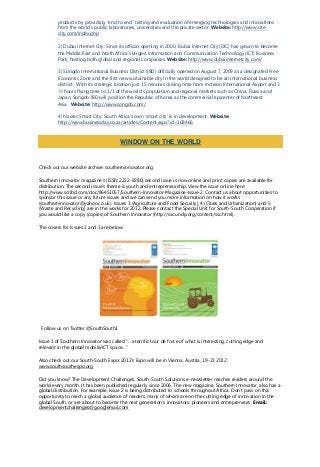
Southern Innovator magazine’s (ISSN 2222-9280) second issue is now online and print copies are available for
distribution. The second issue’s theme is youth and entrepreneurship. View the issue online here:
http://www.scribd.com/doc/86451057/Southern-Innovator-Magazine-Issue-2. Contact us about opportunities to
sponsor this issue or any future issues and we can send you more information on how it works
(southerninnovator@yahoo.co.uk). Issues 3 (Agriculture and Food Security), 4 (Cities and Urbanization) and 5
(Waste and Recycling) are in the works for 2012. Please contact the Special Unit for South-South Cooperation if
you would like a copy (copies) of Southern Innovator (http://ssc.undp.org/content/ssc.html).
The covers for Issues 2 and 3 are below:
Follow us on Twitter @SouthSouth1
Issue 1 of Southern Innovator was called “…a terrific tour de force of what is interesting, cutting edge and
relevant in the global mobile/ICT space...”
Also check out our South-South Expo: 2012’s Expo will be in Vienna, Austria, 19-23 2012:
www.southsouthexpo.org
Did you know? The Development Challenges, South-South Solutions e-newsletter reaches readers around the
world every month. It has been published regularly since 2006. The new magazine, Southern Innovator, also has a
global distribution. For example, Issue 2 is being distributed to schools throughout Africa. Don’t pass on this
opportunity to reach a global audience of readers, many of whom are on the cutting edge of innovation in the
global South, or are about to become the next generation’s innovators, pioneers and entrepreneurs. Email:
developmentchallenges@googlemail.com
WINDOW ON THE WORLD
BOOKS
The New Harvest: Agricultural Innovation in Africa by Calestous Juma, Publisher: Oxford University Press.
Website: http://belfercenter.ksg.harvard.edu/publication/20504/new_harvest.html
The Coming Prosperity by Philip Auerswald, Publisher: Oxford University Press. Website: http://auerswald.org/
Need, Speed and Greed: How the New Rules of Innovation Can Transform Businesses, Propel Nations to
Greatness, and Tame the World’s Most Wicked Problems by Vijay Vaitheeswaran, Publisher: HarperBusiness.
Website: www.amazon.com
Concrete edited by William Hall, Publisher: Phaidon Press. Concrete takes a fresh look at the world’s most
versatile and abundant building material. Website: http://uk.phaidon.com/store/
Abundance: The Future Is Better Than You Think by Peter Diamandis and Steven Kotler, Publisher: Free Press.
Since the dawn of humanity, a privileged few have lived in stark contrast to the hardscrabble majority.
Conventional wisdom says this gap cannot be closed. But it is closing—fast. In Abundance, space entrepreneur
turned innovation pioneer Peter H. Diamandis and award-winning science writer Steven Kotler document how
progress in artificial intelligence, robotics, infinite computing, ubiquitous broadband networks, digital
manufacturing, nanomaterials, synthetic biology, and many other exponentially growing technologies will enable
us to make greater gains in the next two decades than we have in the previous two hundred years. Website:
http://www.abundancethebook.com/
Indian Superspices: A collection of lab-inspired recipes using spices in abundance to alleviate the
symptoms of everyday illnesses by Gurpareet Bains, Publisher: Gurpareet Bains. Website: www.amazon.com
Vitamin Green: The Definitive Guide to the World of Contemporary Sustainable Design by Amara Holstein,
Publisher: Phaidon Press. Website: http://uk.phaidon.com/store/
Emerging Economies: The Geopolitics of the BRICS Nations Publisher: Stratfor. They make up nearly half the
world's population and wield significant influence within their respective regions. Combined, their GDPs are not
too far behind that of the United States. Understand the geopolitics of Brazil, Russia, India, China and South
Africa. Website: www.stratfor.com
China’s Regulatory State: A New Strategy for Globalization by Roselyn Hsueh, Publisher: Cornell University
Press. Website: www.cornellpress.cornell.edu
Living in the Endless City edited by Ricky Burdett and Deyan Sudjic, Publisher: Phaidon Press. The city is the
subject of the 21st century. All over the world, populations are shifting towards urban centres. Living in the
Endless City depicts an authoritative survey of cities of today and the prospects for our urban future of tomorrow.
36 contributors from across Europe, South America, China, Africa and the U.S. set the agenda for the city -
detailing its successes as well as its failures. Website: http://www.urban-age.net/publications/living-in-the-
endless-city/
Consumptionomics: Asia’s Role in Reshaping Capitalism by Chandran Nair, Publisher: Infinite Ideas. Website:
www.amazon.com
World 3.0: Global Prosperity and How to Achieve It by Pankaj Ghemawa, Publisher: Harvard Business School
Press. Website: www.amazon.com
The China Miracle: Development Strategy and Economic Reform by Justin Yifu Lin, Publisher: The Chinese
University Press. Website: www.eurospanbookstore.com
The End of Cheap China: Economic and Cultural Trends that will Disrupt the World by Shaun Rein,
Publisher: John Wiley and Sons. Website: www.amazon.com
Global Slump: The Economics and Politics of Crisis and Resistance by David McNally, Publisher: PM Press.
Global Slump analyzes the global financial meltdown as the first systemic crisis of the neoliberal stage of
capitalism. It argues that – far from having ended – the crisis has ushered in a whole period of worldwide
economic and political turbulence. In developing an account of the crisis as rooted in fundamental features of
capitalism, Global Slump challenges the view that its source lies in financial deregulation. Website:
https://secure.pmpress.org/index.php?l=product_detail&p=271
Creative Ecologies: Where Thinking is a Proper Job by John Howkins, Publisher: UQP. Website:
www.creativeeconomy.com/think.htm
Breakout Nations by Ruchir Sharma, Publisher: Penguin. Breakout Nations offers journeys through more than
two dozen of the most interesting economies in the emerging world. Website: http://breakoutnations.com/
Light Manufacturing in Africa by Hinh T. Dinh et al, Publisher: World Bank. This book examines how light
manufacturing can offer a viable solution for sub-Saharan Africa’s need for structural transformation and
productive job creation, given its potential competitiveness based on low wage costs and an abundance of
natural resources that supply raw materials needed for industries. Website:
http://issuu.com/world.bank.publications/docs/9780821389614
Why Nations Fail: The Origins of Power, Prosperity and Poverty by Daron Acemoglu and James A. Robinson,
Publisher: Profile Books. Website: www.amazon.com
Arrival City by Doug Saunders, Publisher: Pantheon. A third of humanity is on the move. History’s largest
migration is creating new urban spaces that are this century’s focal points of conflict and change — centres of
febrile settlement that will reshape our cities and reconfigure our economies. Website: http://arrivalcity.net/
China: And the End of Poverty in Africa – Towards Mutual Benefit? by Penny Davis, Publisher: Diakonia and
the European Network on Debt and Development. Website:
www.eurodad.org/uploadedFiles/Whats_New/Reports/Kinarapport_A4.pdf
Globalization and Competition: Why Some Emergent Countries Succeed while Others Fall Behind by Luiz
Carlos Bresser Pereira, Publisher: Cambridge University Press. Website:
www.networkideas.org/book/jan2010/bk12_GACL.htm
State of the Field in Youth Enterprise, Employment, and Livelihoods Development Publisher: Making Cents
International. This practical resource features learning from over 80 leading organizations that are working
around the world to increase and improve economic opportunities for young people. Topics include youth
enterprise development; workforce development; youth-inclusive financial services; working with adolescent girls
and young women; and monitoring, evaluation and impact assessment. Website:
www.YouthEconomicOpportunities.org/media.asp
PAPERS AND REPORTS
African Economic Outlook 2012: Promoting Youth Employment Publisher: Various. With almost 200 million
people aged between 15 and 24, Africa has the youngest population in the world. This number will double by
2045. Many jobs have been created over the last decade, but the pace needs to accelerate significantly to match
the demand of Africa's next generations. Website: http://www.africaneconomicoutlook.org/en/
State of China’s Cities: 2010/2011: Better City, Better Life Publisher: UNHABITAT. Website:
www.scribd.com/doc/39882697/State-of-China-s-Cities-Report-2010-2011
Still our Common Interest: Commission for Africa Report 2010 Publisher: Commission for Africa Website:
www.commissionforafrica.info/2010-report
World Economic Outlook Update: Restoring Confidence without Harming Recovery Publisher: IMF.
Website: www.imf.org/external/pubs/ft/weo/2010/update/02/index.htm
Empowering People and Transforming Society: The World Economic Forum’s Technology Pioneers 2011
Publisher: World Economic Forum. Website: www.scribd.com/doc/35953976/Technology-Pioneers-2011
The Emerging Middle Class in Developing Countries Publisher: OECD. Website:
www.oecdilibrary.org/oecd/content/workingpaper/5kmmp8lncrns-en (PDF - 2.09 mb)
The Implications of China’s Ascendancy for Africa by Hany Besada, Publisher: The Centre for International
Governance Innovation. This paper examines the extent to which China’s engagement with Africa has produced
mutual benefits for both and whether Africa is reaping the necessary benefits required for poverty alleviation and
economic development. Website: http://www.cigionline.com/sites/default/files/Paper_40-web.pdf
Global Economic Decoupling Alive and Well Emerging economies decouple from the US, come closer to
Europe. Website: http://www.marketoracle.co.uk/Article23670.html
The Global Financial Crisis and Africa’s “Immiserizing Wealth” Research Brief, United Nations University,
Number 1 2010. Website: www.unu.edu/publications/briefs/policy-briefs/2010/UNU_ResearchBrief_10-01.pdf
Africa begins to make poverty history: US economists challenge conventional view that the continent is a
basket case Website: www.guardian.co.uk/business/2010/mar/03/africa-makes-povery-history
ON THE WEB
Blogs and Websites
Polis: A collaborative blog about cities around the globe. Website: http://www.thepolisblog.org/2012/03/coca-
cola-in-africa.html
mDirectory: The mDirectory is the most comprehensive database of information on mobile tech for social
change on the Web: case studies, mobile tools, research, and how-to guides. Website:
http://mobileactive.org/directory
Global Development: Launched in September 2010, this website from the Guardian newspaper tracks progress
on the MDGs, encourages debate on its blogs, offers a rich store of datasets from around the world, and features
monthly podcasts and resources for schools. Website: www.guardian.co.uk/global-development
Latameconomy Website Launches: Latameconomy.org is the latest evolution of the annual Latin American
Economic Outlook report, essentially bringing its trusted, high quality content into the digital age. Its wide
country coverage and methods of analysis are essential for anyone seeking to understand the economic, social
and political developments of Latin American countries. Website: www.latameconomy.org/en/
International Development Economics Associates (IDEAs): International Development Economics Associates
(IDEAs) is a pluralist network of progressive economists across the world, engaged in research, teaching and
dissemination of critical analyses of economic policy and development. Website: www.networkideas.org/
OECD, Tackling the economic crisis: The global economic crisis is entering a new phase amid signs of a return
to positive growth in many countries. But unemployment is likely to remain high and much still needs to be done
to underpin a durable recovery. This website will track the recovery.
Website: http://www.oecd.org/document/24/0,3343,en_2649_201185_41707672_1_1_1_1,00.html
The Global Urbanist: News and analysis of cities around the world: planning, governance, economy,
communities, environment, international. Website: globalurbanist.com
ICT Update: A bimonthly printed bulletin, a web magazine, and an accompanying email newsletter that explores
innovative uses of information technology in agriculture and rural development in African, Caribbean and Pacific
(ACP) countries. Website: http://ictupdate.cta.int/en/Regulars/Perspectives/%28issue%29/56
Youth-Inclusive Financial Services (YFS-Link) Program website: The first space for financial services providers
(FSPs) and youth-service organizations (YSOs) to gather, learn and share about youth-inclusive financial services.
Website: yfslink.org
Triple Crisis Blog: Global Perspectives on Finance, Development and Environment: Website:
http://triplecrisis.com/
Full Disclosure: The Aid Transparency Blog: A Devex blog, written by members of the international community.
Website: www.devex.com/en/blogs/full-disclosure
Africa Portal: An online knowledge resource offering researchers and opinion leaders a forum to share their
insights on Africa and publish their work on pressing areas of concern to policymakers and the public. It aims to
fill the gap in accessibility to research and information on policy issues on the continent. Website:
africaportal.org
African Economic Outlook: A unique online tool that puts rigorous economic data, information and research on
Africa at your fingertips. A few clicks gives access to comprehensive analyses of African economies, placed in
their social and political contexts. This is the only place where African countries are examined through a common
analytical framework, allowing you to compare economic prospects at the regional, sub-regional and country
levels. Website: africaneconomicoutlook.org/en
Africa Renewal: The Africa Renewal information programme, produced by the Africa Section of the United
Nations Department of Public Information, provides up-to-date information and analysis of the major economic
and development challenges facing Africa today. Website: www.un.org/ecosocdev/geninfo/afrec/
Timbuktu Chronicles: A blog by Emeka Okafor With “a view of Africa and Africans with a focus on
entrepreneurship, innovation, technology, practical remedies and other self-sustaining activities.” Website:
http://timbuktuchronicles.blogspot.com/
AfriGadget: AfriGadget is a must-read for African invention junkies. They are always on the look out for
ingenious innovation that is new or a repurposing of existing technology in a new way, interesting in the sense
that the story captures the imagination of others, inspiring others to see solutions in uncommon ways, practical
ideas that solve problems in a demonstrable way, and entrepreneurs who are inventing new products or
solutions. Website: afrigadget.com
Interesting Blogger
White African: About high-tech mobile and web technology change in Africa. Website: http://whiteafrican.com/
Social Media
Africa Entrepreneurship Platform
This ground breaking initiative is created as a forum to showcase innovative ideas and businesses from Africa
that have the ability to scale internationally, driving job creation and sustainable economic development between
Africa and the Americas. Website: www.sacca.biz
AfriGadget on Facebook: ‘Solving everyday problems with African ingenuity’: Website:
www.facebook.com/group.php?gid=2402629579
Start-up Funding
The SEED Initiative
Hosted by the UN Environment Programme's World Conservation Monitoring Centre (UNEP-WCMC), the SEED
Initiative is a global partnership for action on the Green Economy. The annual SEED Awards help to develop the
most promising social and environmental start-ups in emerging economies and developing countries.
Website: http://unep.org/newscentre/Default.aspx?DocumentID=2647&ArticleID=8798&l=en
The Pioneers of Prosperity Grant and Award
This competition is a partnership between the OTF Group and the John F. Templeton Foundation of the United
States, and promotes companies in East Africa by identifying local role models that act as examples of
sustainable businesses in their country/region. It is open to businesses from Kenya, Uganda, Tanzania, Burundi
and Rwanda. Five pioneers will receive US $50,000 to re-invest in their business. It is open to for-profit businesses
that provide high wages to their workers and that operate in sustainable ways. Website:
http://pioneersofprosperity.org/index.php
Oxford Said Business School Youth Business Development Competition
Open to youth between 16 and 21 across the world, the competition is run by students at Oxford University to
promote social enterprise. A prize fund of £2,000 in seed capital is up for grabs. It calls itself the ‘world’s first
global youth development competition’. Website: www.sbs.ox.ac.uk/oba/se/ybd
Challenge
InnoCentive (www.innocentive.com/) is a challenge to the world’s inventors to find solutions to real scientific and
technological problems affecting the poor and vulnerable. It is an open marketplace where anybody with a
problem can post it, and rewards for effective solutions stretch up to US $100,000. They use rigorous intellectual
property protection so ideas are not stolen without credit being given to the inventor. Website:
www.rockfound.org/about_us/news/2007/0720first_seeker.shtml
Video
Forum for the Future: Compelling animated videos exploring the hard choices of an urbanizing world and the
need to promote sustainable development and environmental harmony. Website:
http://www.youtube.com/user/forumforthefuture96
Have an event you would like the South-South community to know about? Then send details to
developmentchallenges@googlemail.com.
2012
August
Experience Management Africa Summit
Cape Town, South Africa (2-3 August 2012)
CEM Africa seeks to re-educate delegates on industry trends and developments, including the latest technologies which supply
end-user specific software, solutions and best practices to help you effectively manage risk and reduce costs while ensuring
your customers receive outstanding service across the proliferation of touch points.
Website: http://www.cemafricasummit.com/
Conference on China - Africa Relations
Nairobi, Kenya (9 august 2012)
Inter Region Economic Network (IREN) in collaboration with the Chinese Embassy in Nairobi, Kenya will host high level scholars
from across Africa and China to brainstorm on China Africa relations on August 9, 2012. The conference will also focus on
outcomes of the 5th Ministerial Conference of the Forum on China-Africa Cooperation.
Website: http://www.africanexecutive.com/modules/magazine/articles.php?article=6692&magazine=395
Biodiversity Asia 2012: Science, Policy, and Governance
Bengaluru (Bangalore), India (7-10 August 2012)
This international conference is being organized in India to highlight the urgency of biodiversity conservation in Asia ahead of
the 11th Conference of the Parties (CoP) of the UN Convention on Biological Diversity (CBD) to be held in India in October
2012. Biodiversity Asia 2012 will bring together researchers, policy makers, managers, students, teachers, NGOs, activists, and
others working towards the conservation of Asia's biodiversity.
Website: http://www.scbasia2012.org/
3rd
International Conference on Research for Development
Bern, Switzerland (20-22 August 2012)
Participants in the conference are expected to bring in multiple national and international perspectives on development-
oriented research, policy dialogue, and practice aiming towards global transformation. The conference will have a strong focus
on the global South; but the role of the global North will also be addressed. Further emphasis will be given to discussing
research policy and funding in the North, including in Switzerland. In addition, the conference will take into account and
UPCOMING EVENTS
critically review the outcomes of the international ‘Planet under Pressure’ science conference (London in March 2012) and
Rio+20 (Rio de Janeiro in June 2012), and discuss the consequences of these global events for research partnerships.
Website: http://www.icrd.ch/
World Water Week
Stockholm, Sweden (26-31 August 2012)
Each year the World Water Week addresses a particular theme to enable a deeper examination of a specific water-related topic.
While not all events during the week relate to the overall theme, the workshops driven by the Scientific Programme Committee
and many seminars and side events do focus on various aspects of the theme. The current niche for 2009-2012 is "Responding
to Global Changes", which looks at the potential and necessary responses in water policy, management and development to
address pervasive and increasingly impacting global changes.
Website: http://www.worldwaterweek.org/
Aitec West Africa ICT Summit
Accra, Ghana (15-16 August 2012)
West African enterprises can no longer complain about lack of international bandwidth. The region is fully integrated into the
world market via plentiful undersea and satellite connections. But it still has a long way to go to realise the economic benefits
that should derive from this new era of connectivity and innovation. ICT ROI is sadly lacking at government, corporate, national
and regional levels. The Summit will provide an ideal opportunity for the region’s ICT policy-makers, regulators, managers and
professionals to assess the impact of this new paradigm on their countries and organisations and what are the optimum
strategies and technologies they should deploy to maximise the benefits.
Website: http://aitecafrica.com/event/view/86?symfony=fe056cf4d51ed5754b085375fb554778
DEMO China
(23-24 August 2012)
DEMO has been the premier conference for companies from around the world to launch product at the North American events.
Now, with three DEMO events produced in China, Singapore, Brazil and Africa, DEMO has established a powerful international
network of launch events. Each international conference will showcase local emerging technologies as well as provide a
platform for companies outside the region to access the local community of press, venture capitalist, buyers and distribution
partners. Email: Mary Nan (Mary.nan@cyzone.cn)
Website: http://www.demo.com/ehome/DEMO/events/international-events
September
The Second Global Conference on Agriculture, Food Security and Climate Change
Ha Noi, Vietnam (3-7 September 2012)
Co-organized by Viet Nam and the Netherlands, in close collaboration with other partners, including FAO and the World Bank,
the conference will allow global leaders, practitioners, scientists, civil society and the private sector to share experiences and
demonstrate how early action on Climate-Smart Agriculture can act as a driver of green growth.
Website: http://www.afcconference.com/background-note
6th
International Hybrid Rice Symposium
Hyderabad, India (10-12 September 2012)
The symposium aims to create a discussion platform that tackles the issue of increasing rice yields to adapt to the worlds’
increasing demand for rice. The symposium will discuss the topics: Hybrid Rice Development; Hybrid Rice Seed Production;
Applications of Molecular Technology; Crop and Resource Management, and; Hybrid Rice Economics.
Website: http://hybrid-rice.org/
The World of Rural Co-operation International Roundtable Event - How Rural Co-operative Enterprises Build a Better
World
Dublin, Ireland (11-12 September 2012)
This invitation only roundtable event will be used to debate and discuss the impact and future of rural co-operation
worldwide. This prestigious event will be a unique opportunity to share knowledge and expertise with rural co-operators from
across the world to inform the development of a plan for the future development of rural co-operatives worldwide.
Website: http://www.rural2012.coop/
Annual Meeting of the New Champions 2012
Tianjin, People’s Republic of China (11-13 September 2012)
The Annual Meeting of the New Champions is the foremost global business gathering in Asia. After five years, it is widely
known as the Summer Davos – reflecting the “spirit of Davos” that for more than four decades has meant openness, collegiality
and frank, yet friendly, exchange among leaders from business, government, academia, civil society and media.
Website: http://www.weforum.org/events/annual-meeting-new-champions-2012
Making Cents’ 2012 Global Youth Economic Opportunities Conference
Washington, D.C., USA (11-13 September 2012)
The conference will take place September 11-13, 2012 at the Inter-American Development Bank’s Conference Centre in
Washington, DC. Submit a proposal to share your lessons learned, promising practices, and innovative ideas in one or more of
the following learning tracks: workforce development; adolescent girls and young women; youth-inclusive financial services and
financial capabilities; monitoring, evaluation and impact assessment; and youth enterprise development
Website: youtheconomicopportunities.org/how_to_submit.asp
Water Quality 2012
HangZhou, China (19-21 September 2012)
Water Quality 2012 will consider the range of issues and challenges that affect global water quality. By providing a forum for
researchers, industry, policymakers and other stakeholders, the conference will identify the key concerns and big challenges of
the future.
Website: http://www.accwa.net/the-project/water-quality-2012/
October
Digital UNDivided: Focus 100
New York, New York, USA (6 October 2012)
Connect with thought leaders, rockstar start-ups, and top brands who are using emerging technologies to engage black
women.
Website: http://www.digitalundivided.com/
4th OECD World Forum on "Statistics, Knowledge and Policies" - Measuring Well-being and Fostering the Progress of
Societies
New Delhi, India (16-19 October 2012)
The goal of the 4th OECD World Forum on "Statistics, Knowledge and Policies" is to assess progress in implementing the
Istanbul Declaration (2007), to share results and lessons learned from work undertaken by OECD and other organizations, and
to give impetus to concrete measurement programmes based on existing national and regional statistical capacities,
mechanisms and tools.
Website: http://www.oecd.org/document/47/0,3746,en_2649_33715_49312751_1_1_1_1,00.html
Integrated Soil Fertility Management in Africa: From Microbes to Markets
Nairobi, Kenya (22-26 October 2012)
This conference assembles the strengths of several organizations and collaborative research projects committed to designing,
refining and delivering potent solutions to food insecurity and agricultural resource degradation in sub-Saharan Africa.
Website: http://www.isfmafrica2012.org/index.html
Second Global Conference on Agricultural Research for Development
Punta del Este, Uruguay (29 October – 1 November 2012)
The GCARD II will focus on the ways to implement the tasks identified in the GCARD RoadMap with special attention to
“Foresight and partnership for innovation and impact on small-holder livelihoods”.
Website: http://www.egfar.org/gcard-2012
2012 African Economic Conference
Kigali, Rwanda (30 October – 2 November 2012)
The main objective of the African Economic Conference is to provide a platform for experts on Africa, both within and outside
the continent, to reflect and dialogue on new directions for growth policy on the continent in order to determine the best
approaches to attain the Millennium Development Goals, achieve the objectives of NEPAD and accelerate Africa’s sustainable
development.
Website: http://www.africaneconomicconference.org/2012/index.htm
November
Implementing Rio+20 for Drylands and Desertification
Sede Boqer Campus, Israel (12-15 November 2012)
The International Conference on Drylands, Deserts and Desertification (DDD) has emerged as an important global gathering of
scientists, field workers, industry, government, CSOs, international development aid agencies and other stakeholders from over
60 countries concerned about land degradation in the drylands, and their sustainable use and development land degradation
and development.
Website: http://in.bgu.ac.il/en/desertification/Pages/default.aspx
AITEC Southern Africa ICT Congress 2012
Maputo, Mozambique
The Southern African ICT Summit will gather the region’s ICT policy-makers, regulators, CIOs and professionals from
throughout the SADC region to share knowledge, network with industry leaders from throughout the world, and develop best
practice strategies for the coming year. The Summit coincides with the opening of the Mozambique Science Park so will feature
a number of sessions and presentations highlighting the business and development opportunities associated with this. The
Summit will focus on the deployment of ICT solutions to improve the quality of life for Southern Africa’s citizens and empower
them to export their knowledge and skills.
Website: http://aitecafrica.com/event/view/85
5th Euro-Africa Cooperation Forum on ICT Research
Lisbon, Portugal (28-29 November 2012)
EuroAfrica-P8 is a FP7 project funded by the European Commission (DG INFSO) with the aim of strengthening ICT research and
policy links between Africa and Europe under the 8th Strategic Partnership.
Website: http://tinyurl.com/bvdf9yh
December
Have an event you would like the South-South community to know about? Then send details to
developmentchallenges@googlemail.com.
2013
March
AITEC Banking and Mobile Money West Africa
Lagos, Nigeria (13-14 March 2013)
Now entering its sixth year as the region’s leading banking forum, AITEC Banking & Mobile Banking West Africa 2013 will
address the key issues faced by the region’s increasingly dynamic financial services sector.
Website: http://aitecafrica.com/event/view/90
July
Broadcast, Film and Music Africa 2013
Nairobi, Kenya (10-11 July 2012)
Theme: Building a world class electronic media industry in Africa. Just under half of the countries in Africa have liberalised their
broadcast markets and there has been a considerable growth in the number of new television and radio stations. The final
opening up by the rest of the countries on the continent promises the kind of growth that the mobile market has experienced
over the next five years.
Website: http://aitecafrica.com/event/view/93
World Summit Youth Award
The international contest for young people using the Internet and mobiles to take action on the UN Millennium Development
Goals. Website: www.youthaward.org
Grand Challenges Canada: Request for Proposals
Grand Challenges Canada is pleased to announce a new initiative in its Maternal, Neonatal and Child Health grand challenge.
It’s called Saving Brains. Its goal is to unlock potential in children and dramatically transform lives in the developing world. The
money to fund this program comes from the Development Innovation Fund. In Budget 2008, the Government of Canada
committed $225 million CAD over five years to the Development Innovation Fund, to support the best minds in the world in a
collaborative search for solutions to global health challenges. For the Request for Proposals:
Website: http://www.grandchallenges.ca/wp-content/uploads/2011/05/Request_for_Proposals-Saving_Brains_EN.pdf
Zayad Future Energy Prize
The world is in desperate need of innovative solutions to create a new, sustainable energy future. No one knows
who or where the next great energy solution will come from. Solutions and technologies that could change the world are being
developed globally, and the $2.2 million Zayed Future Energy Prize, managed by Masdar in Abu Dhabi, recognizes and rewards
innovation, leadership, and long-term vision in renewable energy and sustainability.
Website: www.zayedfutureenergyprize.com/
Philips Liveable Cities Award
Philips is looking for individuals and community or non-government organizations and businesses with ideas for “simple
solutions” that will improve people’s health and well-being in a city to enter the Philips Liveable Cities Award. To help translate
these ideas into reality, three Award grants totalling €125,000 are on the line. One overall winning idea from any of the three
categories outlined below will receive a grant of €75,000, while the two additional ideas will receive grants of €25,000.
Website: http://www.because.philips.com/livable-cities-award/about-the-award
Piramal Foundation in India
Has established a US $25,000 prize for ideas that help advance full access to effective public health care in India. The Piramal
Prize is a $25,000 Social Entrepreneurship Competition focused on democratizing health care in India that seeks to encourage
and support bold entrepreneurial ideas which can profoundly impact access to higher standards of health for India’s rural and
marginalized urban communities. The award recognizes high-impact, scalable business models and innovative solutions that
directly or indirectly address India’s health-care crisis.
Website: www.piramalprize.org
Special Award for South-South Transfer
The aim of the award is to identify, provide visibility, and honour those who have successfully shared their projects and
approaches internationally, thereby increasing the impact of the initiative. The winning practice receives US $15,000 to further
transfer the awarded practice to other communities in developing countries.
Website: www.southsouthexpo.org
South-South Experience Exchange Facility
Supported by Mexico, China, India, Denmark, Spain, The Netherlands, and the U.K. and now Colombia, the South-South
Experience Exchange Facility is a multi-donor trust fund that promotes the idea that developing countries can learn from the
successes of other developing countries in overcoming similar challenges. In the past 12 months, the trust has given out 35
grants to countries for learning activities ranging from working with at risk youth in the Caribbean to outsourcing IT services in
Africa.
Website: www.southsouthcases.info
African Writers Fund
Together with the Ford Foundation, the Fund supports the work of independent creative writers living on the continent. The
Fund recognizes the vital role that poets and novelists play in Africa by anticipating and reflecting the cultural, economic and
political forces that continuously shape and reshape societies.
Website: http://www.trustafrica.org/index.php?option=com_content&task=view&id=91&Itemid=90&lang=fr
Joint NAM S&T Centre - ICCS Fellowship Programme
Centre for Science and Technology of the Non-Aligned and Other Developing Countries (NAM S&T Centre) and International
Center for Chemical Sciences (ICCS), (H.E.J. Research Institute of Chemistry and Dr. Panjwani Centre for Molecular Medicine and
Drug Research), University of Karachi, Karachi, Pakistan
Click here for more information
or contact: namstct@vsnl.com, namstct@bol.net.in, apknam@gmail.com
AWARDS AND FUNDING
PhD Plant Breeding Scholarships at the University of Ghana
The University of Ghana (www.ug.edu.gh) has been awarded a project support grant by the Alliance for a Green Revolution
(www.agra-alliance.org) in Africa (a joint venture between the Bill and Melinda Gates Foundation and the Rockefeller
Foundation, for the establishment of a West African Centre for Crop Improvement (WACCI). This is available to scientists
working at NARIs, universities and international centres in West Africa. Women scientists are especially encouraged to apply for
a fellowship under this programme. Website: www.acci.org.za/Default.asp?nav=Home&idno=10
Genesis: India’s Premier Social Entrepreneurship Competition
Is a social entrepreneurship competition aiming to bring together social entrepreneurs, students, NGOs, innovators, incubators,
corporations and financiers and encourage them to come up with innovative ideas which are socially relevant and feasible.
Website: http://genesis.iitm.ac.in/
Weitzenegger’s International Development Job Market:
Website: www.weitzenegger.de/new/jobmarket.php
Global Knowledge Initiative
The Global Knowledge Initiative seeks to build global knowledge partnerships between individuals and institutions of higher
education and research. It seeks to help partners access the global knowledge, technology, and human resources needed to
sustain growth and achieve prosperity for all."
Website: www.globalknowledgeinitiative.org/
ExportHelp - Promoting and supporting access to the European market
The European Commission runs a database for the explicit support of market players in developing countries who want to bring
their products to the EU market. The database gives an overview on the EU´s preferential trade regimes established for
developing countries as well as lists all tariffs, taxes and other requirements for goods
imported into the EU.
Website: http://exporthelp.europa.eu
Development Executive Group Devex Networking Website
Over 90,000 global experts can network and connect and learn about more than 47,000 registered projects.
Website: www.devex.org
Website Offers Career Advice to Young Africans
Set up by the Commonwealth Secretariat, Africancareerguidance.com is aimed at providing career guidance to African youth
and helping them to link with prospective employers. AfricaRecruit is a human resources organization that provides skills
training for African professionals in the Diaspora and on the continent. The website has an inbuilt email subscriber list for all its
users and offers a searchable database of career profiles for job seekers and prospective employers. It also offers skills and
interest assessments and advice on CV and résumé preparation. It provides tips about interviewing techniques, as well as
information on internship and volunteer opportunities, and entrepreneurial skills.
Website: www.africacareerguidance.com
African Diaspora Skills Database
This database was compiled to provide an overview of qualified African Diaspora professionals with varied areas of expertise
and experience. The African Diaspora contributes substantially to the social, economic and political development of Africa, and
this database is set up to further mobilize this considerable potential.
Website: www.diaspora-centre.org/NEWSLETTER/Database
Aid Workers Network (AWN)
Aid Workers Network (AWN) is an online platform for aid, relief and development workers to ask and answer questions of each
other, and to exchange resources and information. AWN is registered in the United Kingdom as a charity. You will
find discussions about a range of questions and issues on the AWN forum from aid, relief and development workers all over the
world and representing a variety of fields, with new threads or responses posted daily. The forum is a great way to get in
contact with
other aid and development workers in your geographic area or working in a similar area of work.
Website: www.aidworkers.net
Bizzlounge
Bizzlounge is where people committed to ethical behaviour meet, who want to establish and maintain business contacts in an
exclusive and relaxed environment.
Website: http://bizzlounge.com
Business Action for Africa
Business Action for Africa is a network of businesses and business organizations working collectively to accelerate growth and
poverty reduction in Africa.
Website: http://businessactionforafrica.blogspot.com
Business Fights Poverty
Business Fights Poverty is a professional network for all those passionate about fighting world poverty through the power of
good business.
Website: http://businessfightspoverty.ning.com
Business in Development Network (BiD)
TRAINING AND JOB OPPORTUNITIES
The BiD Network Foundation runs the BiD Challenge to contribute to sustainable economic development by stimulating
entrepreneurship in developing countries.
Website: www.bidnetwork.org
Zunia
By Development Exchange, it offers news, publications and networking opportunities with the world’s development community.
Website: www.zunia.org
Catalogue of Poverty Networks
UNDP is organizing an online catalogue of Poverty Networks as a means to facilitate access to knowledge and sharing this to a
wider audience in 189 countries. Poverty Networks are web-based platforms that provide space for sharing and
disseminating development-related information and initiatives. Below you will find information on IPC’s collaborating networks,
which help foster dialogue between researchers, policymakers, civil society and multilateral organizations.
Website: www.undp-povertycentre.org/povnet.do
Connections for Development (CfD)
CfD is a UK, Black and Minority Ethnic (BME) led, membership based organization committed to ensuring that UK BME
communities, and the organizations they are involved in, are supported in the process of shaping and delivering policy and
projects that affect their countries of origin or interest – collectively ''our world”.
Website: www.cfdnetwork.co.uk
Development Crossing
Development Crossing was set up in 2006 by a small group of friends with diverse backgrounds ranging from business
consulting to international development. In a world where the environment, corporate responsibility, and sustainable
development are becoming increasingly intertwined, our goal was to create a site where individuals that shared our passion
could keep up-to-date with relevant happenings in the world and connect with like-minded individuals. The idea behind
Development Crossing is to provide a social network that brings together people from a variety of sectors, countries and
professions to discuss corporate social responsibility and sustainable
development.
Website: www.developmentcrossing.com
DevelopmentAid.org
The one-stop-information-shop for the developmental sector, DevelopmentAid.org is a membership organization that brings
together information for developmental professionals, NGOs, consultancy firms and donors.
Website: www.developmentaid.org
Zunia.org
Zunia.org, a free online service by the Development Gateway Foundation is devoted to knowledge-sharing and collaboration
for people working to reduce poverty in the developing world.
Website: http://topics.developmentgateway.org
Diaspora African Forum
This Forum exists ''to invite and encourage the full participation of Africans in the Diaspora in the building of the African Union,
in its capacity as an important part of the Continent''. We will provide the vital linkage for Diaspora Africans to become involved
in Africa's development as well as reap the fruits of African unity.
Website: www.diasporaafricanforum.org
Business Planet: a new data map on Entrepreneurship
Business Planet, an interactive Google map, now includes data on new business creation around the world. Measures of
entrepreneurial activity are based on the number of total and newly registered corporations. Click on colour markers to learn
more about each country.
Website: http://rru.worldbank.org/businessplanet/default.aspx?pid=8

Development Challenges, South-South Solutions: July 2012 Issue

  • 1.
    DEVELOPMENT CHALLENGES, SOUTH-SOUTH SOLUTIONS E-newsletterof the Special Unit for South-South Cooperation in UNDP ……………………………………………………………………………………………….…. 1) African Innovation Eco-system Taking Shape How to increase the rate of innovation in Africa? And specifically, innovation that actually improves people's lives and reduces poverty? It is a hard question to answer, but some are putting in place the building blocks of a 21st century innovation culture by riding the information technology revolution as it rolls across Africa. The transformative story of mobile phones in Africa has captured the attention of the world. Technologies like mobile phone payment systems developed in Africa are now being rolled out around the globe. But there is more to come as undersea cables increase the communication links between African nations and the rest of the world. New undersea cables including TEAMs, Seacom and Eastern Africa Submarine Cable System (EASSy) (eassy.org) are vastly increasing the continent's Internet capacity and bandwidth (http://en.wikipedia.org/wiki/Bandwidth_%28computing%29). These communications links will revolutionize the type and scale of innovation that can happen in Africa. As websites like AfriGadget (afrigadget.com) amply prove, there is already an entrenched do-it-yourself innovation culture hardwired into daily life on the continent. While impressively resourceful and able to make the most of often very little, this innovation culture is often confined to a narrow geographical area. And this is the difference the new information technologies will make: They will allow this energetic and resourceful innovators' culture to develop businesses and business models that can reach beyond narrow geographical parameters. New technologies will also accelerate the spread of new ideas and solutions. Across the continent, ways and means are being stitched together that enable people to transcend borders, old divisions and obstacles to connect with like- minded collaborators, seek out funding and take ideas from dreams to schemes and eventually to continent- and world-straddling levels. According to the Deloitte 2011 East Africa Private Equity Confidence Survey: Promising 2012, "Many investors see East Africa's strong growth potential as a driver of better investment performance than in South Africa: This is a huge shift in private equity attitudes toward Africa, which have been historically focused on South Africa. East African investment potential is seen as roughly on par with West Africa, where similar growth dynamics are at play." Identifying the elements that are making this innovation culture flourish came under analysis in a recent post on the Afrinnovator website (afrinnovator.com). Afrinnovator is dedicated to "telling the stories of African startups, African innovation, African made technology, African tech entrepreneurship and entrepreneurs." While it is well known that new infrastructure, better governance, new policies, and new services like mobile phones and mobile money have made a big difference in shifting perceptions of Africa from despair to optimism, Afrinnovator found there were other key ingredients to this innovation renaissance. July 2012 Subscribe Unsubscribe Contact Us In this issue: African Innovation Eco-system Taking Shape African Fuel Pioneer Uses Crisis to Innovate Indian Entrepreneur Brings Dignity to Poor Women Turning Human Waste to Fertilizer: An African Solution East Africa to get its First Dedicated Technology City ……………………………….. Featured links: Babajob.com Equator Initiative Kiva.org SSC Website FUNDING ……………………………….. Quick links: Window on the World Upcoming Events Awards and Funding Training and Job Opportunities Past Issues ……………………………….. Bookmark with: what is this? ……………………………….. ……………………………….. what is this? ………………………………..
  • 2.
    Afrinnovator argues thereare four elements that have come together to change circumstances for innovators on the continent: education, mentoring and incubators, funding, and showcase events. Afrinnovator found education was critical to the quality of emerging technological innovations. Information and communication technology (ICT) education has moved from just computer science courses to a vast array of options, from bachelors degrees to masters programmes. For mentoring and incubators, Afrinnovator found hubs and incubators are providing places for young educated people to go and get down to work. Examples include iHub (http://ihub.co.ke/pages/home.php), mLab East Africa (http://mlab.co.ke/pages/home.php), ccHub (Co-Creation Hub Nigeria) (http://cchubnigeria.com/about-cchub/), Lusaka, Zambia's Bongohive (bongohive.com), iLab Africa (http://ilabafrica.ac.ke/) NaiLab (http://nailab.co.ke/) iBid Labs (http://ibidlabs.com/) and Uganda's HiveColab (http://hivecolab.org/), among others. These places offer like-minded fellowship and access to mentors to take them on the journey from "idea to viable profitable business." According to Business Daily Africa, "There are more than 3,000 software developers who have come up with both mobile and personal computer-based software applications that are changing lives across the continent." A transformation in funding access has seen a renaissance in new thinking that is transforming tech start-ups into viable businesses. Kenya has the Kenya ICT Board (http://www.ict.go.ke/) and it awards US $50,000 through its Tandaa grant programme (https://sites.google.com/a/ict.go.ke/tandaa/). Because of this enthusiastic local support, the World Bank is now committing a US $55 million grant targeting Kenya's technology innovators to be distributed through the Kenya ICT Board. East Africa also saw 16 new investor funds launch in 2011 alone. They include early-stage investor funds like eVentures Fund Africa (eVA) (http://www.eva-fund.com/), which calls itself "the first venture capital firm investing in African SME's active in digital media." Another is Kenya-based 88mph (http://www.humanipo.com/88mph), with its "focus on startups targeting the East African mobile and web market." In Kenya, the World Bank money will be used to help technology developers bring to market simple solutions in health and education. According to the World Bank (http://tinyurl.com/cm3g2rf), “Kenya has put in place the second-fastest broadband on the continent (after Ghana), which has reduced the wholesale internet capacity prices by over 90% and increased internet penetration from 3% to 37% of the population in the past decade. Today, about 90% of Kenyan adults have or have the use of a mobile phone." And the final game-changer, according to Afrinnovator, is "showcase events." These events give investors and potential partners the opportunity to meet start-ups and explore their new ideas. Examples include DEMO (http://www.demo.com/ehome/index.php?eventid=29414&) - which connects the idea people with the money people - and Pivot East in East Africa (http://pivoteast.com/). Pivot East provides 25 technology entrepreneurs with the opportunity to make a pitch in front of investors. DEMO is working with USAID, Microsoft, Nokia and others to launch DEMO Africa in Nairobi, Kenya from 21 to 22 October 2012. Afrinnovator concludes: "This is the last virgin tech landscape left on the planet. The best time to become a player in the African technology innovation ecosystem is now." LINKS: 1) Read more about Africa’s evolving innovation system. Website: http://afrinnovator.com/blog/2012/06/13/the-innovation-ecosystem-in-east-africa/ 2) Southern Innovator: Youth and Entrepreneurship Issue. Website: http://www.scribd.com/doc/86451057/Southern-Innovator-Magazine-Issue-2 3) Southern Innovator: Mobile Phones and Information Technology Issue. Website: http://www.scribd.com/doc/57980406/Southern-Innovator-Magazine-Issue-1 4) Notes from ‘Understanding Broadband Demand in Africa: Internet Going Mobile’. Website: http://www.oafrica.com/mobile/notes-from-understanding-broadband-demand-in-africa-internet- going-mobile/ 5) Deloitte Private Equity Survey 2012. Website: deloitte.com
  • 3.
    2) African FuelPioneer Uses Crisis to Innovate Crisis, as the old saying goes, is also a window of opportunity. And there is one African entrepreneur who knows this better than most. Daniel Mugenga has been on a journey of innovation that has led him to become a pioneer in the emerging new field of algae technologies. The story of how he got there is a testament to the power of using business to both solve problems and make profits. Kenyan entrepreneur Daniel Mugenga has found a solution to the problem of high fuel costs for the transport sector in his country. He has been making money from turning waste cooking oil and inedible vegetable oil into biodiesel (http://en.wikipedia.org/wiki/Biodiesel). He then discovered that he could boost his production of biodiesel by using marine algae as a source for oil. According to the body that represents the algae fuel industry, Oilgae (oilgae.com), algae are "plant-like organisms that are usually photosynthetic and aquatic, but do not have true roots, stems, leaves, vascular tissue and have simple reproductive structures. They are distributed worldwide in the sea, in freshwater and in wastewater. Most are microscopic, but some are quite large, e.g. some marine seaweeds that can exceed 50 m in length." The U.S. Department of Energy has been investigating algae as a fuel source since 1978, and it is being investigated as a potentially transformative fuel source around the world. His business, Pure Fuels Ltd. (http://www.purefuels.co.ke/), is currently seeking venture capital funding for expansion and innovation. Pure Fuels is "a commercial producer of biodiesel and also manufactures biodiesel processors, which we sell to budding entrepreneurs," says Mugenga. The Pure Fuels website educates readers on biodiesel as well as offering opportunities for investors and news updates. Pure Fuels was registered as a business in Kenya in 2010. The business was born out of crisis: in 2008 there were frequent fuel shortages in Kenya and prices were volatile. That was bad news for Daniel Mugenga's job, working for a transport company with a fleet of trucks. Rising or volatile fuel prices can destroy businesses in areas like trucking, where the biggest expense is fuel. Mugenga began to do research into fuel alternatives in the crisis and came upon biodiesel. He then set about training in how to produce biodiesel. A period of testing, trials and research ensued between 2008 and 2010, which enabled Pure Fuels to build confidence they had something that was high quality. The company started producing 120,000 litres of biodiesel in 2010 and increased production to 360,000 litres in 2011 and 700,000 so far in 2012. In 2011, Pure Fuels had revenue of US $230,000 from selling biodiesel. "We started off using jatropha oil, but when its price went up it was no longer profitable," Mugenga told the VC4Africa website blog. "Having invested in the machinery, we switched to the next quickest alternative which is used cooking oil. We source it from several of the tourist hotels along the Kenyan coast." Turning to cooking oil for biodiesel at first was a good idea. The company was able to get enough waste cooking oil from Kenya hotels and tourist resorts to meet demand. But as demand rose, the thorny problem of Kenya's tourism business being seasonal arose. "For about five months of the year, many hotels in Mombasa temporarily shut down or operate at lower capacity. Of course this is affecting the amount of waste cooking oil," Mugenga said. This is where algae (http://en.wikipedia.org/wiki/Algae) comes in. Pure Fuels found a biotechnologist in Kenya to help develop a solution using algae as a source for fuel. While the company is keeping details of its innovation secret, it is currently hunting for investors to help increase the quantity of biodiesel it can make - and in turn, revenues. Investor funds would be used to import non-edible vegetable oil and also to continue the company's work on extracting oil from marine algae. Pure Fuels make a bold statement on algae fuel development: it "may actually be Kenya's next cash crop." Pure Fuels sells several products: there is the biodiesel itself, as well as a processing machine called the GXP-200, which can turn customers into biodiesel manufacturers themselves. The company also builds large, industrial- scale processors that can produce between 1,000 litres and 5,000 litres a day. Pure Fuels currently sells fuel to truck, bus and tuk-tuk companies, and also operates biofuel stations.
  • 4.
    The firm haspatented its biodiesel and makes all its fuel go through seven quality checks for purity. An in-house laboratory ensures adherence to international standards, and the company is certified by the Kenya Bureau of Standards (http://www.kebs.org/). Mugenga is a passionate advocate of biodiesel's advantages: he believes it is cheaper, and better for engines and for the environment. He admits it does have a disadvantage: it gels below 13 degrees Celsius and must be mixed 50-50 with conventional diesel to stay fluid. Pure Fuels encourages others to use biofuels for business, throwing in a home training kit with the biodiesel processors it manufactures and sells, complete with DVDs, manuals and a business plan. The GXP-200 biodiesel processor was developed after years of experience, and Pure Fuels hopes it will be bought by people who then set up businesses - especially youth, women and the disabled. As a further incentive, Pure Fuels promises to buy the biodiesel produced. The GXP-200 was recently awarded "Most Innovative Product 2012" at a small and medium business entrepreneurs event in Nairobi. In Israel, there are a number of pioneers working on further developing algae as a biofuel source too. Isaac Berzin of Seambiotic (seambiotic.com) sees algae as a good source for biofuel because it does not compete with food crops like other biofuel sources (sugar, potatoes, corn etc.). Algae is among a group of so-called second- generation biofuels that includes jatropha, wood and castor plants. The disadvantage of plant-based fuel sources is they need arable land and water. This seriously holds back their ability to meet the world's demand for fuel since they would just take up too much land and water. Algae takes up less space and produces a higher yield per acre than conventional crops. Seambiotic makes marine microalgae using the CO2 from electric power plant flue gas. It pioneered making large quantities of fuel algae in the United States, creating the first gallons of bio-diesel and bio-ethanol from marine microalgae. Seambiotic is also working on a US $10 million commercial microalgae farm in China, partnering with China Guodian (http://www.cgdc.com.cn/), one of the country's largest power companies. Another Israeli company in this field is UniVerve (http://www.univerve-biofuel.com/). Its CEO, Ohad Zuckerman, runs the10-person company in Tel Aviv, Israel. It is developing a new biofuel from a special strain of algae that can grow quickly in a wider range of temperatures. LINKS: 1) A website with all the details on biodiesel and how to make it. Website: http://www.biodiesel.org/ 2) How to make your own biodiesel. Website: http://journeytoforever.org/biodiesel_make.html 3) Oilgae is the global information support resource for the algae fuels industry. Website: http://www.oilgae.com/ 4) Algae as a superfood and cancer-fighter: Chlorella. Website: http://en.wikipedia.org/wiki/Chlorella 3) Indian Entrepreneur Brings Dignity to Poor Women Driven by the revelation that his wife was torn between spending money on milk for the children and buying commercially manufactured sanitary napkins, Indian innovator and inventor Arunachalam Muruganantham embarked on a long and intensive journey to find a solution. His achievement – a simple machine – is bringing dignity to poor women and providing them with a much-needed income source. The innovation is both a technological and a business solution. Muruganantham has come up with a simple machine to manufacture affordable hygienic sanitary napkins for poor women. It works by turning the pulp of pine wood into the flat, white sanitary pads (http://en.wikipedia.org/wiki/Sanitary_napkin) commonly used by women during their monthly menstruation. The machine’s simplicity means it can be expanded easily to other communities and is designed to fit well with the way women’s cooperatives work and help them earn an income. Muruganantham sees it is a business model that “can deliver livelihood, hygiene and dignity to poor women, and help them strengthen society,” according to his website. The manufacturing process produces the sanitary napkins in just five steps. This simple intervention is revolutionizing women’s health in India by giving them an alternative to using found and unhygienic rags every month when they menstruate.
  • 5.
    It took Murugananthamfour years of research to create a patented machine that sells for between US $1,332 and US $5,330. It can make 120 sanitary pads an hour. Each one sells for 10 rupees (US 18 cents). By comparison, the multinational company Procter & Gamble sells its product for 30 rupees (US 54 cents) a packet. Two multinationals dominate the marketplace for sanitary napkins in India: Procter & Gamble and Johnson & Johnson, with the Stayfree and Carefree brands. Muruganantham’s machine was awarded the best innovation national award by the former President of India, Prathiba Patil, in 2009. Like many innovators and inventors, his work at first was little understood by others and meant he had to plough a lonely furrow. But his persistence paid off and is now receiving attention from countries across the global South. Apart from its technological simplicity, the idea is to make it easy for women to form cooperatives and businesses to boost their incomes. India has seen the concept of so-called Ladies Self Help Groups (SHGs) (http://en.wikipedia.org/wiki/Self- help_group_%28finance%29) become more popular as a source of income. One of the problems they encounter is finding a successful business to undertake. The machine invented by Muruganantham is being seen as a good business model for the SHGs to follow. The key is the simplicity of operating the machine, the growing and stable market for the product, and its affordable and competitive price. Typical businesses that can be set up using the machine can employ 10 women. Muruganantham set up his main business, Jayaashree Industries (motto: ‘new inventions… small is beautiful’) (http://newinventions.in/aboutus.aspx), after his education was disrupted due to family problems and he took up a job in a welding shop. At first, he had a difficult time convincing people of the utility of the machine. He enlisted his wife to help with the marketing of the new napkins to nearby women. He says the advantage of his business model is that it turns the making of the napkins into a sustainable, grassroots activity. It provides an essential commodity for poor women at an affordable price, removing middlemen and using a simple, non-chemical technology. It also cuts down on expensive transport costs by keeping manufacturing local. Over 225 machines have been delivered to 14 Indian states and also to Nigeria, Ethiopia, Kenya, Uganda, Nepal and Bangladesh. And while Muruganantham is focused on making the machine a success, he is already looking forward to working on his next big invention. The only question is: what will it be? LINKS: 1) Women’s Health: A website packed with facts and advice from the UK’s National Health Service. Website: http://www.nhs.uk/livewell/women1839/Pages/Women1839home.aspx 4) Turning Human Waste to Fertilizer: An African Solution While South Africa has been free of the racist Apartheid regime since the mid-1990s, the expected boost to living standards for the majority black population has not been as widespread and as quick as many had expected. One important aspect of lifting living standards is making sure the entire population has access to adequate sanitation and hygiene services. Another is making sure they have access to adequate and healthy food sources. A bright idea based on intensive research is meeting both goals in an innovative way. According to the Council for Scientific and Industrial Research (http://www.csir.co.za/), some 11 million South Africans have received access to basic sanitation services since 1994 - but 13.3 million still lacked basic sanitation services by 2008. The Water Research Commission (WRC) (http://www.wrc.org.za/) believes there is a crisis with South Africa’s toilet pit latrines, which are quickly filling up past their original design capacity. WRC’s solution is to turn the human faeces or faecal sludge deposited in pit latrines into fertilizer for farming and agriculture. The Water Research Commission is advocating using the fertilizer either for fruit trees or for trees that will be turned to income sources like paper and fuel. The WRC’s project and series of experiments are called “What happens when pit latrines get full?” “Only one third of municipalities have a budget to maintain on-site sanitation," WRC researcher and scientist David Still told Inter Press Service (IPS). "If pits fill up, all the hard work that was done to address the sanitation
  • 6.
    backlog will bewasted. Why not use faecal sludge to address the growing problem of food insecurity by planting fruit trees? Or use the sludge to cultivate trees for fuel or paper production?” Human faecal sludge contains a variety of nutrients, such as nitrogen, phosphates and potassium. The WRC estimates the average person excretes enough human faecal sludge per year to fertilize 300 to 400 square metres of crops. The big reason people are reluctant to use human waste as fertilizer is because of the pathogens it contains. Spreading this on edible crops is dangerous and it is also a risk to groundwater when it leaches in to the soil. The WRC conducted research on two sites: Umlazi and Karkloof, both in KwaZulu-Natal, South Africa. They used property owned by the South African Paper and Pulp Industry (SAPPI) and the local municipality. The first step in the experiments was to bury the sludge in pits and plant crops on top of it. The pathogens were contained using this method and in time died off. The test trenches were 0.75 metres in depth and filled with different quantities of sludge. Two control sites did not use faecal sludge. The scientists found the sites where the human waste was used saw plant growth and volume increase by “as much as 80 per cent." They then tested for pathogens in the soil. This included looking for the eggs of the large roundworm (http://www.nhs.uk/conditions/Roundworm/Pages/Introduction.aspx), a parasite whose presence would be harmful to humans. The site was tested over a period of 30 months, but none could be found. Tests for microbes at the Umlazi site also found none. The plants were found to have healthy dark green leaves and the trees grew larger with the sludge present. Researchers also monitored the groundwater around the sites. They found in flat ground and sandy soil there was no impact. In the site with sloping and shallow soil, small increases in nitrate were observed in the groundwater after rainfall. They concluded the best place to apply this technique is in places that are flat and where the soil is deep. One local resident, Lindiwe Khoza, was selected to be part of the test. Citrus and peach trees were planted on top of the buried sludge. She told IPS: “The fruit grows much faster and it seems to be tastier and juicier than fruit bought at supermarkets. We now enjoy fruit from our own garden.” WRC’s clever solution to these twin problems could help make life much more pleasant in communities still grappling with poor hygiene services, while dramatically improving the health of crops and their yields. LINKS: 1) World Bank guide to pit latrines. Website: http://water.worldbank.org/shw-resource- guide/infrastructure/menu-technical-options/pit-latrines 2) A video on how to construct a ventilated pit latrine. Website: http://www.youtube.com/watch?v=n4yfAyhiV74 3) A Practical Guide for Building a Simple Pit Latrine: How to Build Your Latrine and Use It Hygienically, for the Dignity, Health, and Well Being of Your Family. Website: http://www.crsprogramquality.org/publications/2011/9/13/a-practical-guide-for-building-a-simple-pit- latrine-how-to-b.html 4) The Control of Pathogens from Human Waste and their Aquatic Vectors by L. E. Obeng. Website: http://www.jstor.org/discover/10.2307/4312882?uid=3738032&uid=2129&uid=2&uid=70&uid=4&sid= 21100919752851 5) East Africa to get its First Dedicated Technology City An ambitious scheme is underway to create a vast technology city on the outskirts of Nairobi, Kenya. With information technology proliferating across Africa after decades of stagnation and underinvestment, a host of exciting new technologies have had to exist within structures not built for the 21st century. One attempt to change things is Konza Technology City (konzacity.co.ke), an ambitious project that aims to build the infrastructure to host the companies of the 21st century for Kenya and East Africa.
  • 7.
    Konza Technology Cityjoins a growing network of technology cities and parks across the global South. If the links between these centres of technological innovation and smart thinking can be strengthened, they have the potential to contribute to exceptional gains in human development. Konza Technology City will be built on 5,000 acres (2,023 hectares) of land 60 kilometres south of Kenya's capital, Nairobi. The lead agency on the US $10 billion project is the Ministry of Information and Communication (http://www.information.go.ke/). The Kenyan government is seeking partners and investors to help with funding the project, whose components include a business process outsourcing (BPO) (http://en.wikipedia.org/wiki/Business_process_outsourcing) zone – where specific business functions are contracted to third party providers. There is also a financial district and a commercial district with office space. This will be combined with the other side of Konza: hotels, hospitals, a sports stadium and other support services necessary to support a city. The idea is to develop the site over a period of 20 years, with the BPO and IT Educational and Science Park taking up 23 per cent of the site. Kenya plans to expand its business process outsourcing sector and has been hosting conferences in Europe to gather the best advice. The sector has experienced double-digit growth in the past three years, rising on the increasing capacity brought by new undersea cables like TEAMs, Seacom and EASSy. The idea is to put in place the building blocks of a 21st century Kenya and to become the leading hub for the whole of East Africa. Kenya has an ambitious plan to become a middle-income country by 2030 (http://www.vision2030.go.ke/). There is scepticism about large projects in Kenya, with some fearing they will be abandoned before they are finished. But it does seem this project has galvanized a wide community of support. According to IT Web’s (http://www.itweb.co.za/) Ken Macharia, opponents of the project make various arguments. People in the information and communication technologies sector would like to see greater local capacity in place before such massive investment in buildings goes ahead. Others oppose the idea of having a planned city and would like to see things evolve organically. Still others question the government’s capacity to undertake such an ambitious scheme. According to Macharia, the ‘if you build it, they will come’ argument is winning the day. The scope and ambition of the project has both excited many players within and outside government and focused their efforts. Macharia even believes the public sector is way ahead of the private sector. "The government is light years ahead in terms of the vision and drive of developing the ICT sector in the country, while the private sector is trying to catch up," he said. Kenya will become the first country in the region to build a technology city. It can look to China for some examples. One is Shenzhen City and its Science and Technology Park (http://www.ship.gov.cn/en/index.asp?bianhao=20). Or Cairo, Egypt’s Smart Village (http://www.smart- villages.com/). Macharia also says the focus solely on technology is missing the bigger impact Konza can have. “The city's concept has financial, educational, commercial and industrial implications, which have not been sold as aggressively as the tech aspect has. Perhaps the better name for the proposed city would be Konza Special Economic Zone, where the key pillars mutually benefit from each other's presence. Technology, after all, is a means to an end, not the end itself.” The timing for a place like Konza City is excellent: undersea cables are being placed around and to Africa. The continent was notorious for being the most underserved continent on the planet and is in a furious transition from this information technology wasteland to a potential oasis of prosperity. The undersea cable projects are promising a bandwidth explosion for the continent of Africa. The WACS cable (http://wacscable.com/index.jsp) is being put in place to link South Africa and Britain, and is due to be completed in 2012. It runs up the West Coast of Africa and will become the first direct connection to the undersea cable network for Namibia, the Congo and Togo. It will increase South Africa’s bandwidth by an estimated 23 per cent. Various technology investors, including the search engine giant Google, are also planning to build an undersea cable linking the so-called BRICS countries by 2014 – Brazil, Russia, India, China and South Africa. The cable will also link them all to the United States. The technology group i3 Africa is leading the project (http://www.i3- mea.com/africa/), which should open up 21 additional African countries to the world’s undersea cable network. Konza Technology City could make Kenya a significant beneficiary of all this new connectivity and bandwidth. LINKS: 1) Center for Innovation Testing and Evaluation: CITE will represent a 20th century American city with a population of approximately 35,000 people and be built on roughly 15 square miles. CITE’s test city will be unpopulated. CITE will be a catalyst for the acceleration of research into applied, market-ready
  • 8.
    products by providing“end to end” testing and evaluation of emerging technologies and innovations from the world’s public laboratories, universities and the private sector. Website: http://www.cite- city.com/index.php 2) Dubai Internet City: Since its official opening in 2000, Dubai Internet City (DIC) has grown to become the Middle East and North Africa’s largest Information and Communication Technology (ICT) Business Park, hosting both global and regional companies. Website: http://www.dubaiinternetcity.com/ 3) Songdo International Business District (IBD) officially opened on August 7, 2009 as a designated Free Economic Zone and the first new sustainable city in the world designed to be an international business district. With its strategic location just 15 minutes driving time from Incheon International Airport and 3 ½ hours flying time to 1/3 of the world's population and regional markets such as China, Russia and Japan, Songdo IBD will position the Republic of Korea as the commercial epicenter of Northeast Asia. Website: http://www.songdo.com/ 4) Nasrec Smart City: South Africa’s own ‘smart city’ is in development. Website: http://www.businessday.co.za/articles/Content.aspx?id=168466 Check out our website archive: southerninnovator.org Southern Innovator magazine’s (ISSN 2222-9280) second issue is now online and print copies are available for distribution. The second issue’s theme is youth and entrepreneurship. View the issue online here: http://www.scribd.com/doc/86451057/Southern-Innovator-Magazine-Issue-2. Contact us about opportunities to sponsor this issue or any future issues and we can send you more information on how it works (southerninnovator@yahoo.co.uk). Issues 3 (Agriculture and Food Security), 4 (Cities and Urbanization) and 5 (Waste and Recycling) are in the works for 2012. Please contact the Special Unit for South-South Cooperation if you would like a copy (copies) of Southern Innovator (http://ssc.undp.org/content/ssc.html). The covers for Issues 2 and 3 are below: Follow us on Twitter @SouthSouth1 Issue 1 of Southern Innovator was called “…a terrific tour de force of what is interesting, cutting edge and relevant in the global mobile/ICT space...” Also check out our South-South Expo: 2012’s Expo will be in Vienna, Austria, 19-23 2012: www.southsouthexpo.org Did you know? The Development Challenges, South-South Solutions e-newsletter reaches readers around the world every month. It has been published regularly since 2006. The new magazine, Southern Innovator, also has a global distribution. For example, Issue 2 is being distributed to schools throughout Africa. Don’t pass on this opportunity to reach a global audience of readers, many of whom are on the cutting edge of innovation in the global South, or are about to become the next generation’s innovators, pioneers and entrepreneurs. Email: developmentchallenges@googlemail.com WINDOW ON THE WORLD
  • 9.
    BOOKS The New Harvest:Agricultural Innovation in Africa by Calestous Juma, Publisher: Oxford University Press. Website: http://belfercenter.ksg.harvard.edu/publication/20504/new_harvest.html The Coming Prosperity by Philip Auerswald, Publisher: Oxford University Press. Website: http://auerswald.org/ Need, Speed and Greed: How the New Rules of Innovation Can Transform Businesses, Propel Nations to Greatness, and Tame the World’s Most Wicked Problems by Vijay Vaitheeswaran, Publisher: HarperBusiness. Website: www.amazon.com Concrete edited by William Hall, Publisher: Phaidon Press. Concrete takes a fresh look at the world’s most versatile and abundant building material. Website: http://uk.phaidon.com/store/ Abundance: The Future Is Better Than You Think by Peter Diamandis and Steven Kotler, Publisher: Free Press. Since the dawn of humanity, a privileged few have lived in stark contrast to the hardscrabble majority. Conventional wisdom says this gap cannot be closed. But it is closing—fast. In Abundance, space entrepreneur turned innovation pioneer Peter H. Diamandis and award-winning science writer Steven Kotler document how progress in artificial intelligence, robotics, infinite computing, ubiquitous broadband networks, digital manufacturing, nanomaterials, synthetic biology, and many other exponentially growing technologies will enable us to make greater gains in the next two decades than we have in the previous two hundred years. Website: http://www.abundancethebook.com/ Indian Superspices: A collection of lab-inspired recipes using spices in abundance to alleviate the symptoms of everyday illnesses by Gurpareet Bains, Publisher: Gurpareet Bains. Website: www.amazon.com Vitamin Green: The Definitive Guide to the World of Contemporary Sustainable Design by Amara Holstein, Publisher: Phaidon Press. Website: http://uk.phaidon.com/store/ Emerging Economies: The Geopolitics of the BRICS Nations Publisher: Stratfor. They make up nearly half the world's population and wield significant influence within their respective regions. Combined, their GDPs are not too far behind that of the United States. Understand the geopolitics of Brazil, Russia, India, China and South Africa. Website: www.stratfor.com China’s Regulatory State: A New Strategy for Globalization by Roselyn Hsueh, Publisher: Cornell University Press. Website: www.cornellpress.cornell.edu Living in the Endless City edited by Ricky Burdett and Deyan Sudjic, Publisher: Phaidon Press. The city is the subject of the 21st century. All over the world, populations are shifting towards urban centres. Living in the Endless City depicts an authoritative survey of cities of today and the prospects for our urban future of tomorrow. 36 contributors from across Europe, South America, China, Africa and the U.S. set the agenda for the city - detailing its successes as well as its failures. Website: http://www.urban-age.net/publications/living-in-the- endless-city/ Consumptionomics: Asia’s Role in Reshaping Capitalism by Chandran Nair, Publisher: Infinite Ideas. Website: www.amazon.com
  • 10.
    World 3.0: GlobalProsperity and How to Achieve It by Pankaj Ghemawa, Publisher: Harvard Business School Press. Website: www.amazon.com The China Miracle: Development Strategy and Economic Reform by Justin Yifu Lin, Publisher: The Chinese University Press. Website: www.eurospanbookstore.com The End of Cheap China: Economic and Cultural Trends that will Disrupt the World by Shaun Rein, Publisher: John Wiley and Sons. Website: www.amazon.com Global Slump: The Economics and Politics of Crisis and Resistance by David McNally, Publisher: PM Press. Global Slump analyzes the global financial meltdown as the first systemic crisis of the neoliberal stage of capitalism. It argues that – far from having ended – the crisis has ushered in a whole period of worldwide economic and political turbulence. In developing an account of the crisis as rooted in fundamental features of capitalism, Global Slump challenges the view that its source lies in financial deregulation. Website: https://secure.pmpress.org/index.php?l=product_detail&p=271 Creative Ecologies: Where Thinking is a Proper Job by John Howkins, Publisher: UQP. Website: www.creativeeconomy.com/think.htm Breakout Nations by Ruchir Sharma, Publisher: Penguin. Breakout Nations offers journeys through more than two dozen of the most interesting economies in the emerging world. Website: http://breakoutnations.com/ Light Manufacturing in Africa by Hinh T. Dinh et al, Publisher: World Bank. This book examines how light manufacturing can offer a viable solution for sub-Saharan Africa’s need for structural transformation and productive job creation, given its potential competitiveness based on low wage costs and an abundance of natural resources that supply raw materials needed for industries. Website: http://issuu.com/world.bank.publications/docs/9780821389614 Why Nations Fail: The Origins of Power, Prosperity and Poverty by Daron Acemoglu and James A. Robinson, Publisher: Profile Books. Website: www.amazon.com Arrival City by Doug Saunders, Publisher: Pantheon. A third of humanity is on the move. History’s largest migration is creating new urban spaces that are this century’s focal points of conflict and change — centres of febrile settlement that will reshape our cities and reconfigure our economies. Website: http://arrivalcity.net/ China: And the End of Poverty in Africa – Towards Mutual Benefit? by Penny Davis, Publisher: Diakonia and the European Network on Debt and Development. Website: www.eurodad.org/uploadedFiles/Whats_New/Reports/Kinarapport_A4.pdf Globalization and Competition: Why Some Emergent Countries Succeed while Others Fall Behind by Luiz Carlos Bresser Pereira, Publisher: Cambridge University Press. Website: www.networkideas.org/book/jan2010/bk12_GACL.htm
  • 11.
    State of theField in Youth Enterprise, Employment, and Livelihoods Development Publisher: Making Cents International. This practical resource features learning from over 80 leading organizations that are working around the world to increase and improve economic opportunities for young people. Topics include youth enterprise development; workforce development; youth-inclusive financial services; working with adolescent girls and young women; and monitoring, evaluation and impact assessment. Website: www.YouthEconomicOpportunities.org/media.asp PAPERS AND REPORTS African Economic Outlook 2012: Promoting Youth Employment Publisher: Various. With almost 200 million people aged between 15 and 24, Africa has the youngest population in the world. This number will double by 2045. Many jobs have been created over the last decade, but the pace needs to accelerate significantly to match the demand of Africa's next generations. Website: http://www.africaneconomicoutlook.org/en/ State of China’s Cities: 2010/2011: Better City, Better Life Publisher: UNHABITAT. Website: www.scribd.com/doc/39882697/State-of-China-s-Cities-Report-2010-2011 Still our Common Interest: Commission for Africa Report 2010 Publisher: Commission for Africa Website: www.commissionforafrica.info/2010-report World Economic Outlook Update: Restoring Confidence without Harming Recovery Publisher: IMF. Website: www.imf.org/external/pubs/ft/weo/2010/update/02/index.htm Empowering People and Transforming Society: The World Economic Forum’s Technology Pioneers 2011 Publisher: World Economic Forum. Website: www.scribd.com/doc/35953976/Technology-Pioneers-2011 The Emerging Middle Class in Developing Countries Publisher: OECD. Website: www.oecdilibrary.org/oecd/content/workingpaper/5kmmp8lncrns-en (PDF - 2.09 mb) The Implications of China’s Ascendancy for Africa by Hany Besada, Publisher: The Centre for International Governance Innovation. This paper examines the extent to which China’s engagement with Africa has produced mutual benefits for both and whether Africa is reaping the necessary benefits required for poverty alleviation and economic development. Website: http://www.cigionline.com/sites/default/files/Paper_40-web.pdf Global Economic Decoupling Alive and Well Emerging economies decouple from the US, come closer to Europe. Website: http://www.marketoracle.co.uk/Article23670.html The Global Financial Crisis and Africa’s “Immiserizing Wealth” Research Brief, United Nations University, Number 1 2010. Website: www.unu.edu/publications/briefs/policy-briefs/2010/UNU_ResearchBrief_10-01.pdf Africa begins to make poverty history: US economists challenge conventional view that the continent is a basket case Website: www.guardian.co.uk/business/2010/mar/03/africa-makes-povery-history
  • 12.
    ON THE WEB Blogsand Websites Polis: A collaborative blog about cities around the globe. Website: http://www.thepolisblog.org/2012/03/coca- cola-in-africa.html mDirectory: The mDirectory is the most comprehensive database of information on mobile tech for social change on the Web: case studies, mobile tools, research, and how-to guides. Website: http://mobileactive.org/directory Global Development: Launched in September 2010, this website from the Guardian newspaper tracks progress on the MDGs, encourages debate on its blogs, offers a rich store of datasets from around the world, and features monthly podcasts and resources for schools. Website: www.guardian.co.uk/global-development Latameconomy Website Launches: Latameconomy.org is the latest evolution of the annual Latin American Economic Outlook report, essentially bringing its trusted, high quality content into the digital age. Its wide country coverage and methods of analysis are essential for anyone seeking to understand the economic, social and political developments of Latin American countries. Website: www.latameconomy.org/en/ International Development Economics Associates (IDEAs): International Development Economics Associates (IDEAs) is a pluralist network of progressive economists across the world, engaged in research, teaching and dissemination of critical analyses of economic policy and development. Website: www.networkideas.org/ OECD, Tackling the economic crisis: The global economic crisis is entering a new phase amid signs of a return to positive growth in many countries. But unemployment is likely to remain high and much still needs to be done to underpin a durable recovery. This website will track the recovery. Website: http://www.oecd.org/document/24/0,3343,en_2649_201185_41707672_1_1_1_1,00.html The Global Urbanist: News and analysis of cities around the world: planning, governance, economy, communities, environment, international. Website: globalurbanist.com ICT Update: A bimonthly printed bulletin, a web magazine, and an accompanying email newsletter that explores innovative uses of information technology in agriculture and rural development in African, Caribbean and Pacific (ACP) countries. Website: http://ictupdate.cta.int/en/Regulars/Perspectives/%28issue%29/56 Youth-Inclusive Financial Services (YFS-Link) Program website: The first space for financial services providers (FSPs) and youth-service organizations (YSOs) to gather, learn and share about youth-inclusive financial services. Website: yfslink.org Triple Crisis Blog: Global Perspectives on Finance, Development and Environment: Website: http://triplecrisis.com/ Full Disclosure: The Aid Transparency Blog: A Devex blog, written by members of the international community. Website: www.devex.com/en/blogs/full-disclosure
  • 13.
    Africa Portal: Anonline knowledge resource offering researchers and opinion leaders a forum to share their insights on Africa and publish their work on pressing areas of concern to policymakers and the public. It aims to fill the gap in accessibility to research and information on policy issues on the continent. Website: africaportal.org African Economic Outlook: A unique online tool that puts rigorous economic data, information and research on Africa at your fingertips. A few clicks gives access to comprehensive analyses of African economies, placed in their social and political contexts. This is the only place where African countries are examined through a common analytical framework, allowing you to compare economic prospects at the regional, sub-regional and country levels. Website: africaneconomicoutlook.org/en Africa Renewal: The Africa Renewal information programme, produced by the Africa Section of the United Nations Department of Public Information, provides up-to-date information and analysis of the major economic and development challenges facing Africa today. Website: www.un.org/ecosocdev/geninfo/afrec/ Timbuktu Chronicles: A blog by Emeka Okafor With “a view of Africa and Africans with a focus on entrepreneurship, innovation, technology, practical remedies and other self-sustaining activities.” Website: http://timbuktuchronicles.blogspot.com/ AfriGadget: AfriGadget is a must-read for African invention junkies. They are always on the look out for ingenious innovation that is new or a repurposing of existing technology in a new way, interesting in the sense that the story captures the imagination of others, inspiring others to see solutions in uncommon ways, practical ideas that solve problems in a demonstrable way, and entrepreneurs who are inventing new products or solutions. Website: afrigadget.com Interesting Blogger White African: About high-tech mobile and web technology change in Africa. Website: http://whiteafrican.com/ Social Media Africa Entrepreneurship Platform This ground breaking initiative is created as a forum to showcase innovative ideas and businesses from Africa that have the ability to scale internationally, driving job creation and sustainable economic development between Africa and the Americas. Website: www.sacca.biz AfriGadget on Facebook: ‘Solving everyday problems with African ingenuity’: Website: www.facebook.com/group.php?gid=2402629579 Start-up Funding The SEED Initiative Hosted by the UN Environment Programme's World Conservation Monitoring Centre (UNEP-WCMC), the SEED Initiative is a global partnership for action on the Green Economy. The annual SEED Awards help to develop the most promising social and environmental start-ups in emerging economies and developing countries. Website: http://unep.org/newscentre/Default.aspx?DocumentID=2647&ArticleID=8798&l=en The Pioneers of Prosperity Grant and Award This competition is a partnership between the OTF Group and the John F. Templeton Foundation of the United States, and promotes companies in East Africa by identifying local role models that act as examples of sustainable businesses in their country/region. It is open to businesses from Kenya, Uganda, Tanzania, Burundi and Rwanda. Five pioneers will receive US $50,000 to re-invest in their business. It is open to for-profit businesses that provide high wages to their workers and that operate in sustainable ways. Website: http://pioneersofprosperity.org/index.php
  • 14.
    Oxford Said BusinessSchool Youth Business Development Competition Open to youth between 16 and 21 across the world, the competition is run by students at Oxford University to promote social enterprise. A prize fund of £2,000 in seed capital is up for grabs. It calls itself the ‘world’s first global youth development competition’. Website: www.sbs.ox.ac.uk/oba/se/ybd Challenge InnoCentive (www.innocentive.com/) is a challenge to the world’s inventors to find solutions to real scientific and technological problems affecting the poor and vulnerable. It is an open marketplace where anybody with a problem can post it, and rewards for effective solutions stretch up to US $100,000. They use rigorous intellectual property protection so ideas are not stolen without credit being given to the inventor. Website: www.rockfound.org/about_us/news/2007/0720first_seeker.shtml Video Forum for the Future: Compelling animated videos exploring the hard choices of an urbanizing world and the need to promote sustainable development and environmental harmony. Website: http://www.youtube.com/user/forumforthefuture96 Have an event you would like the South-South community to know about? Then send details to developmentchallenges@googlemail.com. 2012 August Experience Management Africa Summit Cape Town, South Africa (2-3 August 2012) CEM Africa seeks to re-educate delegates on industry trends and developments, including the latest technologies which supply end-user specific software, solutions and best practices to help you effectively manage risk and reduce costs while ensuring your customers receive outstanding service across the proliferation of touch points. Website: http://www.cemafricasummit.com/ Conference on China - Africa Relations Nairobi, Kenya (9 august 2012) Inter Region Economic Network (IREN) in collaboration with the Chinese Embassy in Nairobi, Kenya will host high level scholars from across Africa and China to brainstorm on China Africa relations on August 9, 2012. The conference will also focus on outcomes of the 5th Ministerial Conference of the Forum on China-Africa Cooperation. Website: http://www.africanexecutive.com/modules/magazine/articles.php?article=6692&magazine=395 Biodiversity Asia 2012: Science, Policy, and Governance Bengaluru (Bangalore), India (7-10 August 2012) This international conference is being organized in India to highlight the urgency of biodiversity conservation in Asia ahead of the 11th Conference of the Parties (CoP) of the UN Convention on Biological Diversity (CBD) to be held in India in October 2012. Biodiversity Asia 2012 will bring together researchers, policy makers, managers, students, teachers, NGOs, activists, and others working towards the conservation of Asia's biodiversity. Website: http://www.scbasia2012.org/ 3rd International Conference on Research for Development Bern, Switzerland (20-22 August 2012) Participants in the conference are expected to bring in multiple national and international perspectives on development- oriented research, policy dialogue, and practice aiming towards global transformation. The conference will have a strong focus on the global South; but the role of the global North will also be addressed. Further emphasis will be given to discussing research policy and funding in the North, including in Switzerland. In addition, the conference will take into account and UPCOMING EVENTS
  • 15.
    critically review theoutcomes of the international ‘Planet under Pressure’ science conference (London in March 2012) and Rio+20 (Rio de Janeiro in June 2012), and discuss the consequences of these global events for research partnerships. Website: http://www.icrd.ch/ World Water Week Stockholm, Sweden (26-31 August 2012) Each year the World Water Week addresses a particular theme to enable a deeper examination of a specific water-related topic. While not all events during the week relate to the overall theme, the workshops driven by the Scientific Programme Committee and many seminars and side events do focus on various aspects of the theme. The current niche for 2009-2012 is "Responding to Global Changes", which looks at the potential and necessary responses in water policy, management and development to address pervasive and increasingly impacting global changes. Website: http://www.worldwaterweek.org/ Aitec West Africa ICT Summit Accra, Ghana (15-16 August 2012) West African enterprises can no longer complain about lack of international bandwidth. The region is fully integrated into the world market via plentiful undersea and satellite connections. But it still has a long way to go to realise the economic benefits that should derive from this new era of connectivity and innovation. ICT ROI is sadly lacking at government, corporate, national and regional levels. The Summit will provide an ideal opportunity for the region’s ICT policy-makers, regulators, managers and professionals to assess the impact of this new paradigm on their countries and organisations and what are the optimum strategies and technologies they should deploy to maximise the benefits. Website: http://aitecafrica.com/event/view/86?symfony=fe056cf4d51ed5754b085375fb554778 DEMO China (23-24 August 2012) DEMO has been the premier conference for companies from around the world to launch product at the North American events. Now, with three DEMO events produced in China, Singapore, Brazil and Africa, DEMO has established a powerful international network of launch events. Each international conference will showcase local emerging technologies as well as provide a platform for companies outside the region to access the local community of press, venture capitalist, buyers and distribution partners. Email: Mary Nan (Mary.nan@cyzone.cn) Website: http://www.demo.com/ehome/DEMO/events/international-events September The Second Global Conference on Agriculture, Food Security and Climate Change Ha Noi, Vietnam (3-7 September 2012) Co-organized by Viet Nam and the Netherlands, in close collaboration with other partners, including FAO and the World Bank, the conference will allow global leaders, practitioners, scientists, civil society and the private sector to share experiences and demonstrate how early action on Climate-Smart Agriculture can act as a driver of green growth. Website: http://www.afcconference.com/background-note 6th International Hybrid Rice Symposium Hyderabad, India (10-12 September 2012) The symposium aims to create a discussion platform that tackles the issue of increasing rice yields to adapt to the worlds’ increasing demand for rice. The symposium will discuss the topics: Hybrid Rice Development; Hybrid Rice Seed Production; Applications of Molecular Technology; Crop and Resource Management, and; Hybrid Rice Economics. Website: http://hybrid-rice.org/ The World of Rural Co-operation International Roundtable Event - How Rural Co-operative Enterprises Build a Better World Dublin, Ireland (11-12 September 2012) This invitation only roundtable event will be used to debate and discuss the impact and future of rural co-operation worldwide. This prestigious event will be a unique opportunity to share knowledge and expertise with rural co-operators from across the world to inform the development of a plan for the future development of rural co-operatives worldwide. Website: http://www.rural2012.coop/
  • 16.
    Annual Meeting ofthe New Champions 2012 Tianjin, People’s Republic of China (11-13 September 2012) The Annual Meeting of the New Champions is the foremost global business gathering in Asia. After five years, it is widely known as the Summer Davos – reflecting the “spirit of Davos” that for more than four decades has meant openness, collegiality and frank, yet friendly, exchange among leaders from business, government, academia, civil society and media. Website: http://www.weforum.org/events/annual-meeting-new-champions-2012 Making Cents’ 2012 Global Youth Economic Opportunities Conference Washington, D.C., USA (11-13 September 2012) The conference will take place September 11-13, 2012 at the Inter-American Development Bank’s Conference Centre in Washington, DC. Submit a proposal to share your lessons learned, promising practices, and innovative ideas in one or more of the following learning tracks: workforce development; adolescent girls and young women; youth-inclusive financial services and financial capabilities; monitoring, evaluation and impact assessment; and youth enterprise development Website: youtheconomicopportunities.org/how_to_submit.asp Water Quality 2012 HangZhou, China (19-21 September 2012) Water Quality 2012 will consider the range of issues and challenges that affect global water quality. By providing a forum for researchers, industry, policymakers and other stakeholders, the conference will identify the key concerns and big challenges of the future. Website: http://www.accwa.net/the-project/water-quality-2012/ October Digital UNDivided: Focus 100 New York, New York, USA (6 October 2012) Connect with thought leaders, rockstar start-ups, and top brands who are using emerging technologies to engage black women. Website: http://www.digitalundivided.com/ 4th OECD World Forum on "Statistics, Knowledge and Policies" - Measuring Well-being and Fostering the Progress of Societies New Delhi, India (16-19 October 2012) The goal of the 4th OECD World Forum on "Statistics, Knowledge and Policies" is to assess progress in implementing the Istanbul Declaration (2007), to share results and lessons learned from work undertaken by OECD and other organizations, and to give impetus to concrete measurement programmes based on existing national and regional statistical capacities, mechanisms and tools. Website: http://www.oecd.org/document/47/0,3746,en_2649_33715_49312751_1_1_1_1,00.html Integrated Soil Fertility Management in Africa: From Microbes to Markets Nairobi, Kenya (22-26 October 2012) This conference assembles the strengths of several organizations and collaborative research projects committed to designing, refining and delivering potent solutions to food insecurity and agricultural resource degradation in sub-Saharan Africa. Website: http://www.isfmafrica2012.org/index.html Second Global Conference on Agricultural Research for Development Punta del Este, Uruguay (29 October – 1 November 2012) The GCARD II will focus on the ways to implement the tasks identified in the GCARD RoadMap with special attention to “Foresight and partnership for innovation and impact on small-holder livelihoods”. Website: http://www.egfar.org/gcard-2012
  • 17.
    2012 African EconomicConference Kigali, Rwanda (30 October – 2 November 2012) The main objective of the African Economic Conference is to provide a platform for experts on Africa, both within and outside the continent, to reflect and dialogue on new directions for growth policy on the continent in order to determine the best approaches to attain the Millennium Development Goals, achieve the objectives of NEPAD and accelerate Africa’s sustainable development. Website: http://www.africaneconomicconference.org/2012/index.htm November Implementing Rio+20 for Drylands and Desertification Sede Boqer Campus, Israel (12-15 November 2012) The International Conference on Drylands, Deserts and Desertification (DDD) has emerged as an important global gathering of scientists, field workers, industry, government, CSOs, international development aid agencies and other stakeholders from over 60 countries concerned about land degradation in the drylands, and their sustainable use and development land degradation and development. Website: http://in.bgu.ac.il/en/desertification/Pages/default.aspx AITEC Southern Africa ICT Congress 2012 Maputo, Mozambique The Southern African ICT Summit will gather the region’s ICT policy-makers, regulators, CIOs and professionals from throughout the SADC region to share knowledge, network with industry leaders from throughout the world, and develop best practice strategies for the coming year. The Summit coincides with the opening of the Mozambique Science Park so will feature a number of sessions and presentations highlighting the business and development opportunities associated with this. The Summit will focus on the deployment of ICT solutions to improve the quality of life for Southern Africa’s citizens and empower them to export their knowledge and skills. Website: http://aitecafrica.com/event/view/85 5th Euro-Africa Cooperation Forum on ICT Research Lisbon, Portugal (28-29 November 2012) EuroAfrica-P8 is a FP7 project funded by the European Commission (DG INFSO) with the aim of strengthening ICT research and policy links between Africa and Europe under the 8th Strategic Partnership. Website: http://tinyurl.com/bvdf9yh December Have an event you would like the South-South community to know about? Then send details to developmentchallenges@googlemail.com. 2013 March AITEC Banking and Mobile Money West Africa Lagos, Nigeria (13-14 March 2013) Now entering its sixth year as the region’s leading banking forum, AITEC Banking & Mobile Banking West Africa 2013 will address the key issues faced by the region’s increasingly dynamic financial services sector. Website: http://aitecafrica.com/event/view/90 July Broadcast, Film and Music Africa 2013
  • 18.
    Nairobi, Kenya (10-11July 2012) Theme: Building a world class electronic media industry in Africa. Just under half of the countries in Africa have liberalised their broadcast markets and there has been a considerable growth in the number of new television and radio stations. The final opening up by the rest of the countries on the continent promises the kind of growth that the mobile market has experienced over the next five years. Website: http://aitecafrica.com/event/view/93 World Summit Youth Award The international contest for young people using the Internet and mobiles to take action on the UN Millennium Development Goals. Website: www.youthaward.org Grand Challenges Canada: Request for Proposals Grand Challenges Canada is pleased to announce a new initiative in its Maternal, Neonatal and Child Health grand challenge. It’s called Saving Brains. Its goal is to unlock potential in children and dramatically transform lives in the developing world. The money to fund this program comes from the Development Innovation Fund. In Budget 2008, the Government of Canada committed $225 million CAD over five years to the Development Innovation Fund, to support the best minds in the world in a collaborative search for solutions to global health challenges. For the Request for Proposals: Website: http://www.grandchallenges.ca/wp-content/uploads/2011/05/Request_for_Proposals-Saving_Brains_EN.pdf Zayad Future Energy Prize The world is in desperate need of innovative solutions to create a new, sustainable energy future. No one knows who or where the next great energy solution will come from. Solutions and technologies that could change the world are being developed globally, and the $2.2 million Zayed Future Energy Prize, managed by Masdar in Abu Dhabi, recognizes and rewards innovation, leadership, and long-term vision in renewable energy and sustainability. Website: www.zayedfutureenergyprize.com/ Philips Liveable Cities Award Philips is looking for individuals and community or non-government organizations and businesses with ideas for “simple solutions” that will improve people’s health and well-being in a city to enter the Philips Liveable Cities Award. To help translate these ideas into reality, three Award grants totalling €125,000 are on the line. One overall winning idea from any of the three categories outlined below will receive a grant of €75,000, while the two additional ideas will receive grants of €25,000. Website: http://www.because.philips.com/livable-cities-award/about-the-award Piramal Foundation in India Has established a US $25,000 prize for ideas that help advance full access to effective public health care in India. The Piramal Prize is a $25,000 Social Entrepreneurship Competition focused on democratizing health care in India that seeks to encourage and support bold entrepreneurial ideas which can profoundly impact access to higher standards of health for India’s rural and marginalized urban communities. The award recognizes high-impact, scalable business models and innovative solutions that directly or indirectly address India’s health-care crisis. Website: www.piramalprize.org Special Award for South-South Transfer The aim of the award is to identify, provide visibility, and honour those who have successfully shared their projects and approaches internationally, thereby increasing the impact of the initiative. The winning practice receives US $15,000 to further transfer the awarded practice to other communities in developing countries. Website: www.southsouthexpo.org South-South Experience Exchange Facility Supported by Mexico, China, India, Denmark, Spain, The Netherlands, and the U.K. and now Colombia, the South-South Experience Exchange Facility is a multi-donor trust fund that promotes the idea that developing countries can learn from the successes of other developing countries in overcoming similar challenges. In the past 12 months, the trust has given out 35 grants to countries for learning activities ranging from working with at risk youth in the Caribbean to outsourcing IT services in Africa. Website: www.southsouthcases.info African Writers Fund Together with the Ford Foundation, the Fund supports the work of independent creative writers living on the continent. The Fund recognizes the vital role that poets and novelists play in Africa by anticipating and reflecting the cultural, economic and political forces that continuously shape and reshape societies. Website: http://www.trustafrica.org/index.php?option=com_content&task=view&id=91&Itemid=90&lang=fr Joint NAM S&T Centre - ICCS Fellowship Programme Centre for Science and Technology of the Non-Aligned and Other Developing Countries (NAM S&T Centre) and International Center for Chemical Sciences (ICCS), (H.E.J. Research Institute of Chemistry and Dr. Panjwani Centre for Molecular Medicine and Drug Research), University of Karachi, Karachi, Pakistan Click here for more information or contact: namstct@vsnl.com, namstct@bol.net.in, apknam@gmail.com AWARDS AND FUNDING
  • 19.
    PhD Plant BreedingScholarships at the University of Ghana The University of Ghana (www.ug.edu.gh) has been awarded a project support grant by the Alliance for a Green Revolution (www.agra-alliance.org) in Africa (a joint venture between the Bill and Melinda Gates Foundation and the Rockefeller Foundation, for the establishment of a West African Centre for Crop Improvement (WACCI). This is available to scientists working at NARIs, universities and international centres in West Africa. Women scientists are especially encouraged to apply for a fellowship under this programme. Website: www.acci.org.za/Default.asp?nav=Home&idno=10 Genesis: India’s Premier Social Entrepreneurship Competition Is a social entrepreneurship competition aiming to bring together social entrepreneurs, students, NGOs, innovators, incubators, corporations and financiers and encourage them to come up with innovative ideas which are socially relevant and feasible. Website: http://genesis.iitm.ac.in/ Weitzenegger’s International Development Job Market: Website: www.weitzenegger.de/new/jobmarket.php Global Knowledge Initiative The Global Knowledge Initiative seeks to build global knowledge partnerships between individuals and institutions of higher education and research. It seeks to help partners access the global knowledge, technology, and human resources needed to sustain growth and achieve prosperity for all." Website: www.globalknowledgeinitiative.org/ ExportHelp - Promoting and supporting access to the European market The European Commission runs a database for the explicit support of market players in developing countries who want to bring their products to the EU market. The database gives an overview on the EU´s preferential trade regimes established for developing countries as well as lists all tariffs, taxes and other requirements for goods imported into the EU. Website: http://exporthelp.europa.eu Development Executive Group Devex Networking Website Over 90,000 global experts can network and connect and learn about more than 47,000 registered projects. Website: www.devex.org Website Offers Career Advice to Young Africans Set up by the Commonwealth Secretariat, Africancareerguidance.com is aimed at providing career guidance to African youth and helping them to link with prospective employers. AfricaRecruit is a human resources organization that provides skills training for African professionals in the Diaspora and on the continent. The website has an inbuilt email subscriber list for all its users and offers a searchable database of career profiles for job seekers and prospective employers. It also offers skills and interest assessments and advice on CV and résumé preparation. It provides tips about interviewing techniques, as well as information on internship and volunteer opportunities, and entrepreneurial skills. Website: www.africacareerguidance.com African Diaspora Skills Database This database was compiled to provide an overview of qualified African Diaspora professionals with varied areas of expertise and experience. The African Diaspora contributes substantially to the social, economic and political development of Africa, and this database is set up to further mobilize this considerable potential. Website: www.diaspora-centre.org/NEWSLETTER/Database Aid Workers Network (AWN) Aid Workers Network (AWN) is an online platform for aid, relief and development workers to ask and answer questions of each other, and to exchange resources and information. AWN is registered in the United Kingdom as a charity. You will find discussions about a range of questions and issues on the AWN forum from aid, relief and development workers all over the world and representing a variety of fields, with new threads or responses posted daily. The forum is a great way to get in contact with other aid and development workers in your geographic area or working in a similar area of work. Website: www.aidworkers.net Bizzlounge Bizzlounge is where people committed to ethical behaviour meet, who want to establish and maintain business contacts in an exclusive and relaxed environment. Website: http://bizzlounge.com Business Action for Africa Business Action for Africa is a network of businesses and business organizations working collectively to accelerate growth and poverty reduction in Africa. Website: http://businessactionforafrica.blogspot.com Business Fights Poverty Business Fights Poverty is a professional network for all those passionate about fighting world poverty through the power of good business. Website: http://businessfightspoverty.ning.com Business in Development Network (BiD) TRAINING AND JOB OPPORTUNITIES
  • 20.
    The BiD NetworkFoundation runs the BiD Challenge to contribute to sustainable economic development by stimulating entrepreneurship in developing countries. Website: www.bidnetwork.org Zunia By Development Exchange, it offers news, publications and networking opportunities with the world’s development community. Website: www.zunia.org Catalogue of Poverty Networks UNDP is organizing an online catalogue of Poverty Networks as a means to facilitate access to knowledge and sharing this to a wider audience in 189 countries. Poverty Networks are web-based platforms that provide space for sharing and disseminating development-related information and initiatives. Below you will find information on IPC’s collaborating networks, which help foster dialogue between researchers, policymakers, civil society and multilateral organizations. Website: www.undp-povertycentre.org/povnet.do Connections for Development (CfD) CfD is a UK, Black and Minority Ethnic (BME) led, membership based organization committed to ensuring that UK BME communities, and the organizations they are involved in, are supported in the process of shaping and delivering policy and projects that affect their countries of origin or interest – collectively ''our world”. Website: www.cfdnetwork.co.uk Development Crossing Development Crossing was set up in 2006 by a small group of friends with diverse backgrounds ranging from business consulting to international development. In a world where the environment, corporate responsibility, and sustainable development are becoming increasingly intertwined, our goal was to create a site where individuals that shared our passion could keep up-to-date with relevant happenings in the world and connect with like-minded individuals. The idea behind Development Crossing is to provide a social network that brings together people from a variety of sectors, countries and professions to discuss corporate social responsibility and sustainable development. Website: www.developmentcrossing.com DevelopmentAid.org The one-stop-information-shop for the developmental sector, DevelopmentAid.org is a membership organization that brings together information for developmental professionals, NGOs, consultancy firms and donors. Website: www.developmentaid.org Zunia.org Zunia.org, a free online service by the Development Gateway Foundation is devoted to knowledge-sharing and collaboration for people working to reduce poverty in the developing world. Website: http://topics.developmentgateway.org Diaspora African Forum This Forum exists ''to invite and encourage the full participation of Africans in the Diaspora in the building of the African Union, in its capacity as an important part of the Continent''. We will provide the vital linkage for Diaspora Africans to become involved in Africa's development as well as reap the fruits of African unity. Website: www.diasporaafricanforum.org Business Planet: a new data map on Entrepreneurship Business Planet, an interactive Google map, now includes data on new business creation around the world. Measures of entrepreneurial activity are based on the number of total and newly registered corporations. Click on colour markers to learn more about each country. Website: http://rru.worldbank.org/businessplanet/default.aspx?pid=8