Hiroyasu Naito, Rinnai Corp.: The Business Case for Energy Efficiency

Loading...

Flash Player 9 (or above) is needed to view presentations.
We have detected that you do not have it on your computer. To install it, go here.

0 comments

Post a comment

    Post a comment
    Embed Video
    Edit your comment Cancel

    1 Favorite

    Hiroyasu Naito, Rinnai Corp.: The Business Case for Energy Efficiency - Presentation Transcript

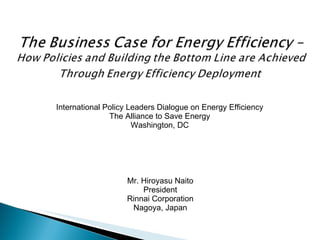
    1. Mr. Hiroyasu Naito President Rinnai Corporation Nagoya, Japan International Policy Leaders Dialogue on Energy Efficiency The Alliance to Save Energy Washington, DC
      • Corporate headquarters: Nagoya, Japan
      • Formed in 1920
      • Operate in 20+ countries around the world
      • One of world’s leaders in gas technology
      • and gas appliances
      • Leading manufacturer of on-demand/
      • tankless water heaters in the world
      Head Office
      • Corporate headquarters: Peachtree City, Georgia (south of Atlanta)
      • Formed in 1974
      • Tankless water heaters, direct vent heaters, fireplaces
      • Leading share of on-demand/ tankless water heaters in the US
      • Climate change
      • National security
      • Economic competitiveness
      • Quality of life
      • Gasoline prices up substantially
      • Soaring electricity and natural gas prices
      • Global climate change
      • Concern for energy security is at an all-time high
        • World market for oil and gas
        • Electricity generating capacity and grid reliability
      • We’ve reached the tipping point: government, industry, and the public all agree there is no turning back…we have to re-think how to work together
      • 7 billion people projected to call the Earth home in 2012
        • Only 6 billion in 1999
        • 6.7 billion today: China (1.33billion), India (1.15 billion ), US (304 million)
      • Projected energy consumptions 2030 v. 2004:
        • Worldwide: 57%
        • Developed countries: 24%
        • Developing countries: 95%
        • China and India alone will be 45% of the worldwide increase
      • Electricity
        • US alone: expected to grow 39% from 2030 v. 2005
      • Oil
        • US: 5% of world population, consumes 25% of the world oil, but the GNP in China is growing at 4x the rate of the US
      • Imagine if the Chinese and Indian lifestyle gets more “western”, impact on electricity and oil
        • Oil usage would rise from 87 million barrels/day to 247 million barrels/day, exceeding the capacity of the planets ecosystem
      • Unsubsidized,
        • Coal and gas is in the 5 – 10 cents/ kilowatt hour
        • Nuclear is 5 – 10 cents/ kilowatt hour
        • Wind energy is 8 – 10 cents/ kilowatt hour
        • Solar energy is currently more than 30 cents/ kilowatt hour, but public interest and public policy has a lot to do with prices
      • US was largest emitter, but passed by China in ’07
        • China: 24%
        • US: 21%
      • Projected increase in carbon emissions 2030 v. 2003: 75%
      • Carbon caps will be coming in some form
        • Global carbon trading has already increased from $10billion in ‘05 to $63billion in ’07
      • Water heating: 13 – 17% of home energy cost
      • #1 energy cost behind heating and cooling
      • Traditionally done with a tank, that heats water 24/7/365, inefficient by design
      • Each year: approx 9.5 million tank water heaters sold
      • 60 million US homes heat their water this way
      • Responsible use: heat it only when you need it
      • Off when it is off
      • 30% more efficient than typical tank water heater
      • Energy is conserved, since actual therms are reduced
      • If consider replacing 500,000 homes with Rinnai water heaters rather than gas tank water heaters:
        • Consumer savings: $51 million
        • CO2 reduction: 442 million pounds
        • Landfills: save the space of 130,000 SUV’s
        • Therms reduced: 37 million
      • These savings are per year, every year
      • No waiting for twenty years to get these savings: Commercially available today and sold in all fifty states
      • Must be a cooperation on multiple levels
      • Both industry and government take responsibility to work together
      • Rinnai approach: we have an obligation to bring the most EE equipment we can to market
      • Invest in R&D, pushing the technological limits
      • Understand the market application
      • Must prove it is high quality, performance, safety, reliability, on a mass-production basis
      In Rinnai’s case:
      • Engineers, architects, code officials, gas companies, builders, specifiers, and installers
      • Proper sizing, application, and intended use
      • Raise the technical competence
      • 90,000 industry people trained; 31,000 active installers
      • in-person installer training
      • www.rinnai.solutions.com developed just for technical people
      • Get them installing, help them build their confidence
      • Public relations and media outlets
      • Performance, safety, and proper use
      • Created www.foreverhotwater.com , with many inter-active tools
      • Make the consumer comfortable with the technology
      • Dispel myths, explain the process, connect them with trained installers
      • Answer as much consumer information as possible, since installers often are not sales people
      • Feed electronic sales leads to the installers
      • Make installer feedback public to keep quality high
      • Warranty returns as a per cent of sales: less than 0.5%
      • Leading market share
      • We don’t have customers, we have “believers”
      • High quality product + proper installation = market introduction success
      • We consider training for proper installation and educating the consumer our “obligation”
      • At this point, government needs to come forward with incentives and policy support
    2. Tax Incentive Energy Star Regulation Change Timeline ‘ 07 ‘ 08 ‘ 09 ‘ 10 ‘ 11 ‘ 12 Click 3x for animation Tankless Sales
      • Manufacturers are more confident that they might ultimately achieve a return on their energy-efficient technology investment
      • Prices for manufacturers and installers stabilize or fall, which stimulates consumer sales
      • More volume installed, positive impact on consumer prices, more benefit to the environment, and more energy is conserved
      • Policy and process must be led at the federal level,
      • and must not let it default to multiple versions of state codes
      • Multiple versions of state codes drives up costs, which are passed to consumers, inhibiting growth, energy is not saved; everybody loses
      • US is a leader in many categories; should be a leader in all energy efficiency categories as well
      • Policy-makers need to study what has been successful in other countries, and get it moving in the US sooner
      • Otherwise, a lot of money and time is wasted
      • Future solutions will not just be discrete projects, but combinations of technologies
        • “ Silos” of different technologies will become a thing of the past
      • Therefore incentives, public policy and laws needs to be technology “neutral” with the goal just focused on higher efficiency standards
      • Rinnai will continue its move to expand from gas appliance company to energy solutions portfolio company
      • Rinnai is optimistic that the political climate and government policy is now more favorable than ever before toward energy efficient technology
      • Rinnai will continue to innovate and broaden our energy solutions portfolio in the market
      • We are hopeful that policy-makers will strive for “innovation” in their process, and quicken their pace on facilitating support for new technology
      • If the cooperation is working properly – and keeps pace with industry – it will be a great enabler for energy efficiency, and for Rinnai making the business case of energy efficient products-to-market successfully.
      • Thank you.

    + AllianceToSaveEnergyAllianceToSaveEnergy, 2 years ago

    custom

    1370 views, 1 favs, 0 embeds more stats

    Hiroyasu Naito, President of Rinnai Corporation
    More info about this document

    © All Rights Reserved

    Go to text version

    • Total Views 1370
      • 1370 on SlideShare
      • 0 from embeds
    • Comments 0
    • Favorites 1
    • Downloads 34
    Most viewed embeds

    more

    All embeds

    less

    Flagged as inappropriate Flag as inappropriate
    Flag as inappropriate

    Select your reason for flagging this presentation as inappropriate. If needed, use the feedback form to let us know more details.

    Cancel
    File a copyright complaint
    Having problems? Go to our helpdesk?

    Categories